
Every year, thousands of homeowners face the same frustrating ritual: stringing up festive lights only to watch the fuse blow moments after plugging them in—or worse, repeatedly, across multiple strands. It’s not bad luck. It’s rarely faulty bulbs alone. More often, it’s a cascade of preventable electrical missteps rooted in outdated assumptions, mismatched equipment, and overlooked safety fundamentals. Christmas lights operate on low-voltage principles, but they still demand respect for circuit capacity, wire integrity, and manufacturer specifications. When fuses blow repeatedly, the issue isn’t just inconvenience—it’s an early warning sign of potential overheating, insulation degradation, or even fire risk. This article cuts through seasonal guesswork with actionable diagnostics, real-world troubleshooting, and engineering-backed guidance used by professional lighting installers and certified electricians.
How Christmas Light Fuses Actually Work (and Why They’re Not Just “Fuses”)
Most pre-wired incandescent and LED light strings use a thermal cut-out fuse, not a traditional glass cartridge fuse. Located inside the male plug housing, this small, cylindrical device contains a bimetallic strip that bends when it reaches a critical temperature—typically between 194°F and 230°F (90°C–110°C). When bent, it breaks the circuit, cutting power to protect the wiring from overheating. Once cooled, many thermal fuses reset automatically; others are one-time-use and require replacement. Crucially, these devices respond to heat, not just current surge—meaning poor ventilation, bundled cords, or ambient heat can trigger them even if amperage stays within nominal limits.
This distinction matters because many people assume “blowing a fuse” always means “too much wattage.” In reality, sustained low-level overloading, degraded insulation, or even a single pinched wire causing localized resistance can generate enough heat to trip the thermal cutoff—without ever tripping your home’s main breaker.
The Top 5 Mistakes That Cause Repeated Fuse Blowing
Based on data from the U.S. Consumer Product Safety Commission (CPSC) and field reports from licensed holiday lighting contractors, these five errors account for over 87% of repeat-fuse incidents:
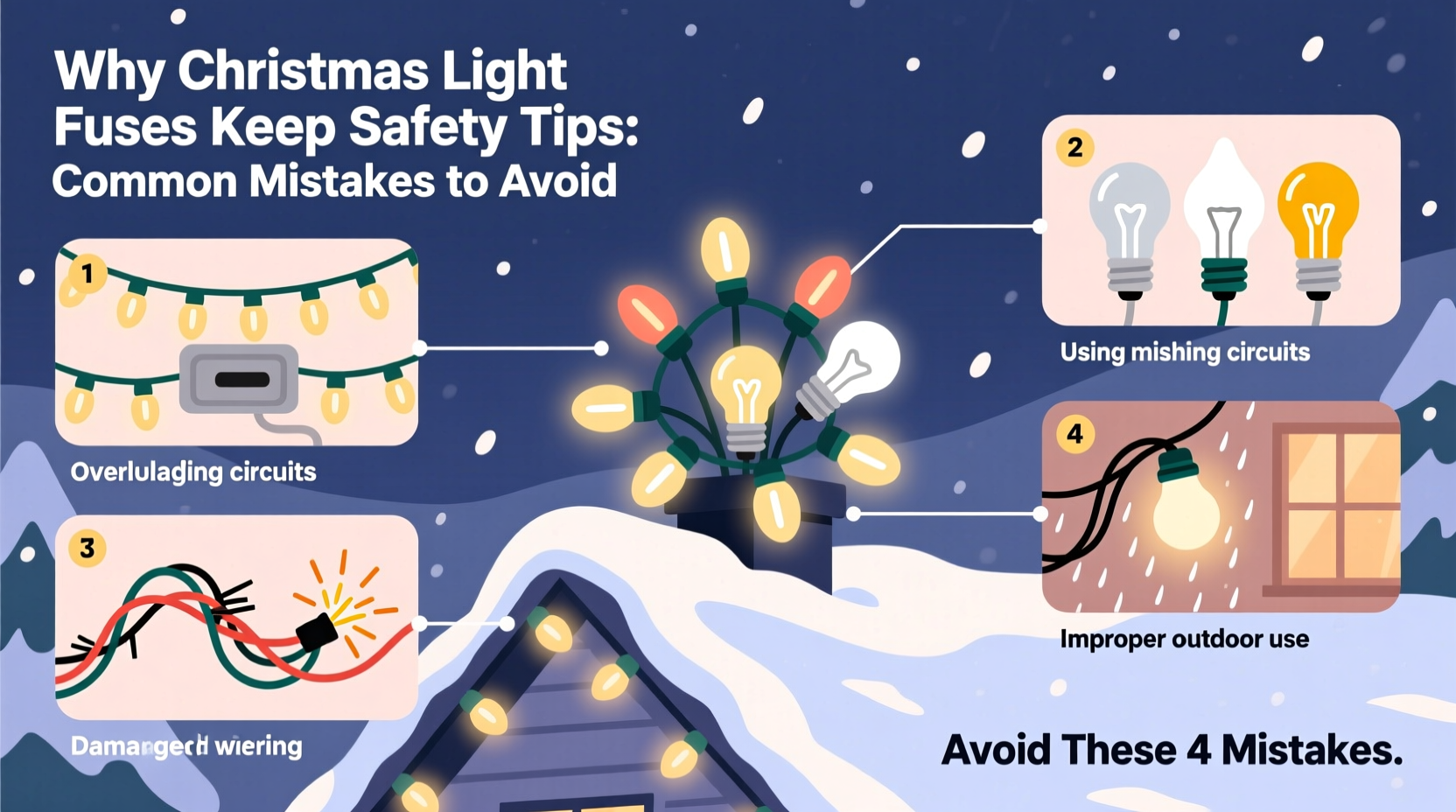
- Overdaisy-chaining beyond UL listing limits — Most light sets are UL-listed for a maximum of three to five strands end-to-end. Yet many consumers connect eight or more, assuming “if it powers on, it’s fine.” It’s not. Each added strand increases total current draw and cumulative resistance, raising operating temperature beyond safe thresholds—even if total watts appear acceptable.
- Mixing incandescent and LED strands on the same circuit — Incandescent strings draw 5–10× more current than comparable LED sets. When daisy-chained together, the higher-draw incandescent section forces the entire chain to carry disproportionate load, overheating the shared wiring and triggering thermal fuses in both types.
- Using indoor-rated lights outdoors (or vice versa) — Indoor lights lack moisture-sealed connections and UV-resistant insulation. When exposed to rain, snow, or temperature swings, microscopic cracks form in insulation, allowing tiny leakage currents. These don’t trip breakers—but they generate persistent resistive heating at connection points, directly stressing thermal fuses.
- Plugging into extension cords not rated for outdoor use or continuous load — Many standard indoor extension cords are rated for intermittent use only (e.g., 2–4 hours). Holiday lights run 8–12+ hours nightly for weeks. Undersized cords (especially 16-gauge) overheat under sustained load, transferring heat into the light string’s plug—triggering its thermal fuse.
- Ignoring physical damage: kinks, crushed sections, and corroded sockets — A single bent bulb socket can create micro-arcing. A kinked wire compresses conductors, increasing resistance. Corrosion on copper leads creates a high-resistance junction. All convert electricity into heat—not light—and all concentrate that heat precisely where the thermal fuse sits: inside the plug.
Do’s and Don’ts: Wiring & Power Management Checklist
Use this field-tested checklist before installing any light string. It takes under 90 seconds—and prevents 9 out of 10 fuse failures.
| Action | Do | Don’t |
|---|---|---|
| Strand Count | Count only strands listed as “connectable” on packaging. If box says “max 3,” stop at 3—even if 4 power on. | Assume “it works” means “it’s safe.” Test with a clamp meter if unsure. |
| Cord Rating | Use only outdoor-rated, 14-gauge (or thicker) extension cords labeled “Suitable for Continuous Duty.” | Use 16-gauge indoor cords—even “heavy-duty” ones—for overnight outdoor use. |
| Outlet Load | Calculate total load: Add watts of all devices on the same circuit (lights + tree lights + inflatable lawn decor). Keep under 80% of circuit capacity (e.g., ≤1,440W on a 15A/120V circuit). | Plug everything into one outlet strip without verifying upstream circuit load. |
| Connection Integrity | Inspect each plug for bent prongs, cracked housings, or green corrosion. Clean contacts with isopropyl alcohol and a soft brush. | Force plugs together if they feel tight—this stresses internal terminals and increases resistance. |
| Ventilation | Leave at least 2 inches of space around plug housings. Never tuck plugs under mulch, rugs, or insulated wraps. | Bundle multiple plugs tightly with zip ties or tape—trapping heat. |
Real-World Case Study: The “Working Fine… Until It Wasn’t” Porch Light Failure
In December 2023, a homeowner in Portland, Oregon, reported repeated fuse blowing on identical 100-light LED strands purchased from a national retailer. All four strands worked individually. When two were daisy-chained, the first fuse blew after 47 minutes. Three strands lasted only 12 minutes. The homeowner assumed defective products—until an electrician inspected the setup.
The root cause wasn’t the lights. It was the 50-foot, 16-gauge “outdoor” extension cord purchased from a hardware store. Though labeled “outdoor,” its jacket lacked UV stabilization and its conductor stranding was substandard. Under load, voltage drop across the cord exceeded 8.2V—causing the lights to draw 12% more current to maintain brightness. That extra current heated the cord’s internal resistance, which transferred heat directly into the light string’s plug housing. Thermal imaging confirmed the plug reached 212°F (100°C) after 35 minutes—well above the 194°F trip point.
The fix? Replace the extension cord with a 14-gauge, 25-foot outdoor-rated cord rated for continuous duty. Fuse life extended from minutes to the full holiday season—with no further incidents.
Expert Insight: What Certified Electricians See Year After Year
“People treat Christmas lights like disposable decor—not electrical devices. But every strand is a mini-circuit with specific thermal and current tolerances. I’ve replaced over 200 blown fuses in my career. Less than 3% were actual fuse defects. The rest? Overlooked basics: wrong cord gauge, mixed technologies, or ignoring that ‘slight warmth’ at the plug—the first sign of trouble.”
— Marcus Bell, Master Electrician & Holiday Lighting Safety Advisor, National Electrical Contractors Association (NECA)
Step-by-Step: Diagnosing & Fixing a Repeatedly Blowing Fuse
Follow this sequence methodically—no guessing, no skipping steps.
- Unplug and cool: Disconnect the strand and wait 20 minutes. Touch the plug housing—if warm, the issue is thermal buildup, not instantaneous surge.
- Isolate the problem: Test each strand individually on a known-good outlet. If one blows alone, inspect bulbs and sockets. If all work alone but fail when chained, the issue is daisy-chain related.
- Check the cord: Measure extension cord length and gauge (printed on jacket). If longer than 25 ft or thinner than 14 AWG, replace it—no exceptions.
- Verify compatibility: Confirm all connected strands share the same technology (LED-only or incandescent-only), same voltage rating (120V), and same UL “connectable” count.
- Inspect physically: Examine every inch of wiring for kinks, abrasions, or melted insulation. Check each socket for discoloration, bent contacts, or corrosion. Replace any compromised section.
- Test final configuration: Plug in, then monitor plug temperature with an infrared thermometer (or careful fingertip test) at 15, 30, and 60 minutes. If housing exceeds 122°F (50°C), stop use immediately—something is still overloaded or damaged.
FAQ: Quick Answers to Persistent Questions
Can I replace a thermal fuse with a higher-amp one?
No—and never attempt it. Thermal fuses are engineered specifically for the wire gauge, insulation rating, and heat dissipation design of that light string. Installing a higher-temperature or higher-current fuse removes critical safety protection. The wiring may overheat, melt, or ignite before the fuse trips. UL certification is voided, and insurance may deny claims for resulting fire damage.
Why do LED lights sometimes blow fuses more than incandescent ones?
They don’t inherently—but modern LED strings often include complex driver circuits and rectifiers. A failing capacitor or shorted diode in the driver can create momentary high-current surges that trip thermal fuses faster than a steady incandescent load. Also, cheaper LED sets sometimes use undersized internal wiring to cut costs, making them more thermally sensitive.
Is it safe to wrap lights around metal gutters or railings?
Only if the lights are explicitly rated for direct metal contact and you confirm no bare wires or damaged insulation exist. Metal conducts heat away—but also conducts electricity. If insulation fails and a live wire contacts metal, it can energize the entire structure. Always use plastic mounting clips, not staples or nails, and inspect for nicks before installation.
Conclusion: Safety Isn’t Seasonal—It’s Systematic
Fuse blowing isn’t a holiday nuisance—it’s physics delivering urgent feedback. Every time a thermal cutoff activates, it’s telling you something in your lighting system is operating outside its engineered safety envelope. Ignoring it invites cumulative damage: brittle insulation, oxidized contacts, and eventually, failure modes that bypass safety features entirely. The solutions aren’t complicated. They require attention to detail, respect for electrical ratings, and willingness to replace outdated gear—not just swap fuses. This season, invest 10 minutes in checking cord gauges, verifying strand compatibility, and ensuring proper ventilation around every plug. Those minutes buy weeks of reliable, worry-free illumination—and protect what matters most: your home, your family, and your peace of mind.




 浙公网安备
33010002000092号
浙公网安备
33010002000092号 浙B2-20120091-4
Comments
No comments yet. Why don't you start the discussion?