
Every holiday season, millions of homeowners reach for their favorite string lights—only to discover a small, often overlooked label on the packaging: “Maximum 3 sets end-to-end” or “Do not exceed 210 feet.” Many assume this is arbitrary marketing language or a manufacturer’s liability hedge. In reality, that limit is grounded in fundamental electrical principles, material science, and decades of real-world safety experience. Exceeding it doesn’t just risk dimmer lights—it can create fire hazards, voltage drop failures, and circuit overloads that compromise both your decorations and your home’s safety infrastructure.
This isn’t about limiting festive cheer. It’s about understanding why electricity behaves differently in long, low-voltage, high-resistance circuits—and how modern LED and incandescent strings respond uniquely to those conditions. Whether you’re wrapping a 40-foot porch railing or illuminating a two-story façade, knowing *why* these limits exist empowers smarter, safer, and more reliable installations.
The Core Issue: Voltage Drop and Circuit Loading
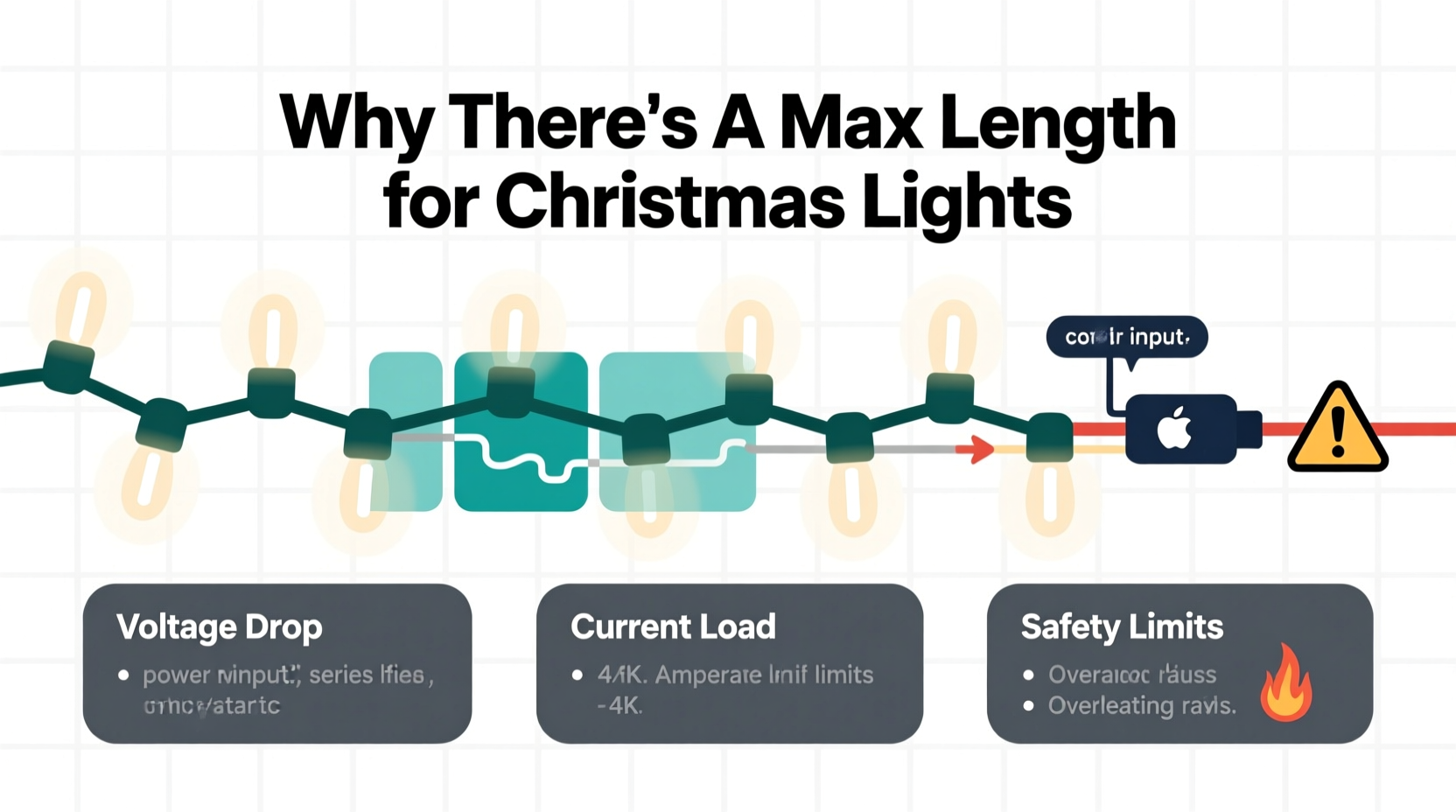
Christmas light strings operate as series-parallel hybrid circuits. While individual bulbs are often wired in parallel groups (to prevent total failure when one bulb burns out), those groups are connected in series along the string. As current travels down the wire, resistance in the conductors converts some electrical energy into heat—reducing available voltage at downstream points. This phenomenon is called voltage drop.
Voltage drop follows Ohm’s Law: V = I × R, where V is voltage loss, I is current (in amps), and R is the total resistance of the wire path. Even thin-gauge copper wire (commonly 22–28 AWG in light strings) adds measurable resistance per foot. A typical 100-light incandescent string draws ~0.33A at 120V; an equivalent LED string draws only ~0.04A. But over extended lengths, cumulative resistance becomes significant—especially with older or lower-quality wiring.
When voltage drops below a critical threshold—usually around 90–95% of nominal supply—bulbs grow noticeably dimmer, colors shift (particularly in warm-white LEDs), and internal drivers may malfunction or shut down intermittently. More critically, the power supply (often built into the first plug or controller) must work harder to maintain output, increasing heat buildup in transformers and rectifiers.
Safety Standards and Regulatory Enforcement
The maximum connectable length isn’t self-imposed by manufacturers alone. It reflects compliance with nationally recognized safety standards—including UL 588 (Standard for Safety of Seasonal and Holiday Decorations) and CSA C22.2 No. 250.1 in Canada. These standards mandate rigorous testing for temperature rise, insulation integrity, fault current handling, and fire propagation under worst-case loading scenarios.
UL-certified light strings undergo “continuous operation testing” for 1,000 hours at elevated ambient temperatures (up to 40°C/104°F) while fully loaded to their rated maximum. If any component exceeds safe surface temperature limits (e.g., >90°C for PVC insulation), the design fails certification. Overloading beyond the labeled limit voids UL listing—and with it, insurance coverage in case of fire-related damage.
“Voltage drop isn’t just about brightness—it’s a leading indicator of thermal stress. When conductors run hotter than designed, insulation degrades faster, increasing risk of short circuits and arc faults—especially near flammable materials like pine boughs or dry wood.” — Dr. Lena Torres, Electrical Safety Engineer, Underwriters Laboratories
Incandescent vs. LED: Why Technology Changes the Math
While both types share the same underlying physics, their operational differences dramatically affect safe connection limits:
| Characteristic | Incandescent Strings | LED Strings |
|---|---|---|
| Typical Power Draw per 100 Lights | 40–60W | 4–7W |
| Average Current Draw | 0.33–0.5A | 0.03–0.06A |
| Max Connectable Length (per UL listing) | 210–250 ft (often 3–5 sets) | 600–1,200 ft (often 10–25 sets) |
| Primary Failure Mode When Overloaded | Overheated sockets, melted insulation, filament burnout | Driver shutdown, color shift, flickering, premature capacitor failure |
| Wire Gauge Commonly Used | 22–24 AWG | 24–28 AWG (lighter due to lower current) |
Note: Higher-rated LED strings—especially commercial-grade or ETL-listed “pro” models—may support longer runs because they use heavier gauge wire, regulated constant-current drivers, and higher-temp insulation (e.g., silicone-jacketed leads). But consumer-grade retail strings almost universally follow conservative UL limits—even if their drivers *could* technically handle more.
A Real-World Consequence: The Oakwood Subdivision Incident
In December 2021, a home in Oakwood, Ohio suffered a smoldering fire originating from its front-porch light display. Fire investigators traced the cause to a 450-foot chain of budget LED mini-lights—marketed as “25-string compatible”—connected end-to-end without regard to the package’s stated “max 12 strings” limit. The homeowner had bypassed the built-in fuse by splicing wires directly, assuming “more LEDs = safer since they’re cool.”
Thermal imaging revealed localized hotspots exceeding 115°C at junction boxes where three strings met—well above the 85°C rating of the PVC insulation. One connector had partially melted, allowing intermittent arcing. That arc ignited accumulated dust and spider webs inside a hollow porch column. The fire spread slowly overnight, damaging $142,000 in property before being detected.
Crucially, the UL listing had been invalidated the moment the user exceeded the labeled maximum and modified the cordset. Insurance denied the claim, citing violation of “instructions for safe use.” This wasn’t a manufacturing defect—it was a preventable outcome rooted in misunderstanding the purpose of connection limits.
Practical Solutions and Safe Extension Strategies
You don’t need to sacrifice scale for safety. Professional installers and municipal lighting teams routinely illuminate large structures using compliant methods. Here’s how to extend your display responsibly:
- Use multiple dedicated outlets: Plug separate light chains into different GFCI-protected outlets on separate circuits—not daisy-chained power strips.
- Install outdoor-rated multi-outlet hubs: UL-listed weatherproof boxes (e.g., “Christmas Light Power Distribution Boxes”) let you branch from one outlet to 4–6 independent strings—keeping each within its rated limit.
- Choose “stackable” or “repeatable” controllers: Some smart LED systems (like those from Twinkly or Lumenplay) include signal repeaters that regenerate data and power—effectively resetting voltage drop every 100–150 feet.
- Upgrade wire gauge for custom runs: For permanent or semi-permanent installations, replace factory cords with 18 AWG or 16 AWG SPT-2 or SJTW-rated extension cables between segments. This cuts resistance by up to 60% versus standard 22 AWG.
- Monitor temperature proactively: After installing, gently touch connectors and transformer housings after 30 minutes of operation. If too hot to hold comfortably (>60°C), reduce load immediately.
Frequently Asked Questions
Can I safely connect more strings if I’m using a heavy-duty extension cord?
No. A heavy-duty extension cord reduces voltage drop *between the outlet and the first string*, but it does nothing to alleviate cumulative resistance *within* the light string chain itself. The maximum connectable length refers specifically to the series-connected light sets—not the feed cable. Adding thicker extension wire won’t allow you to exceed the manufacturer’s UL-tested limit for the light string assembly.
Why do some “professional” light strings advertise “unlimited” connectivity?
They don’t—reputable commercial brands never claim “unlimited.” What they offer are higher-rated systems: 12V DC or 24V DC low-voltage strings with regulated power supplies, thicker internal wiring (16–18 AWG), and modular connectors designed for field termination. These still carry explicit maximum run lengths (e.g., “max 165 ft per 12V channel”), but those limits are higher because every component is engineered for scalability—not convenience.
If my lights get dim at the end, is it dangerous—or just annoying?
It’s both. Dimming signals voltage drop severe enough to stress internal electronics. In LED strings, under-voltage forces drivers to operate outside their optimal range, accelerating electrolytic capacitor aging and increasing harmonic distortion on the circuit. In incandescents, low voltage causes filaments to run cooler and less efficiently—increasing current draw during startup surges and promoting tungsten migration, which shortens bulb life and raises failure risk. Persistent dimming should trigger immediate re-evaluation of the run length.
Conclusion: Celebrate Smart, Not Just Bright
The maximum connectable length on your Christmas light packaging isn’t a restriction—it’s a safeguard calibrated to physics, tested in labs, and validated by real fires prevented. Understanding the interplay of resistance, current, heat, and certification transforms that tiny footnote from an inconvenience into an essential part of your holiday planning process. It shifts your focus from “How many strings can I cram together?” to “How can I distribute power intelligently across my space?”
When you respect these limits—not as barriers, but as engineering guardrails—you gain reliability, longevity, and peace of mind. Your lights will shine consistently night after night. Your circuit breakers won’t trip mid-carol. And most importantly, your home—and everyone in it—stays protected while you create warmth and joy.
This holiday season, let your lights reflect thoughtful preparation as much as festive spirit. Check labels. Measure voltage. Use distribution hubs. Prioritize UL/ETL listings over price tags. And remember: the safest, most beautiful displays aren’t the longest—they’re the ones engineered to last, year after year, without compromise.




 浙公网安备
33010002000092号
浙公网安备
33010002000092号 浙B2-20120091-4
Comments
No comments yet. Why don't you start the discussion?