
Every holiday season, millions of people pull out their festive Christmas lights only to face the same frustrating ritual: untangling a knotted mess of wires. It’s not just bad luck or clumsy storage—it’s physics. The tendency for cords to spontaneously knot themselves is rooted in scientific principles that govern flexibility, motion, and entropy. Understanding the science behind this annual annoyance reveals not only why it happens but also how to stop it before it starts.
This isn’t simply about convenience. Tangled cords lead to broken bulbs, damaged sockets, and wasted time. But with insights from mathematics, physics, and practical organization, you can reclaim control over your holiday decor—and possibly avoid one of the most predictable frustrations of December.
The Physics of Knot Formation
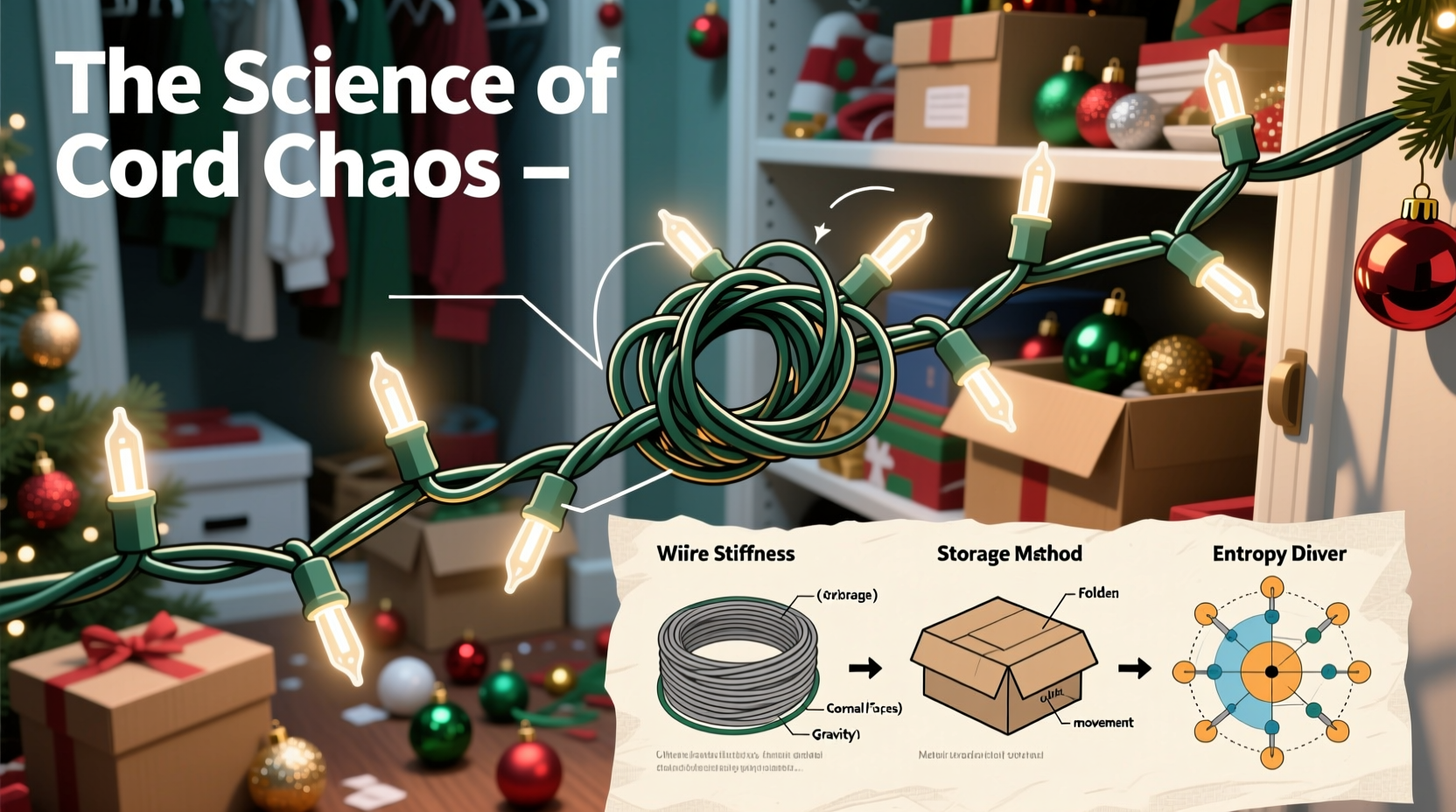
Cords don’t need human error to become tangled. In fact, research shows that flexible strings will naturally form knots when agitated—even without intentional manipulation. A landmark 2007 study by physicists Dorian Raymer and Douglas Smith at the University of California, San Diego demonstrated that when a piece of string is tumbled inside a confined space, complex knots form within seconds. They found that knots occurred in nearly one-third of trials, with some forming as quickly as ten seconds after tumbling began.
The reason lies in the combination of three factors: length, flexibility, and movement. Longer cords have more opportunities to loop around themselves. Flexible materials like insulated copper wire bend easily under small forces. And any kind of motion—shifting in a box, being dropped on the floor, or even temperature-induced expansion—can provide enough agitation to initiate knotting.
“Knots arise spontaneously under random motion. The longer and more flexible the cord, the higher the probability.” — Dorian M. Raymer, PhD, *Proceedings of the National Academy of Sciences*
This phenomenon follows the laws of entropy—the natural tendency of systems to move toward disorder. Just as a tidy room becomes messy over time without effort, an orderly coiled cord tends toward chaos when stored loosely. There are far more possible tangled states than neat ones, making knots statistically inevitable unless preventive measures are taken.
Why Christmas Lights Are Especially Prone to Tangling
Among all household cords, Christmas lights are uniquely vulnerable to entanglement. Their design combines several high-risk traits:
- Length: Strings often exceed 25 feet, increasing knot potential exponentially.
- Rigidity variation: Wires are stiff enough to hold shape but flexible enough to twist and loop.
- Bulb interference: Bulbs act as physical obstacles that catch adjacent loops, locking knots in place.
- Irregular winding: Most people wrap lights haphazardly, creating overlapping layers that snag.
- Seasonal storage: Stored once a year, they endure months of undisturbed jostling during moves or attic shifts.
Moreover, many people store lights in cardboard boxes stacked in attics or basements—environments prone to temperature fluctuations, vibrations from footsteps, and accidental bumps. These subtle disturbances mimic the tumbling effect observed in lab experiments, slowly driving the system toward maximum disorder.
Effective Storage Methods That Prevent Tangles
Preventing tangles requires replacing randomness with structure. By controlling how the cord moves during storage, you dramatically reduce the chance of knot formation. Here are four proven techniques:
1. The Spool Method (Cardboard Roll)
Wrap lights evenly around a rigid circular object like a toilet paper roll, oatmeal container, or custom-made wooden spool. Start at the plug end and wind clockwise or counterclockwise consistently. Secure the last loop with a twist tie or Velcro strap.
2. The Over-Under Technique
Used by electricians and stage crews, this method alternates loops to cancel out twisting tension. Hold the cord in one hand and make a loop over your fingers. Then, instead of repeating the same motion, bring the next loop under your palm before forming it. Repeat “over, under, over, under” until complete. This balances torsional stress and prevents coils from springing into knots.
3. Use a Light Reel or Storage Box
Commercial reels allow you to wind lights smoothly with a crank, maintaining consistent tension. Some include compartments for spare bulbs and plugs. Hard-shell storage boxes protect against crushing and contain built-in wrapping guides.
4. Individual Strand Management
Treat each strand separately. Don’t bundle multiple strings together unless they’re identical and wound perfectly parallel. Mixing lengths or bulb types increases friction points and snagging risk.
| Method | Effectiveness | Cost | Time Required |
|---|---|---|---|
| Loose stuffing | Poor | $0 | 1 min |
| Cardboard roll | Good | $0–$2 | 3–5 min |
| Over-under coil | Excellent | $0 | 4–6 min |
| Spool reel | Excellent | $10–$25 | 2–4 min |
Real Example: How One Family Solved Their Holiday Hassle
The Thompson family in Portland, Oregon, used to spend nearly two full evenings every December untangling strands of Christmas lights. With a large outdoor display requiring over 1,200 bulbs across 15 separate lines, the process was both time-consuming and frustrating. Broken connections were common, and children often lost interest before decorating even began.
In 2021, Sarah Thompson, a mechanical engineer, decided to apply systematic thinking to the problem. She purchased six plastic reels designed for extension cords and labeled each with its corresponding light type (e.g., “Front Roof – Warm White”). Before storing the lights after New Year’s, she rewound each strand using the over-under technique and mounted them securely on the reels. Each reel was then placed upright in a durable plastic bin with dividers.
The following year, setup time dropped from 14 hours to under 4. Not a single strand was tangled. Over three seasons, the family has not replaced a single bulb due to handling damage. What was once a dreaded chore became a smooth, almost enjoyable part of their tradition.
“We didn’t realize how much stress came from the tangles until we eliminated them. Now we actually look forward to putting up the lights.” — Sarah Thompson
Step-by-Step Guide to Tangle-Free Storage
Follow these steps immediately after taking down your lights to ensure next year’s setup is seamless:
- Inspect each strand: Check for frayed wires, broken sockets, or missing bulbs. Replace or repair as needed.
- Choose your winding method: Decide between the over-under coil, spool wrap, or reel system based on available tools and time.
- Start at the plug end: Always begin winding from the plug side so you know where to start next year.
- Wind slowly and evenly: Avoid overlapping or crossing loops. Keep tension moderate—not too tight, not too loose.
- Secure the ends: Use soft ties (avoid rubber bands, which degrade) or clips to fasten the final loop.
- Label clearly: Note location, color, length, and voltage requirements on a tag or directly on the storage device.
- Store vertically and separated: Place reels or rolls upright in a bin. Do not stack heavy items on top.
- Keep in a stable environment: Choose a dry, temperature-consistent area away from pests and moisture.
Common Myths About Cord Tangles Debunked
Several misconceptions persist about why cords tangle and how to prevent it. Let’s clarify the facts:
- Myth: Only careless people get tangled cords.
Reality: Even meticulously coiled cords can tangle if subjected to vibration or compression over time. - Myth: Using twist ties causes more tangles.
Reality: Properly applied twist ties prevent uncoiling and reduce movement. Just don’t cinch them too tightly. - Myth: All cords tangle the same way.
Reality: Thicker, stiffer cords (like speaker wire) resist knotting more than thin, supple ones (like fairy lights). - Myth: Knots only happen if you don’t coil properly.
Reality: Improper coiling increases risk, but random motion alone can generate knots regardless of initial state.
Frequently Asked Questions
Can I use zip ties to secure wrapped Christmas lights?
It’s not recommended. Zip ties can cut into insulation over time, especially in cold environments where plastic becomes brittle. Opt for reusable Velcro straps or fabric twist ties, which hold firmly without damaging the cord.
Is there a difference between LED and incandescent lights in terms of tangling?
Yes. LED strands are typically lighter and more flexible, which makes them easier to wind—but also slightly more prone to tangling if not secured properly. However, their lower heat output allows tighter coiling without risk of melting.
How long should I keep my Christmas lights before replacing them?
With proper care, LED Christmas lights can last 10–15 years. Inspect annually for signs of wear: flickering, dark sections, cracked insulation, or loose plugs. If repairs become frequent, consider upgrading to newer, more durable models designed for easy storage.
Conclusion: Turn Chaos Into Control
The annual battle with tangled Christmas lights isn’t a personal failing—it’s a predictable outcome of physics and poor storage habits. But now that you understand the science of cord chaos, you’re equipped to defeat it. From applying the over-under winding technique to investing in smart storage solutions, every step you take reduces entropy and restores order.
Think of it as a gift to your future self: a few minutes of mindful effort today can save hours of frustration next December. This season, don’t just pack away your lights—protect them with intention. Your future holiday spirit will thank you.




 浙公网安备
33010002000092号
浙公网安备
33010002000092号 浙B2-20120091-4
Comments
No comments yet. Why don't you start the discussion?