
Every holiday season, the same ritual unfolds: you pull out last year’s Christmas lights, only to find them knotted beyond recognition. Despite careful coiling and best intentions, untangling them becomes a frustrating prelude to festive decorating. This isn’t just bad luck—it’s physics. The tendency of cords to tangle is rooted in fundamental principles of entropy, flexibility, and motion. Understanding the science behind this seasonal struggle not only demystifies the chaos but also reveals smarter ways to store and handle these essential holiday items.
The Role of Entropy in Cord Tangling
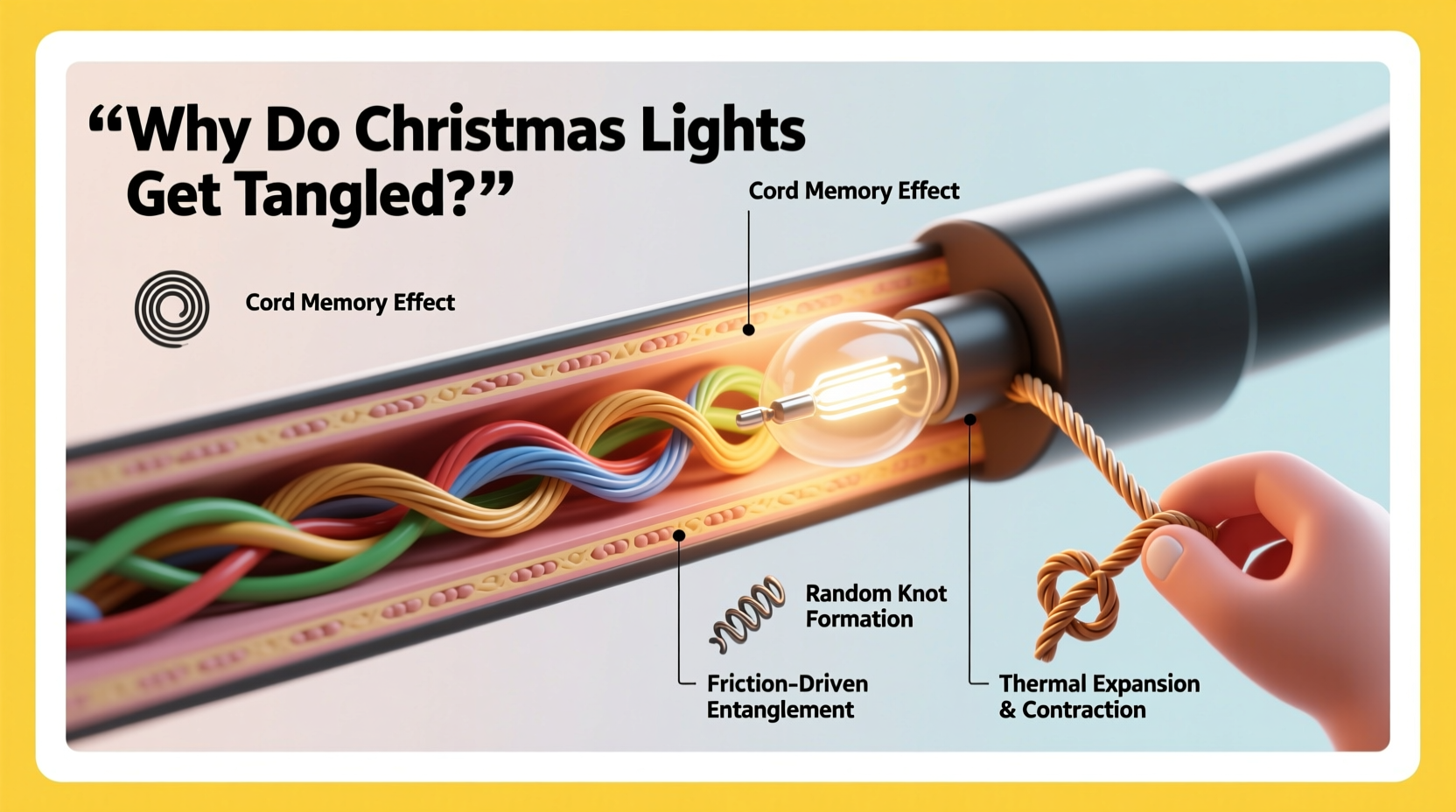
At the heart of why Christmas lights tangle lies the second law of thermodynamics: entropy always increases in a closed system. In simpler terms, disorder is more probable than order. A neatly coiled string represents a low-entropy state—highly organized and unstable over time. When stored loosely or jostled during transport, even minor movement introduces randomness. Each wiggle, twist, or shift nudges the cord toward a higher-entropy configuration: a tangle.
Cords like Christmas light strands are particularly prone to entanglement because they are long, flexible, and often contain multiple segments (bulbs, wires, plugs) that create friction points. These irregularities act as nucleation sites for knots. Once a small loop forms, continued motion can feed adjacent sections through it, forming overhand knots or complex snarls. Research from physicists at UC San Diego demonstrated that even in controlled environments, agitated strings spontaneously form knots within seconds. The longer and more flexible the cord, the higher the probability of knotting.
“Given enough time and movement, any sufficiently long flexible strand will eventually become knotted.” — Dorian M. Raymer, co-author of *Spontaneous Knotting of an Agitated String*
This principle applies far beyond holiday decor. Headphones, garden hoses, extension cords, and ropes all follow the same pattern. But Christmas lights present a perfect storm: they’re used infrequently, stored for months, and often packed haphazardly into boxes where they experience shifting and compression.
Material Properties That Encourage Twisting
Not all cords tangle equally. The physical characteristics of Christmas light wiring significantly influence how easily they knot. Most traditional incandescent and LED light strands use PVC-insulated copper wire, which is both pliable and memory-prone. While flexibility makes the lights easy to drape, it also means they retain residual twists from previous handling.
When you wrap a cord around your hand or a box, you introduce torsional stress. If not released properly, this twist propagates along the length of the wire. Over time, stored torsion causes the cord to coil on itself, increasing the chance of loops catching and intertwining. This phenomenon is known as “twist-to-writhe” conversion—a term borrowed from biophysics used to describe how DNA strands supercoil under strain.
Additionally, the presence of bulbs disrupts uniformity. Bulbs act as bulky nodes that catch on one another, especially when the cord is bent sharply. Unlike smooth cables, Christmas lights can’t slide freely past themselves, making disentanglement harder once a knot forms. The combination of stiffness at connection points and softness in between creates a “stick-slip” dynamic that exacerbates tangling.
Storage Methods and Their Real-World Impact
How you store your Christmas lights determines whether you’ll spend minutes or hours untangling them next season. Common methods vary widely in effectiveness. Consider the following comparison of popular storage techniques:
| Method | Effectiveness | Risk of Tangling | Notes |
|---|---|---|---|
| Hand-coiling loosely | Poor | High | Introduces random twists; prone to slippage and nesting |
| Wrapping around a cardboard rectangle | Good | Medium | Prevents loose loops but may retain twist if not managed |
| Using a spool or reel | Excellent | Low | Controls tension and twist; ideal for long-term storage |
| Stuffing into a bin | Very Poor | Very High | Maximizes movement and contact; worst-case scenario |
| Figure-eight braiding | Excellent | Low | Neutralizes twist with each loop; professional-grade method |
The key factor across all methods is minimizing independent movement of the cord segments. When individual parts can shift freely, the likelihood of spontaneous knot formation rises exponentially. Controlled winding ensures that each turn is predictable and stable.
Mini Case Study: The Community Center Decorators
A local community center in Burlington, Vermont, faced recurring delays every December due to tangled light strands. Volunteers spent up to three hours untangling 500 feet of outdoor lighting. After consulting with a physics teacher from the nearby high school, they adopted the figure-eight method using wooden reels. They also labeled each strand by location (e.g., “Front Porch,” “Tree Wrap”) to reduce handling.
The result? Setup time dropped to under 45 minutes the following year. One volunteer noted, “We went from dreading the box to being impressed by how neat everything stayed.” The change wasn’t about effort—it was about applying the right technique based on physical principles.
Step-by-Step Guide to Tangle-Free Storage
Eliminating tangles requires consistency and attention to detail. Follow this proven sequence to store your Christmas lights effectively:
- Unplug and inspect: Before storing, ensure all lights work and check for frayed wires or broken bulbs. Repair or replace as needed.
- Unwind fully: Lay the entire strand straight on the ground or a table. Let it rest for a few minutes to release internal twist.
- Choose a winding tool: Use a cable reel, piece of cardboard (cut into an ‘H’ shape), or a purpose-built light keeper.
- Start with the plug end: Secure the plug to the winder with tape or a clip to prevent unwinding.
- Wind evenly: Use consistent tension—neither too tight nor too loose. For best results, use the figure-eight pattern: after each loop, cross the cord over itself to cancel out twist.
- Secure the end: Fasten the bulb end with a Velcro tie or elastic band. Avoid metal clips that can damage insulation.
- Label and box: Mark each wound strand with its location or color. Store upright in a dry, temperature-stable space.
This process takes only a few extra minutes but saves significant time and frustration later. More importantly, it respects the physical nature of the cord, working with—not against—its tendencies.
Expert Tips for Long-Term Cord Management
Even with proper winding, environmental factors can degrade performance over time. Temperature fluctuations cause materials to expand and contract, potentially loosening coils. Humidity may stiffen insulation, reducing flexibility. To maximize longevity and minimize tangles:
- Store lights in climate-controlled areas, away from attics or damp basements.
- Keep cords away from sharp objects or heavy items that could crush or kink them.
- Rotate usage among multiple sets to reduce wear on any single strand.
- Consider upgrading to pre-mounted light strips or net lights for hard-to-reach areas—they eliminate the need for long cords altogether.
“Twist management is more important than people realize. A little attention to winding technique can prevent years of frustration.” — Dr. Laura Chen, Materials Scientist specializing in polymer durability
Checklist: Tangle-Proof Your Holiday Lights
- ✅ Test all strands before storage
- ✅ Unwind completely to release twist
- ✅ Use a reel, H-board, or figure-eight method
- ✅ Wind with consistent tension
- ✅ Secure both ends properly
- ✅ Label each set clearly
- ✅ Store in a cool, dry, undisturbed location
Frequently Asked Questions
Can I prevent tangling without special tools?
Yes. If you don’t have a reel, use the figure-eight method over your hands or a book. The critical point is neutralizing twist with alternating loops. Even wrapping around a cereal box cut into an ‘H’ shape works well.
Why do my new LED lights tangle just like old ones?
Despite being lighter, LED strands still have the same fundamental structure: long, flexible wires with periodic bulks (bulbs). They may be thinner, but their susceptibility to entanglement remains governed by length and movement, not brightness or energy use.
Is there a difference between coiling and crocheting cords?
Coiling refers to circular winding, which can trap torsion. Crocheting (or knitting) cords into a loose braid is sometimes used, but it risks creating new entanglements. The figure-eight method is superior because it balances twist without introducing complex interweaving.
Conclusion: Master the Science, Not the Struggle
The battle against tangled Christmas lights isn’t lost to fate or clumsiness—it’s a challenge grounded in physics. From the relentless push of entropy to the subtle twist in every bend of the wire, the forces at play are predictable and manageable. By applying scientific insight to everyday habits, you transform a chaotic chore into a streamlined ritual.
This holiday season, treat your lights not just as decorations, but as engineered objects deserving thoughtful care. A few deliberate actions now can spare you hours of frustration later. And when your lights come out next year—neat, functional, and ready to shine—you’ll know you’ve mastered more than storage. You’ve harnessed the science behind the sparkle.




 浙公网安备
33010002000092号
浙公网安备
33010002000092号 浙B2-20120091-4
Comments
No comments yet. Why don't you start the discussion?