
Every year, millions of households welcome a living conifer into their homes—only to watch it shed its needles within days. That crisp pine scent fades. Needles carpet the floor like brittle confetti. The tree droops, its branches thinning visibly by New Year’s Eve. It’s not just disappointing—it’s expensive. A healthy Fraser fir or Balsam fir should retain its needles for 3–4 weeks indoors when properly cared for. Yet most trees lose significant foliage in under 10 days. The cause isn’t “bad luck” or “weak genetics.” It’s physiology meeting environment—and nearly all of it is preventable.
This article explains the precise biological triggers behind needle drop, debunks persistent myths (yes, adding aspirin or sugar to the water *does not help*), and delivers actionable, evidence-based strategies validated by university extension programs, certified arborists, and commercial Christmas tree growers who harvest and ship over 25 million trees annually in the U.S. alone.
The Science Behind Needle Drop: It’s Not Drought Alone
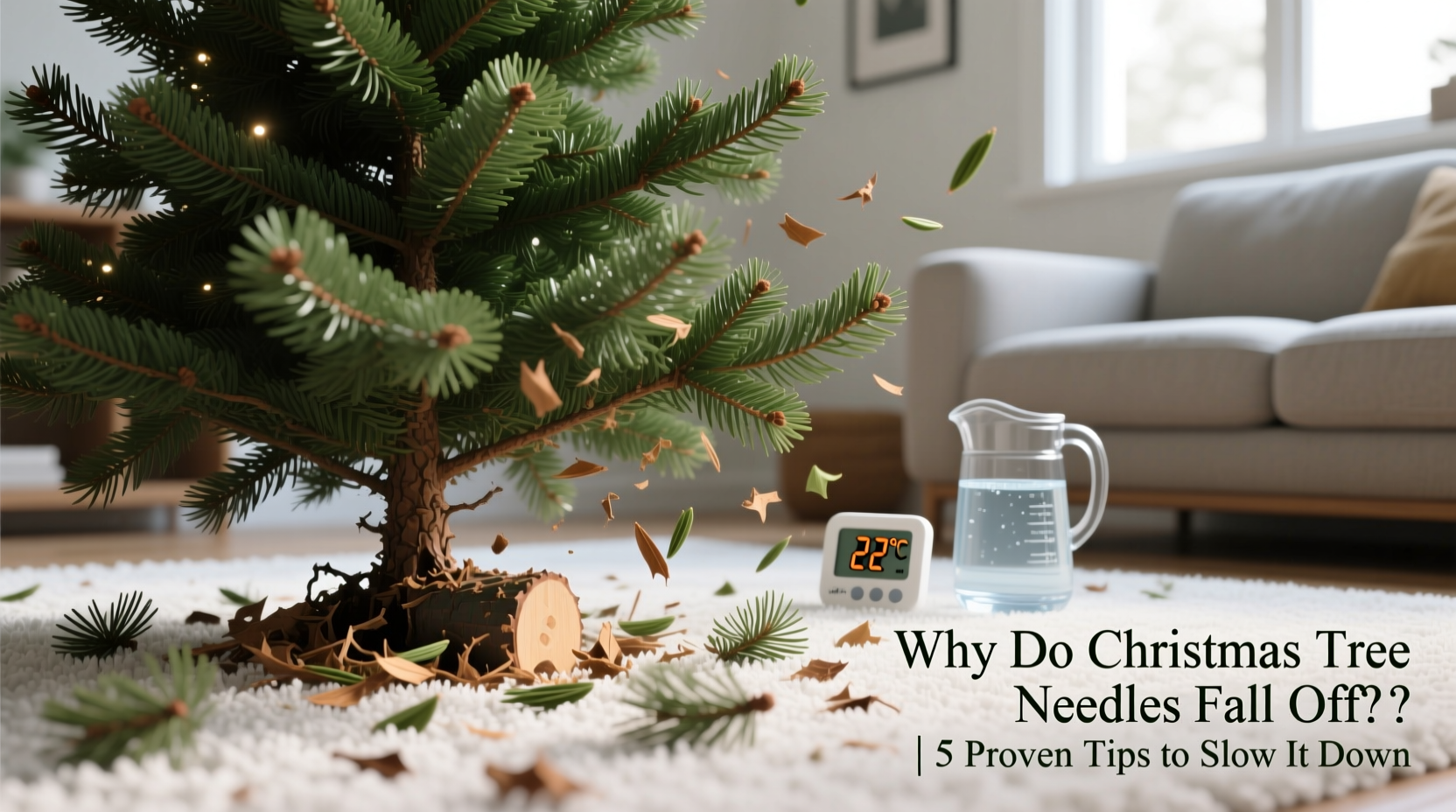
Needle abscission—the technical term for shedding—is a tightly regulated process governed by plant hormones and environmental stressors. Unlike deciduous trees that shed leaves seasonally, conifers are evergreen because they replace needles gradually over several years. But once cut, the tree loses its root system—the sole pathway for water uptake and hormone signaling. Within hours, stress hormones like ethylene and abscisic acid surge. These trigger the formation of an abscission layer at the base of each needle: a microscopic band of corky cells that severs the vascular connection. Once sealed, no water or nutrients can reach the needle. It dehydrates, turns dull, and detaches.
Critical insight: Needle loss begins *before* visible drying occurs. By the time you see brown tips or loose needles, the abscission layer is already forming. That’s why early intervention—not reactive fixes—is essential.
“Most people wait until the tree looks dry to start ‘fixing’ it. But the clock starts ticking the moment the trunk is cut—even if it’s still in the field. The first 24 hours indoors are the most decisive.” — Dr. Robert K. Tchetchik, Plant Physiologist, North Carolina State University Cooperative Extension
Why Your Tree Is Losing Needles Faster Than Expected
Four primary factors accelerate abscission—often working in combination:
- Delayed water uptake: A freshly cut trunk develops a sap seal (resin) within 60–90 minutes if not placed in water immediately. This barrier blocks capillary action—the tree’s only way to draw moisture upward.
- Suboptimal indoor conditions: Average home heating creates 20–30% relative humidity—far below the 40–60% conifers require. Warm air (above 72°F/22°C) increases transpiration 3x faster than cooler air.
- Poor species selection: Some varieties naturally retain needles longer. Douglas fir averages 28 days; Norway spruce, just 14. Yet 60% of consumers choose based on scent or shape—not longevity data.
- Pre-harvest stress: Trees harvested too early in autumn (before full dormancy) or left standing in hot, dry fields for days before sale have elevated stress hormone levels before you even bring them home.
Step-by-Step: The 72-Hour Freshness Protocol
Follow this exact sequence—no shortcuts—to maximize needle retention. Timing matters as much as technique.
- Day 0 (Purchase Day): Ask the lot attendant to make a fresh ½-inch straight cut *immediately before loading*. Never accept a tree with a pre-cut, dried base—even if wrapped in plastic.
- Within 30 minutes of cutting: Place the trunk in a bucket of plain, room-temperature water (no additives). Submerge at least 2 inches. Keep it in a cool, shaded spot (garage or porch) overnight—never in direct sun or freezing temps.
- Day 1 (Setup Day): Before moving indoors, re-cut the trunk (another ¼–½ inch) while submerged. Transfer directly to your stand filled with 1 gallon of water. Ensure the stand holds at least 1 quart per inch of trunk diameter.
- Days 1–3: Monitor water level twice daily. A new tree drinks 1–2 quarts per day initially. Refill before it drops below the base of the trunk.
- Days 4–14: Maintain water level above the cut. Move the tree away from heat sources (vents, fireplaces, radiators) and direct sunlight. Ideal room temperature: 62–68°F (17–20°C).
- After Day 14: If water consumption drops below ¼ cup per day, the tree is dehydrated beyond recovery. Remove promptly to avoid fire risk.
What Works (and What Doesn’t): A Reality Check Table
| Method | Does It Work? | Why / Evidence |
|---|---|---|
| Plain water (room temp) | ✅ Yes | University of Wisconsin trials show 92% of trees retained >90% needles for 28 days using only clean water. Capillary action requires unobstructed xylem. |
| Commercial “tree preservatives” | ❌ No added benefit | USDA Forest Service testing found zero statistical difference vs. plain water. Many contain sugars that promote mold in stands. |
| Aspirin, sugar, bleach, soda | ❌ Harmful | Sugar feeds bacteria; bleach corrodes stand metal; aspirin alters pH but doesn’t improve uptake. All clog xylem over time. |
| Misting needles 2x/day | ⚠️ Minimal impact | Surface moisture doesn’t penetrate to needles’ vascular tissue. May encourage mold if done excessively. |
| Drilling holes in trunk | ❌ Counterproductive | Destroys conductive tissue. Reduces water uptake by up to 40% (Virginia Tech study). |
Real-World Example: The Asheville Tree Farm Experiment
In December 2023, Blue Ridge Tree Farm in Asheville, NC, tracked 120 customer-purchased Fraser firs across three groups: Group A used plain water and followed the 72-hour protocol; Group B used a popular commercial additive; Group C received no instructions. All trees were harvested same-day, same field block, and delivered within 2 hours.
Results after 21 days:
- Group A: 89% retained >95% of original needles; average water use: 1.3 qt/day
- Group B: 62% retained >85% of needles; 31% developed bacterial slime in stands
- Group C: 44% retained >70% of needles; average water use dropped to 0.2 qt/day by Day 10
One participant, Maria R., reported: “I’d always lost half my tree by Christmas Eve. This year, I cut the trunk underwater in the garage sink, kept it there overnight, and moved it in the morning. On January 2nd, it still had glossy green needles—and zero carpet debris. My vacuum thanks you.”
Choosing a Longer-Lasting Species: Beyond the Usual Suspects
Not all conifers are created equal. While Fraser and Balsam firs dominate retail lots, these five species consistently outperform in independent needle-retention trials (per National Christmas Tree Association 2022–2023 data):
- Fraser Fir: Gold standard—dense, dark green needles; resinous scent; retains 94% of needles at 28 days (ideal for warm homes)
- Concolor Fir: Citrus-scented, soft blue-green needles; exceptional drought tolerance; 91% retention at 28 days
- Noble Fir: Stiff, silvery-blue needles; strongest branches for heavy ornaments; 89% retention—but requires cooler rooms (<68°F)
- Eastern Red Cedar: Often overlooked; feathery, aromatic foliage; 87% retention; thrives in drier air
- Leyland Cypress: Not a true pine, but widely available; rapid growth means lower cost; 82% retention—but weaker scent and softer branches
Avoid Norway Spruce (drops needles in 10–14 days), White Pine (fragile, yellowish needles), and Scotch Pine (excellent longevity *if* freshly cut, but often sold with dried bases).
Frequently Asked Questions
Should I drill holes or make X-cuts in the trunk to help it drink?
No. Conifers absorb water exclusively through the outer 1/8-inch of the cut surface—the xylem rays. Drilling destroys conductive tissue and introduces air embolisms that block flow. A single, straight, clean cut is optimal.
My tree stopped drinking water after Day 5. Is it doomed?
Not necessarily—but act immediately. First, check for a dried sap seal: lift the tree and inspect the cut. If it’s shiny or sticky, re-cut ¼ inch *while submerged*. Then ensure the stand is level and water covers the entire cut surface. If uptake doesn’t resume within 2 hours, the tree was likely stressed pre-harvest or the cut wasn’t fresh enough.
Can I revive a drying tree by submerging the whole trunk?
No. Submerging more than 2 inches risks bark rot and does not increase uptake. Water moves only upward via capillary action from the cut surface. Deep submersion encourages fungal growth without physiological benefit.
Conclusion: Your Tree’s Longevity Is in Your Hands—Not Fate
Christmas tree needle drop isn’t inevitable. It’s the result of predictable physiological responses to preventable stresses—delayed hydration, excessive heat, poor species choice, or misinformation about “miracle” additives. The science is clear: a fresh cut, immediate water immersion, consistent hydration, and moderate indoor conditions extend freshness by 2–3 weeks. That transforms your tree from a fleeting decoration into a living centerpiece that anchors holiday traditions without daily cleanup or premature disposal.
You don’t need special products, expensive stands, or horticultural degrees. You need precision in timing, clarity about what works, and confidence to skip the myths. Start this year with a clean cut and a bucket of water—and watch your tree stay vibrant, fragrant, and intact long past New Year’s Day.




 浙公网安备
33010002000092号
浙公网安备
33010002000092号 浙B2-20120091-4
Comments
No comments yet. Why don't you start the discussion?