
If you’ve ever spent a summer evening outdoors, you’ve likely heard the rhythmic chirping of crickets. That familiar sound is more than just background noise—it’s a complex form of communication rooted in biology, environment, and survival. Crickets produce these sounds primarily through a process called stridulation, and each chirp carries specific meaning, from attracting mates to warning off rivals. Understanding why crickets chirp offers insight into insect behavior, environmental cues, and even helps scientists estimate temperature. This article explores the science behind cricket sounds, their behavioral significance, and how you can interpret what those chirps really mean.
The Science Behind Cricket Chirping: How Do They Make That Sound?
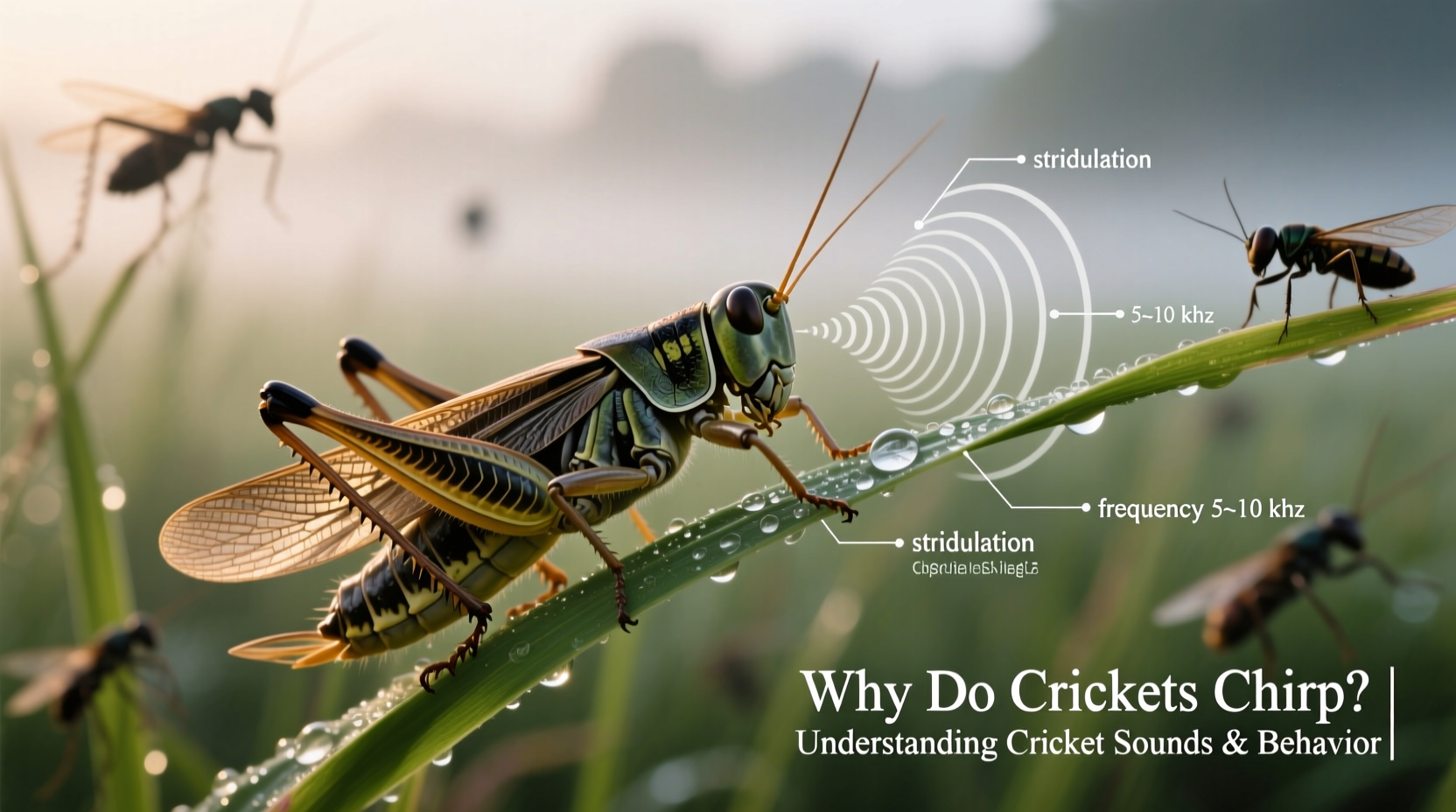
Crickets don’t have vocal cords. Instead, they generate sound using their wings—a process known as stridulation. Male crickets possess a specialized structure on their forewings: one wing has a series of ridges (like a file), and the other has a hardened edge (the scraper). When the cricket rubs these two parts together, it produces the distinctive chirping noise we recognize.
The frequency and pattern of chirps depend on species, temperature, and purpose. For example, field crickets (Gryllus spp.) produce loud, repetitive calls at night, while house crickets tend to chirp more consistently indoors where temperatures are stable. The sound resonates because the wings act like amplifiers, vibrating against the air and surrounding surfaces.
“Crickets are among the most precise bio-acoustic communicators in the insect world. Their songs are finely tuned to environmental conditions and social needs.” — Dr. Laura Simmons, Entomologist, University of California
Mating Calls: The Primary Reason for Chirping
The most common reason male crickets chirp is to attract females. Each species has a unique song pattern that helps females identify suitable mates. These courtship calls vary in duration, rhythm, and pitch, acting like acoustic fingerprints.
Females listen for specific traits in a male’s song—such as consistency and volume—which often correlate with health and genetic fitness. A strong, steady chirp signals a robust male capable of surviving predators and harsh conditions. In contrast, irregular or weak chirping may indicate poor health or low energy reserves.
Interestingly, not all males sing. Some adopt a “satellite” strategy—remaining silent and positioning themselves near singing males to intercept approaching females. This sneaky tactic avoids the energy cost of singing and reduces the risk of attracting predators.
Chirping and Temperature: Nature’s Thermometer
One of the most fascinating aspects of cricket chirping is its direct relationship with ambient temperature. Crickets are cold-blooded, so their metabolic rate—and thus their muscle activity—depends heavily on heat. As temperatures rise, crickets chirp faster; when it cools down, their chirping slows.
This predictable pattern led to the development of Dolbear’s Law, formulated by physicist Amos Dolbear in 1897. It allows you to estimate the air temperature in Fahrenheit by counting chirps over a set period.
Dolbear’s Formula (Fahrenheit):
Temperature = Number of chirps in 14 seconds + 40
For example, if you count 30 chirps in 14 seconds, the approximate temperature is 70°F (21°C). This method works best with snowy tree crickets (Oecanthus fultoni), whose chirps are remarkably consistent and temperature-dependent.
| Chirps in 14 Seconds | Estimated Temperature (°F) | Estimated Temperature (°C) |
|---|---|---|
| 20 | 60 | 15.6 |
| 25 | 65 | 18.3 |
| 30 | 70 | 21.1 |
| 35 | 75 | 23.9 |
| 40 | 80 | 26.7 |
While not perfectly accurate for all species, this natural thermometer remains a popular educational tool and backyard science experiment.
Other Reasons Crickets Chirp
Beyond mating and temperature response, crickets use different types of chirps for various social interactions:
- Aggressive calls: Males emit short, rapid chirps when competing with other males. These warnings help establish territory without physical combat.
- Alarm calls: Sudden disturbances—like a predator nearby—trigger high-pitched, erratic chirps meant to startle threats or alert others.
- Close-range courtship songs: Once a female approaches, males switch to softer, more complex trills designed to encourage mating.
These variations show that cricket communication is nuanced. Just like human language has context, tone, and intent, cricket songs change based on situation, audience, and environment.
Mini Case Study: Urban vs. Rural Cricket Chirping Patterns
In a 2020 study conducted in Ohio, researchers compared chirping behaviors of field crickets in urban parks versus rural meadows. They found that city-dwelling crickets adjusted their calling times due to artificial lighting and noise pollution. While rural crickets began singing shortly after sunset, urban males delayed their calls by up to 90 minutes to avoid peak human activity.
Additionally, urban crickets produced slightly higher-pitched chirps, possibly to cut through low-frequency city noise. This behavioral flexibility highlights how adaptable crickets are—even modifying their acoustic signals in response to modern environmental pressures.
How to Observe and Interpret Cricket Sounds
You don’t need special equipment to begin understanding cricket behavior. With careful listening and basic observation, you can decode much of what their chirps mean. Follow this simple guide to get started:
- Choose a quiet outdoor location at dusk or night when crickets are most active.
- Listen for patterns: Is the chirping continuous, intermittent, or sudden and sharp?
- Count chirps for 14 seconds and apply Dolbear’s formula to estimate temperature.
- Note the time and weather: Are crickets more active on warm, humid nights? Do they stop during wind or rain?
- Watch for movement: Do chirps pause when someone walks nearby? This could indicate an alarm response.
Common Misconceptions About Cricket Chirping
Despite their prevalence, several myths persist about cricket sounds:
| Misconception | Reality |
|---|---|
| All crickets chirp loudly at night. | Only males chirp, and some species are diurnal or live in areas with little human detection. |
| More chirping means more crickets. | Increased chirping often reflects warmer temperatures, not population size. |
| Crickets chirp with their legs. | They use modified wings (tegmina), not legs, to produce sound. |
FAQ
Do female crickets chirp?
No, female crickets do not chirp. They lack the specialized wing structures required for stridulation. Their role is to listen and select mates based on song quality.
Why do crickets stop chirping suddenly?
Sudden silence usually indicates a perceived threat—such as a predator, sudden light, or vibration. Crickets are highly sensitive to movement and will cease calling to avoid detection.
Can I keep crickets as pets to observe their behavior?
Yes. House crickets are commonly kept in ventilated containers with food (vegetables, grains) and moisture. Observing them can provide firsthand insight into chirping patterns, though indoor temperatures may alter natural rhythms.
Conclusion: Listening to the Language of Nature
The chirping of crickets is far more than a nostalgic summer soundtrack—it’s a sophisticated system of survival, communication, and adaptation. From attracting mates to signaling environmental shifts, every note carries meaning. By paying attention to when, how, and why crickets sing, we gain a deeper appreciation for the subtle languages woven into the natural world.
Next time you hear that rhythmic serenade outside your window, take a moment to listen closely. Count the chirps, consider the temperature, and reflect on the intricate life unfolding in the grass. You might just find yourself attuned to one of nature’s oldest and most reliable voices.




 浙公网安备
33010002000092号
浙公网安备
33010002000092号 浙B2-20120091-4
Comments
No comments yet. Why don't you start the discussion?