
At first glance, a goat’s eyes might seem like something out of a sci-fi movie. Their horizontal, rectangular pupils stand out starkly against the round or oval shapes common in most mammals—including humans. But this unusual feature isn’t random. It’s the result of millions of years of evolution, finely tuned to support the goat’s survival in rugged, open environments. Scientists have studied these distinctive eyes extensively, uncovering how their shape enhances vision, depth perception, and predator detection. This article dives into the biological mechanics, evolutionary advantages, and ecological context behind why goats have rectangular pupils—revealing a masterclass in natural adaptation.
The Anatomy of a Goat’s Eye
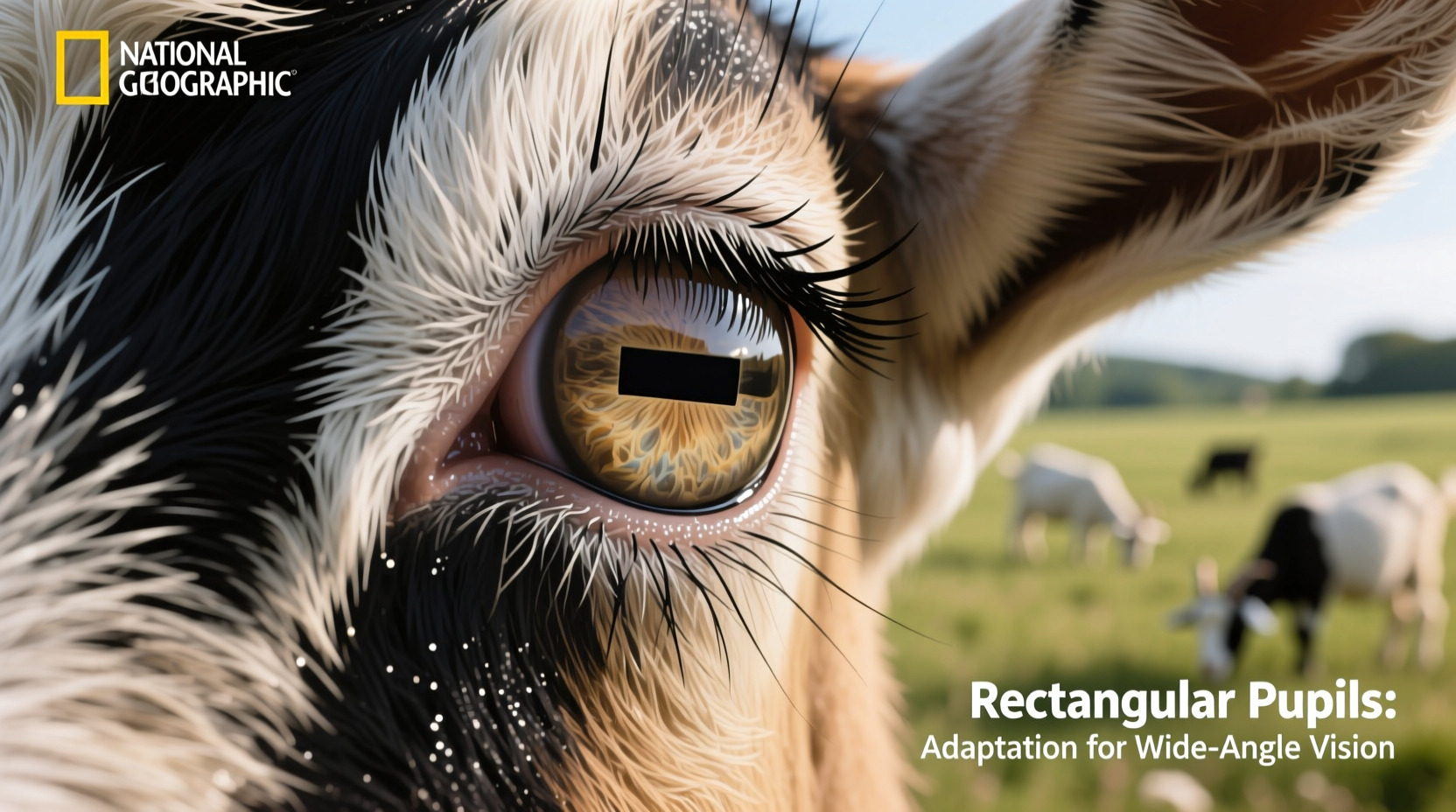
Unlike the circular pupils of predators such as cats or humans, goats possess horizontally elongated, rectangular pupils. These pupils can expand and contract dramatically depending on light conditions, but they always retain their slit-like shape. The key lies in the structure of the iris and surrounding muscles, which allow for precise control over how much light enters the eye.
This pupil shape is not unique to goats; it’s shared by many prey animals including sheep, deer, octopuses, and certain lizards. What sets goats apart is how effectively they use this trait in combination with other visual adaptations. Their eyes are positioned laterally on the head, giving them a panoramic field of view of up to 320 degrees—compared to about 180 degrees in humans. This means goats can see nearly all around them without turning their heads, a critical advantage when scanning for predators.
How Rectangular Pupils Enhance Survival
The primary reason goats evolved rectangular pupils is directly tied to survival. As prey animals, goats must remain vigilant against threats from multiple directions. Their pupil shape plays a crucial role in three key areas: wide-angle vision, improved depth perception, and reduced glare.
First, the horizontal orientation of the pupil aligns with the horizon, allowing more light to enter from the sides while minimizing excessive brightness from above (like sunlight). This creates a sharper, clearer image across a broad visual plane—ideal for spotting movement in grasslands or rocky terrain.
Second, research published in *Science Advances* shows that animals with horizontal pupils tend to have better depth perception along the ground. When combined with eye rotation—a goat can tilt its eyes to keep the pupil aligned with the horizon even when bending down to graze—they maintain optimal visual clarity whether standing upright or feeding.
“Horizontal pupils act like built-in panoramic filters, enhancing visibility where it matters most—foraging and fleeing.” — Dr. Martin Banks, Vision Scientist, UC Berkeley
Evolutionary Advantages Over Round Pupils
To understand why rectangular pupils outperform round ones in certain environments, consider the challenges goats face. They live in mountainous or open habitats where predators approach silently from various angles, and food sources are scattered across uneven ground. A round pupil would limit their ability to monitor both the distant skyline and nearby terrain simultaneously.
In contrast, the rectangular pupil functions like a camera aperture set for landscape mode. It increases the amount of light captured from left to right while reducing vertical blur. This enables goats to detect subtle movements at great distances, even under low-light conditions such as dawn or dusk—times when many predators are most active.
Moreover, goats can constrict their pupils more precisely than species with circular apertures. In bright daylight, the slit closes tightly, protecting the retina without sacrificing peripheral awareness. At night, it opens wide, capturing every available photon. This dynamic range gives goats superior visual flexibility compared to animals reliant solely on rod or cone cells.
Comparative Vision: Goats vs. Predators
| Feature | Goats (Prey) | Cats (Predators) |
|---|---|---|
| Pupil Shape | Rectangular, horizontal | Vertical slit |
| Field of View | Up to 320° | Around 200° |
| Depth Perception | Moderate, optimized for ground-level motion | High, focused on close targets |
| Light Regulation | Excellent across wide ranges | Highly sensitive in low light |
| Primary Use | Detecting predators, grazing navigation | Stalking prey, judging distance |
This comparison highlights a fundamental trade-off in nature: prey prioritize surveillance and escape readiness, while predators emphasize focus and precision. Goats sacrifice some binocular overlap (and thus fine depth judgment) for an expansive view of their surroundings. Cats, conversely, have forward-facing eyes ideal for calculating pounces but leave them vulnerable to ambush from behind.
Real-World Example: The Alpine Forager
Consider a wild ibex—a close relative of domestic goats—grazing on a steep cliffside in the Swiss Alps. One misstep could mean a fatal fall, and a momentary lapse in vigilance might invite an attack from an eagle or fox. As it lowers its head to eat, its eyes rotate upward and inward, keeping the rectangular pupils parallel to the ground. This adjustment ensures that despite the change in posture, the animal still monitors the sky and valley below.
Even while chewing, the ibex remains visually alert. Its pupils filter harsh alpine sunlight during midday and expand at twilight to track shadows moving through the rocks. This seamless adaptation allows it to feed efficiently without compromising safety—an evolutionary solution perfected over millennia.
Actionable Insights: What We Can Learn from Goat Vision
- Design with environment in mind: Just as goats evolved pupils suited to open landscapes, engineers designing surveillance systems or autonomous vehicles can take cues from nature to optimize wide-field detection.
- Prioritize functional form: Biological traits often reflect direct responses to environmental pressures. Understanding these links helps biologists, veterinarians, and conservationists better support animal welfare.
- Respect natural behaviors: Farmers and pet owners should avoid sudden movements from the side when approaching goats, since their vision is highly attuned to lateral motion.
Frequently Asked Questions
Can goats see color?
Yes, goats have dichromatic vision, meaning they perceive blues and greens well but have limited sensitivity to reds. While not as rich as human color vision, it's sufficient for identifying vegetation and environmental changes.
Do all goats have rectangular pupils?
Virtually all members of the Bovidae family—including sheep, antelope, and goats—share this trait. Minor variations exist between species, but the horizontal rectangular shape is consistent across the group.
Why don’t humans have rectangular pupils?
Humans are neither specialized prey nor ambush predators. Our round pupils offer balanced vision suited to varied tasks, from reading to navigating complex social environments. Evolution shaped our eyes for versatility rather than extreme specialization.
Conclusion: Nature’s Design at Its Finest
The rectangular pupil of the goat is far more than a curious oddity—it’s a sophisticated optical instrument honed by natural selection. By expanding peripheral vision, stabilizing images during movement, and adapting seamlessly to changing light, this trait equips goats to thrive in challenging terrains. It exemplifies how even the smallest anatomical details can carry profound implications for survival.
Next time you meet a goat’s gaze, take a moment to appreciate the science behind those striking eyes. They’re not just watching the world—they’re processing it with remarkable efficiency. And perhaps, in studying such adaptations, we gain deeper insight into the elegance of evolution itself.




 浙公网安备
33010002000092号
浙公网安备
33010002000092号 浙B2-20120091-4
Comments
No comments yet. Why don't you start the discussion?