
Fingerprints are among the most distinctive biological features of human beings. No two individuals—even identical twins—share the same fingerprint pattern. These intricate ridges on our fingertips are more than just tools for identification; they are the product of millions of years of evolution, shaped by natural selection to serve essential functions in survival, grip, and sensory perception. While fingerprints are routinely used in forensic science and biometric security, their biological purpose is often overlooked. Understanding why humans evolved fingerprints requires exploring embryology, biomechanics, and evolutionary biology.
The story of fingerprints begins before birth, unfolds through daily physical interaction with the environment, and extends into modern applications in law enforcement and technology. Far from being mere random patterns, fingerprints represent a sophisticated adaptation that enhances tactile sensitivity, improves friction during manipulation of objects, and may even play a role in moisture regulation. This article examines the evolutionary pressures that led to the development of fingerprints, their functional roles in human dexterity, and how science continues to uncover new insights about these remarkable skin formations.
The Biological Formation of Fingerprints
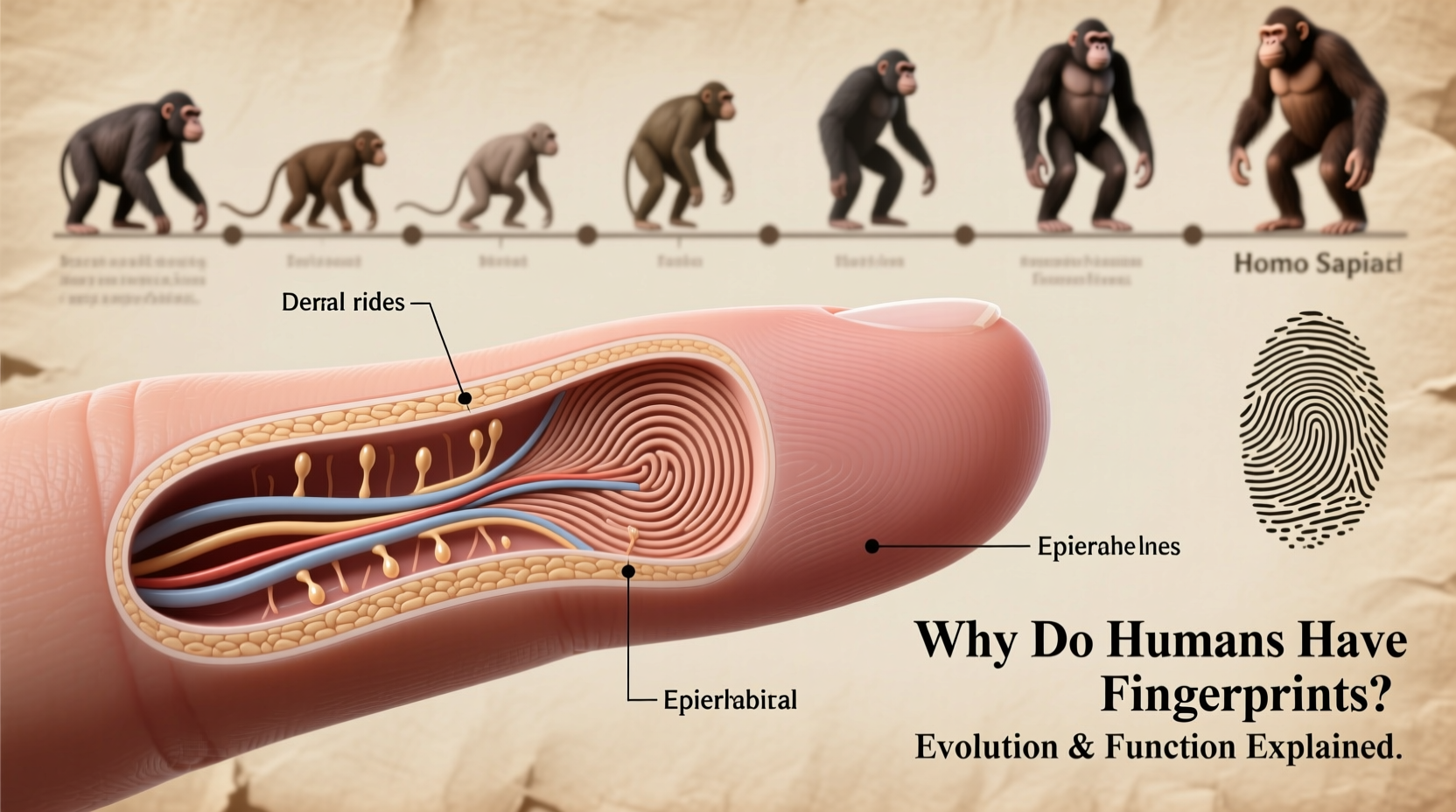
Fingerprints form during fetal development, specifically between the 10th and 24th weeks of gestation. They arise from the interaction between the epidermis (outer layer of skin) and the dermal papillae (the layer beneath). As the hand grows in the womb, mechanical stresses cause the basal layer of the epidermis to buckle and fold into ridges. The exact pattern—whether loops, whorls, or arches—depends on factors such as the rate of cell growth, tension in the skin, and the shape of the fingertip.
What makes this process fascinating is its blend of genetic influence and randomness. While genetics determine general tendencies—such as whether someone is more likely to have looped or whorled prints—the fine details are shaped by micro-environmental conditions in the womb, including amniotic fluid pressure, blood supply, and positioning. This explains why even identical twins, who share nearly 100% of their DNA, have different fingerprints.
These ridges are not limited to fingertips. They also appear on palms, toes, and soles of the feet, suggesting a systemic developmental mechanism rather than a localized feature. Once formed, fingerprint patterns remain unchanged throughout life, barring injury or disease affecting the dermal layer. Scarring can alter ridge structure, but the overall layout persists, making fingerprints a stable lifelong identifier.
Evolutionary Origins: Why Did Fingerprints Evolve?
To understand the evolutionary rationale behind fingerprints, we must consider the ecological niche early primates occupied. Millions of years ago, our ancestors lived in forested environments where climbing trees, grasping branches, and manipulating small objects were critical for survival. Natural selection favored traits that enhanced grip, dexterity, and tactile feedback—all areas where fingerprints provide measurable advantages.
One leading theory suggests that fingerprints evolved primarily to improve friction when handling wet or smooth surfaces. Unlike flat skin, the ridge patterns create micro-channels that help displace water and oils, much like tire treads on a rainy road. This hydrodynamic effect prevents slippage and increases effective contact with surfaces. Studies using synthetic fingerprint-like surfaces have demonstrated up to a 20% improvement in grip efficiency on moist materials compared to smooth skin.
Another hypothesis focuses on sensory enhancement. The ridges amplify vibrations when fingers move across textured surfaces, stimulating mechanoreceptors—particularly Meissner’s corpuscles—located just beneath the skin. These receptors are responsible for detecting light touch and fine textures. By concentrating mechanical stress along ridges, fingerprints effectively “tune” the skin to detect subtle surface variations, aiding in object recognition without visual input.
“Fingerprints aren’t just for ID—they’re biomechanical tools that sharpen our sense of touch and improve manual control.” — Dr. Lena Torres, Evolutionary Biologist, University of Edinburgh
Functional Advantages of Fingerprints in Daily Life
Beyond evolutionary roots, fingerprints continue to serve practical functions in modern human activity. Their design supports three key capabilities: grip optimization, moisture management, and sensory acuity.
Grip Enhancement: When gripping an object, the ridges compress slightly, increasing surface area contact and creating micro-adhesion points. This is especially useful when handling delicate items like glass or paper. The ridges also reduce shear stress during lateral movements, minimizing skin damage during repetitive tasks.
Moisture Regulation:
Sweat pores open along the crest of each ridge, allowing controlled perspiration. This moisture helps maintain skin elasticity and improves conductivity between the finger and object. However, too much sweat can cause slipping. Fingerprints counteract this by channeling excess moisture away through tiny grooves between ridges—a self-regulating system honed by evolution.Tactile Sensitivity: Research shows that fingerprint ridges enhance the detection of spatial details as small as 1 micrometer. When scanning a surface, the ridges act like a comb, filtering and amplifying vibrations transmitted to nerve endings. This allows humans to distinguish textures such as silk versus cotton or detect imperfections in manufactured goods through touch alone.
| Function | Mechanism | Real-World Benefit |
|---|---|---|
| Grip Stability | Ridges increase friction and displace liquids | Prevents dropping tools or utensils |
| Sensory Feedback | Amplifies micro-vibrations to nerve endings | Enables blind reading of Braille |
| Thermoregulation | Sweat ducts aligned along ridges | Keeps hands cool during prolonged use |
| Skin Protection | Distributes mechanical stress evenly | Reduces blistering and callus formation |
Comparative Biology: Do Other Animals Have Fingerprints?
Humans are not alone in possessing fingerprint-like structures. Certain primates, including chimpanzees, gorillas, and orangutans, exhibit remarkably similar ridge patterns on their fingers and toes. These species also rely heavily on manual dexterity for feeding, climbing, and social interaction, supporting the idea that fingerprints co-evolved with complex hand use.
Surprisingly, some non-primate animals have independently evolved analogous features. Koalas, for instance, have fingerprints almost indistinguishable from humans under microscopic examination—an extraordinary case of convergent evolution. Given that koalas spend much of their time gripping eucalyptus branches and stripping leaves, enhanced grip and tactile sensitivity would offer clear survival benefits.
Nearly all mammals have textured skin on their palms and soles, but few match the complexity of primate fingerprints. Rodents, dogs, and cats have paw pads with grooves, but these lack the individual variability and ridge continuity seen in humans. This distinction underscores that while grip enhancement is widespread, the full fingerprint system—with its uniqueness and sensory integration—appears to be a hallmark of species with advanced manipulative abilities.
Mini Case Study: The Role of Fingerprints in Tool Use
In a field study conducted in rural Kenya, researchers observed traditional toolmakers crafting stone blades using only hand-held rocks. Participants frequently rotated tools mid-task, adjusting grip based on wear and angle. High-speed video analysis revealed that subtle shifts in finger position allowed them to maintain optimal pressure and control. When participants’ hands were dampened, performance declined significantly—unless they wiped their hands regularly to restore ridge-to-surface contact.
This real-world example illustrates how fingerprints contribute to precision work. The ability to maintain traction despite sweat or environmental moisture enables sustained manual labor without constant re-gripping. In prehistoric contexts, such reliability would have been crucial for survival-related tasks like weapon-making or food preparation.
Modern Applications Rooted in Biology
The very traits that make fingerprints biologically useful also make them ideal for identification. The combination of permanence, uniqueness, and ease of capture has made fingerprints indispensable in forensic science since the late 19th century. Automated fingerprint identification systems (AFIS) now store digital templates of ridge endings, bifurcations, and minutiae points to match individuals with over 99% accuracy.
In technology, biomimicry of fingerprint structures is inspiring new materials. Engineers are designing rubber coatings with micro-ridge patterns to improve robotic grippers used in manufacturing. These仿生 (biomimetic) surfaces allow robots to handle fragile items like eggs or electronic components without crushing them, mimicking the balance of flexibility and friction inherent in human skin.
Step-by-Step Guide: How to Improve Fingerprint Scanner Reliability
- Clean your fingers: Wash hands with mild soap to remove dirt and oil buildup.
- Moisturize regularly: Use a fragrance-free hand cream to prevent cracking and dryness.
- Avoid harsh chemicals: Limit exposure to solvents, detergents, or abrasive cleaners.
- Register multiple fingers: Enroll several fingers in your device settings as backups.
- Scan slowly: Place your finger gently and hold it steady until recognition completes.
Frequently Asked Questions
Can fingerprints change over time?
No, the fundamental ridge pattern remains the same from infancy to adulthood. However, temporary changes due to dryness, cuts, or swelling can affect readability. Permanent alteration occurs only if the basal layer of the skin (dermis) is damaged, such as in deep burns or scarring.
Are fingerprints truly unique?
Yes, statistical models estimate the probability of two people having identical fingerprints at less than 1 in 64 billion. Even with global population growth, no verified case of duplicate fingerprints has ever been documented.
Do gloves eliminate fingerprint traces?
While gloves prevent direct deposition of prints, certain thin materials like latex or nitrile can sometimes transfer partial ridge impressions under pressure. Additionally, fabric gloves may leave textile patterns that investigators can still analyze.
Conclusion: The Enduring Value of a Tiny Trait
Fingerprints are a perfect example of how evolution solves multiple problems with a single, elegant adaptation. What began as a means to climb trees and grasp fruit millions of years ago now underpins global security systems, medical diagnostics, and robotics. Their persistence across lifetimes and their unmatched individuality make them invaluable—not just to scientists, but to anyone who relies on touch, grip, or identity verification.
Understanding the evolution and function of fingerprints reminds us that even the smallest biological details can have profound implications. From ancient survival to cutting-edge technology, these swirling patterns on our fingertips connect biology with innovation in ways we are still learning to appreciate.




 浙公网安备
33010002000092号
浙公网安备
33010002000092号 浙B2-20120091-4
Comments
No comments yet. Why don't you start the discussion?