
Sitting down to unwind with your favorite show seems like a simple pleasure—until a dull throb begins behind your eyes or at your temples. If you’ve noticed that watching TV in a dark room consistently triggers headaches, you’re not imagining things. This is a common issue rooted in how our eyes and brain respond to visual stimuli under low-light conditions. While it might seem harmless, prolonged exposure to bright screens in darkness can lead to significant eye strain, fatigue, and neurological discomfort. Understanding the underlying causes and implementing small environmental changes can dramatically improve your viewing experience and overall comfort.
The Science Behind Screen Light and Eye Strain
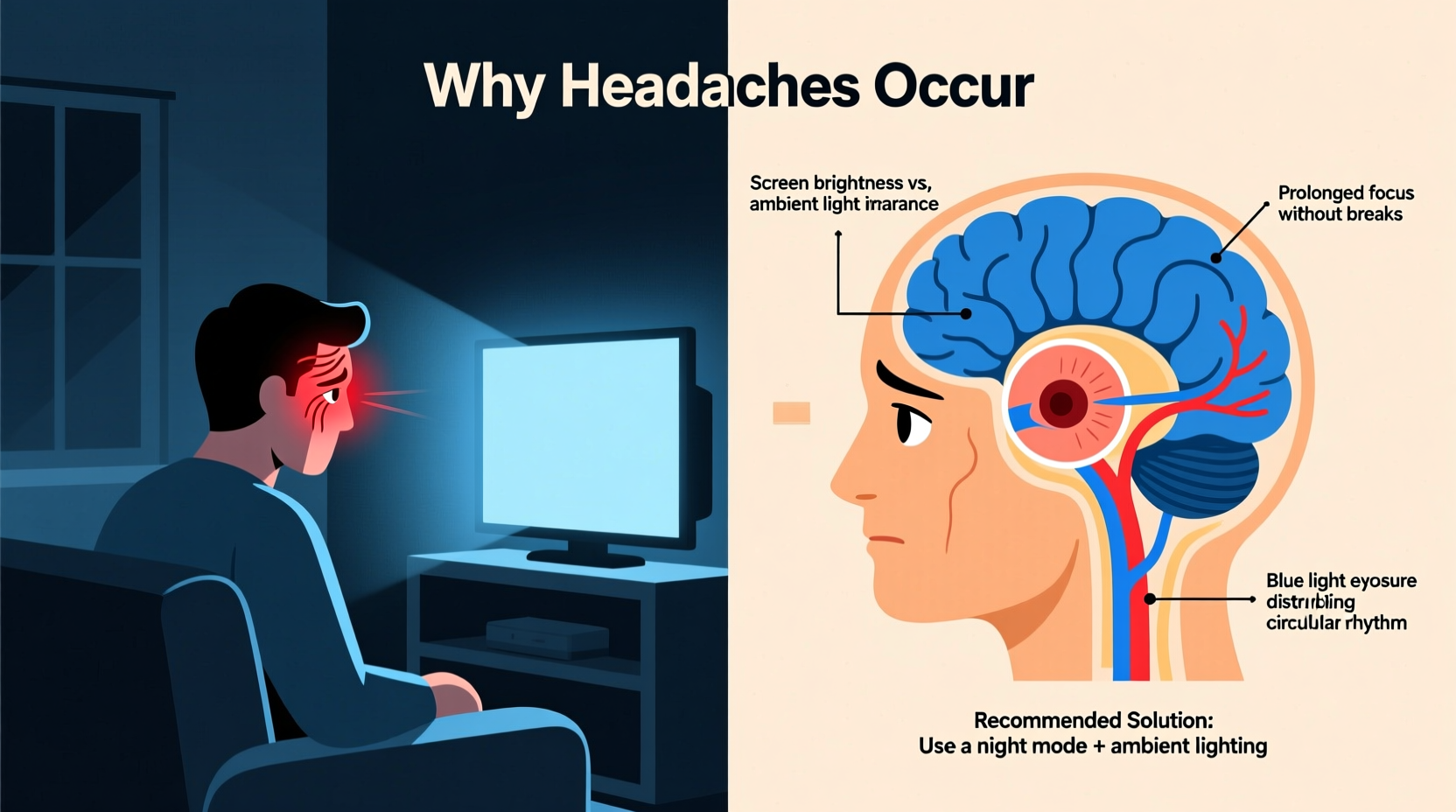
When you watch television in a completely dark room, your eyes are subjected to a high level of contrast between the bright screen and the surrounding darkness. This imbalance forces your pupils to rapidly dilate and constrict as they try to adjust to the fluctuating light levels across your field of vision. The retina, which processes visual information, becomes overstimulated by the intense brightness against a black backdrop, leading to a condition known as referral headache or more commonly, eye strain headache.
The human eye evolved to function best under balanced lighting. In natural daylight, ambient light diffuses evenly, minimizing harsh contrasts. Modern LED and OLED TVs emit strong, focused light that, when isolated in a dark environment, creates what ophthalmologists call “luminance disparity.” This mismatch disrupts the normal functioning of the ciliary muscles responsible for focusing, resulting in muscle fatigue and tension.
“Prolonged screen exposure in dim environments can trigger photophobia and neural fatigue, especially in individuals predisposed to migraines.” — Dr. Lena Torres, Neuro-Ophthalmologist, Massachusetts Eye and Neuro Institute
How Pupil Response Contributes to Headaches
Your pupils act like camera apertures: they open wider in low light and narrow in bright conditions. When fixed on a bright screen in total darkness, your pupils remain partially dilated while simultaneously reacting to the screen’s brightness. This constant adjustment leads to micro-fatigue in the iris muscles. Over time, this physical strain sends signals to the trigeminal nerve—the primary pathway for head pain—which can initiate a headache.
Additionally, blue light emitted by most modern screens suppresses melatonin production, disrupting circadian rhythms. Even if you don’t fall asleep during TV time, this hormonal interference can increase sensitivity to light and lower your threshold for discomfort.
Contributing Factors Beyond Lighting
While ambient darkness plays a central role, several other factors compound the problem:
- Poor posture: Slouching on a couch with your neck bent upward strains cervical muscles, contributing to tension headaches.
- Screen flicker: Some displays use pulse-width modulation (PWM) for brightness control, creating imperceptible flickering that fatigues the visual cortex.
- Viewing distance: Sitting too close intensifies the focal demand on your eyes, especially during fast-moving scenes.
- Pre-existing conditions: People with astigmatism, uncorrected vision, or migraine disorders are more vulnerable to screen-induced headaches.
Blue Light and Circadian Disruption
Blue light wavelengths (between 400–500 nm) are particularly stimulating to the brain. Evening exposure tricks your body into thinking it’s daytime, delaying sleep onset and increasing alertness when relaxation should be occurring. For sensitive individuals, this neurological activation can manifest as a headache, even without direct eye strain.
A 2021 study published in Clinical Ophthalmology found that participants who watched two hours of TV in complete darkness reported significantly higher rates of frontal lobe discomfort and photophobia compared to those who viewed under moderate ambient lighting.
Solutions and Preventive Measures
The good news is that most screen-related headaches are preventable with minor adjustments to your viewing environment and habits. You don’t need to give up evening entertainment—just make smarter choices about how and where you watch.
Optimize Room Lighting
The key is eliminating extreme contrast. Instead of turning off all lights, introduce soft, indirect illumination. Bias lighting—placing a gentle glow behind the TV—is highly effective. This technique works because it raises the ambient light level just enough to stabilize pupil size without washing out the picture.
| Lighting Option | Effectiveness | Recommendation |
|---|---|---|
| No lights (total darkness) | Poor – High risk of strain | Avoid |
| Bright overhead light | Fair – Reduces contrast but causes glare | Not ideal |
| Soft floor lamp (side of room) | Good – Balanced ambient light | Recommended |
| Bias lighting (behind TV) | Excellent – Minimizes eye fatigue | Best option |
| Candle or salt lamp | Fair – Low intensity, calming effect | Supplemental only |
Adjust TV Settings
Modern televisions come with built-in features designed to reduce eye strain. Activate these settings:
- Warm color temperature: Shift from “cool” or “vivid” modes to “warm” or “cinema,” which reduces blue emission.
- Auto-brightness: Enable ambient light sensors so the screen dims in darker rooms.
- Reduce motion smoothing: While marketed as “smooth motion,” this feature increases flicker perception and may contribute to discomfort.
- Night mode / blue light filter: Turn on after sunset to minimize circadian disruption.
Step-by-Step Guide to Headache-Free Viewing
Follow this routine to create a comfortable, sustainable TV-watching environment:
- Assess your current setup: Watch one episode in your usual conditions and note when discomfort begins.
- Add ambient lighting: Install a dimmable floor lamp or LED strip behind the TV set to 10–20% brightness.
- Reposition seating: Sit at least 6–10 feet from the screen (depending on size) with your eyes level with the center of the display.
- Calibrate display settings: Switch to “Movie” or “Cinema” mode, disable motion interpolation, and enable blue light reduction.
- Take visual breaks: Every 30 minutes, look away from the screen for 20 seconds, focusing on a distant object (follow the 20-20-20 rule).
- Limit session length: Avoid binge-watching for more than 2 consecutive hours without a longer break.
- Monitor symptoms: Keep a log for a week to see if headaches decrease with the new setup.
Real-Life Example: Sarah’s Experience
Sarah, a 34-year-old graphic designer, began experiencing frequent headaches after switching to a larger 4K OLED TV. She loved watching shows late at night with the lights off but started noticing a consistent pattern: within 45 minutes, a pressure-like sensation would build behind her left eye. Initially, she assumed it was stress from work. After visiting an optometrist, she learned that her dark-room viewing habit was the main culprit.
Following her doctor’s advice, Sarah installed a warm-white LED strip behind her TV and adjusted her screen settings to warmer tones. She also committed to turning on a small table lamp during viewing sessions. Within three days, her headaches disappeared. “I didn’t realize how much strain I was putting on my eyes,” she said. “Now I watch just as much, but I feel relaxed instead of drained.”
Checklist: Create a Headache-Safe Viewing Environment
Use this checklist before your next TV session:
- ✅ Lights are on—soft ambient or bias lighting present
- ✅ Blue light filter enabled on TV or via glasses
- ✅ Screen brightness adjusted to room lighting (not max)
- ✅ Seating at proper distance (at least 1.5 times screen diagonal)
- ✅ No glare from windows or reflections on screen
- ✅ Posture supported (back straight, head aligned)
- ✅ Breaks scheduled every 30–60 minutes
Frequently Asked Questions
Can watching TV in the dark cause permanent eye damage?
No, there is no evidence that watching TV in the dark causes permanent eye damage. However, chronic eye strain can lead to persistent discomfort, dry eyes, and worsened vision fatigue, especially in people with pre-existing conditions. While the effects are usually temporary, repeated strain may accelerate age-related visual decline.
Are some people more susceptible to screen-induced headaches?
Yes. Individuals with migraines, light sensitivity (photophobia), uncorrected refractive errors (like astigmatism), or convergence insufficiency (a binocular vision disorder) are more likely to experience headaches from screen contrast. Children and older adults may also be more vulnerable due to less adaptable visual systems.
Do blue light blocking glasses really help?
For some users, yes. While clinical studies show mixed results on melatonin protection, many report reduced eye fatigue and fewer headaches when wearing amber-tinted blue light glasses during evening screen use. They are most effective when combined with proper room lighting and screen settings.
Conclusion: Take Control of Your Visual Comfort
Headaches after watching TV in the dark are not inevitable—they’re a signal from your body that your visual environment needs adjustment. By understanding how light, contrast, and screen technology interact with your physiology, you can transform an uncomfortable habit into a relaxing ritual. Small changes like adding background lighting, tweaking display settings, and taking regular breaks can yield dramatic improvements in comfort and well-being.




 浙公网安备
33010002000092号
浙公网安备
33010002000092号 浙B2-20120091-4
Comments
No comments yet. Why don't you start the discussion?