
It’s a familiar holiday disappointment: you spend hours draping premium LED string lights across your roofline, only to step outside at noon and find them nearly invisible—faded, washed out, or indistinguishable from the gutters. The contrast is jarring: at dusk, they glow warmly; by 10 a.m., they vanish. This isn’t a flaw in your installation—it’s physics meeting marketing. Most Christmas lights are engineered for nighttime performance, not solar competition. Understanding *why* they fade in daylight—and what technical attributes actually sustain visibility when the sun is high—is essential for anyone who wants their display to impress all day long, not just after dark.
The Science Behind the Fade: Why Daylight Drowns Out Your Lights
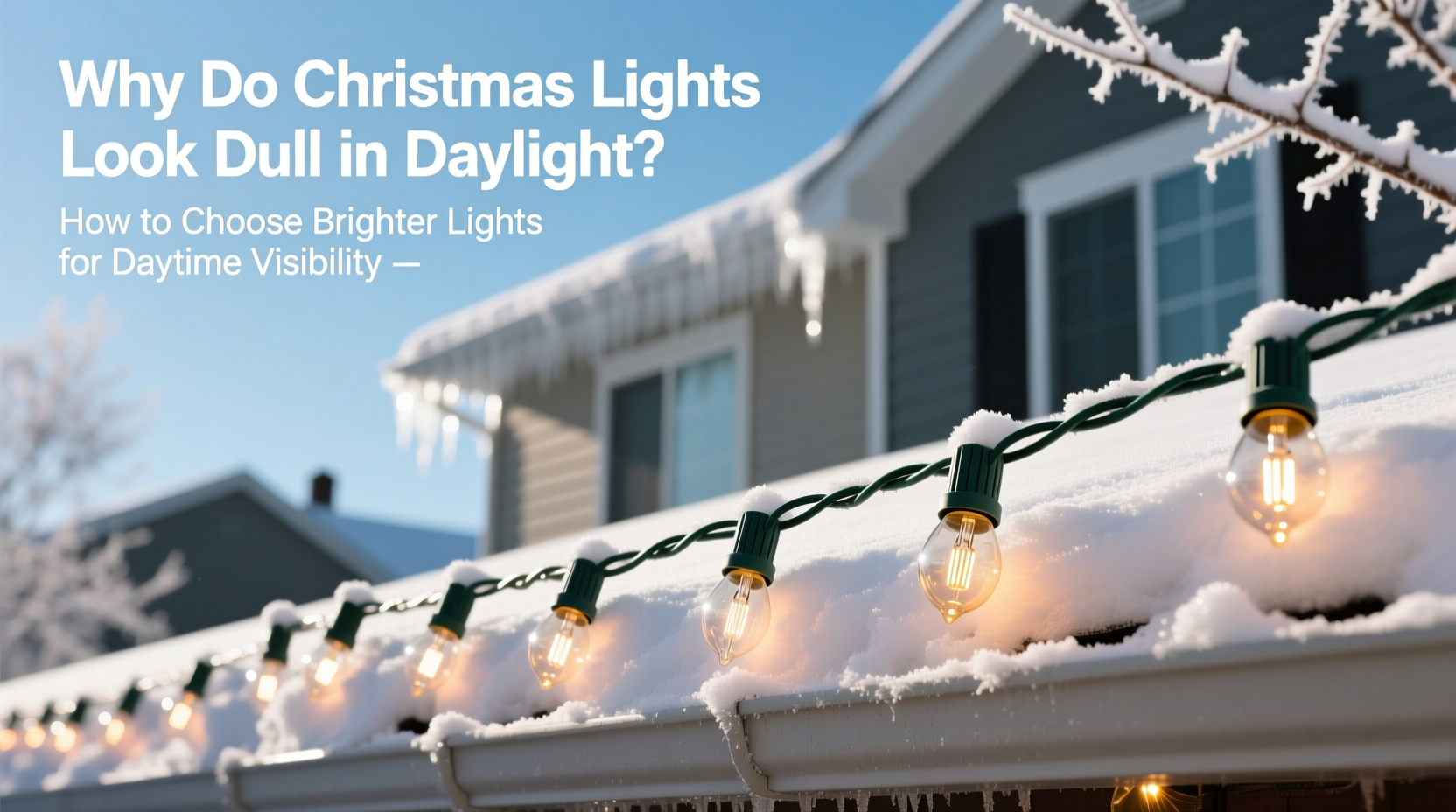
Christmas lights don’t “dim” in daylight—they’re overwhelmed. Human vision perceives brightness relative to ambient light. At night, even a 2-lumen bulb appears brilliant against near-total darkness. At noon, ambient illuminance can exceed 10,000 lux (a clear, sunny day). To remain perceptible, a light source must emit enough photons to create sufficient contrast against that background. Most standard mini lights output just 0.5–2 lumens per bulb. When placed against a sky reflecting 8,000–12,000 lux, their signal-to-noise ratio collapses. The eye simply stops registering them as distinct points of light.
Two optical phenomena compound the issue. First, luminance adaptation: your pupils constrict in bright light, reducing retinal sensitivity. Second, veiling glare—scattered sunlight bouncing off windowpanes, wet surfaces, or even airborne particles—creates a diffuse haze that further obscures low-contrast light sources. As lighting engineer Dr. Lena Torres explains:
“Daytime visibility isn’t about raw wattage—it’s about luminance density, spectral purity, and directional control. A 3-lumen bulb with a narrow-beam lens and saturated color will outperform a 5-lumen bulb with a wide, diffused emission pattern every time in full sun.” — Dr. Lena Torres, Optical Design Lead, Lumina Labs
This distinction matters because many consumers assume “brighter” means “more watts” or “more LEDs.” In reality, it’s about how efficiently each lumen is delivered to the viewer’s eye—and how well the light holds its color identity against daylight’s broad spectrum.
Lumens, Color Temperature, and Saturation: What Actually Matters for Daylight Performance
When shopping for daylight-visible lights, shift your focus from generic “brightness” claims to three measurable, comparable specs:
- Luminous intensity (measured in millicandelas, mcd): This quantifies how much light is emitted *in a specific direction*. High-mcd LEDs (e.g., 8,000–15,000 mcd) concentrate output into a tight beam—like a spotlight rather than a floodlight—making them far more discernible at distance.
- Color rendering & chromaticity: Daylight contains all visible wavelengths. To stand out, your lights need high color saturation—especially in reds and blues, which retain contrast best against blue-sky backgrounds. Look for lights with a CRI (Color Rendering Index) >90 and coordinates near the edge of the CIE 1931 chromaticity diagram (e.g., reds at x=0.70, y=0.30).
- Correlated Color Temperature (CCT) for white lights: Avoid “warm white” (2700K–3000K) for outdoor daytime use. Its yellowish tint blends with sunlight. Instead, choose “cool white” (5000K–6500K) or “daylight white” (6500K+), which matches the sky’s spectral peak and creates sharper visual separation.
Design Features That Make or Break Daytime Clarity
Not all high-lumen LEDs perform equally in daylight. Physical construction determines whether that intensity reaches the observer. Key design elements include:
| Feature | Why It Matters for Daylight Visibility | What to Look For |
|---|---|---|
| Lens type | Diffused lenses scatter light widely, diluting intensity. Clear, convex lenses focus output into a narrow viewing angle (15°–30°), boosting perceived brightness. | “Water-clear” or “optical-grade” polycarbonate lenses; avoid frosted or silicone-dome bulbs. |
| Bulb shape & size | Larger surface area increases glare risk and reduces contrast. Smaller, focused emitters (e.g., 5mm or 8mm LEDs) deliver higher luminance per mm². | 5mm or 8mm LEDs over traditional 12mm incandescent-style bulbs; avoid oversized “retro” shapes unless specifically rated for daylight use. |
| Wiring & spacing | Closely spaced bulbs (>100 per 25 ft) create visual clutter, making individual points harder to resolve. Wider spacing (6–12 inches) lets each light “breathe” and stand out. | Strings with 50–70 bulbs per 25 ft for architectural outlines; avoid ultra-dense net lights or curtain lights for primary daytime displays. |
| Mounting hardware | Black or matte-black wire and clips absorb ambient light instead of reflecting it, preserving contrast around each bulb. | Black-coated copper wire (not silver or green); UV-stabilized black PVC insulation; non-reflective mounting clips. |
One often-overlooked factor is thermal management. LEDs lose efficiency and shift color when overheating. Poorly ventilated housings or cheap drivers cause “color drift”—a warm-white light turning bluish or a red becoming orange—as temperatures rise midday. Premium daylight-rated strings use aluminum heat sinks and regulated constant-current drivers to maintain stable output from dawn to dusk.
A Real-World Example: How One Home Transformed Its Display
In Portland, Oregon, homeowner Marcus Chen installed two identical-looking 300-bulb LED strings along his front eaves in late November. Both were marketed as “super bright.” String A used standard 12mm warm-white LEDs with frosted lenses and green wire. String B featured 5mm cool-white LEDs with water-clear lenses, black wire, and a 12-inch spacing. At sunset, both glowed evenly. By 11 a.m. the next day, String A was nearly invisible—bulbs blurred into the shingles, colors muted. String B remained sharply defined: each cool-white point stood out like a tiny star against the gray-blue sky.
Marcus measured both with a handheld lux meter and photometer. String A registered 1.2 lumens per bulb and 2,200 mcd; String B delivered 3.8 lumens and 11,500 mcd. More importantly, String B’s chromaticity coordinates stayed fixed within ±0.005 across temperatures from 20°F to 85°F, while String A drifted significantly toward yellow. His solution wasn’t more lights—it was smarter light engineering.
How to Choose Daylight-Visible Christmas Lights: A Step-by-Step Selection Guide
Follow this practical sequence to identify truly daylight-capable lights—no guesswork required:
- Define your primary use case: Will the lights be viewed mostly during daytime (e.g., storefront, office lobby, front porch)? Or is dusk-to-dawn the priority? Prioritize daylight specs only if >4 hours of daily sun exposure is expected.
- Check the datasheet—not the box: Search the manufacturer’s website for the exact model number. Look for published specs: luminous intensity (mcd), viewing angle (°), CCT (K), and CRI. If these aren’t listed, assume the lights aren’t engineered for daylight.
- Verify lens material and clarity: Hold a sample bulb up to a printed page. If text appears blurry or distorted, the lens scatters light. You should see sharp, undistorted edges.
- Assess wire and housing quality: Bend the wire gently. Does it crack or feel brittle? Does the bulb housing wobble loosely on the wire? Robust construction correlates strongly with thermal stability and longevity.
- Read reviews with daylight photos: Filter Amazon or specialty retailer reviews for terms like “daylight,” “sun,” “outside,” or “noon.” Authentic user photos taken in direct sun reveal real-world performance far better than studio shots.
- Start small and test: Buy one 25-ft string first. Install it on a south-facing section. Observe at 10 a.m., 1 p.m., and 4 p.m. over three consecutive sunny days. Note color fidelity, edge definition, and distance visibility.
FAQ: Addressing Common Daylight Visibility Questions
Do battery-operated lights work better in daylight?
No—battery voltage doesn’t affect luminance or color quality. In fact, many battery lights sacrifice output and thermal management to conserve power, making them *worse* for daytime use. Mains-powered strings with regulated drivers deliver consistent, high-intensity output all day.
Can I retrofit my existing lights for better daytime performance?
Not effectively. Lens diffusion, bulb size, and driver electronics are built-in. Adding reflectors or painting backgrounds black may help marginally, but won’t overcome fundamental optical limitations. Replacement is the only reliable solution.
Are “commercial grade” lights always better for daylight?
Not automatically. “Commercial grade” often refers to durability (wire gauge, IP rating, UL listing), not optical performance. Some commercial strings prioritize longevity over brightness. Always verify the photometric specs—not just the grade label.
Conclusion: Light With Intention, Not Just Illumination
Your Christmas lights are more than decoration—they’re visual communication. They convey warmth, celebration, and care. When they vanish in daylight, that message gets lost—not through neglect, but through mismatched expectations and unexamined specifications. Choosing lights designed for solar conditions isn’t about extravagance; it’s about respect for how human vision works and commitment to craftsmanship that endures beyond twilight. The difference between a display that flickers into relevance only after dark and one that commands attention from sunrise to sunset comes down to precise engineering: tighter beams, purer colors, cooler whites, and intelligent materials. Don’t settle for lights that apologize to the sun. Choose ones that hold their ground.




 浙公网安备
33010002000092号
浙公网安备
33010002000092号 浙B2-20120091-4
Comments
No comments yet. Why don't you start the discussion?