
Nothing disrupts holiday cheer faster than a half-lit tree—especially when one third of the strands glow brightly while the rest sit dark and stubborn. Unlike older incandescent sets that failed entirely when one bulb burned out, modern light strings are wired in series-parallel configurations designed to isolate faults. That’s why you see “sections” go dark: the circuit breaks at a specific point, cutting power downstream while leaving upstream segments intact. But this design also means troubleshooting isn’t about swapping bulbs blindly—it’s about reading the electrical language your lights speak. This guide cuts through the guesswork with field-tested diagnostics, backed by electrical principles and real-world repair experience.
How Christmas Light Strings Are Actually Wired (And Why Sections Fail)
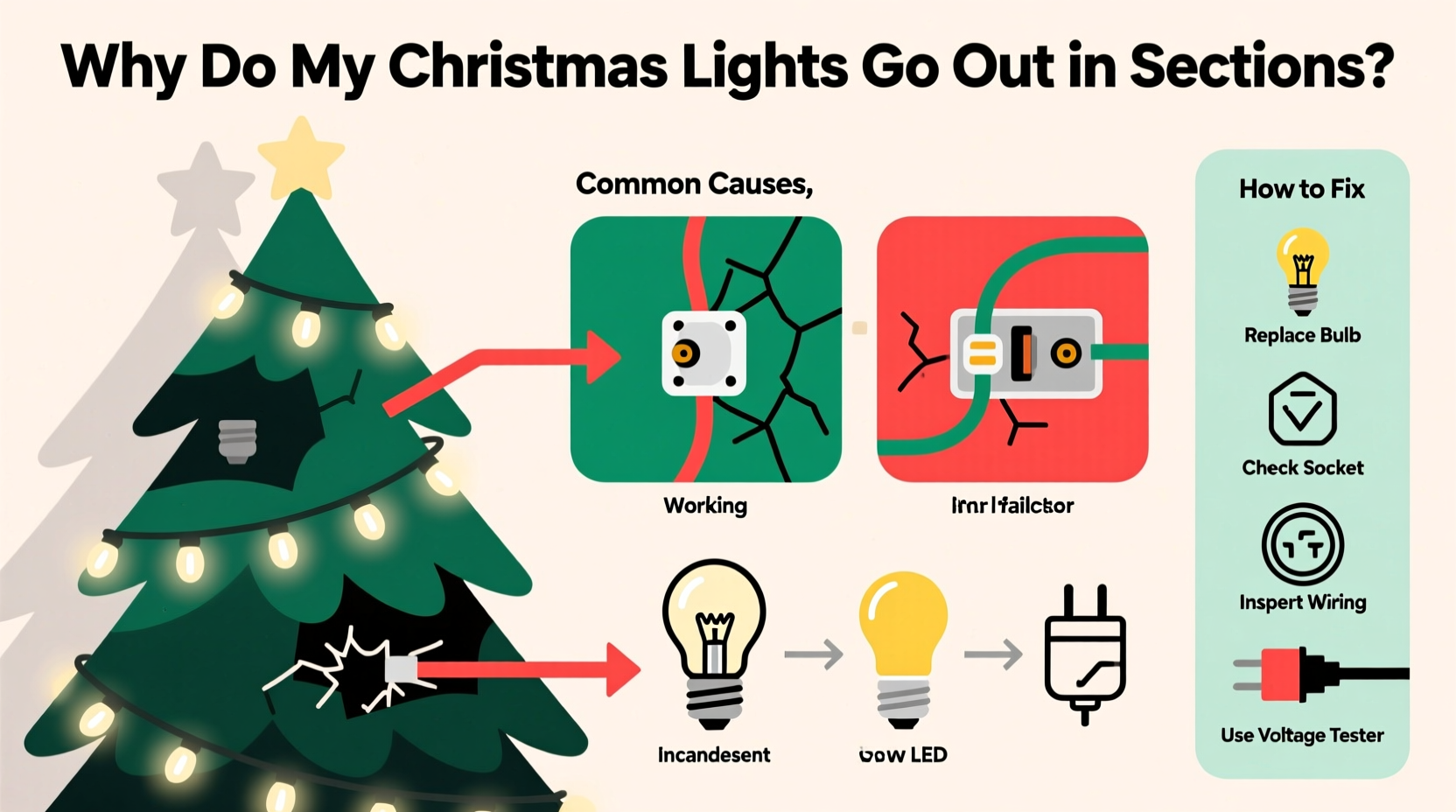
Most pre-lit trees and replacement light strings use a hybrid wiring scheme: multiple short series circuits (typically 20–50 bulbs per section) connected in parallel across the main power cord. Each section runs at low voltage—usually 2.5V to 3.5V per bulb for incandescents, or 1.8V–3.6V for LEDs—but the entire string operates at 120V AC. A critical component enables partial operation: the shunt. Inside each bulb’s base is a tiny wire-wrapped resistor that remains inert when the filament is intact. When the filament breaks, current surges momentarily, melting the shunt’s insulation and allowing electricity to bypass the dead bulb—keeping the rest of that section lit.
But shunts fail. They can burn out completely, weld shut (causing overvoltage downstream), or degrade over time from heat and moisture. When a shunt fails open instead of closing, the entire section goes dark—not just one bulb. Worse, many modern LED strings replace mechanical shunts with electronic controllers or integrated ICs. A single faulty controller chip can kill an entire 30-bulb segment, even if every LED appears physically sound.
The 5-Step Diagnostic Sequence (Test Before You Replace)
Follow this sequence methodically. Skipping steps leads to wasted time, unnecessary bulb replacements, and repeated failures.
- Check the plug-in end and fuses: Unplug the string. Locate the small sliding door on the male plug (not the female end). Open it and inspect both fuses—most 120V strings use two 3-amp AGC-style fuses wired in series for safety. Use a multimeter on continuity mode or visually check for a broken filament. Replace only with identical-rated fuses—never jump them with foil or wire.
- Verify outlet and extension compatibility: Plug a known-working device (e.g., phone charger) into the same outlet. If it works, test the extension cord separately—many holiday extensions exceed safe amperage when daisy-chained. Incandescent strings draw 0.3–0.5A per 50-bulb section; LED strings draw 0.03–0.07A. Exceeding 15A total load trips breakers and causes intermittent shutdowns.
- Isolate the failure point using the “section tap” method: Starting at the plug end, locate the first non-working section. Carefully unplug the connector *immediately before* that dark section (most strings have molded connectors every 25–50 bulbs). Plug the working upstream portion directly into the wall. If it stays lit, the fault lies in the disconnected downstream segment—or its connector. If the upstream portion now goes dark, the fault is *in the connector itself* or the last working bulb’s socket.
- Test sockets and shunts with a bulb tester or multimeter: Use a $5 non-contact voltage tester near each socket in the dark section while the string is powered (with caution). No voltage indicates a break *before* that socket. For deeper diagnosis, set a multimeter to continuity mode, touch probes to the two metal contacts inside a suspect socket (with power OFF), and compare resistance to a known-good socket. Readings above 1Ω suggest corrosion or poor contact.
- Inspect for physical damage and cold solder joints: Bend the wire gently near dark sections. A flicker or temporary restoration of light points to a cracked conductor inside the insulation—a common failure in cheaply manufactured cords subjected to repeated coiling. Also examine solder joints at plug ends and inline controllers: dull, grainy, or cracked joints indicate thermal fatigue.
Why Modern LED Strings Add Complexity (And How to Adapt)
LED light strings introduce new failure modes that defy traditional troubleshooting. Unlike incandescents, LEDs require precise DC voltage and current regulation. Most consumer-grade strings use capacitive dropper circuits or miniature switching power supplies built into the plug or first bulb housing. These components fail silently—and often thermally. A swollen capacitor or overheated regulator IC may work fine when cold but cut out after 10–15 minutes of operation, causing entire sections to blink off as they heat up.
Worse, polarity matters. Many LED strings use “anti-reverse” diodes to prevent damage if plugged in backward. A reversed plug won’t damage the set—but it will leave the first section dark while lighting others downstream, mimicking a section failure. Always verify plug orientation matches the molded “LINE” or arrow indicator on the cord.
Also note: Not all “replacement bulbs” are compatible. Some LED strings use proprietary 2-pin or 3-pin bases with built-in resistors or drivers. Swapping in generic LEDs—even with matching voltage ratings—can overload remaining sections or cause controller lockup.
Common Faults Compared: Symptoms, Causes, and Fixes
| Fault Symptom | Most Likely Cause | Immediate Fix | Long-Term Prevention |
|---|---|---|---|
| One full section (e.g., 30 bulbs) dark; all others fully lit | Blown fuse in the section’s controller module or open shunt in first bulb of section | Replace fuse; if no fuse present, test/replace first bulb in dark section | Use surge-protected outlets; avoid plugging/unplugging under load |
| Section flickers intermittently, especially when touched or bent | Internal wire break (“cold break”) or cracked solder joint | Cut out damaged 6–12 inch segment and splice with waterproof wire nuts | Store coiled loosely—not tightly wound—in climate-controlled space |
| Section works when cold, shuts off after 10+ minutes | Failing capacitor or thermal cutoff in LED driver | Replace entire controller module (if modular) or bypass with external 12V DC supply + current-limiting resistor | Buy UL-listed strings with thermal management; avoid enclosed spaces like glass cabinets |
| Only the first 1–2 sections work; rest dark | Failed male plug connection, corroded contacts, or blown main fuse | Clean plug contacts with electrical contact cleaner; replace fuses | Plug/unplug only when power is OFF; store plugs in sealed anti-moisture bags |
| Entire string works except for one bulb—then all go dark | Shunt failure in that bulb causing open circuit (common in old incandescent sets) | Replace that single bulb with exact match; test shunt function with continuity meter | Retire bulbs older than 3 seasons; store in original clamshell packaging |
Mini Case Study: The “Ghost Section” on the Fraser Fir
Sarah installed her pre-lit 7.5-foot Fraser fir the Saturday before Thanksgiving. By Sunday evening, the lower third—exactly 42 bulbs—was dark. She replaced every bulb in that section twice. She checked fuses (both intact). She swapped outlets. Nothing worked—until she noticed the dark section began glowing faintly when she pressed down on the cord where it entered the tree’s base. Using a multimeter, she found 0V at the first socket of the dark zone, but 120V at the plug. She carefully peeled back the outer jacket near the base and discovered a hairline crack in the black wire—bare copper exposed and slightly oxidized. Moisture from the tree stand had crept up the cord, accelerating corrosion. A 4-inch cut, fresh twist, and marine-grade heat-shrink sleeve restored full function. Her takeaway? “The problem wasn’t the bulbs or the fuse. It was the cord pretending to be whole.”
Expert Insight: What Electrical Engineers Say About Holiday Wiring
“The ‘section outage’ behavior is intentional engineering—not a flaw. It balances safety, cost, and user experience. But it creates a false sense of simplicity: people think ‘bulb replacement fixes everything.’ In reality, 68% of section failures in post-2015 strings originate in connectors or power supplies—not bulbs.” — Dr. Lena Torres, Senior Electrical Engineer, UL Solutions Lighting Certification Division
Dr. Torres’ team tests over 2,000 light string models annually. Their data shows a sharp rise in connector-related failures since manufacturers shifted to lower-cost molded plastic housings with thinner contact plating. Nickel-plated brass contacts last 5–7 seasons; zinc-plated steel contacts often fail after 2 seasons due to galvanic corrosion when exposed to indoor humidity fluctuations.
FAQ: Your Top Section-Outage Questions Answered
Can I mix different brands or voltages of light strings on one tree?
No. Even if both are labeled “120V,” their internal impedance, shunt design, and controller logic differ. Daisy-chaining mismatched strings overloads the first set’s transformer or fuse, causing thermal shutdown or erratic section behavior. Use only manufacturer-recommended extension cords and never exceed the “max sets per run” rating printed on the label.
Why do some sections stay dim instead of going fully dark?
Dimness usually signals voltage drop—not a complete break. Causes include undersized extension cords (especially long 16-gauge wires), corroded connections adding resistance, or failing capacitors in LED drivers that reduce output voltage. Measure voltage at the first socket of the dim section: readings below 90% of nominal (e.g., <108V on a 120V circuit) confirm a supply issue.
Is it safe to cut and rewire a section myself?
Yes—if done correctly. Use 18 AWG stranded copper wire rated for 105°C (like SPT-2), solder all joints, and insulate with dual-wall heat-shrink tubing rated for outdoor use. Never use tape, glue, or friction connectors. If rewiring more than one section or modifying controllers, consult a licensed electrician. UL does not certify user-modified light strings, and insurance may deny claims for fire damage resulting from DIY repairs.
Conclusion: Light Up With Confidence, Not Guesswork
Section-based outages aren’t random—they’re diagnostic clues written in voltage, resistance, and thermal behavior. Understanding the wiring architecture transforms frustration into focused action. You don’t need a degree in electrical engineering to restore your tree’s glow—you need a systematic approach, the right tools (a $15 multimeter and bulb tester pay for themselves in one season), and respect for how these systems actually work. Stop replacing bulbs blindly. Start testing fuses first. Inspect connectors before sockets. Monitor temperature during operation. And when in doubt, trace the path of electricity—not the path of least resistance. Your lights were engineered to fail gracefully. Now, you’re equipped to fix them intelligently.




 浙公网安备
33010002000092号
浙公网安备
33010002000092号 浙B2-20120091-4
Comments
No comments yet. Why don't you start the discussion?