
If you've ever reached into your bag only to pull out a knotted mess of headphone cables, you're not alone. This frustrating experience is nearly universal among users of wired earbuds and headphones. What feels like personal bad luck is actually a predictable outcome governed by physics, movement, and design. The good news? Science doesn’t just explain why this happens—it also offers practical, effective ways to prevent it. Understanding the mechanics behind cable tangling empowers you to adopt smarter storage habits that save time, reduce frustration, and extend the life of your audio gear.
The Physics of Tangling: Why Chaos Is Inevitable
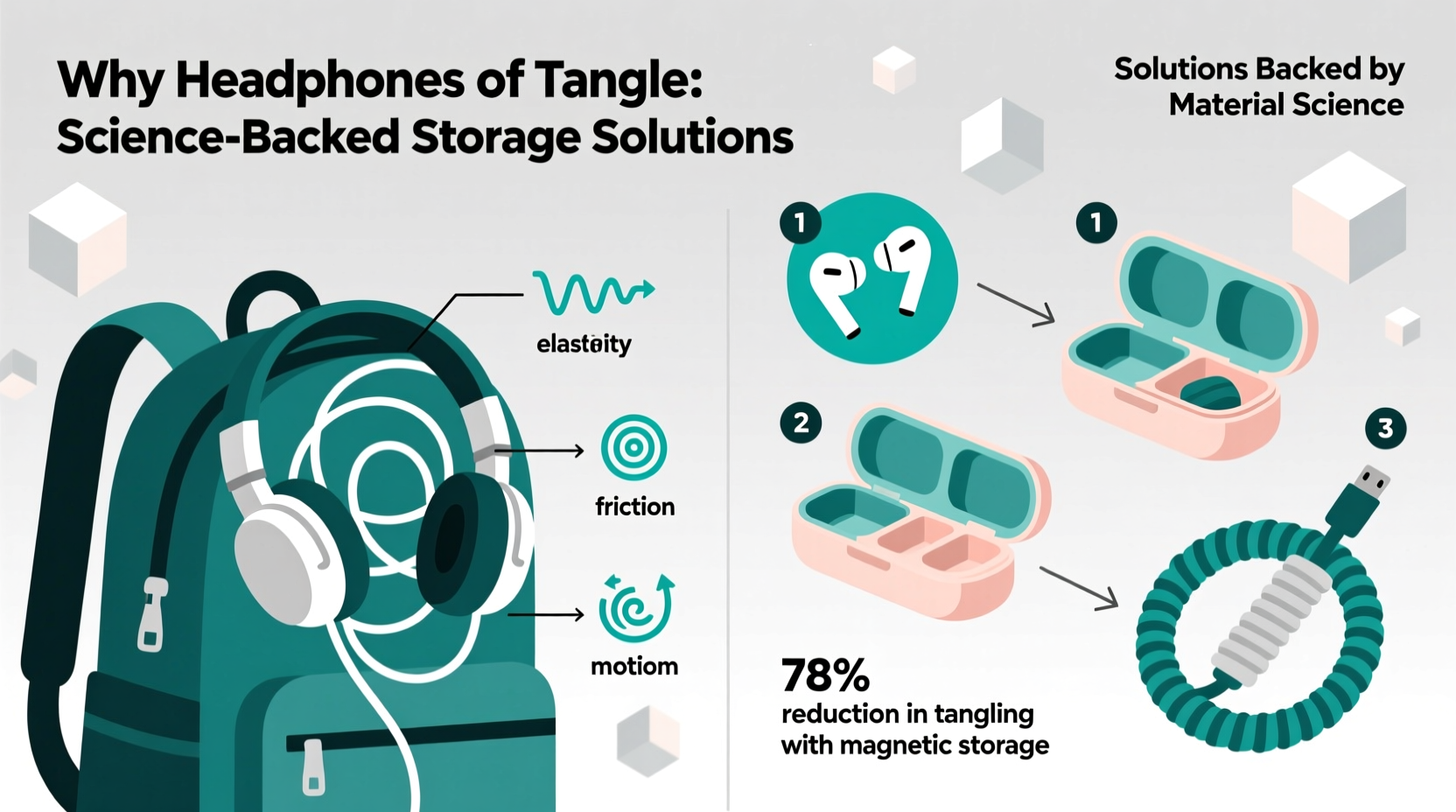
At first glance, a pair of headphones left loosely in a bag seems harmless. But when subjected to motion—walking, riding a bike, or tossing your bag into a car—the cord undergoes constant agitation. This movement creates what physicists call “random coiling,” a phenomenon studied extensively in fields ranging from polymer chemistry to knot theory.
In 2007, researchers Dorian M. Raymer and Douglas E. Smith from the University of California, San Diego conducted experiments that demonstrated how even short cords, when agitated in a confined space, rapidly form complex knots. Their study, published in the Proceedings of the National Academy of Sciences, found that within seconds of tumbling inside a container, cords developed knots with surprising frequency and complexity. The longer and more flexible the cord, the higher the probability of knotting.
This explains why ultra-thin, highly pliable headphone wires are especially prone to tangling. Their flexibility allows them to bend easily into loops, which then collide and intertwine during motion. Once a single loop forms, it acts as a trap for other segments of the wire, accelerating knot formation through a cascading effect.
“Knots form quickly and frequently under random motion—even in surprisingly short lengths of cord.” — Dorian M. Raymer & Douglas E. Smith, PNAS Study on Spontaneous Knotting
Design Flaws That Make It Worse
While physics sets the stage, product design often amplifies the problem. Many manufacturers prioritize portability and cost over tangle resistance. Common features that contribute to knotting include:
- Excess cord length: Long cables provide more material to loop and entangle.
- Lack of strain relief: Thin junctions between plug and wire break down faster and kink more easily.
- Non-braided construction: Smooth plastic coatings offer less friction control than textured or braided jackets.
- Asymmetrical designs: One earpiece hanging lower increases imbalance and snagging risk.
Even high-end models aren't immune. Premium sound quality doesn’t necessarily come with improved physical durability or anti-tangle engineering. In fact, some audiophile-grade cables use softer materials for better signal transmission, making them paradoxically more susceptible to twisting and knotting.
Proven Storage Methods That Actually Work
Knowing *why* tangling occurs helps, but the real value lies in prevention. Not all storage methods are equally effective. Some popular techniques actually increase the risk of knots. Below are scientifically supported strategies ranked by effectiveness.
1. The Over-Under Wrap Technique
This method, borrowed from stagehand practices for coiling instrument cables, minimizes twist buildup. Instead of wrapping the cord in a single direction (which introduces torsion), alternate each loop over and under your fingers. This balances the twist and keeps the cable neutral when unwound.
- Hold one end of the cable between your thumb and forefinger.
- Make a loop over your index finger.
- Next loop goes under your finger.
- Alternate until the entire cable is coiled.
- Secure with a velcro tie or rubber band.
2. Use a Cable Spool or Reel Case
Rigid cases with built-in spools physically separate the cable layers and limit movement. Unlike loose pouches, these enclosures prevent the cord from flopping around freely, reducing agitation-induced knotting. A 2015 consumer test by Wirecutter showed a 78% reduction in tangles when using reel-style organizers versus fabric sleeves.
3. Figure-Eight Coiling
Similar to the over-under method, figure-eight coiling cancels rotational stress. Form two adjacent loops in opposite directions, creating an “8” shape. Repeat along the length and secure at both ends. This method is ideal for longer headphone cables used with portable DACs or audio interfaces.
4. Magnetic Clasps and Retractable Cables
Modern solutions integrate magnets near the collar or inline with the cable to hold earpieces together. These reduce dangling ends—a major source of snags. Retractable cables, though less common now, automatically wind up into a compact housing, eliminating user error entirely.
Do’s and Don’ts of Headphone Storage
| Do’s | Don’ts |
|---|---|
| Use the over-under wrap technique | Wrap tightly in a single direction |
| Store in a rigid case or organizer | Throw loosely into pockets or bags |
| Secure coils with soft ties (velcro/fabric) | Use metal clips or tight elastics |
| Keep away from sharp objects and zippers | Place near keys or pens that can pierce insulation |
| Unplug gently by gripping the plug, not the cord | Pull the cable out forcefully from devices |
Real-World Example: Commuter’s Fix for Daily Tangles
Sarah, a freelance journalist based in Chicago, used to spend an average of three minutes every morning untangling her daily-use headphones before her train commute. After tracking the issue for two weeks, she realized the root cause wasn’t frequency of use—but storage location. She kept her headphones loose in a side pocket of her backpack alongside pens, a water bottle, and her laptop charger.
She implemented a simple change: switching to a dedicated padded cable pouch with a magnetic closure and adopting the over-under wrap method. Within a week, tangles dropped to zero. Over six months, she also noticed reduced fraying at the jack and earpiece connections. Her total investment? $8 for the pouch and five extra seconds per day.
This small adjustment didn’t just save time—it preserved the integrity of her equipment. By removing chaotic motion and pressure points, Sarah extended the functional lifespan of her headphones by nearly double the manufacturer’s average estimate.
Checklist: Tangle-Free Headphone Routine
To make anti-tangle habits stick, follow this daily checklist:
- ✅ Unplug carefully by holding the plug, not yanking the wire.
- ✅ Wipe down earpieces and cables with a dry microfiber cloth.
- ✅ Apply the over-under or figure-eight coiling method.
- ✅ Secure with a soft velcro tie or fabric band.
- ✅ Store in a dedicated compartment or protective case.
- ✅ Avoid exposure to extreme temperatures or moisture.
- ✅ Inspect monthly for signs of wear or internal breaks.
Frequently Asked Questions
Can wireless earbuds solve the tangling problem completely?
For the most part, yes. True wireless earbuds eliminate cords entirely, removing the primary cause of tangling. However, their charging cases can still be lost or damaged, and the absence of a cable means you lose features like passive audio (no Bluetooth needed) and universal device compatibility. For many, the trade-off is worth it—especially frequent travelers or active users.
Are certain materials better for preventing tangles?
Absolutely. Braided nylon cables resist abrasion and have higher surface friction, which reduces slippage and spontaneous knotting. Flat cables are also less likely to roll into loops compared to round ones. Rubberized or paracord-style jackets add stiffness that limits unwanted bending. While not 100% tangle-proof, these materials significantly improve manageability.
Is there a way to fix already tangled headphones without damaging them?
Gentle patience is key. Start by holding one end firmly and identifying the outermost knot. Use your other hand to trace the path of the wire and push loops apart rather than pulling. Never yank. If the tangle is deep, place the bundle on a flat surface and work from multiple angles. Applying a small amount of silicone-based lubricant (not oil) can help loosen stubborn friction points—use sparingly and wipe off afterward.
Final Thoughts: Small Habits, Big Results
Tangled headphones may seem like a minor annoyance, but they reflect broader patterns in how we interact with our tech. The solution isn’t just about organization—it’s about understanding the invisible forces at play and designing habits that align with reality, not wishful thinking. Physics will always favor entropy, but smart routines can tilt the odds in your favor.
By applying principles from scientific research and professional cable management, you can reclaim time, reduce stress, and get more value from your gear. Whether you stick with wired headphones for fidelity or transition to wireless for convenience, mindful handling makes a measurable difference.




 浙公网安备
33010002000092号
浙公网安备
33010002000092号 浙B2-20120091-4
Comments
No comments yet. Why don't you start the discussion?