
It starts innocently enough—a few strands of LED string lights strung along the eaves for holiday cheer or backyard ambiance. Then, one morning, your garage door refuses to open. The remote clicks but nothing happens. You press the wall switch—still no response. After troubleshooting sensors and power sources, you realize the only change was the decorative lights. Could those tiny bulbs really be jamming your garage door opener? The answer is yes—and it’s more common than most homeowners suspect.
LED string lights, especially cheaper models, can emit electromagnetic interference (EMI) that disrupts radio frequency (RF) signals used by garage door openers operating at 300–400 MHz. This invisible conflict between modern lighting and essential home automation systems has become a growing issue in residential electronics. But understanding the root cause and applying targeted shielding strategies can resolve the problem efficiently—without sacrificing aesthetics or convenience.
How LED Lights Generate Electromagnetic Interference
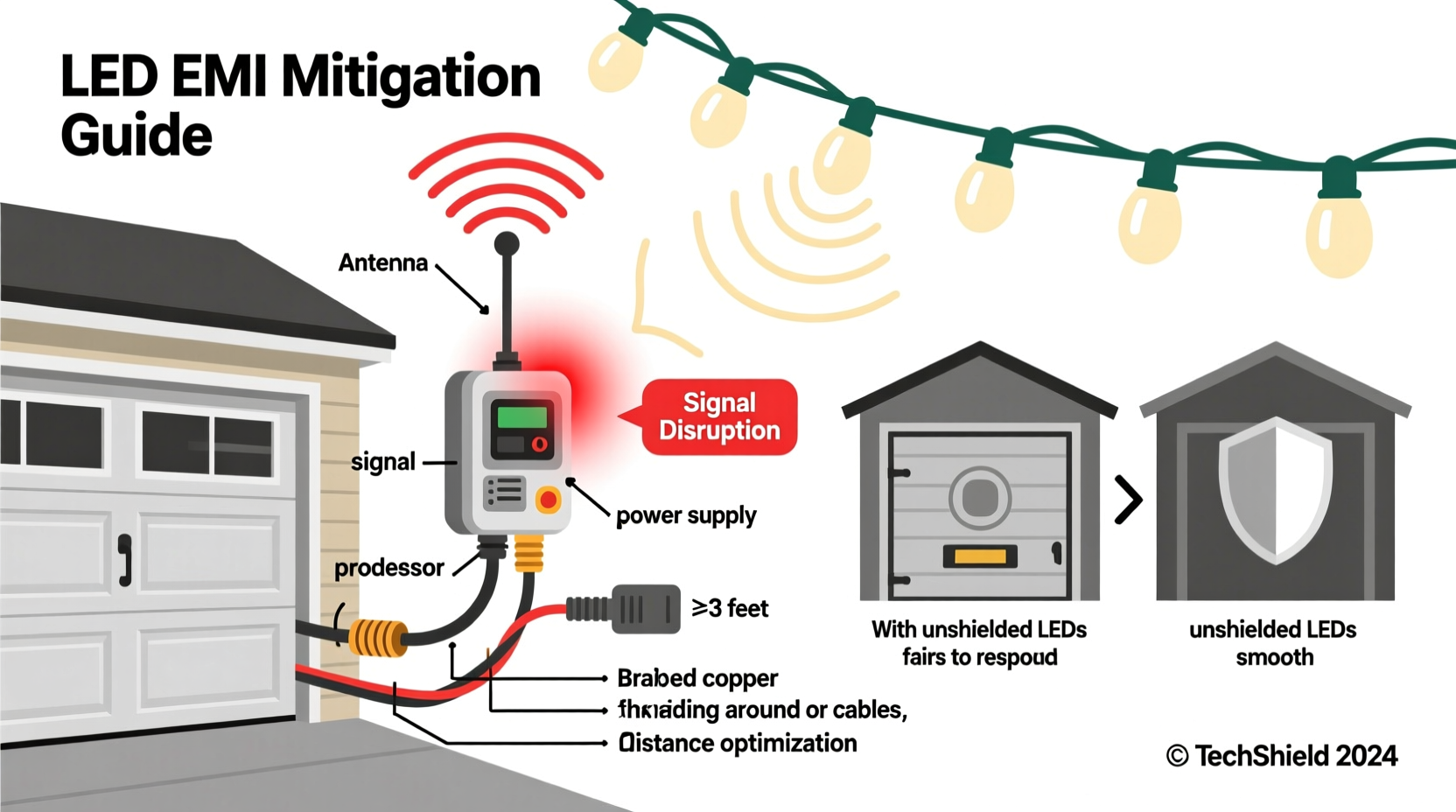
LEDs themselves are not inherently disruptive. They operate on low-voltage direct current and produce minimal EMI. The culprit lies in the supporting circuitry: the driver or transformer that converts household alternating current (AC) into usable DC power for the LEDs. Many budget-friendly LED string lights use poorly designed switching power supplies that lack adequate filtering components like ferrite cores, capacitors, or shielding.
These unfiltered drivers generate high-frequency electrical noise as they rapidly switch current on and off—often thousands of times per second. This creates broadband electromagnetic emissions that radiate from the power cord and light strands. When these frequencies overlap with those used by garage door openers (typically 315 MHz or 390 MHz in North America), signal disruption occurs.
The phenomenon is similar to how an old fluorescent light fixture might cause static on a nearby AM radio. However, because garage door openers rely on precise digital codes for security, even brief interference can prevent command recognition. The result? A non-responsive opener despite fresh batteries and clear sensor paths.
“Poorly regulated LED drivers act like miniature radio transmitters. Without proper EMI suppression, they unintentionally drown out legitimate control signals.” — Dr. Alan Reeves, Electrical Interference Researcher, IEEE Fellow
Identifying the Source of Interference
Before implementing solutions, confirm that LED lights are indeed the source. Other devices—Wi-Fi routers, baby monitors, cordless phones, or faulty electrical wiring—can also emit interfering signals. Use this diagnostic process:
- Isolate the variable: Turn off all LED strings and test the garage door opener. If it works immediately, interference is likely present.
- Reintroduce incrementally: Power on each light strand one at a time while testing the opener after each addition.
- Observe proximity: Note whether interference increases when lights are closer to the opener motor unit, typically mounted near the ceiling.
- Check timing: Does the problem occur only when lights are dimmed or set to flashing modes? These functions often increase EMI output.
If the correlation is confirmed, focus shifts to mitigation rather than replacement—though upgrading to higher-quality lights may ultimately be the best long-term solution.
Effective Shielding and Mitigation Strategies
Once interference is verified, several technical approaches can reduce or eliminate signal disruption. These range from simple fixes to more advanced modifications, depending on your comfort level with electronics and home systems.
1. Install Ferrite Cores on Power Cords
Ferrite beads or clamp-on chokes suppress high-frequency noise by absorbing electromagnetic energy. Snap them onto the LED string’s power supply cord, ideally within 6 inches of the plug or driver housing.
- Use Type 31 or Type 43 ferrite material for optimal RF suppression.
- Wrap the cord through the core 2–3 times if possible to increase impedance.
- Apply cores to both ends of extension cords used with LED strings.
2. Relocate Light Strands and Power Supplies
Distance reduces EMI intensity. Even moving a power adapter six feet away from the garage door motor can restore functionality. Avoid routing LED cords parallel to the opener’s antenna wire; instead, cross them at right angles if necessary.
3. Upgrade to EMI-Compliant LED Products
Look for LED strings certified to meet FCC Part 15 Class B standards, which regulate unintentional radiators in residential environments. Reputable brands such as Philips Hue, GE Relax, or Christmas Light Etc design their drivers with integrated noise filtering.
4. Shield the Garage Door Opener Antenna
The opener’s dangling antenna wire acts like a signal receiver—and unintentional EMI collector. While you shouldn’t cover it completely, ensure it’s not coiled tightly or placed near LED cords. Extend it fully and route it away from potential noise sources. Some technicians recommend wrapping the last few inches in aluminum foil and grounding it, though this should be done cautiously and temporarily during testing.
5. Use Filtered Power Strips
Plug LED strings into a surge protector or power strip with built-in EMI/RFI filtering. These units contain internal capacitors and inductors that absorb electrical noise before it enters the home circuit. While not a complete fix, they reduce overall line noise that could compound interference issues.
Step-by-Step Guide to Eliminating LED-Induced Interference
Follow this sequence to systematically resolve the issue:
- Turn off all LED lighting circuits connected to the same electrical panel as the garage.
- Test the garage door opener using remote, keypad, and wall button to confirm baseline function.
- Reconnect LED strings one by one, waiting 30 seconds between each to monitor for interference.
- When interference returns, mark that specific string as the source.
- Attach a dual-split ferrite core to the power cord near the adapter.
- Retest the opener. If still disrupted, add a second core or reposition the driver away from the garage area.
- Consider replacing the problematic string with an FCC-compliant model if shielding fails.
- Inspect the opener’s antenna—extend it fully and ensure it hangs freely without contact with metal surfaces.
This methodical approach ensures accurate diagnosis and avoids unnecessary replacements or electrical modifications.
Do’s and Don’ts: Managing LED and Opener Coexistence
| Action | Recommended? | Reason |
|---|---|---|
| Use LED strings labeled “FCC Certified” | ✅ Yes | Ensures built-in EMI suppression and compliance with emission limits |
| Coil excess antenna wire from the opener | ❌ No | Reduces signal reception and increases susceptibility to noise |
| Install ferrite cores on LED power cords | ✅ Yes | Inexpensive, reversible, and effective at reducing high-frequency noise |
| Run LED cords alongside garage door opener wiring | ❌ No | Increases inductive coupling and risk of interference |
| Use dimmable LEDs with compatible controllers | ✅ Yes (with caution) | PWM dimming can increase EMI; ensure controller is shielded |
Real-World Example: Resolving Holiday Lighting Conflicts
Mark T., a homeowner in Portland, OR, installed new LED icicle lights along his roofline each December. One year, after powering them on, his Chamberlain garage door opener stopped responding entirely. He replaced batteries, reset the logic board, and even called a technician who found no hardware faults. Only when Mark mentioned the new lights did the technician suspect EMI.
They unplugged the lights—immediately, the opener responded. Testing revealed that one specific strand, purchased online at a steep discount, emitted strong RF noise. By adding two clip-on ferrite cores and relocating the power adapter from the garage outlet to an outdoor-rated box on the side of the house, the interference dropped below critical levels. The opener worked reliably for the rest of the season.
This case underscores how inexpensive electronics can compromise trusted home systems—and how simple fixes often suffice.
FAQ
Can LED interference permanently damage my garage door opener?
No. Electromagnetic interference from LED strings does not cause physical damage. It disrupts communication between the remote and receiver but doesn’t harm internal components. Once interference is removed, normal operation resumes.
Will turning off the LED lights stop the interference?
Usually, yes. Most interference occurs only when the lights are powered. However, some poorly isolated drivers may introduce noise into the electrical circuit even when switched off but still plugged in. For complete elimination, unplug the strand entirely.
Are smart LED lights more likely to cause interference?
Not necessarily. While smart LEDs involve wireless communication (Wi-Fi, Bluetooth, Zigbee), these operate at 2.4 GHz—far above garage opener frequencies. The real risk remains in the power supply quality. High-end smart lights often have better EMI filtering than basic decorative strings.
Conclusion: Restore Control with Smart Solutions
The clash between energy-efficient lighting and legacy RF systems isn't a flaw—it's a sign of evolving technology integration in modern homes. LED string lights offer beauty and efficiency, but their design must account for broader electromagnetic compatibility. By identifying interference sources, applying targeted shielding, and choosing higher-quality products, homeowners can enjoy both festive illumination and reliable garage access.
You don’t need to choose between ambiance and function. With a few strategic adjustments—ferrite cores, smart placement, and informed product choices—you can maintain harmony between your holiday lights and everyday conveniences. Take action today: inspect your current setup, test for interference, and implement one shielding method. Your future self, standing in the cold with a non-responsive remote, will thank you.




 浙公网安备
33010002000092号
浙公网安备
33010002000092号 浙B2-20120091-4
Comments
No comments yet. Why don't you start the discussion?