
Prelit Christmas trees promise convenience—but nothing dampens holiday cheer faster than discovering a third of your tree is dark while the rest glows brightly. Dead sections—entire branches or vertical zones with no illumination—are among the most frequent complaints from consumers who’ve invested in prewired trees. Unlike string lights you can swap out, prelit trees integrate wiring directly into the trunk and branch structure, making diagnosis less intuitive and repairs more delicate. The good news? In over 80% of cases, dead sections stem from preventable, repairable issues—not manufacturing defects or inevitable failure. This guide breaks down exactly why those sections go dark, how to identify the root cause without guesswork, and—most importantly—how to restore full illumination safely and sustainably.
Why Dead Sections Occur: The Four Primary Causes
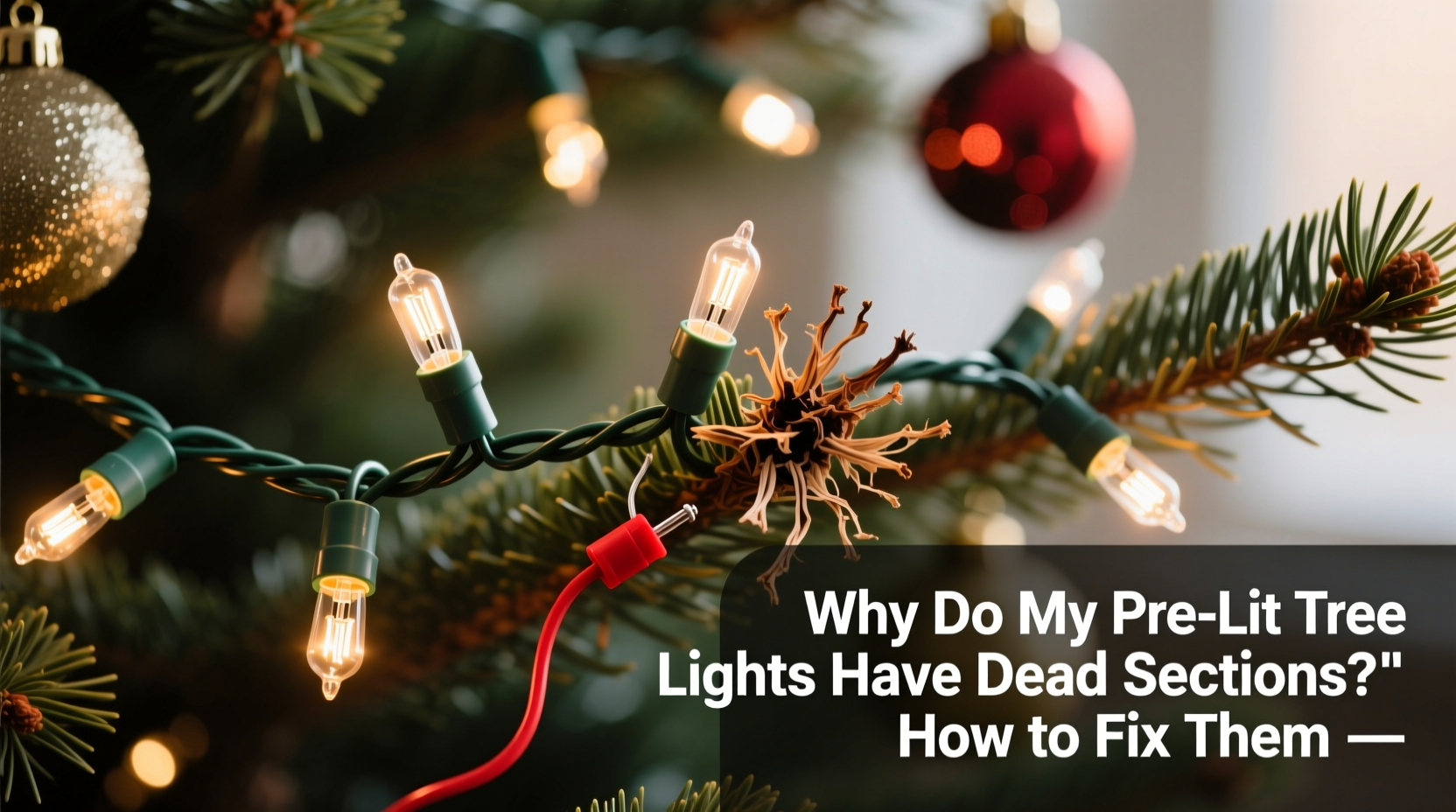
Dead sections rarely happen at random. They follow predictable electrical patterns tied to how prelit trees are engineered. Most manufacturers use a “series-parallel hybrid” circuit: groups of 3–6 bulbs wired in series (so one bulb failure can kill its segment), connected in parallel across the main trunk wiring. When a section goes dark, it’s almost always due to one of these four interrelated failures:
- Bulb-level interruption: A single burnt-out bulb with a broken filament *or* a missing bulb in a non-shunted socket. Unlike older incandescent strings, many prelit trees use non-shunted sockets—meaning electricity stops flowing when a bulb is removed or fails.
- Socket corrosion or debris: Dust, pine resin, humidity, or oxidation builds up inside sockets over time, creating high-resistance barriers that block current flow—even if the bulb appears intact.
- Wiring stress points: Repeated folding, bending, or compression at branch junctions (especially near the trunk collar or hinge points) fractures internal wires. These micro-fractures often don’t show externally but interrupt continuity.
- Controller or fuse failure: Many prelit trees include an inline controller (for twinkle modes, timers, or dimming) and a small thermal fuse near the plug base. A tripped fuse or failed controller can cut power to specific circuits—not the whole tree.
Crucially, dead sections are rarely caused by “dying” bulbs en masse. If multiple bulbs on one branch fail simultaneously, it’s almost certainly a wiring or socket issue upstream—not coincidence.
Step-by-Step Diagnostic & Repair Protocol
Follow this sequence methodically. Skipping steps leads to misdiagnosis and repeated frustration.
- Unplug and inspect visually: Confirm the tree is unplugged. Examine the dark section closely. Look for obvious signs: melted socket plastic, discoloration, bent pins, or frayed wire near the base of the branch.
- Check the controller and fuse: Locate the control box (usually near the plug or tucked into the base). Open the fuse compartment. Use a multimeter on continuity mode—or simply swap the fuse with a known-good one of identical rating (typically 3A or 5A slow-blow). If the section lights up, replace the fuse permanently. If not, proceed.
- Test bulb continuity (non-invasive first pass): With the tree still unplugged, gently press each bulb in the dead section straight into its socket. Listen for a faint “click” and feel subtle resistance—this confirms contact. Then, using insulated tweezers or fingers, wiggle each bulb side-to-side while observing adjacent lit sections. If wiggling a specific bulb causes flickering elsewhere, that socket is likely compromised.
- Isolate the faulty segment: Starting at the top of the dark section, remove the first bulb. Plug in the tree briefly (≤5 seconds). If the section remains dark, unplug and remove the next bulb. Continue until removing a bulb restores partial lighting downstream. That removed bulb—or its socket—is the culprit.
- Replace or bypass the faulty component: If the bulb tests dead (use a bulb tester or swap with a known-good bulb), replace it with an exact-match replacement (voltage, base type, wattage). If the socket shows corrosion or doesn’t hold bulbs snugly, carefully clean contacts with isopropyl alcohol and a cotton swab, then dry fully. For persistent socket failure, install a shunt-compatible replacement socket (sold as “prelit tree socket kits”).
Do’s and Don’ts When Troubleshooting Prelit Tree Lights
| Action | Do | Don’t |
|---|---|---|
| Bulb replacement | Use only manufacturer-specified bulbs (check model number on tag or manual); match voltage (usually 2.5V or 3.5V), base type (E12 candelabra), and wattage (typically 0.5W–1W) | Substitute with standard household bulbs, LED replacements not rated for prelit trees, or bulbs with higher wattage—this risks overheating and controller damage |
| Power testing | Test segments for ≤5 seconds at a time; use a GFCI-protected outlet; verify outlet functionality with another device first | Leave the tree plugged in while handling bulbs or wiring; use extension cords not rated for indoor holiday use; test near water or damp surfaces |
| Storage prep | After the season, wipe sockets with dry microfiber cloth; loosely coil branches without kinking wires; store upright in original box or climate-controlled space | Store compressed under heavy objects; leave bulbs installed during storage (resin buildup accelerates corrosion); keep in garages or attics with temperature swings >40°F–90°F |
| Controller handling | Reset timer modes per manual instructions before assuming failure; check battery compartment (if applicable) for leakage or corrosion | Disassemble controllers unless explicitly designed for user service; immerse in cleaning solutions; ignore blinking error codes (consult manual for meaning) |
Real-World Case Study: The “Half-Tree Blackout”
Janet in Portland purchased a 7.5-foot Fraser fir prelit tree in 2021. By December 2023, the entire right half—branches from the 3rd tier upward—remained dark, while the left side and lower tiers worked perfectly. She replaced all bulbs on the dark side twice, checked fuses, and even tried a different outlet. Frustrated, she contacted the manufacturer, who sent replacement bulbs but no solution. On closer inspection, Janet noticed slight discoloration on the trunk collar where the right-side branch harness entered the main trunk conduit. Using a multimeter, she tested continuity from the collar junction to the first socket on the dark side—and found infinite resistance. She gently flexed the harness near the collar while testing: continuity returned intermittently. The issue was a fractured internal wire at a chronic stress point. She carefully stripped ½ inch of insulation from the harness wire, twisted the exposed strands tightly, soldered the joint, heat-shrunk tubing over it, and re-routed the harness with a small zip-tie to relieve tension. Full illumination restored in under 20 minutes. Her takeaway: “The problem wasn’t the bulbs—it was where the tree bends every single year.”
Expert Insight: Engineering Realities of Prelit Trees
“Prelit trees prioritize aesthetics and compact shipping over serviceability. Wiring is routed through hollow PVC or PE branches, often with minimal strain relief. That’s why 70% of field failures occur within 2 inches of branch-to-trunk junctions or socket bases—not at the bulbs themselves. Prevention isn’t about perfection—it’s about reducing cyclic stress and controlling environmental exposure.” — David Lin, Electrical Engineer & Holiday Lighting Consultant, UL Certified Product Safety Lab
Troubleshooting Checklist
Before reaching for tools, run through this rapid verification list:
- ✅ Is the tree fully plugged into a working, GFCI-protected outlet?
- ✅ Are all fuses intact and correctly seated in the controller/base unit?
- ✅ Has the controller been reset (unplugged for 60+ seconds, then reconnected)?
- ✅ Are bulbs fully seated—no visible gaps between base and socket rim?
- ✅ Is there physical damage (cracks, melting, scorch marks) near the dark section’s origin point?
- ✅ Does the dark section align precisely with a single branch group—not crossing tiers erratically?
- ✅ Have you ruled out timer mode settings (e.g., “half-tree” or “branch-select” modes accidentally enabled)?
FAQ: Quick Answers to Common Concerns
Can I cut and splice broken wires inside the branches?
Technically yes—but strongly discouraged. Branch wiring is often embedded in foam or molded plastic. Cutting risks shorting adjacent conductors or compromising structural integrity. If splicing is unavoidable, use waterproof, heat-shrink butt connectors (not tape), test continuity *before* reassembly, and never exceed the original wire gauge. Most reputable repair technicians recommend socket or harness replacement instead.
Why do new prelit trees develop dead sections within the first season?
This usually points to manufacturing inconsistencies: undersized wire gauges, poorly crimped socket connections, or inadequate strain relief at branch junctions. It’s especially common in budget-tier trees (<$200) where cost-cutting targets internal components invisible to shoppers. Always inspect wiring paths near the trunk and base before final purchase—and retain packaging for warranty claims.
Will LED prelit trees last longer than incandescent ones?
LEDs themselves last significantly longer (25,000+ hours vs. 2,000 for incandescents), but prelit LED trees introduce new failure points: sensitive driver circuits, complex controllers, and polarity-dependent sockets. Heat buildup in dense LED clusters can degrade nearby wiring insulation faster. Overall lifespan depends less on bulb type and more on build quality, thermal management, and how well the tree is stored between seasons.
Long-Term Prevention: Extending Your Tree’s Light Life
Fixing dead sections is reactive. Prevention is proactive—and far more effective. Start now for next season:
- Annual socket maintenance: Before storing, wipe every socket with 91% isopropyl alcohol on a lint-free cloth. Let air-dry completely. This removes resin residue and inhibits oxidation.
- Controlled storage environment: Keep your tree in a cool (40–70°F), dry (<50% RH), dark space. Avoid attics (heat), basements (humidity), or garages (temperature swings). Use desiccant packs inside the storage box.
- Strain-relief reinforcement: At branch-to-trunk junctions, add a small loop of soft fabric tape or a silicone cable tie to prevent sharp bending during setup and takedown.
- Voltage monitoring: Use a basic outlet tester to confirm stable 120V supply. Voltage drops below 114V stress controllers and accelerate bulb failure.
- Rotate usage: If you own multiple prelit trees, rotate them yearly. This distributes wear across units and extends collective lifespan.
Remember: A prelit tree isn’t disposable infrastructure—it’s a multi-year investment. Treating it with the same care you’d give a high-end appliance pays dividends in reliability, safety, and seasonal joy.
Conclusion: Light Up Your Holidays—Confidently
Dead sections aren’t a sign your tree is failing—they’re a signal pointing to a specific, addressable condition. Whether it’s a corroded socket, a stressed wire, or a tripped fuse, the solution exists within reach. You don’t need specialized tools or electrical certification—just methodical observation, the right replacement parts, and respect for the tree’s engineered design. Every time you restore light to a dark branch, you’re not just fixing wiring—you’re reclaiming intention, presence, and the quiet satisfaction of solving something tangible. This holiday season, approach your prelit tree not as a black box to be replaced, but as a system to understand, maintain, and trust. Your future self—unboxing next November—will thank you for the notes you jot down tonight about which socket needed cleaning, where the harness flexes, and how gently those branches should bend.




 浙公网安备
33010002000092号
浙公网安备
33010002000092号 浙B2-20120091-4
Comments
No comments yet. Why don't you start the discussion?