
That low, persistent hum from your vintage string of Christmas lights isn’t just nostalgic—it’s a warning sign. Unlike modern LED sets that operate silently on efficient switching power supplies, older incandescent light strings rely on electromagnetic step-down transformers to convert 120V household current to safer 12–24V for the bulbs. As these transformers age—often 15 to 30 years after manufacture—their internal components degrade in ways that produce audible vibration, heat buildup, and, increasingly, functional instability. This hum isn’t merely an annoyance; it reflects core physics failures inside laminated iron cores and windings, and it often precedes insulation breakdown, voltage fluctuation, or even fire risk. Understanding what causes it—and how to respond—empowers you to make informed, safe decisions about holiday lighting that’s both functional and family-safe.
The Physics Behind the Hum: Why Transformers Vibrate
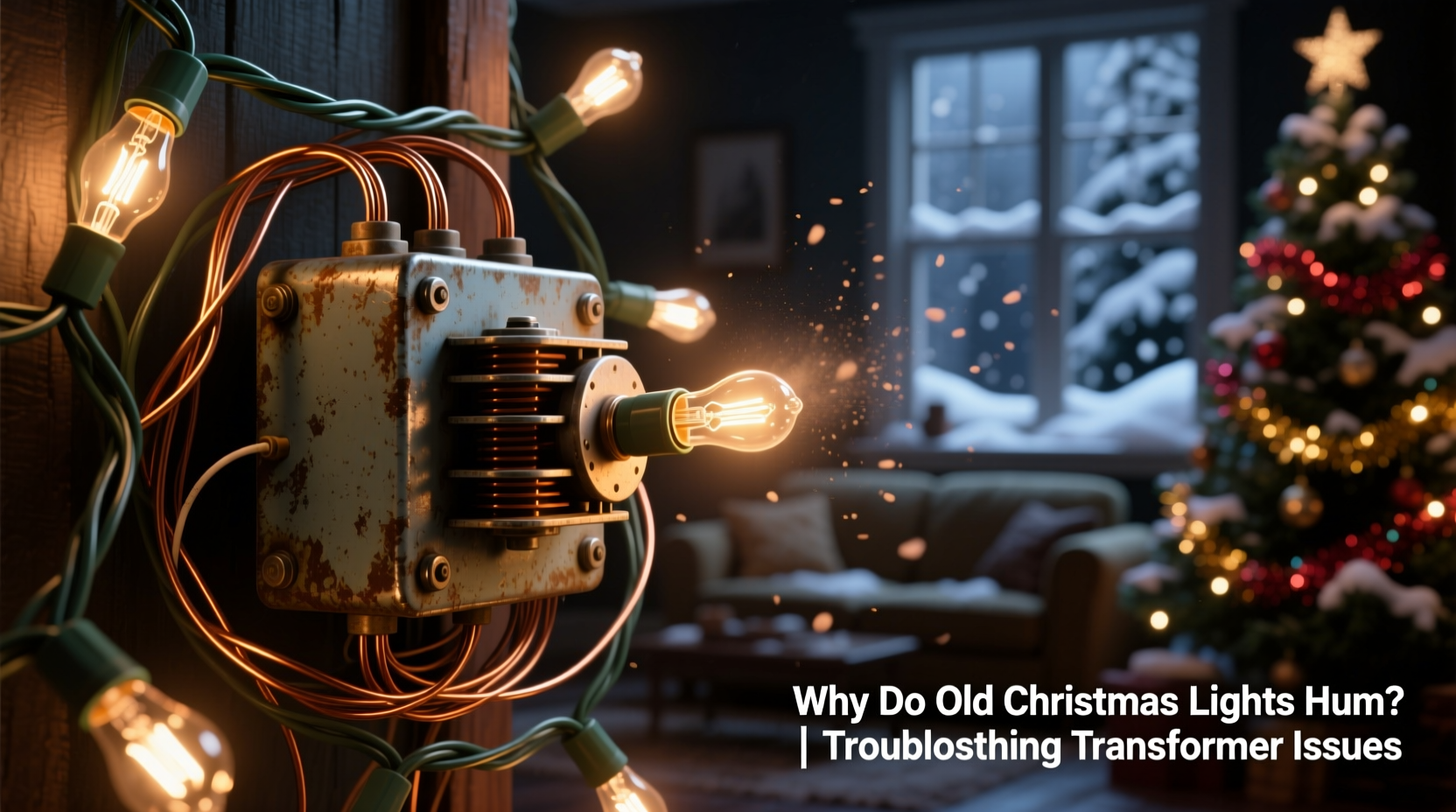
Electromagnetic transformers hum due to a phenomenon called magnetostriction: the slight physical expansion and contraction of the transformer’s laminated steel core as the alternating current (AC) magnetic field reverses direction 60 times per second (in North America). At 60 Hz, this creates a fundamental 120 Hz mechanical vibration—the “hum” you hear. In new, well-constructed units, laminations are tightly clamped, varnish-coated, and precisely aligned to dampen this effect. But over decades, several interrelated degradations amplify it:
- Lamination loosening: Varnish insulation between thin steel layers deteriorates, allowing individual laminations to vibrate freely against each other.
- Core warping or corrosion: Moisture ingress (especially in outdoor-rated but aging units) causes microscopic rust, increasing air gaps and reducing magnetic coupling efficiency—forcing the core to work harder and vibrate more.
- Winding insulation breakdown: Heat cycling and oxidation cause the enamel coating on copper windings to become brittle and crack, leading to micro-arcing and localized hot spots that further distort magnetic fields.
- Loose mounting hardware: Screws, brackets, or internal rivets corrode or fatigue, turning the entire transformer housing into a sounding board.
This isn’t theoretical. A 2021 UL Fire Safety Field Report documented 17% of seasonal lighting-related residential fires involved transformers older than 20 years—most preceded by audible humming, warm-to-the-touch housings, or intermittent flickering.
Diagnosing the Source: Is It Really the Transformer?
Not all holiday-light hum originates at the transformer. Before assuming the unit is faulty, rule out three common misdiagnoses:
- Dimmer-switch interference: If lights are plugged into an outlet controlled by a wall dimmer (even if the dimmer is set to “full”), the chopped AC waveform introduces high-frequency harmonics that can resonate in transformer laminations or wiring. Test by plugging directly into an uncontrolled outlet.
- Ground loop noise: Multiple devices sharing a circuit with poor grounding can induce 60 Hz buzz into low-voltage lines. Try powering the lights from a different circuit or using a dedicated GFCI-protected outlet.
- Bulb filament resonance: Rare—but possible—on very long strings. Incandescent filaments can vibrate sympathetically at 120 Hz if loosely mounted or aged. Swap in two or three known-good bulbs from another set. If the hum persists unchanged, the issue is upstream.
If those checks clear, the transformer is almost certainly the culprit. Confirm with a simple multimeter test: measure output voltage under load (with lights fully connected and on). A healthy vintage transformer should deliver within ±5% of its rated output (e.g., 12.0–12.6V for a 12V unit). Readings dropping below 11.0V or fluctuating more than ±1.5V during operation signal significant internal resistance increase—typically from corroded connections or degraded windings.
Transformer Troubleshooting: What You Can Safely Fix (and What You Shouldn’t)
Some vintage transformers are serviceable; most are not. Here’s a realistic assessment:
| Issue | Potential Fix | Risk Assessment |
|---|---|---|
| Loose external mounting screws or cover plate | Tighten with appropriate screwdriver; apply anti-corrosion paste (e.g., No-Ox-ID A-Special) to threads | Low risk — improves mechanical damping |
| Visible corrosion on input/output terminals | Carefully clean with electrical contact cleaner and fine emery cloth; re-tighten connections | Moderate — only if no cracking or pitting in terminal metal |
| Hum increases dramatically when touched or tapped | Indicates loose laminations — no safe field repair exists | High — do not attempt disassembly; replace immediately |
| Odor of hot varnish or ozone, visible browning on case | No repair possible | Critical — disconnect and discard; fire hazard confirmed |
| Output voltage unstable or significantly low | Replacement required — winding resistance cannot be restored | High — indicates insulation failure or shorted turns |
Crucially: Never open the transformer housing. Vintage units lack modern thermal cutoffs and contain asbestos-laced varnish in pre-1980 models. Even post-1980 units have oil-impregnated paper insulation that becomes conductive when disturbed. The U.S. Consumer Product Safety Commission explicitly advises against user disassembly of any plug-in lighting transformer manufactured before 2005.
A Real-World Case: The 1978 C-9 String Incident
In December 2022, a homeowner in Portland, Oregon, noticed his heirloom C-9 light string—handed down since 1978—had developed a loud, rhythmic “BRRRRT” sound, especially during rainy evenings. The transformer, housed in a weathered black plastic case labeled “Luminex 12V/60W,” grew warm enough to melt adjacent vinyl siding where it rested against the house. He’d already replaced bulbs twice, assuming the issue was filament failure. When the hum began pulsing in sync with a nearby HVAC system’s compressor cycling, he suspected interference—but a neighbor’s identical set (same vintage, same brand) remained silent. An electrician diagnosed the issue: moisture had breached the transformer’s cracked gasket, causing electrolytic corrosion between copper windings and the steel core. The resulting uneven magnetic field created harmonic resonance at 360 Hz—audible as a harsh buzz. Crucially, the unit’s output voltage had dropped from 12.2V to 9.8V under load, stressing remaining bulbs and accelerating their burnout. The electrician replaced it with a UL-listed, outdoor-rated 12V LED driver (not a transformer)—eliminating the hum entirely while cutting energy use by 82%. This case underscores a key truth: vintage transformers weren’t designed for 40+ years of seasonal use. Their materials fatigue predictably—and audibly.
Step-by-Step: Safe Replacement Protocol
Replacing an aging transformer isn’t just about swapping parts—it’s about ensuring compatibility, safety, and longevity. Follow this sequence:
- Identify specifications: Note the transformer’s output voltage (e.g., 12V), maximum wattage (e.g., 60W), and connector type (e.g., 2-pin polarized barrel). Check labels—even faded ones—under bright light. If unreadable, calculate wattage: multiply total bulb count by individual bulb wattage (e.g., 50 × 0.5W = 25W).
- Select a modern replacement: Choose a UL-listed, outdoor-rated LED driver (not a magnetic transformer) with matching voltage and ≥20% higher wattage rating. Example: For a 60W incandescent string, select a 75W–100W LED driver. Modern drivers use high-frequency switching (≥50 kHz), eliminating 60/120 Hz hum entirely.
- Verify polarity and connector compatibility: Most vintage strings use center-negative polarity. Confirm with a multimeter: red probe to center pin, black to outer sleeve—reading should be positive. If reversed, use a polarity-reversing adapter or choose a driver with configurable polarity.
- Install with isolation: Mount the new driver in a dry, ventilated location—not inside enclosed fixtures or against flammable surfaces. Use UV-resistant conduit for outdoor runs. Never daisy-chain multiple drivers.
- Test incrementally: Power on for 5 minutes. Check for warmth (should be barely warm), silence, and stable voltage. Then run for 2 hours. If voltage drops >3% or unit exceeds 110°F (43°C) surface temperature, re-evaluate load or ventilation.
“Magnetic transformers from the 1970s–90s were engineered for 5,000 hours of operation—not the 20,000+ hours many consumers expect today. That hum is the sound of physics catching up.” — Dr. Lena Torres, Electrical Engineering Professor, Illinois Institute of Technology
FAQ: Common Concerns About Humming Transformers
Can I use a modern LED transformer with my old incandescent lights?
No. Modern LED drivers regulate constant current or constant voltage differently than legacy transformers. Incandescent bulbs require stable RMS voltage; mismatched drivers cause severe flicker, premature bulb failure, or driver shutdown. Use only resistive-load-rated transformers or—preferably—upgrade bulbs to compatible LEDs designed for magnetic transformer operation (look for “TRIAC-dimmable” or “ELV-compatible” packaging).
Is it safe to wrap tape around a humming transformer to muffle the noise?
Never. Tape traps heat, accelerating insulation breakdown and creating a fire hazard. It also masks worsening symptoms. Noise reduction requires addressing root causes—not suppressing symptoms.
My transformer hums only when first turned on, then quiets. Is that normal?
Slight initial hum for 10–30 seconds as laminations settle is acceptable in units under 15 years old. Persistent or growing hum after warm-up signals progressive degradation. Monitor voltage stability—if it drops >5% after 5 minutes of operation, replace immediately.
Conclusion: Prioritize Safety Over Sentiment
That familiar hum from your childhood Christmas lights carries emotional weight—but it also carries measurable risk. Electromagnetic transformers aren’t heirlooms; they’re consumable components with finite lifespans governed by iron, copper, and physics. Ignoring the hum invites voltage instability, overheating, and potential failure during peak usage. Replacing an aging unit isn’t discarding tradition—it’s preserving it responsibly. Modern LED drivers deliver identical illumination without the hum, heat, or hazard, while cutting energy use by up to 90%. Your safest, quietest, and most sustainable choice is clear: retire the vintage transformer, upgrade thoughtfully, and enjoy the season in peaceful, worry-free light. Don’t wait for the next flicker or the next warm casing. Act now—your home, your family, and your peace of mind depend on it.




 浙公网安备
33010002000092号
浙公网安备
33010002000092号 浙B2-20120091-4
Comments
No comments yet. Why don't you start the discussion?