
Dreams have fascinated scientists, artists, and philosophers for centuries. One of the most intriguing aspects of dreaming is the variation in sensory experience—particularly when it comes to color. While many people report vivid, cinematic dreams filled with rich hues, others insist their dreams unfold entirely in black and white or shades of gray. This divergence raises a compelling question: Why do some people dream in color while others don’t? The answer lies at the intersection of neuroscience, psychology, memory, and even cultural influences.
Understanding this phenomenon requires more than just anecdotal evidence. It involves examining brain activity during sleep, the role of visual memory, generational shifts in media exposure, and individual differences in perception. Far from being a trivial curiosity, the presence or absence of color in dreams offers insight into how our brains process information, store memories, and construct reality—even in unconscious states.
The Science Behind Dreaming in Color
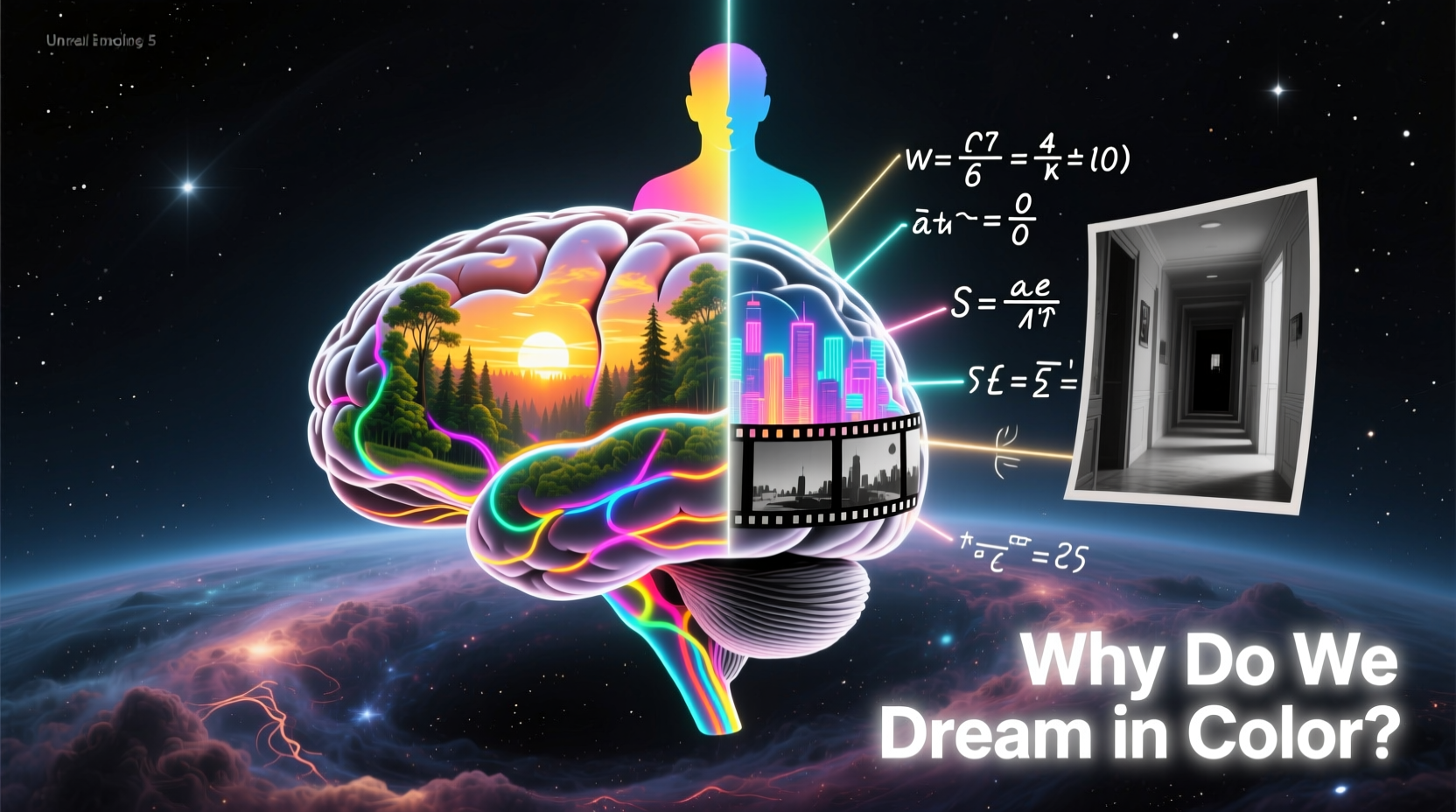
Dreams primarily occur during rapid eye movement (REM) sleep, a phase marked by heightened brain activity resembling wakefulness. During REM, the visual cortex—the part of the brain responsible for processing images—becomes highly active. Functional MRI studies show that regions involved in color perception, such as the V4 area of the visual cortex, are engaged during vivid dreaming.
This neural activation supports the idea that dreaming in color is not only possible but likely common. In fact, research suggests that most people experience colorful dreams. A 2008 study published in Consciousness and Cognition found that around 88% of participants reported dreaming in color when prompted under controlled conditions. However, when asked casually or retrospectively, many claim they rarely or never see color in dreams. This discrepancy points to a critical factor: memory recall.
The ability to remember whether a dream contained color depends on post-sleep awareness and cognitive reconstruction. Dreams are often fragmented upon waking, and details like color may fade quickly unless consciously noted. As Dr. Robert Stickgold, a leading sleep researcher at Harvard Medical School, explains:
“Color in dreams isn’t absent—it’s just forgotten. The brain reconstructs dream narratives after waking, and if color wasn’t salient, it gets edited out of the story we tell ourselves.” — Dr. Robert Stickgold, Cognitive Neuroscientist
In essence, the lack of reported color may reflect poor recollection rather than an actual absence of chromatic content during the dream itself.
Historical and Cultural Influences on Dream Imagery
One of the most fascinating theories about black-and-white dreaming ties back to the 20th century’s dominant visual media. Before the widespread adoption of color television in the 1950s and 60s, most people consumed films and broadcasts in monochrome. Researchers have observed a correlation between exposure to black-and-white media and self-reported dream imagery.
A landmark study conducted by Eva Murzyn at the University of Dundee compared two age groups: those who grew up with black-and-white television and those raised exclusively with color media. She found that older adults who had significant exposure to grayscale screens were significantly more likely to report dreaming in black and white—about 25%, compared to less than 5% in younger participants.
This suggests that early visual experiences shape not only waking perception but also the architecture of dreams. The brain may draw upon familiar visual templates when constructing dream scenes. If someone spent formative years watching grayscale content, their mind might default to similar palettes during unconscious visualization.
Neurological and Psychological Factors
Beyond cultural influences, individual neurological and psychological traits play a crucial role in dream coloration. People with stronger visual imagination or higher levels of visual creativity tend to report more vivid and colorful dreams. Artists, designers, and individuals trained in visual disciplines often describe exceptionally detailed dreamscapes with nuanced color gradients.
Conversely, certain neurological conditions can affect dream chromaticity. For example, patients with achromatopsia (a rare condition causing total color blindness) typically report dreaming in black and white, consistent with their waking visual experience. Similarly, brain injuries affecting the occipital lobe—the visual processing center—can alter dream content, including the presence of color.
Emotional state also influences dream characteristics. High emotional arousal during REM sleep, often linked to stress or trauma, can intensify sensory elements, including color saturation. On the other hand, depression has been associated with less vivid, more monochromatic dream reports. Some studies suggest antidepressants, particularly SSRIs, may dampen dream vividness and color intensity due to their effects on neurotransmitter systems involved in REM regulation.
Do Everyone Actually Dream in Color?
The prevailing scientific consensus is yes—most people likely dream in color, even if they don’t remember it. Modern neuroimaging and controlled dream-reporting experiments support this view. When participants are awakened during REM sleep and asked to describe their dreams in real time, descriptions frequently include specific colors (“a red car,” “a blue sky”), regardless of whether they normally claim to dream in color.
This implies that color is an inherent component of typical dream construction, much like spatial layout or motion. The brain doesn’t switch off its capacity for color processing during sleep; instead, it continues to simulate sensory experiences using stored visual data. What varies is not the dream itself, but the accuracy and detail of retrospective recall.
Memory consolidation during sleep further complicates the picture. As dreams transition from short-term to long-term memory, non-essential features—like background colors—are often stripped away. Only emotionally charged or symbolically significant elements remain prominent. Thus, someone might vividly recall running from a monster but fail to note whether the forest was green or gray.
Common Misconceptions About Black-and-White Dreams
- Misconception: Dreaming in black and white means you’re less creative.
Reality: Creativity does not determine dream color; memory and attention do. - Misconception: Older people dream in black and white because their eyes age.
Reality: Vision changes don’t affect internal imagery; media exposure history is a stronger predictor. - Misconception: Color dreams are more meaningful.
Reality: Meaning is derived from narrative and emotion, not chromatic content.
How to Enhance Dream Recall and Color Awareness
If you're curious about your own dream palette, improving recall can reveal patterns you hadn’t noticed before. Most people underestimate the richness of their dreams simply because they forget them within minutes of waking. With practice, however, dream recall—and the ability to detect color—can be dramatically improved.
- Set intention before sleep: Tell yourself, “I will remember my dreams and notice the colors.” This primes the subconscious to retain details.
- Wake up gradually: Avoid jolting awake with loud alarms. A slow transition preserves fragile dream fragments.
- Keep a notebook by your bed: Write down anything you remember immediately upon waking, even single words or emotions.
- Use descriptive language: Don’t just write “I was in a house”—ask yourself what color the walls were, what the lighting looked like.
- Practice mindfulness: Daily meditation enhances metacognition, which improves awareness during both waking and dreaming states.
Mini Case Study: Maria’s Shift from Monochrome to Full Spectrum
Maria, a 67-year-old retired teacher, always believed she dreamed in black and white. Growing up in the 1950s, her family’s first TV was grayscale, and she recalled watching newsreels and old movies without color well into adulthood. When asked about her dreams over the years, she consistently described them as “like old films.”
At age 65, Maria began keeping a dream journal after attending a workshop on lucid dreaming. Initially, her entries remained vague and lacked sensory detail. But after three weeks of consistent logging and morning reflection, she started noting subtle observations: “The flowers in the garden were pink,” “Her daughter’s dress was yellow.” Over time, her dream reports became increasingly colorful and immersive.
Maria realized her earlier belief in monochrome dreaming was based on incomplete memory, not actual experience. Her case illustrates how expectation and habit can override perception—even in subjective realms like dreaming.
Comparison: Factors Influencing Dream Color Perception
| Factor | Increases Color Dreams | Reduces Color Recall |
|---|---|---|
| Age Group | Youth (post-1970s media) | Older adults (black-and-white TV era) |
| Media Exposure | Frequent color film/TV viewing | High exposure to grayscale media |
| Cognitive Practice | Dream journaling, mindfulness | No reflection or recording |
| Emotional State | High arousal, strong emotions | Depression, emotional numbness |
| Medications | None or placebos | SSRIs, sedatives |
FAQ: Common Questions About Dream Color
Can blind people dream in color?
It depends on when they lost their vision. Individuals who had sight during early childhood often continue to experience visual dreams, including color, for years or even decades after blindness. Those born completely blind typically do not have visual dreams but may experience rich auditory, tactile, and spatial dream content.
Are lucid dreams more likely to be in color?
Yes. Lucid dreaming—where the dreamer becomes aware they are dreaming—is strongly associated with increased dream vividness and sensory clarity, including enhanced color perception. This is likely due to greater prefrontal cortex activation, which supports self-awareness and detailed mental imagery.
Does dreaming in black and white mean something is wrong?
No. While persistent loss of dream vividness could signal sleep disruption or mood disorders, occasional or consistent black-and-white dream reports are normal variations. They do not indicate neurological problems in most cases.
Conclusion: Embracing the Full Spectrum of the Mind
The variation in dream coloration reflects the complexity of human consciousness. Whether you remember your dreams in Technicolor or grayscale, the truth is likely more nuanced than memory suggests. Color exists in dreams not as a binary feature but as a fluid aspect of mental simulation—one shaped by biology, experience, and attention.
By cultivating better dream recall and challenging assumptions about what we “should” experience, we open a window into the unconscious mind’s creative power. The next time you wake from a dream, take a moment to explore its textures, tones, and tints. You might discover a world far more vibrant than you ever imagined.




 浙公网安备
33010002000092号
浙公网安备
33010002000092号 浙B2-20120091-4
Comments
No comments yet. Why don't you start the discussion?