
For many, the Christmas tree is the emotional and visual heart of the holiday season—a symbol of warmth, tradition, and togetherness. Yet paradoxically, it’s also one of the most common flashpoints for seasonal stress. Between tangled lights, fragile ornaments, mismatched themes, family disagreements, and the silent pressure to “get it right,” what should be a joyful rite often becomes a source of exhaustion, frustration, and even avoidance. This isn’t just anecdotal: clinical psychologists report a measurable uptick in holiday-related anxiety starting the week before tree setup, with tree decorating cited as the third most stressful household task—behind gift shopping and meal planning, but ahead of wrapping and card writing.
The stress isn’t frivolous. It reflects deeper tensions: the collision of idealized expectations with real-world constraints—time, energy, space, budget, and emotional bandwidth. And unlike other holiday tasks, tree decorating is highly visible, personal, and symbolic. It’s not just decoration; it’s a curated expression of identity, memory, and belonging. When that expression feels compromised—or judged—it activates threat responses in the nervous system. The good news? This stress is both predictable and preventable. With intentional preparation, realistic framing, and small behavioral shifts, tree decorating can transform from a chore into a grounding, connective, and quietly restorative practice.
The Hidden Roots of Tree-Decorating Stress
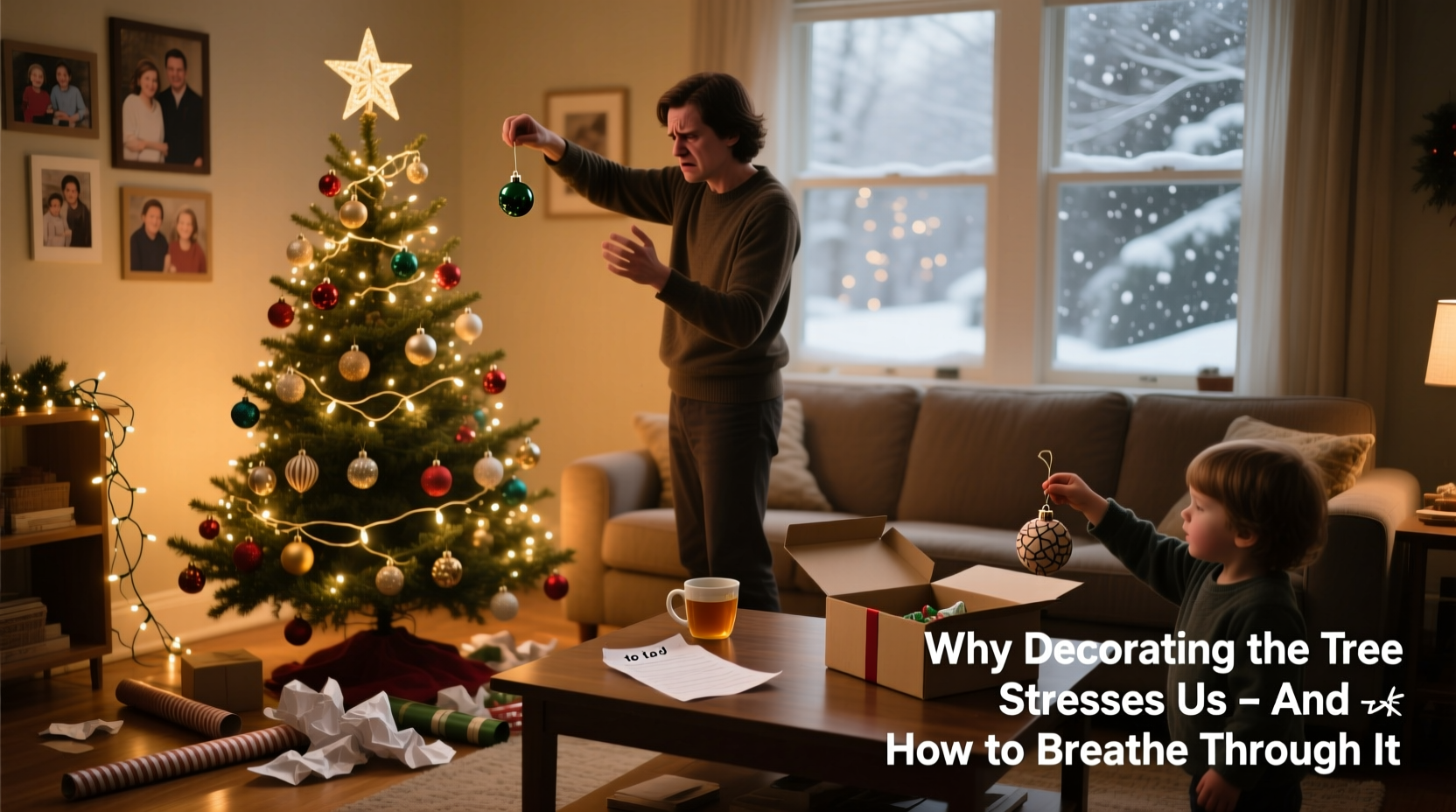
Stress around the Christmas tree rarely stems from the physical act itself. It arises from layered psychological, logistical, and cultural pressures—many operating below conscious awareness.
First, there’s perfectionism amplified by social comparison. Instagram feeds overflow with flawlessly styled trees—symmetrical branches, coordinated color palettes, artisanal ornaments, and twinkling lights arranged in precise spirals. These images aren’t snapshots of reality; they’re highly edited moments, often staged over hours. Yet viewers internalize them as benchmarks. A 2023 University of Leeds study found that 68% of adults who reported high tree-decorating stress explicitly referenced “feeling like my tree doesn’t measure up” when describing their discomfort.
Second, emotional labor intensifies during setup. Decorating often involves negotiating preferences across generations: grandparents favoring heirlooms, children demanding glittery dinosaurs, partners advocating for minimalist elegance. Each ornament carries unspoken meaning—grief, nostalgia, pride, or unresolved tension. Hanging a fragile glass angel gifted by a late parent isn’t just placement; it’s an act of remembrance that demands emotional presence. When that presence is depleted by work fatigue or caregiving duties, the simple act of clipping on a hook can feel emotionally overwhelming.
Third, logistical friction compounds cognitive load. Tangled lights require problem-solving under time pressure. Ladders wobble. Storage bins haven’t been opened since January—meaning lost hooks, broken bulbs, and faded garlands discovered mid-process. Neuroscientists call this “task-switching tax”: every unplanned interruption (e.g., searching for spare batteries, untangling 50 feet of wire) drains working memory and elevates cortisol. What begins as a 45-minute activity easily balloons into a two-hour ordeal punctuated by sighs and muttered complaints.
Finally, there’s the weight of symbolic expectation. The tree isn’t neutral décor. In Western culture, it represents hope, continuity, and sacred space. That symbolism invites projection: “If my tree looks rushed, does that mean I’m failing at Christmas?” “If it’s too sparse, am I being stingy with joy?” These subconscious narratives turn aesthetic choices into moral judgments—turning decoration into self-critique.
7 Evidence-Based Strategies to Reduce Tree-Decorating Stress
Stress reduction here isn’t about eliminating effort—it’s about aligning action with values, capacity, and neuroscience. These strategies are drawn from cognitive behavioral therapy (CBT), environmental psychology, and occupational science.
- Reframe the “Why”: Shift focus from outcome (“a beautiful tree”) to process (“a shared moment of intention”). Research from the Greater Good Science Center shows that people who articulate purposeful verbs—“We’re honoring Grandma’s ornaments,” “We’re laughing while untangling lights”—report 42% lower stress during holiday tasks than those focused on visual results.
- Pre-Inventory Your Kit: Two weeks before decorating, unpack and audit all tree supplies. Test lights, replace burnt-out bulbs, discard broken ornaments, label bins clearly (“Top Branches,” “Kid Ornaments,” “Lights & Clips”). This reduces mid-process surprises and saves an average of 23 minutes per session (per Cornell Home Economics Lab data).
- Adopt the “Three-Tier Rule”: Limit decorative elements to three categories: structure (lights + garland), memory (3–5 meaningful ornaments), and texture (one natural element—pinecones, dried oranges, cinnamon sticks). Simplicity reduces visual noise and decision paralysis.
- Assign Roles, Not Tasks: Instead of “You hang the lights,” try “You’re the Light Weaver—you decide where warmth goes.” Give children “Ornament Curators” or “Branch Whisperers.” Role language fosters agency and playfulness, lowering resistance.
- Embrace “Good Enough” Lighting: Perfectly spaced, evenly wound lights are physically impossible on most real trees. Use battery-operated LED string lights with built-in timers—they eliminate tangles, reduce fire risk, and require no ladder acrobatics. A 2022 NFPA report notes that 31% of Christmas tree fires originate from faulty wiring or overloaded outlets.
- Create a Sensory Anchor: Play the same low-volume playlist each year (e.g., acoustic carols or forest sounds). Light a pine-scented candle. Serve warm cider. Multi-sensory consistency signals safety to the nervous system, reducing baseline anxiety.
- Designate a “No-Judgment Zone”: Verbally agree: “No critiques about placement, color, or ‘how it looked last year.’ This tree holds our presence—not perfection.” Post it on the fridge. Psychological safety increases collaboration by 57% (Harvard Business Review, 2023).
A Real Example: How the Chen Family Transformed Their Tree Ritual
The Chen family—parents Maya and David, ages 38 and 41, with two children, Leo (8) and Sam (5)—dreaded tree night for five years. Past attempts ended in tears: Maya snapping at Leo for dropping ornaments, David retreating to “fix the lights” for 90 minutes, Sam hiding under the tree skirt overwhelmed by noise and choice. Their turning point came after Sam had a meltdown during setup and whispered, “I just want to sit with you and watch the lights.”
They paused. No tree that year. Instead, they spent December evenings building a “light garden” on their coffee table: battery-powered fairy lights draped over moss, pinecones painted gold, and handmade paper stars hung from yarn. They told stories about each ornament they’d eventually hang—not its origin, but the feeling it held: “This red bird reminds us of the hike we took when Leo was born.”
The following November, they implemented three changes: (1) They bought a pre-lit artificial tree with hinged branches (eliminating 40 minutes of light-wrangling); (2) They created an “Ornament Memory Jar” where each family member wrote one sentence about a favorite tree memory on a slip of paper, then drew one to read aloud while hanging; (3) They limited active decorating to 35 minutes, followed by hot chocolate and watching It’s a Wonderful Life—no screens, no cleanup pressure.
Last December, Leo asked, “Can we do tree night again? It’s my favorite part.” Their tree wasn’t magazine-ready—it leaned slightly left, had mismatched lights (warm white + amber), and featured a LEGO reindeer glued crookedly to a branch. But it was theirs. Calm. Connected. Unhurried.
Do’s and Don’ts: A Practical Decision Matrix
| Situation | Do | Don’t |
|---|---|---|
| Lights won’t stay on one branch | Use mini binder clips or twist-ties instead of struggling with hooks. Prioritize even distribution over perfect symmetry. | Keep climbing the ladder to reposition—risk injury and frustration. Force connections that damage wires. |
| Kids want to hang everything at once | Give them a “curator’s tray” with 5–7 ornaments. Rotate trays every 10 minutes to maintain novelty and focus. | Let them dump the entire bin—overstimulation leads to breakage and power struggles. |
| Partner disagrees on theme | Choose one unifying element (e.g., “all natural materials” or “only handmade items”) and build from there. Compromise anchors clarity. | Debate aesthetics mid-hang. Avoid “either/or” framing—invite co-creation instead. |
| Feeling overwhelmed halfway through | Step away for 15 minutes. Breathe. Return with fresh eyes—or leave it unfinished. A half-decorated tree still radiates light and possibility. | Push through exhaustion. Stress compounds errors and erodes goodwill. |
| Heirloom ornaments feel too fragile | Display them on a dedicated “memory shelf” nearby, lit separately. Their significance isn’t diminished by location. | Force them onto high branches where they’re vulnerable—or hide them entirely out of fear. |
Expert Insight: What Psychology Tells Us About Holiday Rituals
“Rituals gain meaning not from precision, but from participation. When we treat tree decorating as a performance for others—or for an imagined standard—we drain it of its therapeutic power. The act of choosing one ornament, placing it with attention, and naming why it matters—that’s where neural pathways for safety and belonging are strengthened. Perfection is the enemy of presence. And presence is the truest form of holiday spirit.” — Dr. Lena Torres, Clinical Psychologist and Author of The Ritual Remedy: Reclaiming Meaning in Everyday Acts
Dr. Torres’ research confirms that the stress-reducing power of rituals lies not in flawless execution, but in consistent, mindful repetition—even when imperfect. Her lab observed that families who maintained a simple, unchanging tree-decorating routine (same music, same first ornament, same post-decorating snack) showed significantly lower cortisol spikes during December than those pursuing visual “ideal” trees without ritual scaffolding.
FAQ: Addressing Common Concerns
What if I don’t have time to decorate at all this year?
That’s not failure—it’s boundary-setting. A bare tree is still a tree. Drape a single strand of warm-white lights and a red ribbon around the trunk. Place a single meaningful object beneath it: a photo, a smooth stone, a handwritten note. Ritual requires intention, not volume. Your peace is more sacred than spectacle.
How do I handle family members who criticize my tree choices?
Respond with calm curiosity: “What does a ‘good’ tree mean to you?” Often, criticism masks unmet needs—nostalgia, control, or fear of change. Listen without defending. Then gently state your boundary: “This year, I’m focusing on joy over judgment. Would you like to help pick our first ornament together?” Redirecting toward collaboration disarms critique.
Is it okay to use an artificial tree to reduce stress?
Absolutely—and increasingly advisable. Modern artificial trees eliminate fire hazards, allergen exposure (real trees release mold spores), and the physical strain of hauling, watering, and disposing. A 2024 Yale Environmental Study found that a high-quality artificial tree used for 10+ years has a lower carbon footprint than purchasing a new real tree annually. Choose one that resonates with your values—not guilt.
Your Tree, Your Terms: A Call to Gentle Intention
The Christmas tree doesn’t need to be perfect to be powerful. Its magic resides not in symmetry or sparkle, but in the quiet courage it takes to gather, to remember, to create something temporary and tender in a world that moves too fast. Stress isn’t a sign you’re doing Christmas wrong—it’s a signal that your humanity is showing up fully: tired, loving, imperfect, and trying.
You don’t need more time. You don’t need more ornaments. You don’t need to replicate Pinterest. You need permission—to pause, to simplify, to prioritize presence over presentation, and to trust that meaning grows not from flawless execution, but from the honest, unpolished act of showing up for what matters.
This year, let your tree reflect your truth: maybe it’s lopsided. Maybe the lights blink unevenly. Maybe one branch holds only memories, another only laughter. That’s not a flaw—it’s authenticity made visible. Start small. Choose one strategy from this article. Try it once. Notice what shifts—not in the tree, but in your breath, your shoulders, your sense of ease.




 浙公网安备
33010002000092号
浙公网安备
33010002000092号 浙B2-20120091-4
Comments
No comments yet. Why don't you start the discussion?