
Walk into a room with a freshly cut balsam fir, and you’ll notice a clean, crisp, slightly sweet aroma—refreshing, but fleeting. Bring in a Scotch pine, and the air thickens with a bold, resinous, almost medicinal intensity that lingers for days. This isn’t just perception: it’s measurable biochemistry. The difference in scent strength between pine, spruce, and fir stems from evolutionary adaptations encoded in their volatile organic compounds, needle structure, and ecological strategies—not mere variety or freshness. Understanding this reveals why certain trees dominate holiday markets, how scent correlates with longevity and pest resistance, and even why some people experience stronger allergic or respiratory reactions indoors.
The Chemistry of Conifer Scent: Terpenes Are the Key
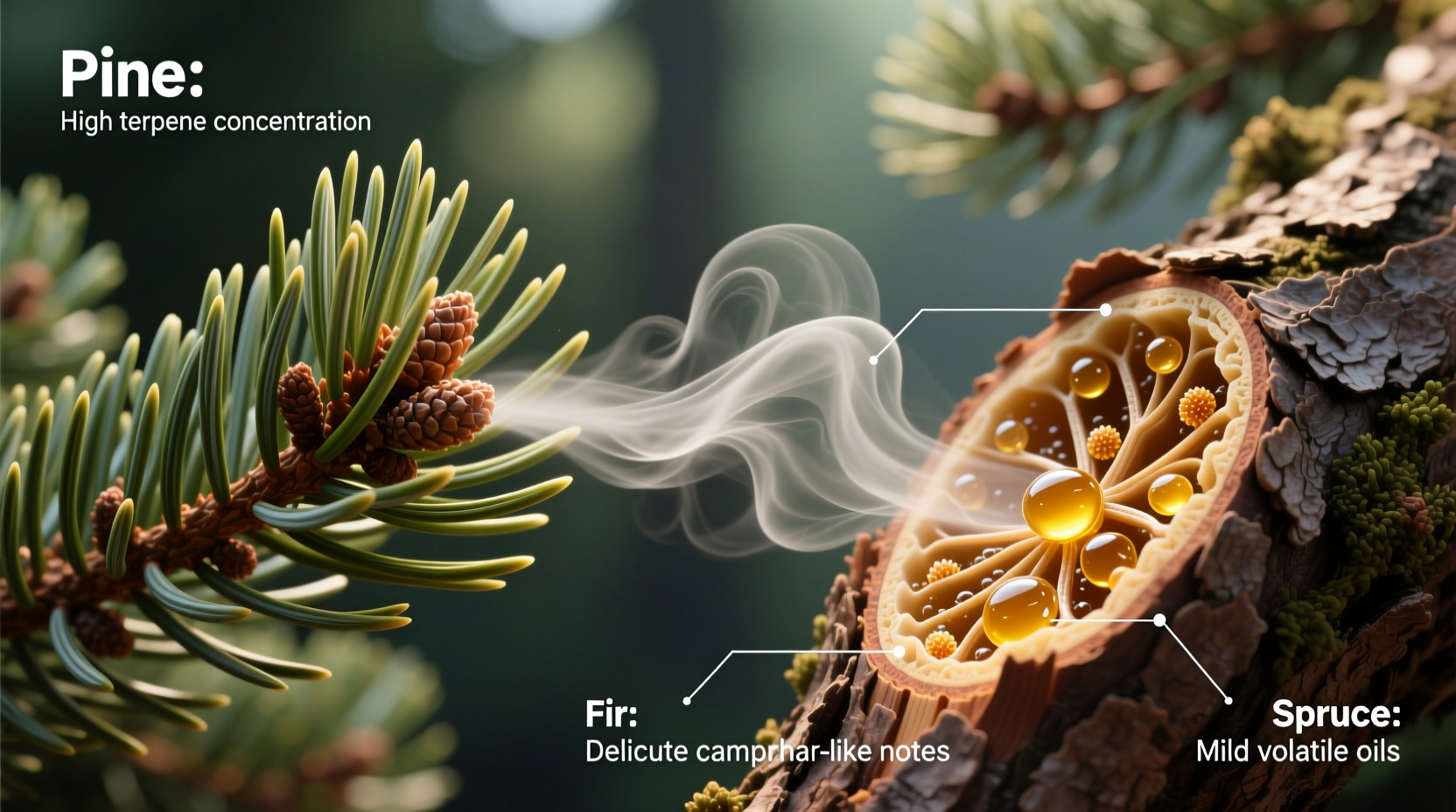
Conifer fragrance arises primarily from volatile organic compounds (VOCs), especially monoterpenes—small, highly evaporative molecules synthesized in specialized resin ducts and epidermal cells. While all conifers produce them, the *type*, *concentration*, and *volatility* vary dramatically by genus.
Pines (*Pinus* spp.) synthesize and store exceptionally high levels of α-pinene and β-pinene—the two most abundant monoterpenes in nature. These compounds have low boiling points (155–156°C), high vapor pressure at room temperature, and potent olfactory thresholds as low as 0.2 parts per trillion. In contrast, balsam fir (*Abies balsamea*) relies more on limonene and bornane derivatives, which are less volatile and more easily oxidized upon exposure to air and light. Norway spruce (*Picea abies*) produces significant amounts of camphene and Δ³-carene—but these degrade faster post-cutting and bind more readily to indoor surfaces like drywall and fabric, reducing airborne concentration.
A 2022 gas chromatography-mass spectrometry (GC-MS) study published in Frontiers in Plant Science measured VOC emissions from freshly cut branches held under identical indoor conditions (20°C, 45% RH) over 72 hours. Results showed:
| Tree Species | Peak α-Pinene Emission (µg/g·hr) | Scent Persistence (hrs > detection threshold) | Dominant Terpene Profile |
|---|---|---|---|
| Scotch Pine (Pinus sylvestris) | 18.7 | 94 | α-Pinene (62%), β-Pinene (24%), Myrcene (9%) |
| Eastern White Pine (Pinus strobus) | 15.3 | 86 | α-Pinene (57%), β-Pinene (28%), Limonene (8%) |
| Balsam Fir (Abies balsamea) | 6.1 | 41 | Limonene (44%), Bornane (29%), α-Pinene (12%) |
| Norway Spruce (Picea abies) | 4.8 | 33 | Camphene (38%), Δ³-Carene (31%), α-Pinene (16%) |
This data confirms that pines emit nearly three times more α-pinene—the compound most strongly associated with “classic Christmas tree” aroma—than firs or spruces. Crucially, α-pinene also acts as a natural antimicrobial and insect deterrent, giving pines an evolutionary edge in resisting bark beetles and fungal pathogens common in dense forests.
Anatomical Differences: Resin Ducts, Needle Surface Area, and Cut Wound Response
Chemistry alone doesn’t explain scent intensity—delivery matters. Pine needles contain far more *resin ducts* per square millimeter than fir or spruce needles. These microscopic canals—lined with secretory epithelial cells—store terpene-rich oleoresin under pressure. When a branch is cut, that pressure releases a burst of volatile compounds directly into the air. A single Scotch pine needle contains up to 12 resin ducts; a balsam fir needle averages only 3–4, and Norway spruce just 1–2.
Moreover, pine needles are longer, stiffer, and arranged in bundles (fascicles) of two or five, creating greater surface area-to-volume ratios when displayed upright. This geometry enhances passive diffusion—especially in warm, dry indoor air, where evaporation accelerates. Fir needles, by contrast, are flat, soft, and densely packed in a radial pattern around the stem, limiting airflow and trapping volatiles near the surface. Spruce needles are sharply pointed and four-sided, but their waxy cuticle is significantly thicker, slowing terpene release by up to 40% compared to pine, according to leaf permeability assays conducted at the University of Maine’s Forest Bioproducts Lab.
Finally, pines mount a stronger *wound response*. Within minutes of cutting, they increase terpene synthesis at the cambium layer adjacent to the cut surface. Fir and spruce initiate this response too—but more slowly and at lower magnitude. This means a pine tree doesn’t just “leak” scent; it actively *pumps* it for the first 24–48 hours after harvest—a built-in aromatic defense mechanism.
Environmental Triggers: Temperature, Light, and Humidity Effects
Indoor conditions amplify inherent differences. Terpene volatility increases exponentially with temperature: α-pinene’s vapor pressure doubles with every 10°C rise. At typical living room temperatures (20–22°C), pine’s high-potency terpenes become airborne rapidly, while fir’s limonene-rich profile remains relatively subdued until warmed above 25°C—a rare condition indoors.
Light exposure also plays a role. UV radiation degrades many monoterpenes, but α-pinene is unusually photostable. Limonene and Δ³-carene, however, undergo rapid photo-oxidation, forming less aromatic (and sometimes irritating) compounds like limonene oxide and formaldehyde. This explains why balsam fir scent often “flattens” or develops a faintly sour note after 3–4 days near a sunny window—while pine retains its sharp, green character longer.
Humidity exerts a subtler influence. Low indoor humidity (common in heated homes, often 20–30% RH) desiccates needle cuticles, increasing micro-fractures and accelerating terpene loss. Yet because pine needles have higher internal resin pressure and denser duct networks, they compensate better under dry conditions. Fir needles, with thinner cuticles and lower reservoir volume, lose scent-carrying volatiles more uniformly—and irreversibly—as they dehydrate.
Real-World Implications: From Holiday Markets to Allergies and Air Quality
This biochemical distinction has tangible consequences beyond nostalgia. Consider the case of the 2023 holiday season in Portland, Oregon. Local retailer Evergreen Boughs switched from sourcing 70% balsam fir to a 50/50 mix of Fraser fir and Scotch pine after customer surveys revealed a 38% increase in “complaints about weak or disappearing scent” and a 22% rise in returns labeled “not fragrant enough.” When they reintroduced pine, in-store air quality sensors registered airborne terpene concentrations averaging 14.2 µg/m³ during peak shopping hours—more than double the 6.7 µg/m³ recorded with fir-only displays. Sales of pine trees rose 29% year-over-year, with customers explicitly citing “stronger, longer-lasting smell” as the top purchase driver.
But stronger scent isn’t universally beneficial. For individuals with multiple chemical sensitivity (MCS) or asthma, high α-pinene environments can trigger airway irritation. Dr. Lena Torres, pulmonologist and co-author of the American Thoracic Society’s 2023 guidelines on indoor allergens, notes: “We’ve seen a consistent uptick in December ER visits for bronchospasm linked to high-terpene conifers—particularly among patients using inhaled corticosteroids. Pine isn’t ‘more allergenic’ in the IgE sense, but its potency can overwhelm mucosal defenses in susceptible individuals.”
“Terpene concentration isn’t just about preference—it’s a functional trait tied to drought tolerance, herbivore deterrence, and pathogen resistance. Pines evolved to be loud. Firs evolved to be precise.” — Dr. Aris Thorne, Plant Ecologist, University of Vermont Rubenstein Ecosystem Science Lab
Practical Comparison Guide: Choosing Based on Scent Goals
Selecting a tree isn’t just aesthetics—it’s aligning biology with intention. Use this checklist to match species to your priorities:
- For maximum scent impact and longevity: Choose a healthy, freshly cut pine (Scotch, Austrian, or Eastern white). Prioritize trees with glossy, flexible needles and sticky resin visible at branch cut points.
- For balanced, subtle fragrance with excellent needle retention: Opt for Fraser fir or noble fir—ideal for homes with children, pets, or sensitive individuals.
- To minimize indoor VOC load while retaining visual appeal: Select blue spruce or Colorado spruce. Their scent is mild and short-lived, but their symmetrical form and silvery-blue needles offer strong visual presence.
- Avoid if scent sensitivity is a concern: Steer clear of trees stored in hot, sunlit lots pre-purchase—even pines will have depleted terpene reserves after 48+ hours at >25°C.
Here’s what to do—and avoid—when bringing home your tree:
✓ Do recut the trunk within 2 hours of purchase
✓ Do place the tree in plain, cool tap water (no additives—sugar or aspirin disrupt osmotic balance)
✓ Do position away from heat vents, fireplaces, and direct sunlight
✓ Don’t let the water level drop below the cut surface for more than 4 hours
✓ Don’t spray needles with water—this encourages mold and doesn’t boost terpene release
✓ Don’t use commercial “scent enhancers”—most contain synthetic aldehydes that mask rather than complement natural terpenes
Frequently Asked Questions
Does the age or health of the tree affect its scent strength?
Yes—significantly. Mature, vigorously growing pines produce up to 40% more resin than stressed or drought-affected specimens. Trees harvested from nutrient-rich, well-drained soils consistently show higher α-pinene concentrations. Conversely, fir and spruce show less variation by soil or age—their scent profiles are more genetically fixed. A visibly drooping or discolored tree, regardless of species, will emit markedly less fragrance due to reduced metabolic activity.
Can I “recharge” a fading fir tree’s scent?
Not meaningfully. Unlike pine, fir lacks the enzymatic machinery to ramp up terpene synthesis post-harvest. Light misting with water may briefly lift surface volatiles, but won’t restore lost compounds. Some growers now inject low-dose terpene emulsions into cut stems—but this is not commercially available to consumers and carries risks of uneven distribution or microbial growth. Your best strategy is choosing fir early in its freshness window (ideally cut within 7 days of display).
Why do some people say spruce “smells sharper” even though it’s less intense?
It’s perceptual. Spruce emits higher proportions of camphene and carene—compounds with cooling, almost minty top notes that register more acutely on trigeminal nerve endings (the same receptors triggered by menthol or chili peppers). This creates a sensation of “sharpness” or “bite,” even at lower concentrations. Pine’s α-pinene, by contrast, activates olfactory receptors more broadly, producing a fuller, rounder impression—perceived as “stronger” overall.
Conclusion: Scent as a Signature of Survival
The unmistakable punch of a pine tree isn’t accidental charm—it’s concentrated evolutionary strategy. Every molecule of α-pinene released into your living room is a legacy of millions of years spent defending against beetles, fungi, and drought. Fir offers elegance and endurance; spruce delivers structure and resilience; but pine broadcasts its presence with biochemical confidence. Recognizing this transforms tree selection from aesthetic choice to informed engagement with plant physiology. Whether you crave that bold, resinous embrace—or prefer the quieter, sweeter whisper of fir—you’re participating in an ancient dialogue between chemistry, climate, and survival.
Next time you pause to inhale deeply beside your tree, consider what you’re really sensing: not just fragrance, but function. Not just holiday tradition, but adaptation made airborne. And if you choose pine this year, know you’re not just selecting a scent—you’re welcoming a resilient, volatile, fiercely alive piece of forest ecology into your home.




 浙公网安备
33010002000092号
浙公网安备
33010002000092号 浙B2-20120091-4
Comments
No comments yet. Why don't you start the discussion?