
In the age of connected living, \"smart villages\" — planned residential communities equipped with IoT (Internet of Things) infrastructure — are redefining convenience, sustainability, and communal experience. From automated lighting to climate-responsive street design, these developments promise seamless integration between technology and daily life. Yet, during festive seasons, one peculiar phenomenon often catches residents off guard: carols playing at odd hours, sometimes overlapping or out of sync across neighborhoods. Why does this happen? And what causes the apparent chaos in holiday music scheduling?
The answer lies not in faulty taste or poor playlist curation, but in technical inconsistencies within distributed audio systems, network latency, and misaligned synchronization protocols. While the intention is to create a joyful, immersive atmosphere, the execution can falter due to overlooked engineering details. This article explores the root causes behind unsynchronized carol playback in smart villages, examines real-world implications, and offers practical solutions for developers, property managers, and tech-savvy residents.
The Architecture of Smart Village Audio Systems
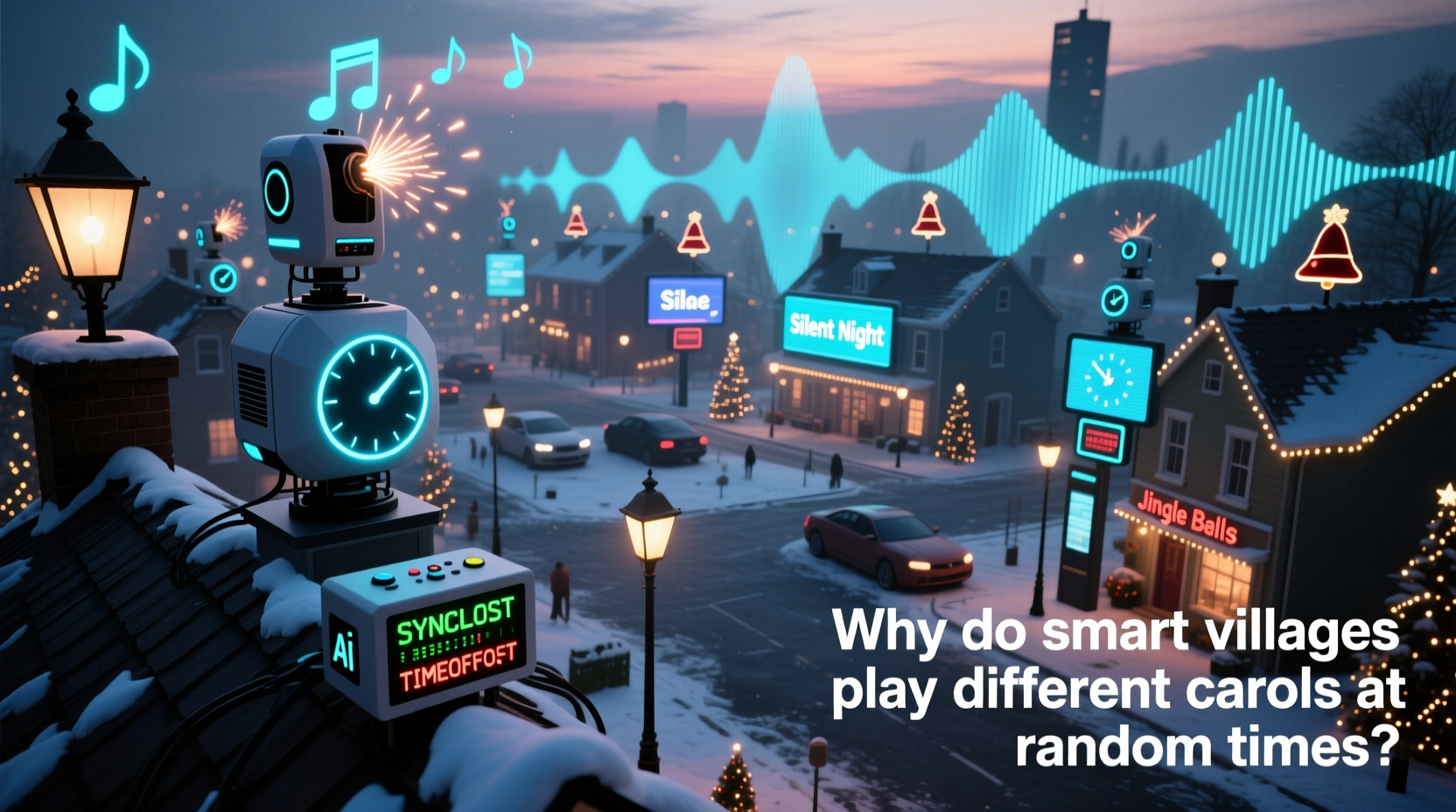
Smart villages typically deploy a networked public address (PA) system that integrates outdoor speakers, Wi-Fi connectivity, cloud-based scheduling software, and local controllers. These systems are designed to deliver announcements, background music, emergency alerts, and seasonal content like Christmas carols. Ideally, all zones — such as parks, plazas, residential blocks, and entry gates — should play the same track simultaneously.
However, most implementations use a hybrid model:
- Centralized Control: A master server hosts playlists and schedules, pushing updates via cloud platforms.
- Distributed Nodes: Local gateways receive instructions and manage individual speaker clusters.
- Edge Devices: Individual speakers or amplifiers with limited onboard processing power.
This architecture introduces multiple points where timing discrepancies can occur. Even a delay of a few hundred milliseconds becomes noticeable when sound travels through open air and overlaps across zones.
“Synchronization isn’t just about precision; it’s about perception. In shared acoustic environments, even small lags break immersion.” — Dr. Lena Torres, Acoustic Engineer at UrbanSound Labs
Common Causes of Syncing Issues in Holiday Music Playback
Several interrelated factors contribute to the seemingly random and disjointed carol experience in smart villages. Understanding these helps clarify why perfectly timed joy can turn into auditory confusion.
1. Network Latency and Packet Jitter
Data transmission over IP networks is rarely instantaneous. When a command to “play ‘Jingle Bells’” is sent from the central server, each node may receive it at slightly different times due to variable network congestion, signal strength, or routing inefficiencies. This results in staggered start times.
Moreover, audio streams themselves are transmitted in packets. If some arrive late or out of order (a condition known as *jitter*), local devices might buffer excessively or begin playback prematurely, creating phase differences between zones.
2. Clock Drift Across Devices
Many edge devices rely on internal clocks that aren’t regularly synchronized. Over time, these clocks drift apart — even by fractions of a second per day. Without a unified time source like NTP (Network Time Protocol), two devices receiving the same trigger could interpret “now” differently.
For example:
| Device | Clock Offset | Effect on Playback |
|---|---|---|
| Plaza Speaker Node | +0.1s | Begins early, leading echo |
| Park Zone Controller | -0.3s | Lags behind, muddying harmony |
| Main Gate Amplifier | Synchronized | Correct timing |
When combined, these offsets result in an uncoordinated soundscape — especially problematic for melodic content like choral arrangements requiring tight harmony.
3. Firmware and Software Version Fragmentation
In large-scale deployments, updating firmware across hundreds of nodes is challenging. Some units may run older versions of audio control software that handle triggers or buffering differently than newer models. This inconsistency leads to unpredictable behavior, including delayed responses or incorrect playlist indexing.
One resident reported hearing “Silent Night” while their neighbor heard “Santa Claus Is Coming to Town,” despite both being in adjacent zones scheduled for the same hour.
4. Manual Overrides and Local Triggers
Some smart village systems allow community staff or security personnel to manually trigger songs — perhaps for special events or guest arrivals. If these overrides bypass the central scheduler or fail to notify other nodes, they disrupt the global sequence.
Additionally, motion sensors or geofenced triggers (e.g., playing a carol when someone enters a plaza) can initiate playback independently, without regard for ongoing tracks elsewhere.
Mini Case Study: Winterlight Estates' December Dilemma
Winterlight Estates, a 500-home smart village in northern Germany, launched its first fully automated holiday soundscape in 2022. The plan was elegant: synchronized carols every evening from 5 PM to 9 PM, rotating through classics every 30 minutes.
By mid-December, complaints flooded the resident app. Users described “ghostly echoes,” “carol collisions,” and one memorable night where three different songs played simultaneously near the central fountain.
An investigation revealed:
- The east block’s gateway had lost NTP sync after a router reboot.
- Two parkside speakers were running outdated firmware that interpreted UTC timestamps incorrectly.
- A temporary override by maintenance staff to welcome VIP guests triggered an unscheduled loop of “We Wish You a Merry Christmas,” which never terminated properly.
After a system-wide reset, firmware update, and implementation of a centralized audio orchestration layer, synchronization improved dramatically. By New Year’s Eve, residents enjoyed a flawless live-streamed countdown with unified music.
Step-by-Step Guide to Fixing Carol Syncing Problems
For smart village administrators or AV integrators, resolving audio desynchronization requires a structured approach. Follow this timeline before and during festive seasons:
- Week 4 Before Holiday Season: Audit all audio hardware. Identify device models, firmware versions, and physical locations.
- Week 3: Deploy firmware updates uniformly. Use staged rollouts with rollback plans.
- Week 2: Synchronize all device clocks using NTP servers. Validate accuracy within ±10ms.
- Week 1: Test full-system playback using a short test track. Monitor from multiple zones with timestamped recordings.
- Daily During Festival: Monitor logs for manual overrides or failed triggers. Set up alerts for anomalies.
- Post-Event: Collect feedback and log discrepancies for next year’s improvements.
“We now treat holiday audio like a concert production — every millisecond counts.” — Markus Reinhardt, AV Manager at Winterlight Estates
Do’s and Don’ts of Smart Village Audio Management
To prevent future disruptions, follow best practices in planning and operation.
| Action | Recommendation |
|---|---|
| Use NTP for clock sync | DO: Ensure all nodes pull time from a reliable NTP source. |
| Allow unrestricted manual control | DON’T: Permit overrides without approval or logging. |
| Deploy mixed firmware versions | DON’T: Run old and new firmware concurrently. |
| Test only locally | DON’T: Assume local success means system-wide performance. |
| Implement audio zoning | DO: Group speakers logically and assign master-slave relationships. |
| Monitor system health | DO: Use dashboards to track playback status and errors in real time. |
FAQ
Why don't smart villages use Bluetooth or standard streaming apps?
Bluetooth has limited range and supports only a few devices at once. Streaming services like Spotify aren’t built for synchronized multi-zone outdoor deployment. Custom IP-based systems offer better scalability and control.
Can residents request specific carols?
Some villages allow curated requests via apps, but these must go through moderation to avoid conflicts. Unsolicited uploads or direct access are typically blocked for security and consistency reasons.
Is there a way to fix sync issues in real time?
Advanced systems use dynamic compensation: if a node detects it's out of sync, it adjusts playback speed slightly (<0.5%) or pauses briefly to realign. However, this requires low-latency feedback loops and robust monitoring.
Tips for Residents: How to Improve Your Experience
While systemic fixes require technical intervention, residents can take steps to reduce frustration and contribute to better outcomes.
- Download the village’s official app to view the current music schedule.
- Avoid using personal speakers outdoors during scheduled carol hours to prevent acoustic interference.
- Join the community AV advisory group if available — your input can shape next year’s setup.
Looking Ahead: The Future of Synchronized Smart Soundscapes
The challenges seen today are paving the way for smarter, more resilient audio ecosystems. Emerging solutions include:
- Time-Sensitive Networking (TSN): An IEEE standard enabling microsecond-level synchronization over Ethernet.
- AI-Powered Orchestration: Machine learning models predict load patterns and preemptively adjust buffers.
- Beamforming Speakers: Directional audio that minimizes bleed between zones, reducing perceptual overlap.
- Decentralized Triggers with Consensus: Nodes vote on playback commands using blockchain-inspired logic to prevent rogue activations.
As smart villages evolve, so too will expectations for sensory harmony. Festive music is more than background noise — it’s part of collective memory and emotional connection. Getting it right enhances quality of life; getting it wrong risks alienating the very people these communities aim to serve.
Conclusion
The sight of snow-lit trees accompanied by harmonious carols is a hallmark of the season. In smart villages, achieving that moment requires more than good intentions — it demands precise engineering, vigilant maintenance, and coordinated management. The randomness some experience isn’t whimsy; it’s a symptom of deeper technical gaps in how we integrate sound into intelligent environments.
By addressing syncing issues through disciplined updates, proper timekeeping, and thoughtful design, communities can transform fragmented noise into unified joy. Whether you're managing a smart village or simply enjoying its ambiance, remember: perfect harmony starts with a single, well-timed note.




 浙公网安备
33010002000092号
浙公网安备
33010002000092号 浙B2-20120091-4
Comments
No comments yet. Why don't you start the discussion?