
Every December, a quiet drama unfolds in homes across the Northern Hemisphere: a freshly erected Christmas tree stands tall—ornaments gleaming, lights twinkling—while nearby, a cat watches with detached curiosity… or launches a full-scale assault. One feline may nap peacefully three feet from the trunk; another scales it like Everest, sending tinsel flying and pine needles scattering. This isn’t random mischief—it’s behavior rooted in neurobiology, early experience, environmental context, and individual temperament. Understanding *why* reveals far more than holiday quirks: it illuminates how cats perceive novelty, assess risk, express play drive, and negotiate their place in a human-centered world.
The Core Drivers: Instinct, Temperament, and Learning
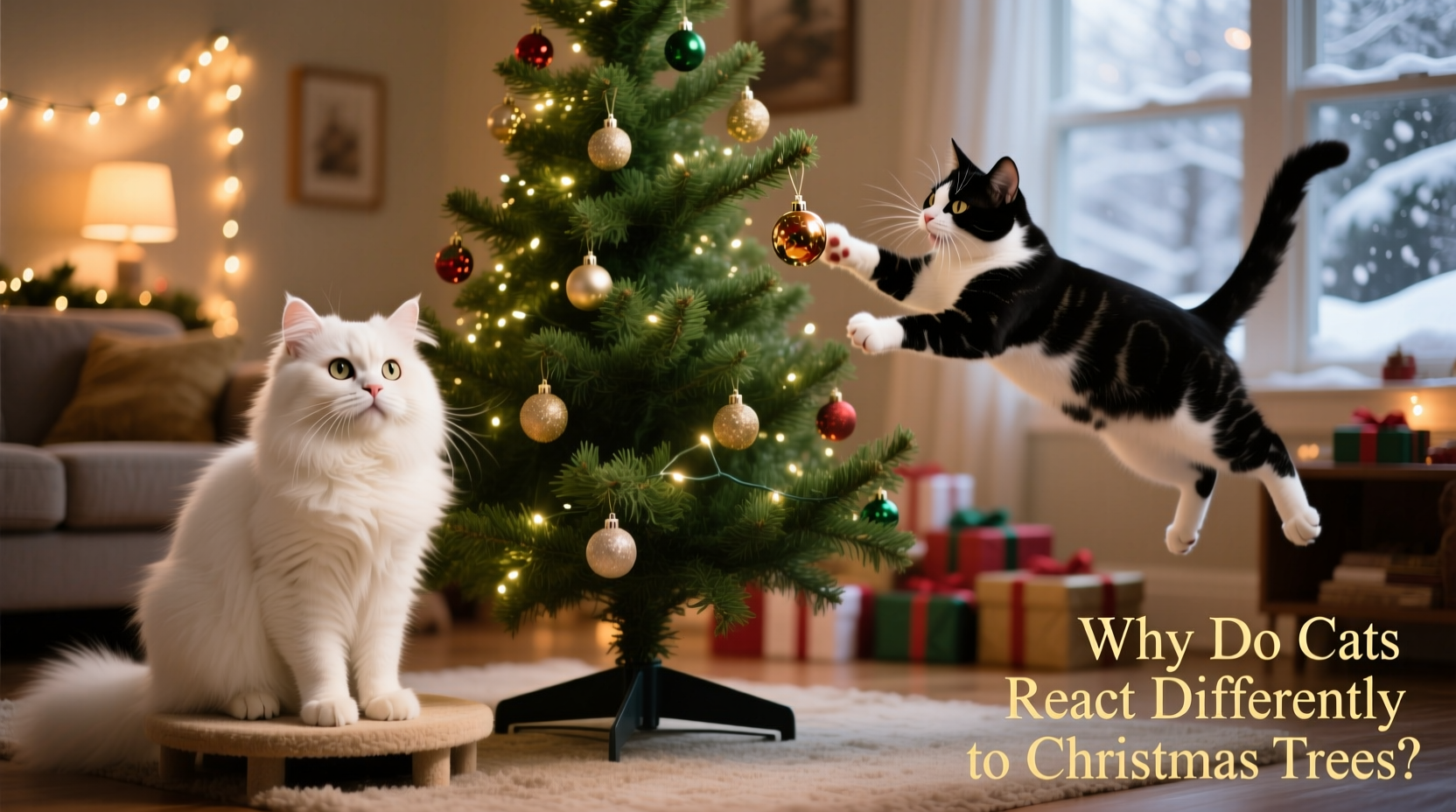
Cats don’t respond to Christmas trees as “holiday decor.” They interpret them as dynamic environmental stimuli—objects that move (when brushed), emit novel scents (pine resin, dust, adhesive), reflect light unpredictably, and offer vertical structure. Three interlocking factors determine whether a cat engages, observes, or avoids:
- Sensory sensitivity: Cats with heightened auditory or visual processing may find blinking lights overstimulating—or fascinating. Those with lower tactile thresholds may recoil from sticky ornaments or sharp pine needles.
- Temperamental baseline: Research published in Applied Animal Behaviour Science identifies consistent feline personality dimensions—including “reactivity,” “sociability,” and “curiosity.” A highly curious, low-reactive cat is statistically more likely to investigate; a cautious, high-reactive one may freeze or retreat.
- Early socialization window (2–7 weeks): Kittens exposed to varied textures, heights, and moving objects during this period develop broader behavioral flexibility. A cat who never climbed a real tree branch as a kitten may lack the motor confidence—or interest—to scale a 6-foot fir.
This explains why two siblings raised in the same home can diverge dramatically: one spends December perched serenely on the tree stand; the other treats every ornament as a live grenade needing immediate disarmament.
Why Some Cats Ignore the Tree: The Calm Observers
Ignoring the tree isn’t apathy—it’s often strategic assessment. These cats operate from a position of security and predictability. Their environment already offers sufficient enrichment: sunbeams for napping, shelves for surveying, puzzle feeders for mental engagement. The tree adds little novelty value. More importantly, they’ve learned through past experience that trees don’t yield food, affection, or play—unless humans intervene.
Dr. Sarah L. Krichbaum, veterinary behaviorist and co-author of Feline Ethology in Human Homes, notes:
“A cat who ignores the tree isn’t ‘bored’—they’re exercising selective attention. Their brain has categorized it as non-relevant. That’s not disinterest; it’s cognitive efficiency.”
These cats typically display traits like:
- Consistent daily routines (feeding, play, sleep)
- Preference for elevated but stable perches (bookshelves, cat trees with wide bases)
- Minimal startle response to sudden noises or movements
- History of calm adaptation to household changes (new furniture, visitors, renovations)
For them, the tree remains background scenery—not a challenge, invitation, or threat.
Why Others Attack: The Climbers, Knockers, and Ornament Hunters
“Attack” is a misnomer. What looks like aggression is usually redirected predatory energy, exploratory play, or stress-driven displacement behavior. Let’s break down the common patterns:
| Behavior Pattern | Primary Motivation | Underlying Need | Risk Level |
|---|---|---|---|
| Vertical climbing | Instinctual need for height + novelty of new structure | Environmental enrichment, sensory input (texture, scent, movement) | Moderate (fall risk, broken ornaments) |
| Swatting ornaments | Prey drive triggered by reflective surfaces & dangling motion | Unmet play needs, under-stimulation | High (choking hazard, glass shards, electrocution) |
| Chewing pine needles/bark | Scent attraction + oral exploration (especially in kittens) | Teething relief, mineral-seeking, or boredom | High (gastrointestinal upset, toxicity) |
| Dragging tinsel/ribbons | Object play mimicking prey capture | Lack of appropriate outlets for pouncing/dragging behaviors | Critical (intestinal obstruction if ingested) |
Note: No healthy cat “hates” the tree. Even destructive behavior signals unmet needs—not malice. Ignoring the behavior or punishing it only increases anxiety and erodes trust.
Actionable Strategies: Prevention, Redirection, and Safety
You can’t change your cat’s genetics—but you *can* shape their environment to support calmer, safer interactions. Start before the tree goes up. Timing matters: introduce the tree gradually, not as a surprise centerpiece.
A 5-Step Tree Introduction Protocol
- Week 1 (Pre-Tree): Increase daily interactive play sessions to 15 minutes twice daily using wand toys that mimic birds or rodents. Exhaust excess energy *before* the tree arrives.
- Week 2 (Tree Setup Day): Assemble the bare tree (no lights or ornaments) in its final location. Let your cat explore at their own pace. Place familiar bedding or toys near the base—not underneath—to create positive associations.
- Week 3 (Lights Only): Add lights *after dark*, using warm-white LEDs (cooler blue tones can overstimulate). Keep them on for short intervals (30 mins), then off. Observe reactions—dilated pupils, flattened ears, or tail flicking signal discomfort.
- Week 4 (Ornaments): Introduce ornaments slowly—start with 3–5 large, unbreakable, matte-finish balls placed high on sturdy branches. Avoid anything small, shiny, or dangling below eye level.
- Ongoing: Rotate enrichment: alternate between a “tree zone” (with safe, supervised access) and a “calm zone” (quiet room with cozy bed, food puzzle, and pheromone diffuser).
Mini Case Study: Luna vs. Jasper
Luna, a 4-year-old domestic shorthair adopted from a rural shelter at 6 months, grew up with outdoor access and abundant climbing structures. Her first Christmas tree was treated as a new territory—she circled it, sniffed the trunk, then settled on the lowest branch to observe. She never knocked anything down. Her owner reinforced calm behavior with quiet praise and occasional treats offered *away* from the tree—never as a reward for approaching it.
Jasper, a 2-year-old rescue with unknown early history, arrived timid and under-socialized. His first tree triggered intense ambivalence: he’d stare from across the room, then dart in to bat at low-hanging ribbons, then flee. His owner initially tried deterrents (citrus spray, double-sided tape on the stand)—which increased his anxiety. Switching to the 5-step protocol above, plus daily clicker training for “touch” and “leave-it” cues, transformed his relationship with the tree in 11 days. By Christmas Eve, he sat beside it grooming himself—no treats, no pressure, just presence.
Their stories underscore a critical truth: behavior is communication. Luna’s confidence reflected security built over time. Jasper’s reactivity signaled unresolved uncertainty. Neither was “good” or “bad”—they were responding authentically to their internal wiring and external conditions.
What Not to Do: Common Missteps and Safer Alternatives
Well-intentioned interventions often backfire. Here’s what to avoid—and what works instead:
- ❌ Spraying with water or citrus: Creates negative association with the *area*, not the behavior—and may generalize to fear of all holiday scents or sounds.
- ❌ Using sticky tape or aluminum foil on the stand: May deter climbing temporarily but teaches avoidance through discomfort—not understanding. Also risks paw pad irritation.
- ❌ Isolating the cat during holidays: Disrupts routine, increases stress, and denies opportunity to adapt gradually.
- ❌ Punishing after the fact: Cats cannot link delayed consequences to actions. Yelling or grabbing triggers fear, not learning.
✅ Better alternatives:
- Provide a dedicated “cat tree” *near* the Christmas tree—identical height, similar texture (if possible), with hanging toys that satisfy the swatting impulse safely.
- Use motion-activated air canisters *only* as a last resort—and only when you’re present to redirect immediately to an approved activity (e.g., “Look—here’s a feather toy!”).
- Install a baby gate to restrict access to the tree zone *during unsupervised hours*, while allowing visual access and gradual desensitization.
- Apply Feliway Classic diffusers in rooms adjacent to the tree—studies show reduced stress-related marking and over-grooming in 72% of multi-cat households using them consistently.
FAQ
Is it normal for my kitten to chew pine needles?
Yes—but it’s unsafe. Pine oils can irritate the mouth and gastrointestinal tract; ingestion may cause vomiting or lethargy. Provide safe alternatives: cat grass (wheatgrass or oat grass), frozen green beans, or chew-resistant rubber toys. If chewing persists beyond 8 weeks, consult your vet to rule out nutritional deficiencies or pica.
Will my cat ever stop being obsessed with the tree?
Most cats’ intensity peaks in the first 1–2 weeks, then declines as novelty fades—especially with consistent enrichment and predictable routines. Obsession lasting longer than 3 weeks may indicate underlying anxiety or insufficient daily stimulation. Track behavior: if your cat shows signs like excessive vocalization, hiding, or litter box avoidance *only* around the tree, consider a veterinary behavior consultation.
Are artificial trees safer than real ones?
Not inherently. While real trees pose ingestion and toxicity risks, artificial trees introduce hazards like plastic needle shedding, wire frame exposure, and static electricity that attracts loose fur and dust—triggering sneezing or respiratory irritation in sensitive cats. Choose a PVC-free, flame-retardant artificial tree with tightly secured branches and no exposed wiring. Always inspect daily for wear.
Conclusion
The Christmas tree is more than décor—it’s a litmus test for your cat’s sense of safety, stimulation, and autonomy. Whether your feline sits like a silent guardian or launches acrobatic raids, their behavior holds valuable insight into their inner world. There’s no universal “right” response, only opportunities to listen more closely, adjust more thoughtfully, and nurture deeper mutual understanding. This season, resist the urge to force compliance. Instead, meet your cat where they are: offer choice, honor their boundaries, and celebrate the quiet moments of shared presence—even if that presence happens to be six feet up a Douglas fir, tail curled neatly around a branch.




 浙公网安备
33010002000092号
浙公网安备
33010002000092号 浙B2-20120091-4
Comments
No comments yet. Why don't you start the discussion?