
That faint, persistent hum emanating from your holiday light display isn’t just background noise—it’s an audible clue pointing to specific electrical or design characteristics. Unlike the sharp crackle of a failing outlet or the loud buzz of a malfunctioning transformer, this soft buzzing is often subtle enough to go unnoticed until you’re sitting quietly in the living room on a December evening. Yet it signals something real: energy conversion, component vibration, or marginal design choices interacting with household electricity. Understanding its origin isn’t about chasing perfection—it’s about safety awareness, longevity planning, and informed purchasing decisions. This article breaks down the physics, components, and real-world conditions behind the phenomenon—not as abstract theory, but as practical diagnostics you can apply before, during, and after the holiday season.
The Core Physics: Why Electricity Can Make Noise
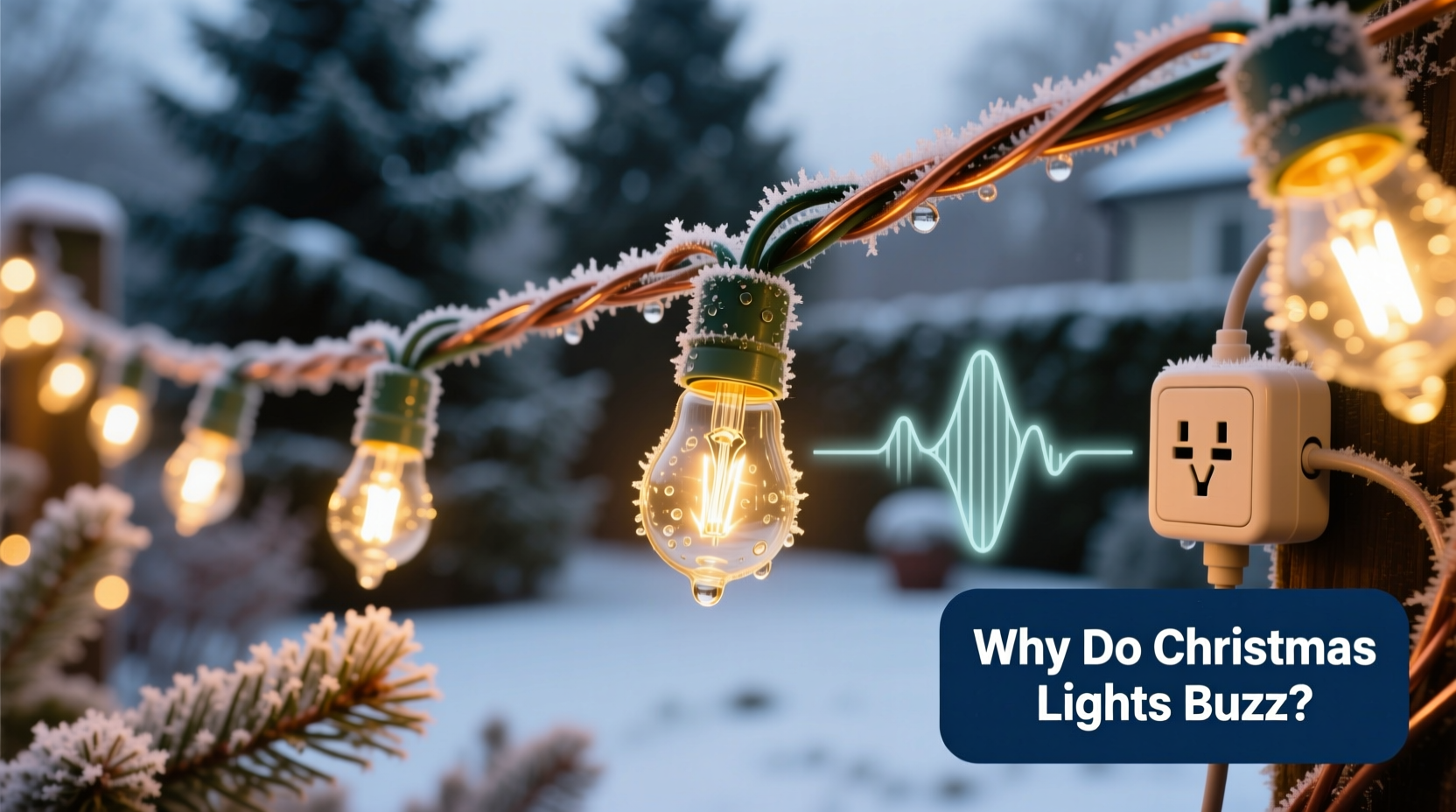
Buzzing in Christmas lights originates from electromechanical vibration—specifically, the 60 Hz (or 50 Hz outside North America) alternating current (AC) that powers most residential lighting. When AC flows through certain components, it creates oscillating magnetic fields that cause physical movement at the same frequency—or at harmonics (multiples) thereof. Human hearing detects vibrations between 20 Hz and 20,000 Hz; 60 Hz sits comfortably within our lower threshold, and its second harmonic (120 Hz) is even more perceptible as a low, steady hum.
This effect is most pronounced where magnetic forces interact with loose or flexible parts: transformer laminations, dimmer switch triacs, or even thin-gauge wires inside LED driver circuits. Incandescent mini-lights, for example, rarely buzz because their filaments heat and cool with each cycle—but they don’t vibrate audibly. Modern LED strings, however, rely on switching power supplies that pulse current thousands of times per second. Poorly shielded or low-cost drivers may allow electromagnetic interference (EMI) to couple into nearby conductors—or induce micro-vibrations in ceramic capacitors or inductor cores—producing that telltale soft buzz.
Four Primary Sources—and How to Isolate Each
Identifying the source requires systematic elimination—not guesswork. Start at the power source and work toward the lights themselves. Below are the four most common culprits, ranked by frequency of occurrence in modern installations:
- Dimmer switches or smart plug controllers — Especially older or non-LED-rated models that chop the AC waveform aggressively.
- Low-quality LED driver circuitry — Found in budget string lights where cost-cutting compromises capacitor quality and shielding.
- Transformer hum in C7/C9 incandescent sets — Particularly in vintage-style replacement bulbs or pre-lit trees using magnetic step-down transformers.
- Loose connections or corroded sockets — Not a direct cause of buzzing, but arcing at poor contacts can generate intermittent buzzing or sizzling sounds—often accompanied by flickering or localized warmth.
Crucially, buzzing *alone* doesn’t indicate danger—but it does signal inefficiency or stress. As Dr. Lena Torres, Electrical Safety Researcher at the National Fire Protection Association, explains:
“Sustained audible buzzing in lighting circuits often reflects energy loss as heat or vibration. While not inherently hazardous, it correlates strongly with premature component failure—especially in drivers rated for 25,000 hours but failing in under 3,000. That hum is the sound of wasted electrons.” — Dr. Lena Torres, NFPA Electrical Safety Researcher
Incandescent vs. LED: Design Differences That Shape Sound
It’s tempting to assume all buzzing comes from LEDs—but incandescent sets contribute significantly, especially in traditional outdoor displays. The difference lies in *how* each technology interfaces with AC power:
| Feature | Incandescent Mini-Lights (Series-Wired) | Modern LED Strings (Parallel or Constant-Current) | High-End Commercial LED (PWM-Optimized) |
|---|---|---|---|
| Power Delivery | Direct AC; no internal electronics | AC-to-DC conversion via switching driver | Dedicated constant-current ICs with EMI filtering |
| Buzz Source | Rare—only if used with magnetic transformer or dimmer | Driver coil/capacitor vibration; PWM frequency bleed | Negligible—shielded inductors, soft-switching topologies |
| Typical Buzz Frequency | 60 Hz or 120 Hz (if transformer-based) | 1–20 kHz (audible whine), plus 120 Hz ripple | Inaudible (>25 kHz) or absent |
| Warranty Indicator | Not applicable—filament burnout is silent | Common in sub-$15 strings; rare above $25 | Virtually absent in UL-listed commercial-grade products |
Note: “Mini-lights” refers to the classic 2.5-volt bulb sets wired in series (20–50 bulbs per string). Their simplicity makes them acoustically quiet—unless paired with incompatible controls. Meanwhile, many $8–$12 LED strings use generic “universal” drivers built around unshielded toroidal inductors and electrolytic capacitors prone to microphonic resonance. You’re not hearing electricity—you’re hearing cheap materials vibrating in time with it.
Real-World Diagnostic Timeline: A Step-by-Step Approach
Follow this sequence to isolate the source—no tools required beyond observation, patience, and a working outlet tester:
- Unplug everything. Confirm silence. If buzzing persists, the source is elsewhere (e.g., HVAC system or refrigerator compressor).
- Plug in only the power cord—no lights attached. If buzzing continues, the issue is the controller, smart plug, or outlet wiring.
- Add one light string at a time. Wait 30 seconds after connecting each. Note whether buzz begins, intensifies, or changes tone.
- Swap outlets. Plug the suspect string into a different circuit—preferably one without dimmers or GFCI breakers. If buzz disappears, the original circuit has noise or voltage instability.
- Test with battery-powered lights. Use a known-quiet USB-powered LED garland on the same shelf or tree branch. If it remains silent while adjacent strings buzz, the issue is localized to those strings’ drivers—not ambient EMF.
- Check temperature. After 15 minutes of operation, gently touch the plug end and any visible driver housing. Warmth is normal; heat that makes you pull your finger away in under 2 seconds indicates excessive resistance or failing components.
This timeline takes under 10 minutes but yields definitive answers. Most homeowners stop at step three—assuming “all lights buzz”—but isolating the exact string reveals whether the problem is systemic (e.g., whole-house dimmer incompatibility) or unit-specific (a single defective batch).
Mini Case Study: The Suburban Porch Display That Wouldn’t Quiet Down
In late November 2023, Mark R., a mechanical engineer in Ohio, installed new LED icicle lights along his front porch eaves. He’d purchased two identical 24-foot strings online—both labeled “UL Listed, 120V, 4.8W.” One string buzzed softly but constantly; the other was silent. Confused, he tried swapping outlets, using extension cords, and even wrapping the noisy string’s plug in aluminum foil (a misguided attempt at shielding). Nothing changed.
Applying the diagnostic timeline above, he discovered the buzz began only when the string was connected to his porch’s GFCI-protected outlet—which also powered his garage door opener. Further testing revealed the opener’s motor generated brief voltage spikes during activation. The noisy string’s driver lacked transient voltage suppression (TVS) diodes; the silent one included them. He returned the buzzing set and confirmed the replacement had identical packaging but a different manufacturing date code—indicating a mid-season supplier change. His takeaway? “Same box, same specs, different internals. The buzz wasn’t a flaw—it was a fingerprint of component sourcing.”
Do’s and Don’ts When Addressing Light Buzz
Once you’ve identified the source, avoid common missteps that compromise safety or void warranties:
- DO replace buzzing strings covered under warranty—especially if purchased from major retailers with clear return policies.
- DO use LED-compatible dimmers (e.g., Lutron Diva DVCL-153P) instead of retrofitting old incandescent models.
- DO inspect plugs and sockets for discoloration, melting, or brittleness—signs of thermal stress that precede failure.
- DON’T wrap buzzing drivers in tape, foam, or insulation to “muffle” sound—this traps heat and accelerates capacitor drying.
- DON’T daisy-chain more than three LED strings unless explicitly rated for it—the cumulative load stresses drivers and increases ripple.
- DON’T assume “UL Listed” guarantees silence—UL certification covers fire and shock hazards, not acoustic performance or long-term reliability.
FAQ: Practical Questions Answered
Is a soft buzz dangerous?
Not inherently—but it’s a red flag for underlying inefficiency. Persistent buzzing often accompanies elevated operating temperatures, which degrade electrolytic capacitors faster. In extreme cases, failed capacitors can bulge, leak, or vent gas. If the buzz is accompanied by burning smells, visible smoke, or tripping breakers, disconnect immediately and discard the string.
Can I fix a buzzing LED string myself?
Generally, no—and attempting repair introduces serious risk. LED drivers contain high-voltage capacitors that retain charge even when unplugged. Soldering or component replacement requires oscilloscope-level diagnostics, ESD-safe workspaces, and deep familiarity with switching regulator topologies. For consumer-grade strings, replacement is safer, faster, and more economical than repair.
Why do some expensive brands still buzz?
Price alone doesn’t eliminate buzz. Some premium lines prioritize aesthetics (e.g., copper wire, frosted lenses) over acoustic engineering. Conversely, commercial-grade strings from brands like Gemmy or Novelty Lights—designed for 8-hour daily operation in retail settings—routinely include multi-stage EMI filters and conformal-coated boards. Look for “commercial use” labeling or explicit mentions of “low-noise drivers,” not just “premium” or “pro” marketing terms.
Conclusion: Turn Awareness Into Action
That soft buzz isn’t a holiday quirk—it’s feedback from your lights’ interaction with your home’s electrical ecosystem. It tells you something about component quality, circuit compatibility, and long-term reliability. Ignoring it won’t ruin your season, but understanding it empowers smarter purchases, safer setups, and longer-lasting displays. Next time you hear it, pause. Unplug. Test. Observe. Let curiosity override convenience. Because the best holiday lights aren’t just bright—they’re quiet, efficient, and engineered to last far beyond the twelfth night.




 浙公网安备
33010002000092号
浙公网安备
33010002000092号 浙B2-20120091-4
Comments
No comments yet. Why don't you start the discussion?