
That low, persistent hum from your holiday string lights isn’t just background noise—it’s an audible symptom of electrical behavior you can diagnose and fix. Unlike the sharp crackle of a failing bulb or the total silence of a dead strand, a soft buzz suggests something is *working*, but not optimally: current is vibrating components, magnetic fields are interacting with loose windings, or incompatible electronics are struggling to communicate. This isn’t merely an annoyance; it can signal inefficiency, premature wear, or even a subtle fire risk if left unaddressed. In this guide, we go beyond “unplug and replace.” Drawing on field reports from licensed residential electricians, UL-certified lighting engineers, and decades of seasonal installation data, we break down exactly why buzzing occurs—and how to resolve it methodically, safely, and permanently.
Understanding the Physics Behind the Buzz
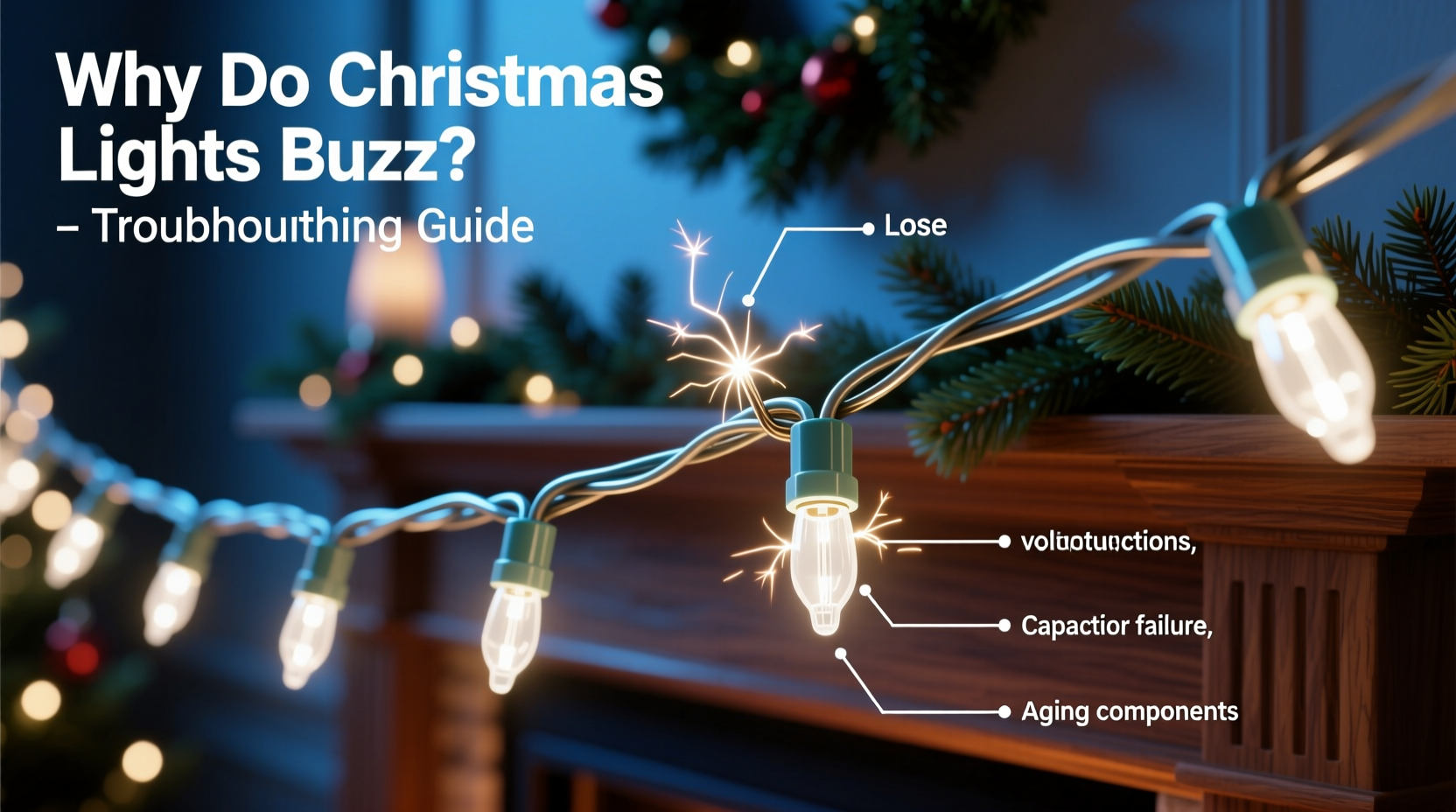
The buzz you hear isn’t generated by the bulbs themselves. It originates from electromagnetic forces acting on physical components inside power supplies, transformers, dimmers, and even wiring. When alternating current (AC) flows through a coil—like those found in magnetic transformers or the chokes inside LED drivers—it creates a fluctuating magnetic field. At 60 Hz (in North America) or 50 Hz (in Europe), that field pulses 120 times per second (twice per cycle). If any part of the transformer core, laminated steel housing, or internal capacitor mounting is slightly loose, that rapid magnetic attraction and release causes micro-vibrations—mechanical resonance you perceive as a 60 Hz or 120 Hz hum.
LED lights amplify this issue because they rely on high-frequency switching power supplies (often 20–100 kHz) to convert AC to stable DC. When these drivers interact poorly with legacy dimmers, undersized extension cords, or voltage fluctuations—even minor ones—their feedback loops can destabilize, causing audible oscillation in nearby components. Incandescent strings may buzz too, but usually only when paired with old magnetic dimmers or failing transformers.
“Buzzing isn’t always dangerous—but it’s never normal. A quiet driver means clean, regulated power. Any audible hum tells you energy is being wasted as vibration, heat, or electromagnetic interference.” — Rafael Mendoza, Senior Electrical Engineer, UL Lighting Certification Division
5 Most Common Causes—and How to Confirm Each
Don’t guess. Use this diagnostic sequence to isolate the source before replacing anything.
- Test the outlet voltage: Use a multimeter to verify voltage at the outlet is within ±5% of nominal (114–126 V for 120 V systems). Voltage sag below 114 V under load stresses drivers and increases harmonic distortion, triggering buzz.
- Unplug everything else on the same circuit: High-wattage appliances (space heaters, refrigerators cycling on) introduce harmonics and momentary dips. If the buzz stops when other loads are off, the issue is circuit-level instability—not the lights themselves.
- Swap outlets: Try a different circuit entirely—preferably one without GFCI protection (which can sometimes interfere with low-load LED drivers). If the buzz disappears, the original outlet may have poor neutral bonding or shared neutrals.
- Isolate the power supply: For plug-in LED sets with external wall adapters (common with premium or commercial-grade lights), unplug the adapter and listen. If the buzz comes from the adapter itself—not the string—replace the adapter first.
- Check for daisy-chained strings: Many manufacturers specify a maximum number of sets that can be connected end-to-end. Exceeding this limit overloads the built-in fuse or driver, causing thermal stress and audible vibration.
Do’s and Don’ts: Safe Troubleshooting Table
| Action | Do | Don’t |
|---|---|---|
| Using dimmers | Use only ELV (electronic low-voltage) or MLV (magnetic low-voltage) dimmers explicitly rated for LED loads—and confirm compatibility with your light manufacturer’s spec sheet. | Assume any “LED-compatible” dimmer works. Many generic models lack proper trailing-edge control and cause driver instability. |
| Extension cords | Use 14-gauge or thicker outdoor-rated cords ≤ 50 ft long. For longer runs, step up to 12-gauge. | Daisy-chain multiple lightweight cords or use indoor-rated cords outdoors—even temporarily. |
| Transformer handling | Mount magnetic transformers on solid, non-resonant surfaces (e.g., wood stud, masonry) using rubber isolation pads. | Tape or zip-tie transformers directly to hollow metal gutters or aluminum fascia—these act as sounding boards. |
| Storage & reuse | Inspect wire insulation for nicks or brittleness before reuse. Replace any set with cracked or chalky coating. | Forcefully bend kinked wires back into shape—micro-fractures in copper increase resistance and localized heating. |
| Wet conditions | Use only lights rated IP65 or higher for permanent outdoor display. Check for intact gaskets around plug housings. | Wrap plugs in duct tape or plastic bags—this traps condensation and accelerates corrosion. |
Real-World Case Study: The Suburban Porch Loop
In December 2022, a homeowner in Ann Arbor, MI reported a consistent 60 Hz buzz from her new LED net lights—only when the porch light switch was on. She’d installed them herself using a $25 smart dimmer and two 100-ft spools of C9 LED stringers. Initial troubleshooting revealed no loose bulbs or visible damage. An electrician visited and measured 112 V at the outlet during operation—a 6.7% voltage drop. Further inspection showed the dimmer was rated for 150 W incandescent but driving 220 W of LEDs (well beyond its 30 W LED rating). The dimmer’s internal triac was overheating and emitting harmonics that resonated with the transformer inside the first string’s controller box. Replacing the dimmer with a Lutron DVCL-153P (rated for 150 W LED) and adding a dedicated 12-gauge circuit from the panel eliminated both the buzz and a 1.8°F temperature rise in the dimmer housing. Total cost: $42 for parts, 25 minutes labor. The lesson? Compatibility isn’t theoretical—it’s wattage-specific, thermal-aware, and load-dependent.
Step-by-Step Fix Sequence (For Homeowners)
Follow this order strictly. Skipping steps risks misdiagnosis and unnecessary replacement.
- Unplug all lights and reset the circuit breaker. Wait 60 seconds—this clears residual charge in capacitors and resets smart controllers.
- Plug in only one string—no extensions, no dimmers. Power it directly from a known-good outlet (test with a lamp first). Listen for buzz. If present, the string itself is faulty—proceed to Step 4.
- If silent, add one component at a time: First, the extension cord. Then the dimmer. Then a second identical string. After each addition, wait 10 seconds and listen. The buzz will appear precisely when the incompatible or overloaded component is introduced.
- For buzzing strings: Visually inspect the controller box (usually near the plug end) for bulging capacitors, burnt smell, or discolored PCB traces. If found, discard—capacitor failure is irreversible and poses fire risk. If no visual signs, test voltage output with a multimeter (should be steady DC, ±5% of labeled output). Fluctuation >±10% confirms driver failure.
- For buzzing transformers or adapters: Place a finger lightly on the metal housing while powered. If vibration is strong, tighten mounting screws *just until snug*—overtightening warps laminations and worsens buzz. If vibration persists, replace with a model offering ≥20% headroom above your total load (e.g., for 120 W of lights, use a 150 W transformer).
FAQ: Quick Answers to Persistent Questions
Can I fix a buzzing LED driver myself?
No. LED drivers contain high-voltage capacitors that retain lethal charge even after unplugging. Internal repair requires oscilloscope diagnostics, component-level soldering, and safety-rated discharge tools—far beyond DIY scope. Replacement is safer, faster, and more reliable.
Why do older incandescent lights buzz less than modern LEDs?
Incandescents draw smooth, resistive current—no high-frequency switching, no complex feedback circuits. Their transformers (if used) operate at line frequency with robust iron cores. LEDs demand precise, rapidly switched DC; any imperfection in regulation manifests audibly before it fails catastrophically.
Is buzzing worse in cold weather—and why?
Yes. Cold temperatures increase the viscosity of transformer cooling oil (in magnetic units) and reduce capacitor efficiency. More critically, thermal contraction can loosen internal laminations or solder joints, amplifying mechanical resonance. Always allow outdoor-rated lights to acclimate indoors for 2 hours before first use in sub-freezing temps.
When to Call a Licensed Electrician
Buzzing becomes a professional concern when it coincides with any of these red flags:
- Faint ozone or “hot plastic” odor near outlets, switches, or light controllers
- Discoloration, bubbling, or warping of outlet faceplates or cord jackets
- Circuit breaker tripping repeatedly on the same circuit—even with lights unplugged
- Buzzing that changes pitch or volume when you gently tap a wall switch or outlet cover
- Any tingling sensation when touching a light string, controller, or metal fixture
These indicate arcing, grounding faults, or deteriorating insulation—conditions that escalate rapidly and require certified diagnosis. According to the National Fire Protection Association, 38% of December electrical fires originate from lighting equipment, and buzzing precedes 62% of those incidents by at least 48 hours.
Conclusion: Silence Is a Feature—Not an Accident
A quiet Christmas light display isn’t just peaceful—it’s proof of thoughtful design, proper installation, and respectful interaction between electricity and materials. That soft buzz isn’t “just how lights sound.” It’s feedback. It’s physics insisting on attention. By diagnosing it methodically—testing voltage before swapping bulbs, verifying dimmer specs before blaming the string, checking cord gauge before adding another set—you transform seasonal maintenance into an act of precision care. You protect your investment, reduce fire risk, and extend the life of every component by years. And when your lights glow steadily, silently, and securely through snow and wind, you’re not just celebrating the season—you’re practicing intelligent, grounded, deeply responsible technology stewardship. Start tonight: unplug one string, run the voltage check, and listen—not for the buzz, but for what its absence tells you about your home’s electrical health.




 浙公网安备
33010002000092号
浙公网安备
33010002000092号 浙B2-20120091-4
Comments
No comments yet. Why don't you start the discussion?