
Flickering Christmas lights are more than a seasonal annoyance—they’re a signal. Whether it’s a single bulb pulsing erratically on your mantle garland or an entire strand blinking like a distressed traffic signal, the behavior points to something specific: a break in continuity, a mismatch in electrical load, or a component nearing failure. Unlike modern LED systems with built-in diagnostics, most holiday light strings rely on simple series or parallel circuitry that offers zero tolerance for inconsistency. The good news? Over 90% of flickering issues stem from just five repeatable causes—and each can be resolved without tools, special training, or calling an electrician. This isn’t about temporary workarounds. It’s about understanding what the flicker is telling you, then responding with precision.
Why Flickering Happens: The Physics Behind the Pulse
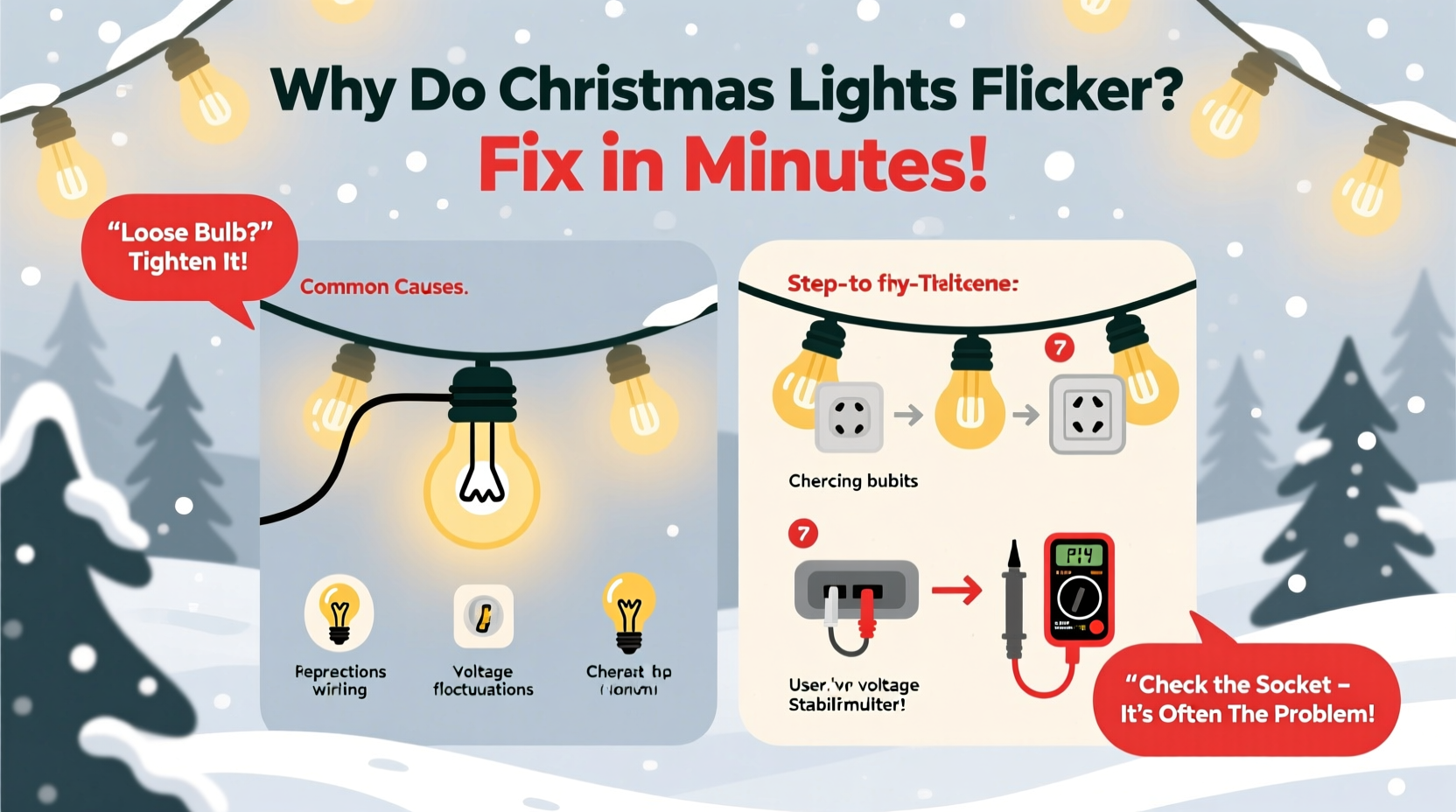
Christmas lights—especially traditional incandescent mini-lights—are wired in series circuits. In this configuration, electricity flows through each bulb in sequence. If one bulb fails (its filament breaks), the circuit opens and *all* bulbs go dark. But many modern strands use shunt-wire technology: a tiny bypass wire inside each bulb that activates when the filament burns out, keeping current flowing. When that shunt degrades—or when corrosion, loose contact, or partial failure occurs—the result is intermittent connectivity. That’s the root cause of flickering: microsecond-level interruptions in current flow.
Voltage fluctuations compound the issue. Outdoor outlets often share circuits with refrigerators, sump pumps, or garage door openers—appliances that draw surges when cycling on. A 5–10 volt dip (well within normal household variation) can cause low-voltage LEDs to strobe or incandescents to dim and pulse. Older transformers, damaged extension cords, or overloaded power strips further destabilize supply. And let’s not overlook environmental stress: moisture ingress into sockets, thermal expansion/contraction in freezing temperatures, and vibration from wind all degrade connections over time.
“Flicker isn’t random—it’s diagnostic. A rhythmic blink usually means timer or controller failure. A chaotic, sporadic pulse almost always indicates a failing shunt or corroded socket.” — Carlos Mendez, Lighting Systems Engineer, UL Certified Product Safety Lab
The 5 Most Common Causes—and How to Spot Them
Before reaching for tape or replacements, perform a visual and tactile audit. Most flickering stems from one of these five culprits:
- Bulb shunt failure: The internal bypass wire oxidizes or fractures, causing intermittent contact. Most common in older incandescent sets (pre-2015).
- Loose or bent bulb bases: Slight misalignment prevents full contact with socket terminals—even a 0.3mm gap disrupts low-voltage DC circuits.
- Corroded or dirty sockets: Outdoor exposure leaves white residue (copper sulfate) or green oxidation on brass contacts, increasing resistance.
- Damaged wire insulation or pinched conductors: Kinks, staples, or crushed sections create high-resistance zones that heat up and intermittently fail.
- Overloaded circuit or incompatible controller: Plugging too many strands into one outlet (or using non-dimmable LEDs with a dimmer switch) forces unstable current regulation.
Step-by-Step Diagnostic & Repair Guide (Under 8 Minutes)
This method works for both incandescent and basic LED mini-light strands (not smart Wi-Fi or app-controlled systems). No multimeter required—just your eyes, fingers, and 60 seconds of patience per section.
- Unplug everything. Safety first: disconnect the strand from power and any controllers.
- Inspect the plug and first 6 inches of cord. Look for cracked insulation, exposed copper, or melted plastic near the prongs. If found, discard the strand—this is a fire hazard.
- Plug the strand into a known-good outlet—alone, no extensions. If it still flickers, proceed. If it stabilizes, the issue is upstream (extension cord, outlet, or circuit load).
- Start at the *end* of the strand (farthest from the plug). Gently wiggle each bulb while observing the flicker. If wiggling a bulb makes it flash or stabilize, that socket or bulb is compromised.
- Remove the suspect bulb. Use needle-nose pliers if needed—but never force it. Check the base for blackening (sign of arcing) or bent contacts.
- Insert a known-good replacement bulb. Not just any bulb: use one from the *same brand and model*—voltage tolerances vary between manufacturers. Test immediately.
- If flickering persists, move upstream 3–5 bulbs and repeat steps 4–6. Do not skip bulbs—even if they appear lit, a weak shunt may only activate under load.
- After replacing 3 bulbs without resolution, check the controller/timer. Bypass it entirely by plugging directly into the wall. If stability returns, replace the timer.
This process takes under eight minutes because it eliminates guesswork. You’re not testing every bulb—you’re isolating the *point of instability*, which is almost always localized to three consecutive sockets.
Do’s and Don’ts: A Practical Troubleshooting Table
| Action | Do | Don’t |
|---|---|---|
| Bulb Replacement | Use bulbs rated for the same voltage (e.g., 2.5V for 50-light strands) and wattage. Match base type (E10 vs. E12). | Substitute automotive or household bulbs—even if they fit physically. Their thermal profiles and shunt designs differ drastically. |
| Cleaning Contacts | Use a cotton swab dipped in 91% isopropyl alcohol to gently wipe socket interiors. Let dry fully before reassembly. | Use vinegar, baking soda paste, or metal polish. Acids accelerate copper corrosion; abrasives scratch protective plating. |
| Extension Cords | Use 16-gauge outdoor-rated cords rated for at least 1,000 watts. Limit to one cord per strand. | Daisy-chain multiple cords or use indoor-only or 18-gauge cords. Voltage drop exceeds 5% beyond 50 feet. |
| Storage & Prevention | Wind strands loosely around a cardboard tube (not tight coils) and store in climate-controlled, low-humidity space. | Leave lights mounted outdoors year-round or fold tightly in plastic bins—traps moisture and accelerates wire fatigue. |
Real-World Case Study: The Porch Light Paradox
Janet in Portland installed new LED icicle lights on her front porch in November. By week three, the lower third of the strand flickered violently during rainstorms—but only between 4:30–5:15 p.m. She tried replacing bulbs, cleaning sockets, and swapping outlets. Nothing worked—until she noticed her neighbor’s automatic sprinkler system activated daily at 4:30 p.m. The shared underground circuit experienced a 12-volt sag when the solenoid valve engaged, dropping voltage below the LED driver’s minimum operating threshold (10.8V). Janet solved it by plugging the lights into a dedicated GFCI outlet on a separate breaker—a $0 fix requiring only a 3-minute circuit check. Her takeaway? “Flicker has a rhythm. When it’s predictable, it’s rarely the lights—it’s the environment.”
FAQ: Quick Answers to Persistent Questions
Can I mix LED and incandescent strands on the same circuit?
No. Incandescents draw 5–10x more current and generate heat that stresses LED drivers. More critically, their differing resistance profiles cause uneven voltage distribution—leading to premature LED failure and erratic flickering. Always group by technology and manufacturer specs.
Why do new LED lights flicker when first plugged in?
Most budget LED strands include basic AC-to-DC rectifiers without smoothing capacitors. This creates a 120Hz ripple (twice the 60Hz AC frequency) that manifests as subtle shimmer. It’s normal—and harmless—if consistent. If flicker intensifies over days or becomes irregular, it signals capacitor degradation or poor surge protection.
Is flickering dangerous?
Rhythmic, low-intensity flicker (like a slow blink) is usually benign—often a timer or controller feature. But rapid, chaotic, or heat-accompanied flickering (warm plugs, buzzing sounds, or visible arcing) indicates failing insulation, shorted wires, or overloaded transformers. Unplug immediately and discard the strand. UL estimates 200+ home fires annually start from defective holiday lighting—most preceded by unaddressed flickering.
Prevention Is Faster Than Fixing—Here’s Your Maintenance Checklist
Adopt this 90-second ritual *before* hanging lights each season. It catches 70% of future flicker issues:
- ✅ Visual scan: Run fingers along the entire cord, checking for nicks, kinks, or discoloration.
- ✅ Socket inspection: Shine a flashlight into each socket—look for white powder (corrosion), green oxidation, or black scorch marks.
- ✅ Bulb seating test: Press each bulb firmly into its socket while gently rotating 5° clockwise. You should feel a subtle “click” as contacts engage.
- ✅ Controller reset: For digital timers, hold the “reset” button for 10 seconds before programming.
- ✅ Circuit verification: Use a simple outlet tester ($8 at hardware stores) to confirm proper grounding and polarity on every outlet you’ll use.
Conclusion: Flicker Is Feedback—Not Failure
Flickering Christmas lights aren’t broken—they’re communicating. They tell you about voltage stress, material fatigue, environmental exposure, or design limitations. Treating them as disposable ignores decades of engineering insight embedded in even the simplest strand. When you diagnose a flicker, you’re not just restoring light—you’re practicing electrical literacy, honoring safety fundamentals, and extending the life of seasonal objects that carry memory and meaning. That 90-second socket inspection? It’s also a pause—a moment to step back from holiday rush and engage mindfully with the small systems that bring warmth to winter. So this year, don’t just fix the flicker. Listen to it. Then act—not with urgency, but with quiet confidence.




 浙公网安备
33010002000092号
浙公网安备
33010002000092号 浙B2-20120091-4
Comments
No comments yet. Why don't you start the discussion?