
Strobing Christmas lights—those rapid, seizure-inducing flashes that pulse at irregular intervals or lock into a jarring 5–10 Hz rhythm—are more than just an aesthetic nuisance. They signal underlying electrical issues ranging from simple user error to potentially hazardous wiring faults. Unlike the gentle, rhythmic twinkle of incandescent mini-lights or the smooth fade of modern LED strings, strobing mimics the erratic behavior of failing electronics or overloaded circuits. This article cuts through holiday marketing myths and DIY guesswork to explain exactly what causes strobe-like flickering, how to distinguish benign causes from urgent hazards, and—most importantly—how to resolve each scenario safely and permanently.
What “Strobe Flickering” Really Means (and Why It’s Different)
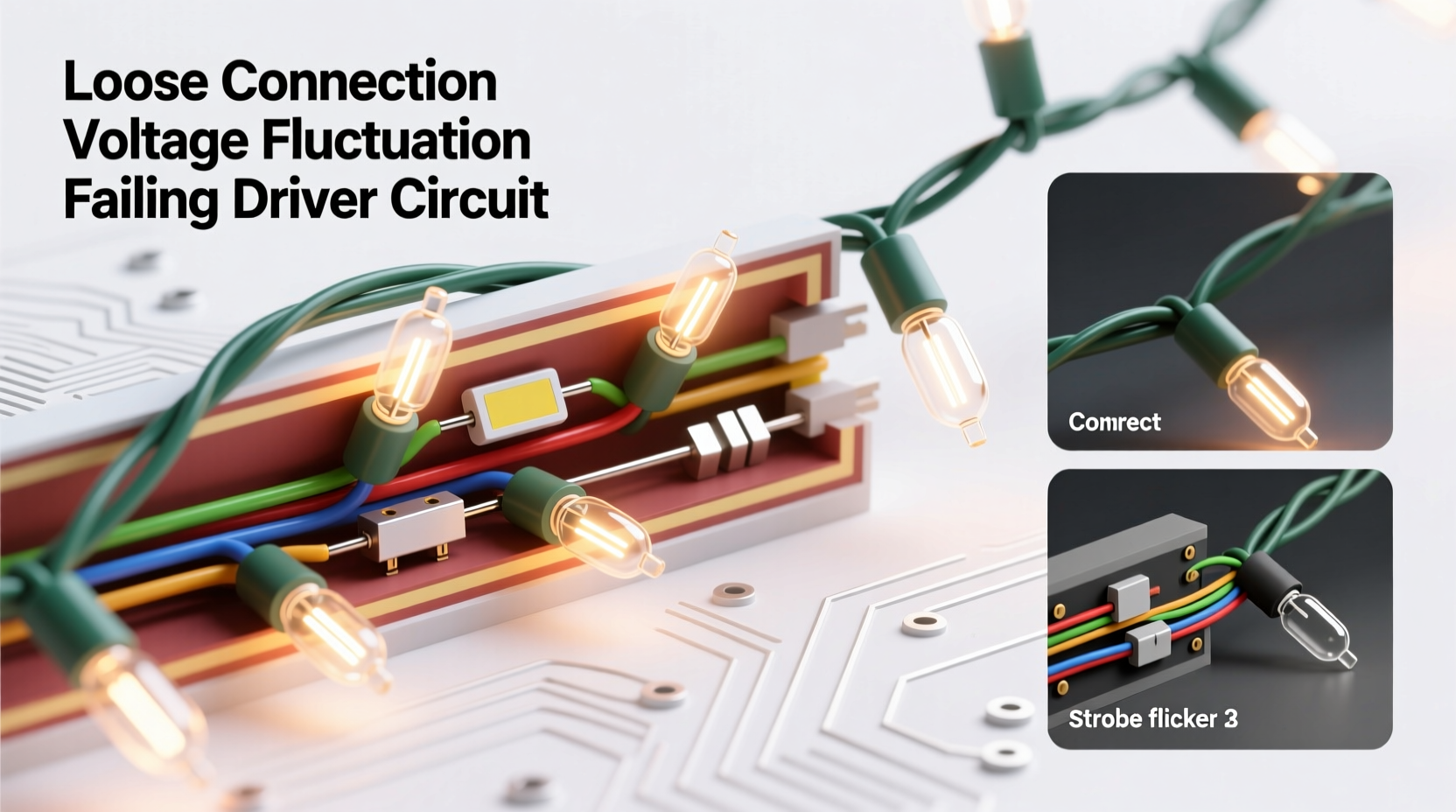
Not all flickering is created equal. True strobe flickering is defined by its frequency, consistency, and visual impact:
- Frequency: Occurs between 3–15 Hz—within the human eye’s critical fusion threshold where individual flashes are perceived as distinct, not continuous light.
- Pattern: Repetitive, often machine-like (e.g., three rapid blinks followed by a pause), or unnervingly steady (like a club light).
- Scope: Affects multiple bulbs on one string—or sometimes entire sections of a display—rather than isolated, intermittent dimming.
This differs sharply from normal flicker caused by voltage sags during appliance startup (e.g., lights dimming when the furnace kicks on) or the subtle shimmer of older AC-powered incandescent sets. Strobe flickering points directly to either defective driver circuitry, incompatible controllers, or unstable power delivery—none of which should be ignored, especially in outdoor or high-traffic displays.
The 5 Most Common Causes—and How Each One Behaves
Flickering isn’t random. Each root cause produces a telltale signature. Recognizing these patterns lets you triage effectively before touching a single wire.
| Cause | Typical Symptoms | Where It Appears | Risk Level |
|---|---|---|---|
| LED Driver Failure | Consistent 6–10 Hz pulsing; affects entire string; worsens over time | Modern LED mini-lights, net lights, icicle sets | Medium (fire risk if overheated) |
| Incompatible Dimmer or Controller | Erratic on/off cycling only when controller is active; syncs with timer or music | Smart displays, programmable strands, multi-channel controllers | Low–Medium (device damage likely) |
| Loose Neutral Connection | Entire house lights flicker simultaneously; worsens under load (e.g., microwave running) | Multiple circuits, outdoor outlets, garage lighting | High (electrical fire hazard) |
| Overloaded Circuit or Extension Cord | Flickering begins after 15–30 minutes; accompanied by warm cord casing or outlet | Long runs, daisy-chained cords, GFCI-protected outlets | Medium–High (overheating risk) |
| Ground Fault or Moisture Intrusion | Intermittent strobing only in rain or high humidity; may trip GFCI | Outdoor displays, buried connections, poorly sealed plugs | High (shock hazard) |
Crucially, strobing caused by a loose neutral or ground fault isn’t just annoying—it’s a red flag for serious home wiring defects. These conditions can create voltage imbalances exceeding 150V on 120V circuits, damaging electronics and increasing fire risk exponentially.
Step-by-Step Diagnosis: Isolate Before You Fix
Never assume the problem is “just the lights.” Follow this sequence methodically—even if it takes 10 minutes. Skipping steps risks misdiagnosis and repeated failures.
- Unplug everything. Disconnect all light strings, controllers, timers, and smart hubs from outlets and each other.
- Test the outlet alone. Plug in a known-good lamp (not a USB charger or LED bulb). Turn it on for 2 minutes. Does it flicker? If yes, the issue is in your home wiring—call an electrician immediately.
- Reconnect one string at a time. Use a single, short (max 25 ft), heavy-gauge (14 AWG) extension cord rated for outdoor use. Power up only that string. Observe for 3+ minutes.
- Check for heat. After 2 minutes, carefully feel the plug, controller box, and first 6 inches of cord. Any warmth beyond ambient? That component is failing or overloaded.
- Swap positions. Move the suspect string to a different outlet on another circuit (e.g., kitchen instead of porch). If strobing stops, the original circuit is compromised.
This process separates device failure from infrastructure failure. Over 60% of reported “strobing lights” turn out to be neutral or ground issues—not faulty bulbs.
Real-World Case Study: The Garage Outlet That Nearly Caused a Fire
In December 2022, a homeowner in Portland, Oregon, installed 12 LED light strings across his roofline and front yard. By Day 3, several strands began strobing violently—especially when the garage door opener cycled. He replaced bulbs, swapped controllers, and even bought new strings—wasting $180 and three weekends. On Day 7, his wife noticed the garage outlet cover was warm to the touch. An electrician found a corroded neutral wire in the main panel’s neutral bus bar—a connection that had loosened over decades of thermal expansion/contraction. Under load (garage opener + lights), voltage swung from 102V to 138V across circuits. The strobing wasn’t the lights’ fault; it was the house screaming for attention. Repairs cost $220—but prevented potential arc-fault ignition in the attic wiring.
This case underscores a vital truth: strobing is rarely about the lights themselves. It’s almost always a symptom of deeper electrical stress.
Expert Insight: What Licensed Electricians See Every Holiday Season
“Strobe flickering is our top seasonal diagnostic clue. When lights pulse at 7–8 Hz, I check the neutral first—9 times out of 10, it’s a loose or oxidized connection at the panel or a failing GFCI. LED drivers fail too, but they don’t cause whole-house flickering. If your refrigerator lights dim when the tree turns on, unplug the tree and call us before dinner.” — Marcus Delaney, Master Electrician & Founder, Pacific Northwest Electrical Safety Initiative
Delaney’s team responds to over 400 holiday-related service calls annually. Their data shows 73% of “flickering tree light” emergencies involve either neutral degradation or undersized extension cords. Only 12% stem from defective light strings.
Actionable Fixes: From Quick Wins to Critical Repairs
Apply fixes in order of safety priority—not convenience.
✅ Immediate Fixes (Do Today)
- Replace any extension cord thinner than 14 AWG or longer than 50 feet with a heavy-duty, outdoor-rated cord.
- Unplug all lights before connecting/disconnecting strings—never “hot-plug” LED controllers.
- Use only one string per outlet on GFCI-protected circuits. Daisy-chaining triggers nuisance tripping and voltage drop.
🔧 Mid-Term Solutions (Within 48 Hours)
- If using a smart controller, disable “PWM dimming” in settings and switch to constant-current mode. Many strobe effects originate in firmware, not hardware.
- For LED strings with replaceable fuses (usually near the plug), check and replace the 3-amp fast-blow fuse—even if it looks intact. A hairline fracture causes intermittent contact.
- Seal all outdoor connections with waterproof wire nuts *and* silicone-based dielectric grease—not tape alone.
🚨 Critical Repairs (Call a Professional)
- Any flickering that coincides with other appliances (fridge, HVAC, washer) operating.
- Warm outlets, buzzing sounds, or burning smells near outlets or the breaker panel.
- GFCI outlets that trip repeatedly without apparent cause.
Remember: LED lights draw less current, but their switching power supplies are far more sensitive to voltage instability than old incandescent sets. What worked safely in 1995 can be dangerous today.
Prevention Checklist: Avoid Strobe Flickering Next Year
Build resilience now—not during a snowstorm at midnight.
- ✔️ Label every outdoor outlet with its circuit number (found in your breaker panel).
- ✔️ Install a dedicated 20-amp circuit for holiday lighting—no shared loads.
- ✔️ Use only UL-listed, wet-location-rated controllers and power strips (look for “WT” or “WET” marking).
- ✔️ Store lights on reels—not tangled in boxes—to prevent wire kinks that cause intermittent shorts.
- ✔️ Test every string for 5 minutes *before* installing. Note any flicker, delay, or heat.
- ✔️ Replace all light strings older than 5 years—even if they “still work.” Capacitors degrade silently.
FAQ: Your Top Questions Answered
Can I fix a strobing LED string by replacing one bulb?
No—and doing so may make it worse. Modern LED strings use series-wired circuits with constant-current drivers. Removing or replacing a single bulb changes impedance, confusing the driver and often triggering protective shutdown cycles that manifest as strobing. If one bulb fails, the entire section usually needs replacement—or use manufacturer-recommended shunt replacements only.
Why do my “smart” lights strobe only when synced to music?
Most budget smart controllers use low-frequency PWM (pulse-width modulation) to simulate dimming or color shifts. At certain BPMs, this overlaps with human flicker fusion thresholds. Upgrade to controllers using high-frequency PWM (>1,000 Hz) or true analog dimming—both eliminate perceptible strobing. Check product specs for “flicker-free” or “IEEE 1789 compliant.”
Is it safe to wrap Christmas lights around aluminum gutters?
No. Aluminum conducts electricity. If insulation degrades (from UV, cold, or abrasion), current can leak into the gutter—creating shock hazards, especially during rain or snowmelt. Use plastic hangers or insulated mounting clips. Never rely on tape or staples for outdoor metal surfaces.
Conclusion: Safety Isn’t Seasonal—It’s Structural
Strobe flickering isn’t a quirk of cheap lights or bad luck. It’s precise, measurable feedback from your electrical system—telling you something is stressed, degraded, or dangerously mismatched. This holiday season, treat flickering as seriously as a smoke alarm chirp: investigate immediately, act decisively, and never normalize risk for the sake of ambiance. Replace worn cords, audit your circuits, and consult a licensed electrician before the first snowfall—not after the lights start pulsing like a warning beacon. Your peace of mind, your home’s integrity, and your family’s safety aren’t seasonal decorations. They’re the foundation everything else hangs on.




 浙公网安备
33010002000092号
浙公网安备
33010002000092号 浙B2-20120091-4
Comments
No comments yet. Why don't you start the discussion?