
It’s a familiar holiday scene: you’re sipping cocoa, the tree glows softly, and then—whirr-click—the air conditioner compressor engages. Instantly, the lights dim or pulse erratically. No loose bulb. No tripped breaker. Just a brief, unsettling flicker that makes you wonder: Is something wrong with the lights? The outlet? Or worse—your home’s electrical system?
This isn’t just seasonal annoyance. It’s a visible symptom of underlying electrical dynamics most homeowners never learn until it manifests in blinking LEDs or buzzing transformers. The flicker is real-time feedback from your home’s power infrastructure—and understanding it helps prevent more than aesthetic disruption. It can reveal overloaded circuits, undersized wiring, or even early signs of deteriorating connections that pose fire or equipment-damage risks.
This article explains precisely why this happens—not with oversimplified analogies, but with grounded electrical principles, real-world diagnostics, and actionable steps you can take *tonight* to stabilize your lighting and protect your home.
How Voltage Drop Triggers Flicker: The Physics Behind the Pulse
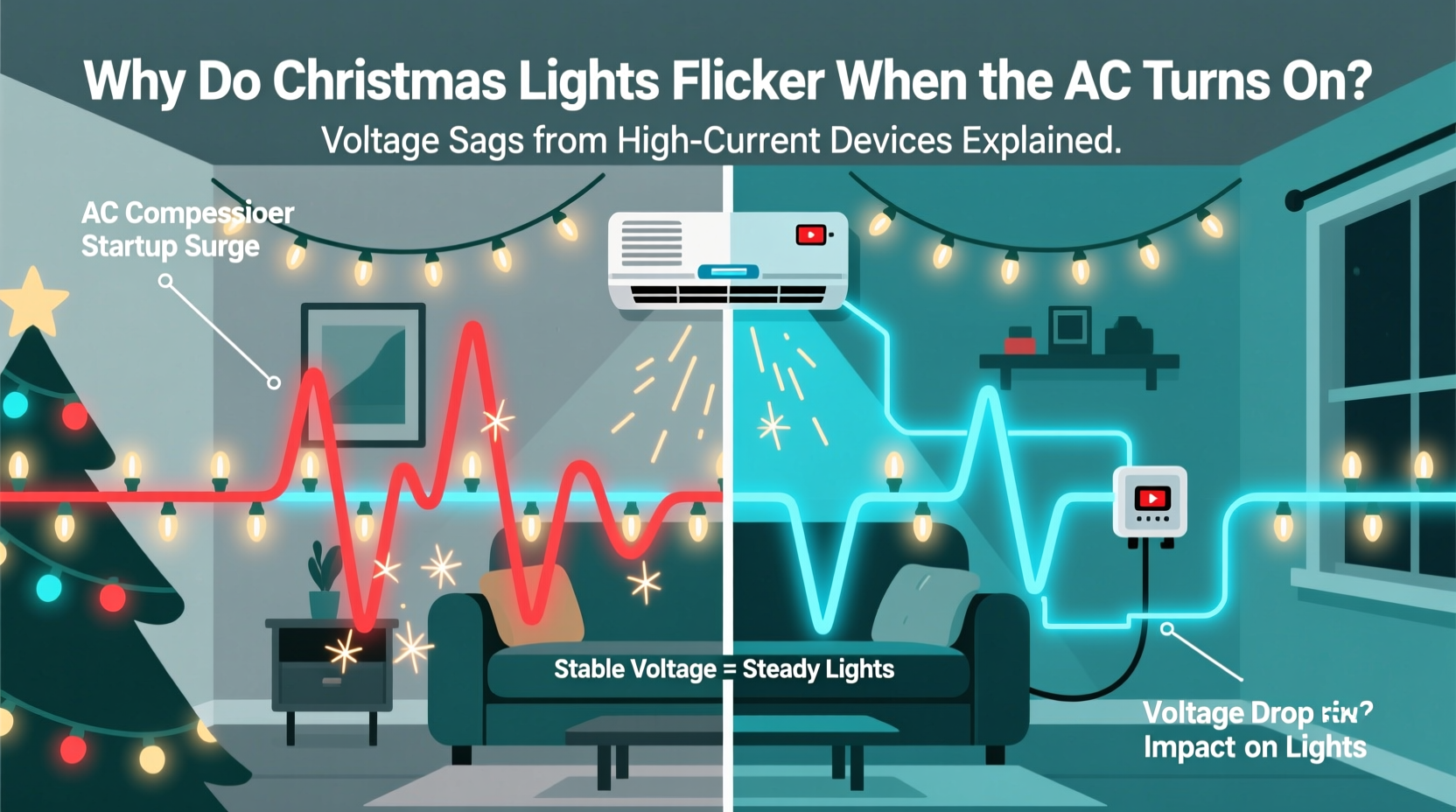
Christmas lights—especially modern LED strings—operate within tight voltage tolerances. Most low-voltage LED sets expect 12–24 V DC (delivered via an internal or external transformer), while plug-in incandescent or basic LED strings run directly on 120 V AC. Both are sensitive to momentary dips in supply voltage.
When your air conditioner starts, its compressor motor draws a massive inrush current—typically 3–8 times its normal running load—for 100–500 milliseconds. A 3-ton residential AC unit may draw 15 amps continuously—but up to 90 amps at startup. That sudden demand creates a temporary voltage drop across the circuit impedance (resistance + reactance) between the panel and the outlet where your lights are plugged in.
According to Ohm’s Law (V = I × R), even small resistance in aging outlets, loose neutral connections, or long wire runs multiplies under high current. A 0.5-ohm resistance at 60 amps generates a 30-volt drop—enough to plunge a 120 V circuit down to 90 V momentarily. LED drivers interpret this as unstable input and may shut down briefly, restart, or modulate brightness—causing the telltale “strobe” effect. Incandescents simply glow dimmer, but the dip is often less perceptible.
Critical nuance: This isn’t always a sign of danger. All homes experience minor voltage fluctuations. But sustained or deep dips (>10% of nominal voltage) indicate conditions warranting investigation.
The Hidden Culprits: Beyond the Obvious Circuit
While “shared circuit” is the go-to explanation, reality is more layered. Here are the four most common root causes—ranked by frequency and risk level:
- Shared Neutral or Loose Neutral Connection: In multi-wire branch circuits (MWBCs), two 120 V legs share one neutral wire. If that neutral becomes loose or corroded at the panel or a junction box, voltage imbalance occurs. When the AC (on Leg A) starts, Leg B can surge to 140+ V while Leg A sags to 90 V—causing lights on the opposite leg to flicker *even if they’re on a different breaker*. This is among the most dangerous causes: arcing at loose neutrals generates heat and is a leading cause of electrical fires.
- Undersized or Long Branch Wiring: Older homes wired with 14-gauge aluminum or 14-gauge copper on 15-amp circuits struggle with modern loads. Add 50 feet of 14 AWG copper wire (≈0.25 Ω per 100 ft), and inrush current easily induces >8 V drop. Longer runs—like outdoor outlets fed from a basement panel—exacerbate this.
- Overloaded Panel Bus or Main Lugs: If your main service panel is near capacity (e.g., 150-amp panel with 140+ amps of continuous load), AC startup can cause voltage sag across the entire system. Lights throughout the house—not just near the AC—may dim or flicker.
- Failing Transformer or Driver in LED Strings: Cheap LED light sets often use under-spec’d switching power supplies. These lack robust input filtering and brown-out protection. They’re not failing—they’re revealing poor design. A quality UL-listed string should tolerate ±15% voltage fluctuation without interruption.
Real-World Diagnosis: A Case Study from a 1950s Bungalow
In December 2023, Sarah K., a homeowner in Portland, OR, reported consistent flickering of her front-yard LED icicle lights every time her 12-year-old heat pump cycled on. She’d replaced bulbs, checked fuses, and even swapped extension cords—no change. An electrician discovered three interrelated issues:
- A corroded neutral splice inside the meter base—visible only after removing the cover—had increased resistance from 0.02 Ω to over 1.8 Ω.
- The outdoor GFCI outlet feeding the lights was backstabbed (wires pushed into spring clips instead of screwed), causing intermittent contact heating.
- Her heat pump shared a 20-amp circuit with the garage door opener and a freezer—a violation of NEC 210.23(A)(2), which prohibits fixed appliances from sharing circuits with outlets.
After tightening the neutral, replacing the GFCI with a screw-terminal model, and relocating the freezer to a dedicated circuit, the flicker ceased entirely. Crucially, the neutral repair prevented potential arcing that could have ignited adjacent wood framing.
This case underscores a key principle: flicker is rarely about the lights themselves. It’s a diagnostic clue pointing to systemic infrastructure issues—some urgent, others merely inefficient.
Do’s and Don’ts: Electrical Safety & Practical Fixes
Not all solutions require an electrician—but missteps carry real risk. Use this table to prioritize actions safely and effectively.
| Action | Do | Don’t |
|---|---|---|
| Testing Voltage | Use a certified plug-in monitor or multimeter on the same outlet. Record min/max during AC startup. | Assume “it’s fine” because lights don’t go out completely. Sub-10% drops still stress electronics. |
| Circuit Management | Plug lights into an outlet on a different phase (opposite leg) than the AC. Use a circuit finder or consult your panel labeling. | Daisy-chain multiple light strings through one power strip. This compounds voltage drop and exceeds outlet ratings. |
| Wiring & Outlets | Replace backstabbed outlets with screw-terminal models. Tighten all terminal screws to manufacturer torque specs (usually 14–18 in-lbs). | Tighten neutral lugs yourself unless qualified. Main neutral connections require lockout/tagout and arc-flash precautions. |
| Light Selection | Choose UL-listed LED strings with “wide input range” (e.g., 90–130 V AC) and active PFC (Power Factor Correction). | Use non-UL “dollar store” lights outdoors. Their transformers lack surge protection and thermal cutoffs. |
Expert Insight: What Licensed Electricians See Behind the Flicker
“Flicker at AC startup is the #1 red flag we document during home electrical audits—not because it’s always catastrophic, but because it’s so rarely isolated,” says Carlos Mendez, Master Electrician and NEC Code Instructor with 28 years of field experience. “In 7 out of 10 cases, it leads us to discover either a compromised neutral connection or panel busbar corrosion. Those aren’t ‘annoyances.’ They’re latent failure points. A 2022 NFPA report linked loose neutrals to 12% of residential electrical fires investigated that year. The lights are literally flashing a warning.”
“The most important thing a homeowner can do is stop treating flicker as a lighting issue—and start treating it as a diagnostic opportunity. That blink is your home’s way of saying, ‘Check the foundation.’” — Carlos Mendez, Master Electrician & NEC Instructor
Step-by-Step: How to Diagnose and Resolve Safely
Follow this sequence before calling an electrician. Each step builds evidence and eliminates low-risk causes first:
- Isolate the Circuit: Turn off all breakers except the AC’s and the lights’. If flicker persists, the issue is upstream (panel, meter, utility). If it stops, they share a circuit or leg.
- Verify Phase Separation: With breakers on, use a non-contact voltage tester to identify which hot wires are on opposing legs (they’ll be adjacent in the panel). Move the light outlet to the opposite leg.
- Measure Voltage Drop: Using a multimeter, measure voltage at the outlet with lights on (baseline), then again *during AC startup*. Compare to voltage at the panel’s output terminals (requires qualified person). A >3 V difference indicates branch wiring issues.
- Inspect Receptacles: Shut off power. Remove outlet cover. Check for discoloration, melted plastic, or backstabbed wires. Replace with a commercial-grade, screw-terminal outlet rated for 20 A.
- Test Under Load: Plug a 1500 W space heater into the same outlet as the lights. Cycle it on/off. If lights flicker identically, the problem is localized to that circuit’s wiring or connections—not the AC specifically.
FAQ: Your Most Pressing Questions Answered
Can a whole-house surge protector fix this flicker?
No. Surge protectors guard against voltage spikes (e.g., lightning), not sags. Some premium models include voltage regulation, but these are rare, expensive ($800+), and require professional installation. They address symptoms—not root causes like loose neutrals or overloaded circuits.
Why do newer LED lights flicker more than old incandescents?
Incandescents respond slowly—their filament doesn’t cool fast enough to visibly dim during a 200-ms sag. LEDs, however, rely on electronic drivers that detect undervoltage and may shut down or pulse to protect components. It’s not inferiority; it’s higher sensitivity to grid instability.
Will upgrading to a “soft-start” AC unit eliminate flicker?
Often—but not always. Soft-start kits reduce inrush current by 50–70%, significantly lowering voltage drop. However, if your neutral is compromised or wiring is undersized, even reduced inrush can expose those weaknesses. Soft-start is a valuable upgrade, but it’s not a diagnostic substitute.
Conclusion: Your Lights Are Telling You Something Important
Flickering Christmas lights when the AC starts aren’t just a quirky holiday quirk. They’re a precise, real-time indicator of how your home’s electrical system handles dynamic loads. Ignoring them might mean accepting inefficiency—or overlooking a hazard that could escalate into equipment damage, premature LED failure, or worse, a fire risk hidden behind drywall.
You now understand the physics behind the pulse, recognize the hierarchy of likely causes, and hold practical tools to investigate safely. Whether it’s swapping an outlet, verifying circuit phasing, or knowing when to call a licensed electrician for neutral inspection—you’re equipped to move beyond frustration and toward informed action.
This holiday season, let your lights shine steadily—not as decoration alone, but as proof of a safer, more resilient home. Take one step this week: grab that voltage monitor, check your panel labeling, or replace that backstabbed outlet. Small actions, rooted in understanding, make the biggest difference.




 浙公网安备
33010002000092号
浙公网安备
33010002000092号 浙B2-20120091-4
Comments
No comments yet. Why don't you start the discussion?