
It’s a familiar holiday frustration: you plug in your string of Christmas lights, but only half of them illuminate. The other half remains stubbornly dark, ruining the festive effect. While this may seem like a random glitch, it’s actually a common symptom rooted in the design and electrical behavior of traditional incandescent mini-light strings. Understanding why this happens—and how to fix it—is essential for anyone who decorates with these classic lights.
Modern LED light strings are more reliable, but many households still rely on older incandescent strands that use series wiring. In such setups, a single faulty bulb or loose connection can break the circuit, leaving part—or all—of the strand unlit. Fortunately, with the right knowledge and tools, you can diagnose and resolve the issue efficiently, often restoring full brightness in under an hour.
How Christmas Light Strings Are Wired
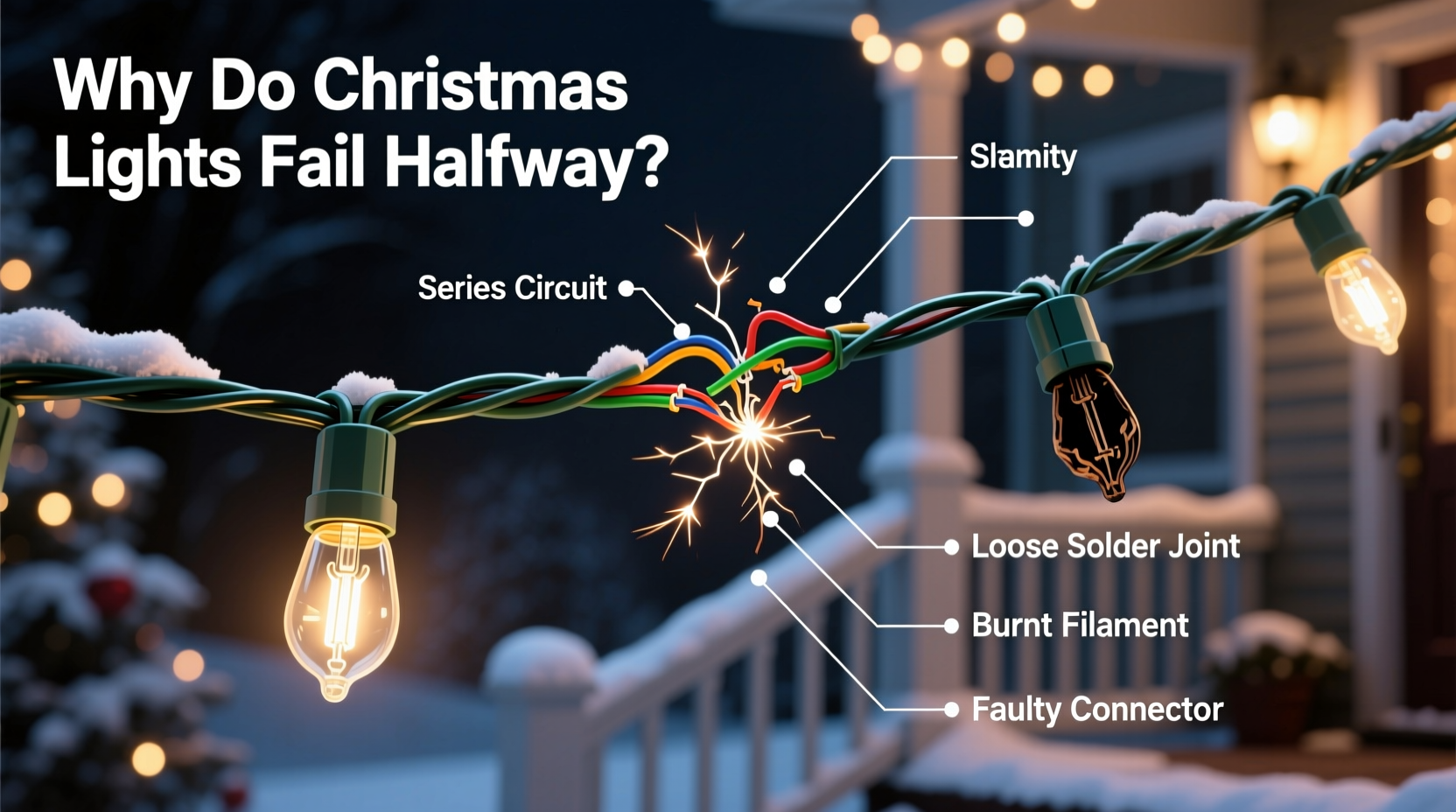
The root cause of partial failure lies in how most traditional Christmas lights are wired: in series. Unlike household appliances that operate in parallel circuits (where each device functions independently), series-wired lights depend on one another to complete the electrical path. If one bulb burns out or becomes loose, the entire circuit is interrupted.
In older designs, manufacturers used a clever workaround called a \"shunt.\" When a filament breaks, the shunt—a small wire coated in insulating material—activates due to increased voltage across the gap. The coating burns off, allowing current to bypass the dead bulb and keep the rest of the string lit. However, this system isn’t foolproof. Shunts can fail to activate, especially if the bulb wasn’t properly seated or if corrosion has built up over time.
Newer LED strings typically use parallel or semi-parallel configurations, which means individual bulbs failing won’t affect others. But because many people reuse older incandescent sets year after year, series-related issues remain widespread during the holiday season.
Common Causes of Half-Lit Christmas Lights
Several specific faults can lead to only half of a light string working. Identifying the culprit requires understanding both the physical construction and electrical flow through the strand.
- Faulty or missing bulb: A single burned-out bulb without a functioning shunt will break the circuit, causing downstream lights to go dark.
- Loose bulb: Even if the filament is intact, a bulb not fully screwed into its socket interrupts continuity.
- Damaged wire or insulation: Frayed wires, pinched sections, or rodent damage can create breaks in the circuit.
- Bad shunt: Some shunts fail to activate when needed, particularly in older or low-quality bulbs.
- Split circuit design: Some longer strands are internally split into two 50-light segments. A problem in one segment doesn’t affect the other, creating the appearance of “half working.”
- Defective fuse or plug: Though less common, a partially damaged plug or blown fuse can reduce power delivery unevenly.
Because multiple bulbs may be involved, diagnosing the exact point of failure often requires systematic testing rather than guesswork.
Understanding Split Circuits in Long Strands
Many light strings longer than 50 bulbs are designed with two independent circuits within a single cord. These are known as “dual-wave” or “split-circuit” strings. Each half operates separately, powered by the same plug but electrically isolated from one another.
This explains why one side might glow brightly while the other remains dark—it’s not a partial failure of a single circuit, but a complete failure of one of the two internal circuits. This configuration improves reliability overall, since a fault in one section doesn’t doom the entire string. But it also means troubleshooting must account for both circuits individually.
“About 60% of ‘half-lit’ calls we get during the holiday season turn out to be split-circuit failures where customers assumed it was one continuous strand.” — Mark Reynolds, Holiday Lighting Technician, BrightHome Electric
Step-by-Step Guide to Diagnose and Fix Half-Lit Lights
Follow this logical sequence to identify and resolve the issue safely and effectively.
- Unplug the lights immediately. Never attempt repairs while the string is connected to power.
- Inspect visually. Look for obvious signs: broken bulbs, cracked sockets, frayed wires, or kinks in the cord. Pay attention to areas near windows, doors, or outdoor fixtures where wires may have been pinched.
- Check the fuses. Most plug ends contain a small compartment housing two fuses (usually rated at 3–5 amps). Use a fuse tester or multimeter to verify they’re intact. Replace with identical-rated fuses only.
- Test each bulb in the dark section. Starting from the first non-working bulb after the last lit one, remove and inspect each. Shake gently—if you hear a rattle, the filament is broken. Replace any suspect bulb with a known-good spare.
- Use a light tester (optional). Devices like the “LightKeeper Pro” send a pulse through the circuit to clear shunt failures or detect open filaments without removing bulbs.
- Re-seat all bulbs. Even bulbs that appear secure can be slightly loose. Rotate each one firmly until snug (but don’t overtighten).
- Plug in and test. After each step, reconnect the string briefly to see if illumination returns. Stop immediately if you notice flickering, buzzing, or smoke.
- Segment isolation (for long strings). If the string is over 50 lights, determine whether it’s split-circuit. Test continuity between the start and midpoint using a multimeter. No continuity suggests a break before the halfway point.
- Replace problematic sections. For permanent fixes, consider cutting out damaged segments and splicing in new ones—or replacing the entire string if repairs become excessive.
Do’s and Don’ts of Christmas Light Maintenance
| Do | Don't |
|---|---|
| Store lights coiled loosely around a cardboard reel or spool | Wrap tightly around sharp objects like hangers or rulers |
| Label strings by location and length before storing | Leave labels exposed to moisture or sunlight |
| Inspect bulbs and cords annually before installation | Use water-damaged or frayed strings outdoors |
| Use insulated bulb changers or gloves when working at height | Stand on metal ladders near electrical outlets |
| Replace bulbs promptly when noticed as dark | Mix old and new bulb types on the same strand |
| Keep spare fuses and bulbs matched to your light type | Use higher-wattage replacements than specified |
Mini Case Study: Restoring a Family Heirloom Strand
Sarah Thompson inherited a set of red-and-white mini-lights from her grandmother, used every Christmas since 1998. Last season, she noticed only the first 35 bulbs lit up; the remaining 65 stayed dark. She tried plugging in a different set to confirm outlet function—those worked fine.
She followed the diagnostic steps: checked fuses (both intact), inspected wiring (no visible damage), then began testing bulbs. By the 37th bulb, she found one that rattled when shaken. Replacing it didn’t help. She continued re-seating each subsequent bulb and discovered the 41st was slightly misaligned. After tightening it, the entire second half suddenly illuminated.
The root cause? A combination of a failed shunt in the 37th bulb and a loose connection at the 41st. Once both were addressed, continuity was restored. Sarah now keeps a log of each strand’s condition and performs maintenance every January to prevent future issues.
When to Replace vs. Repair
While repairing is often cost-effective, there comes a point when replacement makes more sense—especially for safety reasons.
Consider replacing a light string if:
- There are multiple damaged sockets or exposed copper wires.
- The cord feels brittle or cracks when bent.
- More than three fuses have blown in a single season.
- The lights flicker uncontrollably or emit a burning smell.
- The strand exceeds 10 years of age and uses outdated connectors.
Modern LED alternatives consume up to 90% less energy, generate minimal heat, and last 25,000–50,000 hours compared to 2,000–3,000 for incandescent bulbs. Upgrading may save money over time and reduce fire risk, especially in dry indoor environments or near flammable decorations.
FAQ
Why do only half my Christmas lights work when I plug them in?
This usually occurs in series-wired incandescent strings where a single bulb failure breaks the circuit. It can also happen in split-circuit designs where one of two internal segments fails independently. Loose bulbs, bad shunts, or wire damage are typical culprits.
Can I use a multimeter to find the bad bulb?
Yes. Set the multimeter to continuity mode. Disconnect the string from power, then place one probe at the beginning of the dark section and the other at the next socket. Move progressively down the line. When continuity disappears between two points, the fault lies between them—likely in the preceding bulb or socket.
Are half-lit lights dangerous?
Not inherently, but they can indicate underlying issues like frayed wires or overheating components. A blinking or flickering section may suggest arcing, which poses a fire hazard. Always inspect thoroughly and discontinue use if you detect warmth, melting, or unusual smells.
Checklist: Diagnosing Half-Lit Christmas Lights
- Unplug the light string
- Visually inspect for broken bulbs, frayed wires, or kinks
- Open fuse compartment and test/replace fuses
- Determine if the string is split-circuit (common in 100+ light sets)
- Remove and test each bulb in the dark section
- Re-seat all bulbs firmly in their sockets
- Use a light tester tool if available
- Plug in briefly to test progress
- Replace damaged sections or retire unsafe strings
- Label and store repaired strings properly after use
Conclusion
A strand of Christmas lights that only half works is more than just a nuisance—it’s a solvable puzzle rooted in basic electrical principles. With careful observation and methodical testing, most issues can be traced to a single faulty component. Whether it’s a loose bulb, failed shunt, or compromised wire, the fix is often simple and inexpensive.
As holiday traditions continue, so does the value of maintaining reliable, safe decorations. Take the time this season to inspect your lights before hanging them. Address problems early, invest in higher-quality replacements when needed, and pass along the knowledge to family members who share in the decorating joy.




 浙公网安备
33010002000092号
浙公网安备
33010002000092号 浙B2-20120091-4
Comments
No comments yet. Why don't you start the discussion?