
Fluorescent office ceilings, flickering LED holiday strings, emergency strobes, even the subtle pulse of a smartphone notification light—these are everyday sources of visual rhythm we rarely question. Yet for millions, that rhythm isn’t neutral. It’s disorienting, exhausting, or outright painful. The stress response to blinking lights isn’t imagined or exaggerated; it’s rooted in measurable neurophysiology, sensory processing differences, and decades of clinical observation. This article moves beyond anecdote to explain *why* intermittent light triggers distress—and, more importantly, offers concrete, evidence-informed strategies to replace flicker with calm, predictable illumination. Whether you’re designing a workspace, selecting home lighting, supporting a neurodivergent family member, or simply seeking relief from unexplained headaches and fatigue, understanding the science of light stability is the first step toward safer, more humane environments.
The Neurological Roots of Light Sensitivity
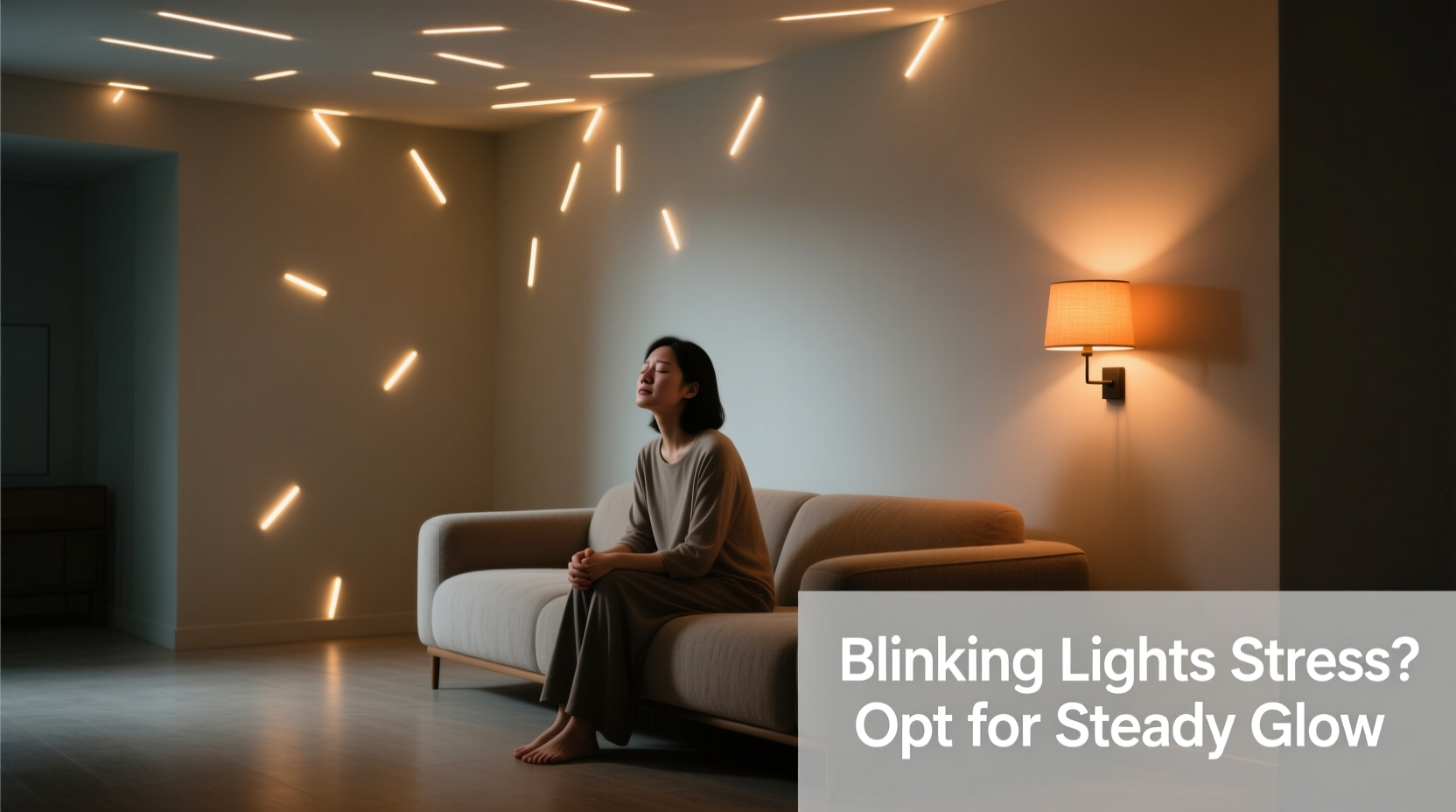
Blinking or flickering light doesn’t just register as “bright” or “dim.” It introduces temporal modulation—a rapid on-off cycle that the visual system must process continuously. For most people, this happens subconsciously. But for those with heightened sensory sensitivity—common in migraine disorders, autism spectrum condition (ASC), post-concussion syndrome, epilepsy, chronic fatigue syndrome, and anxiety disorders—the brain’s filtering mechanisms become overwhelmed.
Research using electroencephalography (EEG) shows that even imperceptible flicker—below the conscious threshold of 80–100 Hz—can induce abnormal cortical activity. A 2022 study published in Neurology: Neuroimmunology & Neuroinflammation found that individuals with migraine with aura exhibited significantly increased gamma-band oscillations (30–80 Hz) when exposed to 120-Hz PWM (pulse-width modulated) LEDs, correlating directly with reports of visual distortion and nausea. This isn’t “just sensitivity”—it’s measurable neural hyperexcitability.
The retina itself plays a role. Intrinsically photosensitive retinal ganglion cells (ipRGCs), which regulate circadian rhythm and pupillary reflex, respond strongly to rapid changes in luminance. When bombarded by erratic pulses, they send conflicting signals to the hypothalamus and thalamus—disrupting alertness, sleep-wake cycles, and emotional regulation. As Dr. Michelle L. K. Williams, a neuro-ophthalmologist at Johns Hopkins, explains:
“Flicker isn’t merely an annoyance—it’s a metabolic stressor. Each blink forces photoreceptors and downstream neurons into repeated cycles of depolarization and recovery. For brains already operating near capacity, that extra load can tip systems into overload: triggering migraines, increasing anxiety, or precipitating sensory shutdown.” — Dr. Michelle L. K. Williams, Neuro-Ophthalmology Division, Johns Hopkins Medicine
Why “Imperceptible” Flicker Is Still Harmful
Many assume that if they don’t *see* the flicker, it’s harmless. That assumption is dangerously misleading. Modern LED and fluorescent lighting often uses pulse-width modulation (PWM) to control brightness—rapidly switching the light on and off thousands of times per second. While high-frequency PWM (e.g., >3,000 Hz) is generally benign, budget fixtures commonly operate between 100–1,200 Hz. At these frequencies, the flicker may be invisible to conscious perception but still detectable by the visual pathway.
Consider this analogy: You don’t consciously hear every vibration of a 17,000 Hz dog whistle—but your inner ear structures still respond. Similarly, the magnocellular pathway (responsible for motion detection and low-spatial-frequency processing) remains highly sensitive to temporal change—even when the parvocellular pathway (detail/color) does not register it.
Practical Alternatives: Choosing Steady-Glow Lighting
Opting for steady-glow lighting means prioritizing technologies and specifications that eliminate temporal instability—not just reducing brightness. Here’s how to make informed choices across common settings:
| Light Source Type | Steady-Glow Potential | Key Specifications to Verify | Best Use Cases |
|---|---|---|---|
| High-CRI Linear LED Tubes (with constant-current drivers) | ✅ Excellent | CRI ≥95, flicker index <0.05, percent flicker <5%, driver labeled “constant current” or “flicker-free” | Offices, classrooms, studios, healthcare exam rooms |
| Incandescent/Halogen | ✅ Excellent (inherently stable) | No electronic dimming; avoid trailing-edge dimmers | Bedrooms, living rooms, hospitality; limited by energy efficiency |
| DC-Powered LEDs (battery or dedicated DC supply) | ✅ Excellent | Must be powered via pure DC (not AC-DC adapter with poor filtering); check datasheet for ripple voltage <1% | Task lamps, under-cabinet lighting, portable devices |
| Low-Cost PWM-Driven LEDs | ❌ Poor | Avoid if no flicker metrics provided; common in strip lights, nightlights, budget bulbs | Avoid entirely in bedrooms, workspaces, and care environments |
| Old Magnetic Ballast Fluorescents | ❌ Very Poor | Operate at 100/120 Hz; visibly flicker and hum | Immediate replacement priority |
Crucially, dimming must also preserve stability. Leading-edge (TRIAC) dimmers often reintroduce flicker in LED loads. Instead, specify trailing-edge (ELV) dimmers paired with compatible “dimmable” LEDs explicitly rated for zero-flicker performance at all dimming levels—or better yet, use 0–10V or DALI digital control systems, which adjust current without chopping the waveform.
A Real-World Shift: How One School Reduced Student Distress
In early 2023, Maplewood Elementary—a public school serving a high-neurodiversity population in Portland, Oregon—began receiving consistent reports from teachers and occupational therapists: students were covering their eyes during math lessons, exhibiting increased meltdowns in the library, and avoiding the cafeteria at lunchtime. Initial assumptions pointed to noise or social demands—until a parent who worked in lighting engineering brought in a flicker meter.
The assessment revealed alarming data: 87% of classroom LED troffers operated at 120 Hz with a flicker index of 0.28 (well above the IEEE PAR1789 recommended safety threshold of 0.08). The library’s decorative pendant lights pulsed erratically at 220 Hz due to incompatible dimmer wiring. Even the “energy-saving” exit signs emitted visible 60 Hz strobing.
Over one summer, the district replaced all fixtures with certified flicker-free linear LEDs (CRI 97, flicker index 0.02), installed non-dimming task lamps at student desks, and retrofitted exit signage with DC-powered models. Within six weeks of the new academic year:
- Teacher-reported incidents of light-avoidance behaviors dropped by 73%
- Nurse log entries citing headache or dizziness decreased by 61%
- Occupational therapy sessions focused on visual regulation declined by 44%, freeing capacity for other needs
As Principal Lena Torres observed: “We didn’t change curriculum or staffing—we changed the light. And for dozens of children, that single change made sustained attention possible for the first time.”
Actionable Implementation Guide: 5 Steps to Steady Glow
Transitioning from flicker-prone to neurologically supportive lighting doesn’t require overhauling entire buildings overnight. Follow this phased, practical sequence:
- Assess & Prioritize: Use your smartphone camera test (as described above) to audit high-impact zones—bedroom, home office, kitchen, child’s study area. Rank by frequency of use and reported discomfort.
- Replace High-Risk Sources First: Swap out any bulb or fixture showing visible banding or pulsing. Prioritize overhead lighting and task lamps. Choose bulbs labeled “flicker-free,” “constant current,” or “IEEE 1789 compliant.”
- Verify Dimmer Compatibility: If dimming is essential, confirm both bulb and dimmer are listed as compatible by the manufacturer—and test at lowest dim level, where flicker is most likely to reappear.
- Layer Ambient + Task Light: Avoid relying solely on overheads. Use warm-white (2700K–3000K), high-CRI table or floor lamps for reading and close work. This reduces reliance on potentially unstable ceiling fixtures.
- Control Light Exposure Temporally: In evenings, switch to steady-glow, warmer-toned lighting at least 90 minutes before bed. Avoid blinking notifications on phones or smart speakers—disable pulsing lights in device settings or cover them with opaque tape.
Frequently Asked Questions
Is “flicker-free” lighting regulated or standardized?
No universal legal mandate exists globally—but technical standards provide strong guidance. IEEE PAR1789 (2015) recommends a flicker index below 0.08 and percent flicker below 5% for low-risk operation. ENERGY STAR V2.0 (2019) requires percent flicker ≤30% at 100% output—but this is far less stringent than IEEE guidance. Always verify metrics in product datasheets, not just marketing claims.
Can screen flicker cause similar issues—and how do I fix it?
Yes. Many laptops and monitors use PWM dimming, especially at lower brightness. Enable “Night Light” or “Blue Light Filter” modes—they often force DC dimming. On Windows, disable “Adaptive Brightness”; on macOS, uncheck “Automatically adjust brightness.” For critical work, use monitors with certified flicker-free backlights (look for TÜV Rheinland “Flicker-Free” certification).
My child covers their eyes in bright stores—is that flicker, or just brightness?
It’s likely both—and flicker amplifies the effect. Large retail spaces frequently use high-output, low-cost LED high-bays with aggressive PWM. The combination of high illuminance (brightness) *and* temporal instability creates a uniquely taxing stimulus. Try visiting during off-hours when fewer lights are active, or use polarized sunglasses indoors—not as a long-term solution, but as a diagnostic tool. If symptoms ease, flicker is almost certainly contributing.
Conclusion: Light as Infrastructure, Not Afterthought
Lighting is infrastructure—on par with ventilation, acoustics, and ergonomics. Yet unlike those systems, its impact on neurological function has been historically overlooked in building codes, product design, and daily decision-making. Choosing steady-glow lighting isn’t about indulgence or niche accommodation. It’s about aligning our environments with human biology—reducing preventable cognitive load, honoring sensory diversity, and creating spaces where attention, comfort, and well-being aren’t constantly negotiated against the hum and pulse of artificial light.
You don’t need to wait for policy change or corporate overhaul to begin. Replace one bulb today. Audit your desk lamp. Adjust your phone’s notification settings. These small acts accumulate into tangible relief—for yourself, your colleagues, your children, your aging parents. Light shouldn’t demand resilience. It should recede gracefully, offering clarity without cost.




 浙公网安备
33010002000092号
浙公网安备
33010002000092号 浙B2-20120091-4
Comments
No comments yet. Why don't you start the discussion?