
LED lighting has transformed homes and businesses, offering energy efficiency, longevity, and design flexibility. But for many users, a persistent issue undermines the experience: buzzing or humming from LED bulbs when used with dimmer switches. This isn’t just an annoyance—it can signal deeper electrical incompatibilities that affect performance and lifespan. The root cause often lies in mismatched technology between modern LEDs and legacy dimming systems designed for incandescent bulbs.
The hum may seem minor, but it reflects a fundamental mismatch in how electricity is delivered and controlled. Understanding this issue empowers homeowners, electricians, and lighting designers to make informed choices—avoiding frustration, ensuring safety, and maximizing the benefits of LED technology.
How Dimmers Work—and Why They Clash with LEDs
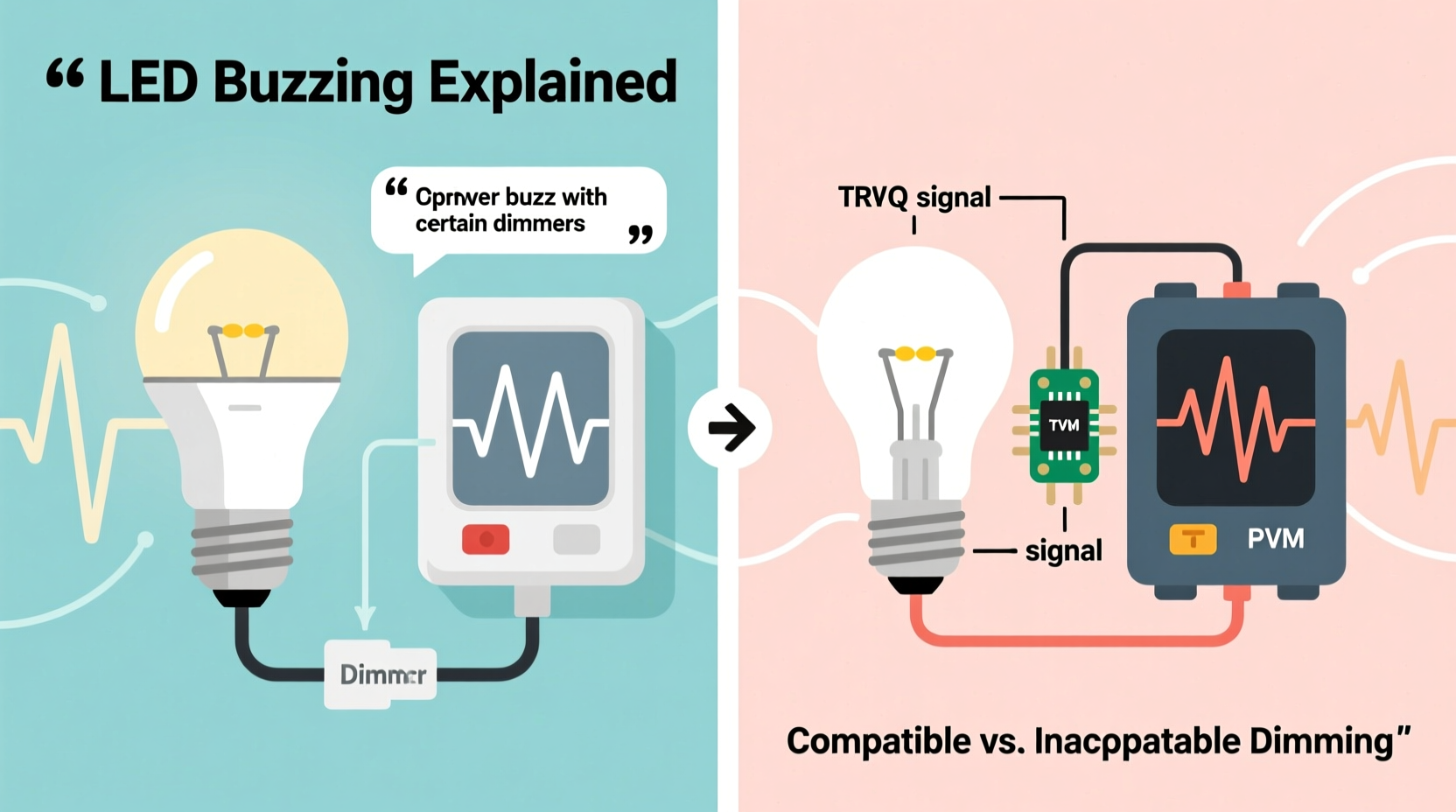
Traditional dimmer switches operate by \"chopping\" parts of the AC voltage waveform to reduce power delivered to the light source. This method, known as phase-cut dimming, comes in two primary forms: leading-edge and trailing-edge dimming.
- Leading-edge dimmers: Commonly used with incandescent and halogen bulbs, these cut the initial part of the AC wave. They’re inexpensive and robust but rely on a minimum load (typically 40–60 watts) to function correctly.
- Trailing-edge dimmers: Designed for electronic loads like LEDs, they cut the latter part of the waveform. These are more precise, quieter, and better suited for low-wattage devices.
Incandescent bulbs respond smoothly to reduced voltage because their filament naturally resists changes in current. LEDs, however, use internal drivers to convert AC to DC power. When a leading-edge dimmer delivers an inconsistent or unstable signal, the driver struggles to regulate power, causing audible vibrations in components—heard as buzzing.
“Many people don’t realize that not all dimmers are created equal. Using an old-style dimmer with LED bulbs is like putting diesel fuel in a gasoline engine—it might run, but it won’t run well.” — Mark Reynolds, Electrical Systems Engineer, Lighting Innovation Group
Common Causes of LED Buzzing with Dimmers
Buzzing doesn’t occur randomly. It’s typically the result of one or more technical mismatches. Identifying these causes is essential to resolving the problem effectively.
1. Incompatible Dimmer Type
As mentioned, leading-edge dimmers were built for high-load incandescent circuits. LEDs draw significantly less power—often under 10 watts per bulb. A circuit with three 9-watt LED bulbs totals only 27 watts, potentially below the dimmer’s minimum load threshold. This leads to erratic operation and buzzing.
2. Poor-Quality LED Drivers
The driver inside an LED bulb regulates current and voltage. Cheap or outdated drivers lack precision filtering and noise suppression. When subjected to chopped waveforms from incompatible dimmers, internal capacitors and coils vibrate audibly.
3. Overloaded or Underloaded Circuits
While underloading is common, overloading can also be problematic. Exceeding the dimmer’s maximum wattage rating—even within LED equivalents—can strain components and generate heat and noise.
4. Mixed Bulb Types on One Circuit
Running a mix of LED and incandescent bulbs on the same dimmer creates uneven load distribution. The differing electrical characteristics confuse the dimmer, leading to instability and buzzing in the LEDs.
Solutions: How to Eliminate LED Buzzing
Resolving buzzing requires matching components properly and sometimes upgrading hardware. The good news is that most issues are fixable without rewiring your entire home.
Replace the Dimmer Switch
The most effective long-term solution is replacing outdated leading-edge dimmers with modern trailing-edge (electronic low-voltage or ELV) models. These are specifically engineered for low-wattage, capacitive loads like LED drivers.
When selecting a new dimmer, ensure it:
- Specifies compatibility with LED bulbs
- Lists a low minimum load (e.g., 5–10 watts)
- Supports the total wattage of your connected LEDs
- Is listed as “MLC” (multi-location control) if used with multiple switches
Upgrade to High-Quality Dimmable LEDs
Not all “dimmable” LEDs are equal. Premium brands invest in advanced drivers with smoother current regulation and better electromagnetic interference (EMI) shielding. While more expensive upfront, they deliver silent operation and longer life.
Add a Bypass Resistor (Load Simulator)
In cases where the total LED load is too low for the dimmer to function stably, installing a shunt resistor or “dummy load” can simulate additional wattage. These devices absorb excess voltage and stabilize the circuit, eliminating flicker and buzz.
However, resistors generate heat and consume energy continuously, so they should be installed in accessible junction boxes with proper ventilation. They are best used as a temporary or supplementary fix.
Use Manufacturer-Matched Systems
For optimal performance, pair LEDs and dimmers from the same brand or ecosystem. Companies like Lutron, Philips Hue, and Leviton offer fully integrated systems tested for seamless operation. For example, Lutron’s Caséta line includes dimmers certified for specific LED models, minimizing compatibility risks.
“Matching components isn’t just about convenience—it’s about engineering synergy. When the dimmer and driver speak the same language, you get smooth dimming, no noise, and no flicker.” — Sarah Lin, Senior Product Designer at BrightWave Lighting
Compatibility Checklist: Avoid Buzzing Before Installation
Before purchasing or installing any LED bulb or dimmer, use this checklist to prevent issues:
- Confirm the LED bulb is labeled “dimmable” (not all are).
- Check the manufacturer’s compatibility list for your dimmer model.
- Verify the dimmer supports low-wattage LED loads (look for min/max ratings).
- Calculate total wattage of all bulbs on the circuit—ensure it falls within the dimmer’s range.
- Avoid mixing LED and non-LED bulbs on the same dimmed circuit.
- Choose trailing-edge dimmers for new LED installations.
- Consider smart dimmers with adaptive learning for variable loads.
Real-World Example: A Homeowner’s Fix
Jessica R., a homeowner in Portland, installed new LED recessed lights in her living room and dining area. She reused existing wall dimmers, assuming “dimmable” bulbs would work fine. Within days, a faint but persistent buzzing emerged when lights were dimmed below 70%.
After ruling out loose fixtures and checking connections, she contacted the bulb manufacturer. Support staff reviewed her setup and identified the core issue: her 15-year-old leading-edge dimmer required a minimum 40-watt load, but her six 8-watt LED cans totaled only 48 watts—just above the threshold, but insufficient for stable operation at lower levels.
The solution? She replaced the dimmer with a Lutron Diva DVTRAIL, a trailing-edge model rated for loads as low as 5 watts. The buzzing stopped immediately, and dimming became smooth and silent. Total cost: $35 for the dimmer and 30 minutes of installation time.
This case illustrates how even marginally compatible setups can fail under real-world conditions. Small gaps in specifications lead to noticeable performance issues.
Comparison Table: Leading-Edge vs. Trailing-Edge Dimmers
| Feature | Leading-Edge Dimmer | Trailing-Edge Dimmer |
|---|---|---|
| Best For | Incandescent, halogen bulbs | LED, CFL, low-voltage lighting |
| Minimum Load | 40–60 watts typical | 5–10 watts typical |
| Dimming Smoothness | Less precise at low levels | Smooth down to 1–5% |
| Noise Level | Prone to buzzing with LEDs | Quiet operation when matched |
| Cost | $10–$20 | $20–$50+ |
| Lifespan with LEDs | Shortened due to stress | Optimal performance and longevity |
Choosing the right dimmer isn’t just about cost—it’s about long-term functionality and user comfort.
Step-by-Step Guide to Troubleshooting LED Buzzing
If you’re already experiencing buzzing, follow this logical sequence to diagnose and resolve the issue:
- Turn off the power at the circuit breaker for safety.
- Inspect the bulbs: Are they labeled “dimmable”? Replace non-dimmable LEDs immediately.
- Check the dimmer switch model: Remove the faceplate and read the label. Search online for its compatibility with LEDs.
- Calculate total load: Add up the wattage of all bulbs on the circuit. Compare to the dimmer’s minimum and maximum ratings.
- Test with full brightness: Turn the system on. If buzzing stops at 100%, the issue is likely dimmer-related, not the bulb itself.
- Try a known-compatible bulb: Temporarily install a high-quality, manufacturer-recommended LED to isolate the problem.
- Upgrade the dimmer: Install a trailing-edge model suitable for LEDs if mismatch is confirmed.
- Re-evaluate after replacement: Test across all dimming levels. If buzzing persists, consult a licensed electrician—there may be wiring or neutral wire issues.
Frequently Asked Questions
Can buzzing damage my LED lights?
Yes, prolonged buzzing indicates electrical stress on the driver. Over time, this can degrade internal components, shorten lifespan, and increase failure risk. While not an immediate fire hazard, chronic incompatibility reduces reliability.
Why do some dimmable LEDs still buzz even with a compatible dimmer?
Even with correct pairing, manufacturing variances, poor batch quality, or aging components can cause noise. Additionally, household voltage fluctuations or shared circuits with motors (like HVAC systems) can introduce interference. Try replacing one bulb at a time to identify faulty units.
Do smart dimmers solve buzzing issues?
Many smart dimmers—especially those using zero-crossing detection or PWM (pulse-width modulation)—are designed specifically for LEDs and minimize buzzing. Brands like Lutron, TP-Link Kasa, and Loxone offer models with adaptive algorithms that adjust to load changes. However, compatibility must still be verified.
Final Thoughts: Silence the Buzz, Maximize Performance
The shift to LED lighting demands updated expectations and tools. What worked flawlessly for decades with incandescent bulbs doesn’t translate directly to solid-state lighting. Buzzing is not normal—and it’s not something you have to live with. By understanding the technical relationship between dimmers and LED drivers, you gain control over your lighting environment.
Investing in compatible components pays off in comfort, durability, and performance. Whether you’re building new or upgrading existing systems, take the time to match LEDs with the right dimmers. Your ears—and your eyes—will thank you.




 浙公网安备
33010002000092号
浙公网安备
33010002000092号 浙B2-20120091-4
Comments
No comments yet. Why don't you start the discussion?