
LED string lights are celebrated for their energy efficiency, longevity, and vibrant illumination. Yet, many consumers have noticed an odd phenomenon: the first few bulbs in a new string of LEDs emit a slightly bluer light than the rest. This subtle but noticeable shift in color temperature can be puzzling—especially when the product is marketed as having uniform warm white or soft white lighting. The answer lies not in defective units, but in the intricacies of LED manufacturing, thermal dynamics, and binning processes.
This variation isn’t a flaw in the traditional sense, but rather a consequence of how LEDs are produced at scale. Understanding this requires a closer look at semiconductor physics, production tolerances, and real-world performance under varying conditions.
The Role of LED Binning in Color Consistency
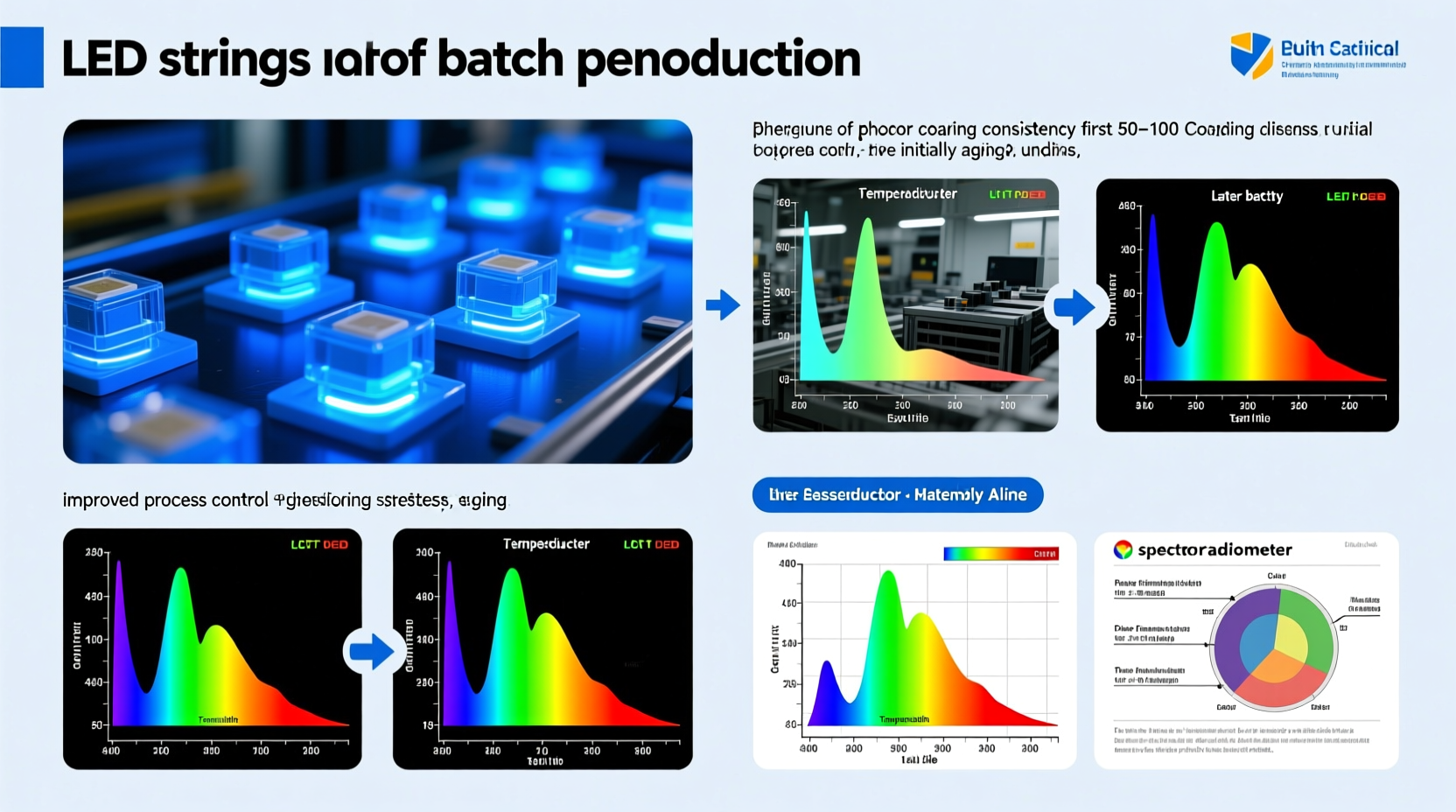
When LEDs are manufactured, they are created from semiconductor wafers cut into tiny chips. Even with precise control over materials and processes, microscopic variations occur across the wafer. These variations affect the wavelength of light emitted—essentially determining whether the LED leans toward blue, green, or red within the white spectrum.
To manage these inconsistencies, manufacturers use a process called binning. After production, LEDs are tested and sorted into \"bins\" based on key characteristics:
- Color temperature (measured in Kelvin)
- Luminous flux (brightness)
- Forward voltage
- Chromaticity coordinates (CIE values)
While high-end lighting products use tight binning to ensure minimal variation, budget-friendly LED strings often draw from broader bins. This means slight differences in color output between individual LEDs are more likely—especially during initial operation.
Thermal Dynamics and Early-Run Behavior
One of the most significant factors behind the blue tint in early-run LEDs is temperature. When an LED string is first powered on, the initial LEDs in the circuit heat up faster than those further down the line. This uneven thermal distribution affects the forward voltage and junction temperature of each diode.
LEDs exhibit a phenomenon known as temperature-dependent wavelength shift. As the semiconductor junction heats up, the bandgap energy decreases slightly, causing the emitted light to shift toward longer wavelengths—i.e., warmer tones. Conversely, cooler LEDs tend to appear slightly bluer.
In a typical string configuration, the first few LEDs receive power directly from the source and may operate at a lower temperature initially due to shorter current paths and less cumulative resistance. However, because they’re also the first to activate, any transient thermal imbalance can create a momentary visual discrepancy.
“Even a 5°C difference in junction temperature can result in a perceptible shift in chromaticity, especially in the 2700K–3000K range.” — Dr. Alan Zhou, Solid-State Lighting Researcher, Pacific Northwest National Lab
Manufacturing Sequence and Batch Run Effects
The term “batch run” refers to the continuous production of LED strings using the same equipment settings over a set period. During a long production cycle, minor drifts in machine calibration, ambient humidity, or material feed rates can influence LED performance.
Early in the batch, machinery may still be stabilizing—thermal chambers reaching optimal temperatures, soldering irons achieving steady heat, or dispensing systems calibrating adhesive volume. These micro-variations can lead to subtle differences in encapsulation thickness, phosphor coating uniformity, or die attachment alignment—all of which impact color output.
Additionally, the phosphor layer that converts blue LED light into white light must be applied with extreme precision. A thinner phosphor coating results in more residual blue light passing through, creating a cooler appearance. If the coating system hasn't fully stabilized at the start of the run, early units may end up with marginally less phosphor coverage.
How Phosphor Coating Impacts Color Temperature
Most white LEDs use a blue LED chip coated with a yellow phosphor blend (often cerium-doped yttrium aluminum garnet, or YAG:Ce). The combination of blue and yellow light produces white. However, the ratio and thickness of this coating determine the final color temperature:
| Phosphor Thickness | Resulting Light Output | Perceived Color |
|---|---|---|
| Thin | More unconverted blue light | Cool/Blue-tinted |
| Optimal | Balanced blue-yellow mix | Warm White (2700K–3000K) |
| Excessive | Overly yellow/orange cast | Amber/Warm |
Early in a production batch, if the phosphor deposition system is ramping up, the first few thousand units might fall on the thinner side of the acceptable range—leading to a faint blue bias visible only upon close inspection.
Electrical Load Distribution Along the String
Another contributing factor is electrical load distribution. In low-voltage DC LED strings (typically 12V or 24V), voltage drops slightly along the length of the wire due to resistance. This means the first few LEDs receive marginally higher voltage than those at the end.
Higher voltage increases current flow through the LED, which raises junction temperature more quickly. While this would normally push the light toward warmer tones, there’s a catch: the relationship isn’t linear. At startup, the rapid increase in current can cause a brief spike in blue intensity before thermal equilibrium is reached.
Moreover, driver circuits in inexpensive strings may lack active current regulation. Without constant-current drivers, early LEDs can experience transient overdrive, enhancing their initial blue output.
Mini Case Study: Holiday Display Installation
A landscape designer in Portland installed 12 identical 50-light warm white LED strings around a client’s porch railing. Upon turning them on, she noticed that the leftmost section—where the plug was located—appeared subtly cooler than the right end.
She documented the change over 15 minutes. Initially, the first six bulbs had a measurable 300K higher color temperature than the rest. After 10 minutes of operation, the difference faded almost entirely. By the 15-minute mark, all strings appeared visually uniform.
Using a calibrated spectrometer, she confirmed that the early-run LEDs started at ~3100K while the others began at ~2800K. Within 12 minutes, all settled near 2950K. The conclusion? Thermal stabilization eliminated the visible discrepancy.
This case illustrates that what appears to be a defect is often just a temporary state during warm-up—particularly pronounced in tightly packed installations where airflow is limited.
Quality Control and Consumer Expectations
Manufacturers face a balancing act between cost, throughput, and quality. High-volume producers may accept minor variations in early-run units as within specification, especially if automated vision systems don’t flag them during final inspection.
Human eyes are particularly sensitive to green-magenta shifts and blue-yellow gradients in white light. What machines classify as “within MacAdam step 3” (a standard for acceptable color variance) may still be noticeable to discerning observers—especially when multiple strings are used side by side.
Some brands address this by discarding or repurposing early-run units for non-critical applications. Others incorporate burn-in testing, where strings operate for several hours before packaging to stabilize performance.
Step-by-Step Guide to Minimizing Blue Tint Issues
If you're using LED strings in a setting where color consistency matters—such as interior décor, event lighting, or commercial displays—follow this sequence to reduce visibility of early-run blue tints:
- Unbox and inspect all strings under consistent lighting to identify obvious outliers.
- Power on all units together and let them run for 15–20 minutes in the environment where they’ll be used.
- Re-evaluate color uniformity after warm-up; many discrepancies will resolve themselves.
- Rotate or reposition strings so that early-run sections aren’t clustered in one area.
- Use diffusers or covers (like fabric shades or acrylic tubes) to soften and blend light output.
- Consider grouping by lot number if purchasing in bulk—avoid mixing very early and late batch runs in the same visual field.
Checklist: Choosing Consistent LED Strings
Before buying, ask yourself or the supplier these questions to avoid color inconsistency issues:
- ✅ Are the LEDs from a single production batch?
- ✅ Does the manufacturer specify binning standards (e.g., ANSI C78.377 or MacAdam steps)?
- ✅ Is there a constant-current driver or current-limiting resistors on each LED?
- ✅ Has the product undergone burn-in testing?
- ✅ Can I purchase a sample first to test color consistency?
- ✅ Are the strings rated for the intended operating temperature range?
Frequently Asked Questions
Is a blue tint a sign my LED string is defective?
Not necessarily. A slight blue hue during the first few minutes of operation is common and usually resolves as the LEDs reach thermal equilibrium. Only consider it defective if the tint persists after 20+ minutes of use or differs significantly from adjacent strings under the same conditions.
Can I fix the blue tint myself?
There’s no physical modification you can make to alter the phosphor coating or semiconductor properties. However, you can mitigate perception by using frosted sleeves, blending with other light sources, or allowing sufficient warm-up time before evaluation.
Do more expensive LED strings avoid this issue?
Generally, yes. Higher-priced models often use tighter binning, better thermal management, regulated drivers, and pre-burn-in procedures. They’re also more likely to come from controlled batch environments with real-time quality monitoring.
Conclusion: Embracing the Nuances of LED Technology
The faint blue tint observed in early-run LED strings is not a flaw, but a window into the complex world of semiconductor manufacturing and thermal physics. It reflects the reality that even in highly automated processes, natural variation exists—and human perception is remarkably acute when it comes to light quality.
By understanding the causes—binning tolerances, thermal transients, phosphor application, and electrical dynamics—consumers and professionals alike can make informed choices, set realistic expectations, and deploy strategies to ensure visually cohesive lighting.
Next time you notice that subtle coolness in the first few bulbs, remember: it’s not broken. It’s just science warming up.




 浙公网安备
33010002000092号
浙公网安备
33010002000092号 浙B2-20120091-4
Comments
No comments yet. Why don't you start the discussion?