
Every December, as families gather to trim their Christmas trees, a subtle but deliberate ritual unfolds in homes across North America, the UK, and parts of Northern Europe: the tree is adorned with dozens—sometimes hundreds—of ornaments, yet one spot remains intentionally bare. Not forgotten. Not overlooked. Left empty on purpose. This quiet omission carries more weight than its silence suggests. It is not superstition, nor oversight—it is inheritance. A gesture passed down through whispered instructions, handwritten notes tucked into ornament boxes, or the gentle pause a grandparent makes before stepping back from the tree. To understand why some people leave one ornament off the tree is to trace a lineage of faith, memory, resilience, and quiet hope.
The Religious Roots: The Empty Space as Sacred Invitation
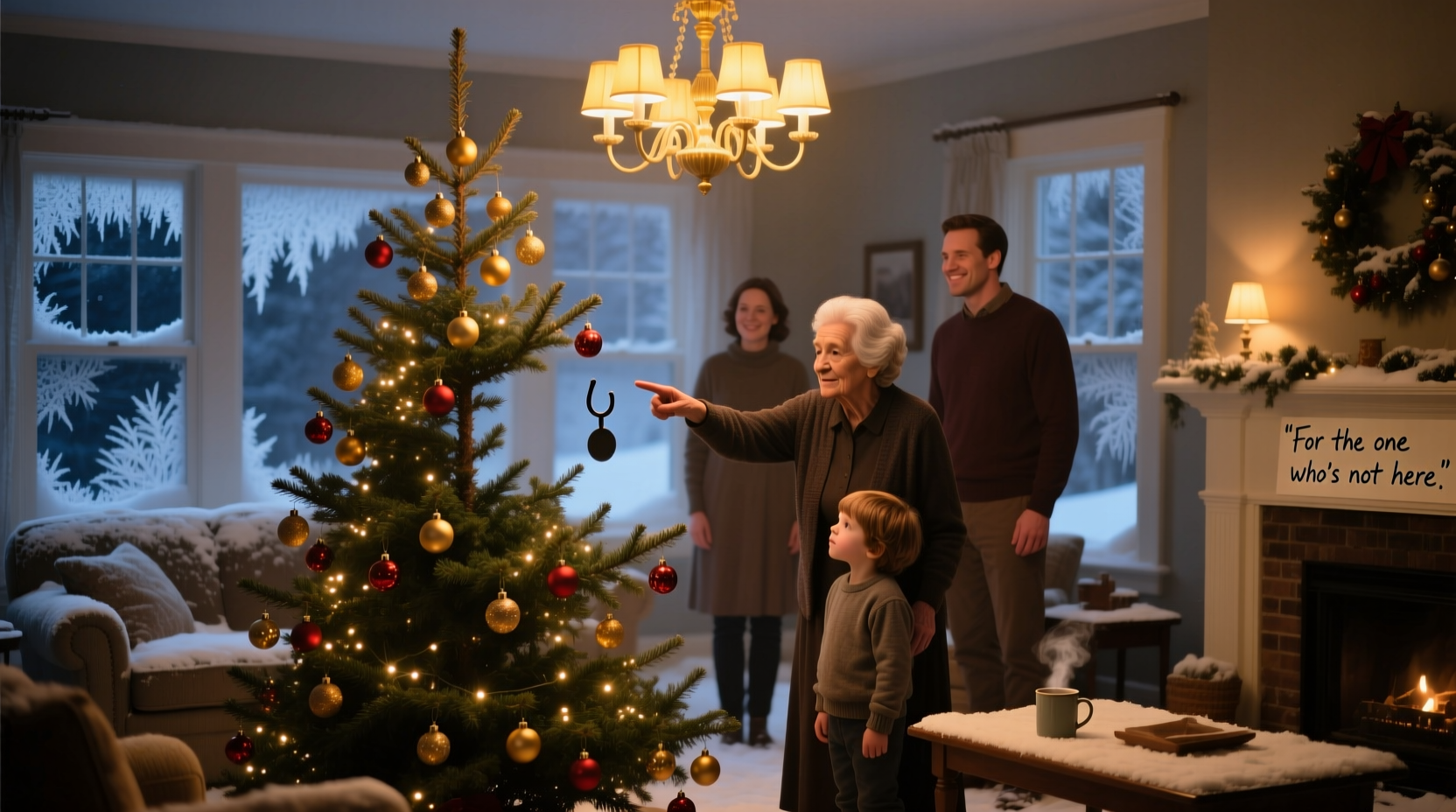
The most widely documented origin of this practice lies in Christian tradition—specifically within Catholic, Anglican, and some Lutheran communities—where the unfilled branch tip symbolizes anticipation of Christ’s arrival. Unlike the nativity scene, which depicts the completed Incarnation, the tree represents the *waiting*. The missing ornament mirrors the theological concept of *adventus*: the coming, not the arrival. In medieval liturgical practice, Advent was observed as a season of solemn preparation—not festivity, but fasting, reflection, and expectant stillness. An unadorned space on the tree visually echoes that spiritual posture.
This idea gained renewed resonance during the Counter-Reformation, when religious symbolism was deliberately embedded into domestic rituals to reinforce doctrine amid rising Protestant emphasis on scripture alone. Families would hang ornaments representing biblical figures—Noah’s dove, Jonah’s whale, Ruth’s sheaf—but reserve the highest bough for the “Christ ornament,” often a plain white dove or a simple silver star. That ornament remained unwrapped until Christmas Eve, when it was placed by the youngest child—a symbolic act of welcoming the divine into the home. The empty space wasn’t absence; it was consecrated readiness.
“An ornament left undone isn’t incomplete—it’s expectant. In liturgical time, waiting isn’t passive. It’s the most active kind of hope.” — Dr. Eleanor Vance, Liturgical Historian, University of Durham
The Grief Tradition: Honoring Absence with Intentional Emptiness
In the 20th century, particularly after the World Wars and during periods of widespread displacement, the tradition evolved to serve another profound human need: mourning. Families who lost loved ones—especially children or young adults—began using the empty hook or branch as a silent memorial. No label, no explanation needed. Just space. One less bauble became a vessel for presence-in-absence. Psychologists working with bereaved families in the 1950s noted how this small, nonverbal ritual helped children process loss without language: “It’s where Grandma’s light goes,” a seven-year-old told a social worker in 1953, pointing to the topmost bare twig.
This adaptation persists today—not only among military families, but also in households touched by addiction, illness, or sudden loss. The ornament isn’t “missing”; it’s held in reserve. Some families place a single candle beside the tree each year on the anniversary date, lighting it beside the empty space. Others write a short message on parchment and tuck it behind the trunk, near the base of the bare branch—never read aloud, but known to be there.
The Practical Origins: A Craftsmanship Legacy
Beyond theology and emotion, there’s a tangible, hands-on history embedded in this custom—one rooted in craftsmanship and community. Before mass-produced ornaments flooded markets in the 1930s, most families made their own: dipped apples in sugar, folded paper stars, carved wooden angels, or strung popcorn and cranberries. These were labor-intensive, seasonal projects done collectively—often over several evenings in late November.
Historians examining diaries from rural Pennsylvania and Yorkshire between 1880–1920 found repeated references to “the last ornament”—a piece reserved for Christmas Eve, made by the youngest child under supervision. Its creation was part of the ritual: not just decoration, but participation. Leaving that final ornament unwrapped, unplaced, or even unfinished served a dual purpose. First, it preserved the child’s sense of agency—their contribution mattered enough to be timed with reverence. Second, it prevented overcrowding: early trees, especially live firs, shed needles rapidly. Over-ornamenting risked imbalance, breakage, or fire hazard near candles. One intentional gap ensured structural integrity and visual breathing room.
| Era | Typical Ornament Count | Reason for Reserved Spot |
|---|---|---|
| Pre-1900 (Handmade Era) | 12–24 | Child’s final ornament; structural balance; candle safety |
| 1920s–1940s (Early Glass Era) | 30–60 | Symbolic “Christ ornament”; family photo placement |
| 1970s–Present (Mass-Produced) | 75–200+ | Memory marker; grief ritual; aesthetic intentionality |
A Modern Revival: Mindfulness, Minimalism, and Meaning-Making
In the last fifteen years, the tradition has reemerged—not as nostalgia, but as conscious resistance. Amid hyper-curated social media feeds where every tree must be “Instagram-perfect,” the deliberate omission stands out as an act of anti-perfectionism. Interior designers report increasing client requests for “intentional negative space” on trees—often citing mental health benefits. “People tell me they feel calmer looking at a tree with rhythm, not saturation,” says interior stylist Maya Chen, whose 2022 book *The Unfilled Branch* explores design as emotional practice.
This revival intersects with broader cultural shifts: the rise of mindfulness practices, the popularity of Japanese concepts like *ma* (negative space as essential to composition), and growing awareness of decision fatigue. Choosing *not* to fill a space requires more focus—and more meaning—than automatic completion. Neuroscientists have observed that moments of intentional pause activate the default mode network, associated with self-referential thought and autobiographical memory. In other words, that empty hook doesn’t just hold absence—it holds attention.
Mini Case Study: The O’Malley Family, Portland, Oregon
When Liam O’Malley’s younger sister died of leukemia at age nine in 2017, his parents removed all ornaments from their 7-foot Douglas fir the following December—not out of despair, but necessity. “We couldn’t face the noise of cheer,” his mother recalled. With guidance from a grief counselor, they began anew: buying one new ornament each year, inscribed with the date and a single word (“Brave,” “Sunlight,” “Laughter”). But they kept the topmost branch bare. Each year, Liam—who was twelve at the time—places a fresh white pinecone there on Christmas Eve, collected from the same trail where he and his sister used to hike. “It’s not about filling her space,” he said in a 2023 school essay. “It’s about keeping the shape of her in our hands.” Now seventeen, Liam leads a high school grief support group where students create “memory branches” on classroom trees—each with one intentional gap.
How to Practice the Tradition with Purpose (Step-by-Step)
Adopting this custom shouldn’t feel like adding another obligation to holiday prep. Done well, it deepens connection rather than burdening it. Here’s how to integrate it meaningfully:
- Choose your intention first. Decide whether this is for remembrance, spiritual anticipation, aesthetic balance, or intergenerational teaching. Write it on a slip of paper and seal it in an envelope labeled “Why This Space Is Held.”
- Select a consistent location. Top branch? Center-right at eye level? Near the trunk base? Consistency builds recognition—especially for children.
- Mark it subtly. Use a plain, natural material: a single pinecone, a smooth river stone wrapped in twine, or a small brass hook with no ornament attached. Avoid anything flashy—it should invite quiet, not draw eyes.
- Explain simply when asked. “This is where we remember Aunt Clara,” or “This is the space we keep open for hope,” or “This is where the light waits to land.” No elaboration needed unless requested.
- Revisit it annually. On Christmas Eve, take 60 seconds as a family to stand together before the tree and acknowledge the space—not with sadness or pressure, but with shared breath and presence.
FAQ
Is this tradition tied to a specific religion?
No. While its earliest documented roots are Christian, the practice has been secularized and adapted across spiritual traditions—including Jewish families marking a loved one’s yahrzeit, Buddhist households honoring impermanence, and atheist families using the space to reflect on collective human resilience. Its power lies in universality, not doctrine.
What if I forget and hang everything?
That’s part of the tradition too. Many families treat the “forgotten ornament” as a gentle reminder—not a failure. Some even keep a small, undecorated bauble in a drawer labeled “The One We Remember Later.” The ritual isn’t about perfection; it’s about returning to meaning, even mid-process.
Can children participate meaningfully?
Absolutely—and often most authentically. Children intuitively grasp symbolic emptiness. One kindergarten teacher in Vermont reports that her students consistently identify the “quiet spot” on their classroom tree as “where the tree takes a breath.” Encourage drawing, storytelling, or placing a small object (a feather, a button, a seashell) in the space—not to fill it, but to honor its role.
Conclusion
The tradition of leaving one ornament off the tree endures because it meets us where we are: in faith and doubt, in joy and sorrow, in abundance and scarcity. It asks nothing of us except honesty—to admit that some spaces remain sacred not because they’re filled, but because they’re held. In a world that measures worth in likes, lists, and lit-up perfection, this small, unlit branch offers something rarer: permission to pause, to remember, to wait, to breathe. It is not lack. It is fullness measured differently.
You don’t need to start grand. This year, choose one hook. Leave it bare. Notice what arises—not just in the space, but in yourself. Then, next year, decide again: will you keep the space? Change its meaning? Invite someone else to name it? Traditions aren’t inherited like heirlooms; they’re renewed like breath—each time, consciously, quietly, fully.




 浙公网安备
33010002000092号
浙公网安备
33010002000092号 浙B2-20120091-4
Comments
No comments yet. Why don't you start the discussion?