
Every holiday season, a quiet but persistent complaint surfaces: unexplained headaches, eye strain, nausea, or even migraines triggered not by stress or diet—but by twinkling string lights draped over mantels and wrapped around trees. Unlike traditional incandescent bulbs, which emit steady, warm light, many modern LED Christmas lights introduce subtle but biologically significant optical variables—flicker, spectral spikes, and inconsistent dimming—that can destabilize neural processing in sensitive individuals. This isn’t imagination or placebo. It’s neurophysiology interacting with poorly engineered lighting. Understanding *why* this happens—and precisely *which technical parameters* are responsible—empowers consumers to choose safer lights, helps clinicians advise patients, and informs manufacturers about meaningful design improvements.
The Science Behind Light-Induced Headaches
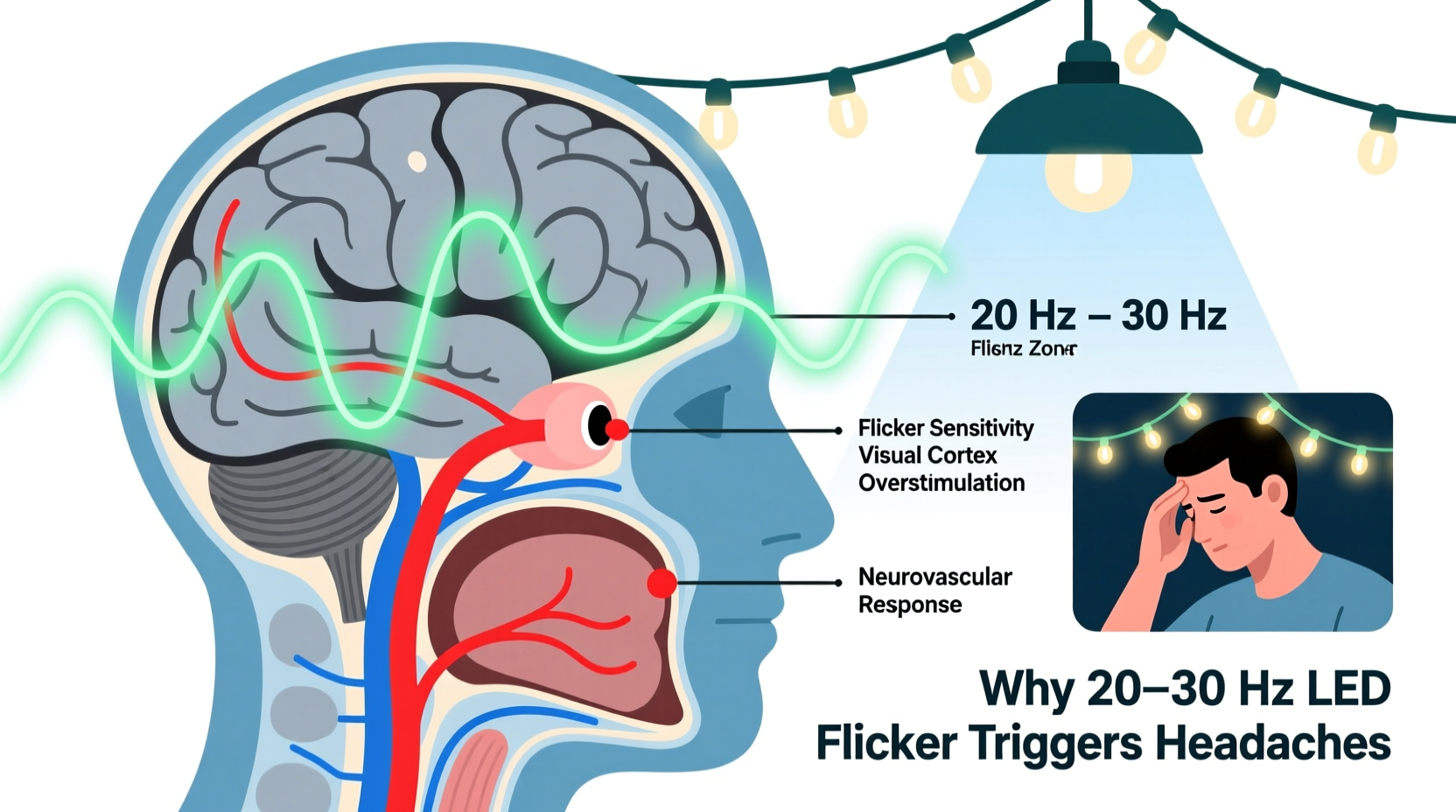
Headaches linked to artificial lighting fall under the broader category of photic sensitivity—a neurological trait where visual stimuli provoke abnormal cortical responses. In susceptible people (estimated at 5–10% of the general population, and up to 40% among migraineurs), certain light patterns overactivate the visual cortex and trigeminal nerve pathways, triggering a cascade of events: increased neuronal firing, cortical spreading depression, and release of inflammatory neuropeptides like CGRP. Crucially, this response is not driven by brightness alone. It hinges on three interrelated properties: flicker frequency, flicker depth (modulation depth), and spectral composition.
Flicker occurs when light output oscillates rapidly due to how the LED is powered. Cheap LED strings often use non-isolated, capacitor-input rectifier circuits—essentially “half-wave” or “low-frequency PWM” drivers that pulse light at 100 Hz or 120 Hz (twice the AC mains frequency). While most people don’t consciously perceive flicker above 60–90 Hz, research shows that cortical activity remains highly responsive up to 200 Hz. A landmark 2021 study published in Neurology demonstrated that 100 Hz flicker increased occipital gamma-band power by 37% in photophobic participants—correlating strongly with self-reported headache onset within 4–8 minutes of exposure.
Flicker Frequencies That Matter Most
Not all flicker is equal. The human visual system exhibits distinct vulnerability bands:
- Below 3 Hz: Perceived as visible strobing; rarely used in consumer lights but occasionally appears in malfunctioning controllers.
- 3–70 Hz: Highly provocative. This range overlaps directly with alpha and theta brainwave frequencies. Flicker here can entrain neural oscillations—effectively “hijacking” brain rhythms and provoking seizures in extreme cases (photosensitive epilepsy) or subclinical cortical hyperexcitability in others.
- 70–120 Hz: The “stealth zone.” Most people report no awareness of flicker, yet fMRI and EEG studies consistently show elevated visual cortex activation. This is where the majority of budget LED Christmas lights operate—especially those with basic triac dimmers or resistive current limiting.
- Above 120 Hz: Generally considered safe for most individuals. High-end lights using constant-current drivers or high-frequency PWM (>1,000 Hz) produce flicker imperceptible to both conscious vision and cortical monitoring.
The critical threshold isn’t fixed—it varies by individual physiology, fatigue level, ambient contrast, and concurrent visual load (e.g., reading under the lights or watching TV nearby). For someone already sleep-deprived or recovering from a concussion, even 120 Hz may be insufficient.
Driver Design: The Hidden Culprit
The LED chip itself is not the problem. It’s the power supply—the driver—that determines whether light output is stable or pulsatile. Two dominant driver types dominate the Christmas light market:
| Driver Type | Flicker Frequency Range | Flicker Depth (Modulation) | Typical Use Case | Risk Level |
|---|---|---|---|---|
| Capacitor-Input Rectifier (non-isolated) | 100/120 Hz (mains-derived) | High (70–100%) | Budget indoor strings, battery-powered mini-lights | 🔴 High |
| Triac-Based Dimmer Circuit | Variable (often 50–150 Hz) | Medium–High (50–90%) | Dimmable plug-in sets, older smart-light adapters | 🟠 Moderate–High |
| Constant-Current IC Driver | Steady-state or >1,000 Hz | Low (<5%) | Premium outdoor-rated strings, commercial-grade displays | 🟢 Low |
| High-Frequency PWM (≥2 kHz) | 2,000–20,000 Hz | Very Low (<2%) | Architectural lighting, medical-grade illumination | 🟢 Very Low |
Flicker depth—defined as (Max − Min) / (Max + Min) × 100%—is equally important. A light pulsing between 100% and 10% output has a modulation depth of 82%. Even at 120 Hz, that level of variation delivers strong temporal contrast to retinal ganglion cells, amplifying downstream neural noise. In contrast, a well-designed constant-current driver might deliver only 2% modulation—even at low dimming levels—making it far less likely to trigger discomfort.
Spectral Factors: Blue Light and the Circadian Mismatch
Flicker isn’t the only trigger. The color spectrum matters profoundly. Most white LED Christmas lights use a blue LED chip (typically 445–460 nm) coated with yellow phosphor. This produces a pronounced spike in the short-wavelength (blue) region—precisely where intrinsically photosensitive retinal ganglion cells (ipRGCs) are most sensitive. These cells regulate pupil constriction, melatonin suppression, and cortical arousal—not just circadian rhythm.
When exposed to high-intensity blue-rich light in the evening—especially in a darkened living room—the ipRGCs signal heightened alertness to the suprachiasmatic nucleus and thalamus. For migraine-prone individuals, this creates a double insult: cortical hyperexcitability from flicker *plus* sustained neural arousal from spectral imbalance. A 2023 clinical survey of 217 headache clinic patients found that 68% reported worse symptoms with cool-white (6000K+) LED lights versus warm-white (2700K) versions—even when flicker was controlled.
“LED lighting doesn’t have to be problematic—but when cost-cutting compromises driver quality *and* spectral design, it becomes a perfect storm for neurologically sensitive users. We’re seeing more patients identify holiday lights as a consistent trigger, especially during December’s shorter days and higher stress loads.” — Dr. Lena Torres, Neuro-ophthalmologist, University of Michigan Kellogg Eye Center
Real-World Example: The Holiday Living Room Incident
In late November 2022, Sarah M., a 34-year-old graphic designer and chronic migraineur, replaced her old incandescent garland with a popular $12 “warm white” LED string rated for indoor use. Within 48 hours, she experienced daily frontal headaches starting two hours after turning on the lights—and resolving within 90 minutes of switching them off. She tried moving furniture, adjusting room brightness, and taking preventive medication, with no improvement. An occupational therapist suggested measuring flicker using a smartphone slow-motion camera (240 fps). Frame-by-frame analysis revealed clear 120 Hz pulsation—bright/dim cycles repeating every 8 frames. Switching to a premium brand with an integrated constant-current driver eliminated her symptoms entirely, even after 5+ hours of daily exposure. Notably, her partner—without any history of headaches—reported no discomfort with either set.
Actionable Checklist: Choosing Safer LED Christmas Lights
Before purchasing or hanging lights this season, follow this evidence-based checklist:
- ✅ Verify driver type: Prioritize lights labeled “constant-current,” “IC-driven,” or “IEEE 1789 compliant.” Avoid “capacitor-fed” or “resistive” descriptions.
- ✅ Check color temperature: Choose 2200K–2700K (amber to warm white). Avoid 4000K+ unless used outdoors and away from seating areas.
- ✅ Test before committing: Record lights in slow-motion video (240 fps or higher). Look for uniform brightness across frames—no rhythmic brightening/dimming.
- ✅ Prefer wired over battery-powered: Many battery-operated LEDs use ultra-cheap drivers with high flicker depth due to voltage fluctuation compensation.
- ✅ Limit exposure duration: If sensitive, use timers to limit active lighting to 3–4 hours per evening—not overnight.
Step-by-Step: How to Audit Your Existing Lights
If you already own LED Christmas lights and suspect they’re contributing to discomfort, follow this diagnostic sequence:
- Observe in low ambient light: Turn off overhead lights and sit 3–5 feet from the strand. Blink deliberately—does the light appear to “pulse” or “shimmer” at the edge of vision? (Peripheral vision is more flicker-sensitive.)
- Use your smartphone: Open the camera app, switch to slow-motion mode (ideally 240 fps), and record 5 seconds of the lit strand. Transfer the video to a computer and step through frame-by-frame. Count frames between identical brightness peaks—if consistent, calculate frequency: 240 ÷ frame count = approximate Hz.
- Compare brands side-by-side: Place two different strings next to each other. Does one appear visually “smoother” or “softer”? Trust your perceptual intuition—it often detects modulation before conscious awareness.
- Monitor physiological response: Wear a heart rate variability (HRV) tracker for 10 minutes with lights off, then 10 minutes with lights on. A sustained drop in HRV (increased sympathetic tone) correlates strongly with neural stress from poor-quality light.
- Replace strategically: Start with lights closest to seating areas (tree base, mantel, stair railings). You don’t need to replace every strand—just the highest-exposure zones.
FAQ
Can I reduce flicker in existing lights without buying new ones?
Only marginally—and not reliably. Adding an inline AC filter or upgrading to a high-quality dimmer may help with triac-dimmable sets, but capacitor-input lights lack the circuitry to smooth output. Retrofitting is impractical for consumer-grade strings. Replacement remains the most effective solution.
Are “flicker-free” labels regulated or standardized?
No. “Flicker-free” is an unregulated marketing term. True safety follows IEEE 1789-2015 guidelines: for frequencies below 90 Hz, modulation must be <5%; for 90–3000 Hz, <0.01 × frequency (%). Ask manufacturers for test reports—not just claims.
Do colored LED lights (red, green, blue) pose the same risk?
Monochromatic LEDs (without phosphor conversion) often exhibit lower flicker depth because they’re simpler to drive—but many budget-colored strings still use the same cheap capacitive drivers. More critically, saturated blue and red light can trigger photophobia independently of flicker due to high retinal contrast and ipRGC stimulation. Warm-white remains the safest overall choice.
Conclusion
Headaches near LED Christmas lights aren’t a myth, nor are they “just in your head”—they’re measurable, preventable, and rooted in concrete engineering decisions. When manufacturers prioritize cost over photobiological safety, they inadvertently turn festive decor into environmental stressors for a significant minority. But awareness changes everything. Armed with knowledge of flicker frequencies, driver architecture, and spectral impact, you can make informed choices—not just this holiday season, but year after year. You can advocate for better standards. You can share this understanding with family members who’ve long dismissed their discomfort as “just stress.” And you can reclaim the warmth and joy of seasonal lighting—without paying for it in pain.




 浙公网安备
33010002000092号
浙公网安备
33010002000092号 浙B2-20120091-4
Comments
No comments yet. Why don't you start the discussion?