
If you’ve ever watched squirrels darting through treetops, twisting around branches in a blur of motion, you’ve likely wondered: what’s going on? Are they fighting over territory, playing like puppies, or engaged in something more instinctual? Squirrel chases are common sights in parks, backyards, and forests across North America and beyond. While they may appear random or purely playful, these high-speed pursuits are driven by complex social behaviors rooted in survival, reproduction, and communication.
Understanding squirrel chases requires looking beyond the surface spectacle. These agile rodents use movement not just to escape predators or gather food, but also to assert dominance, attract mates, and teach young ones essential life skills. The answer to whether a chase is territorial or playful—or both—depends on context: time of year, participants involved, and environmental cues all play a role.
The Science Behind Squirrel Chasing Behavior
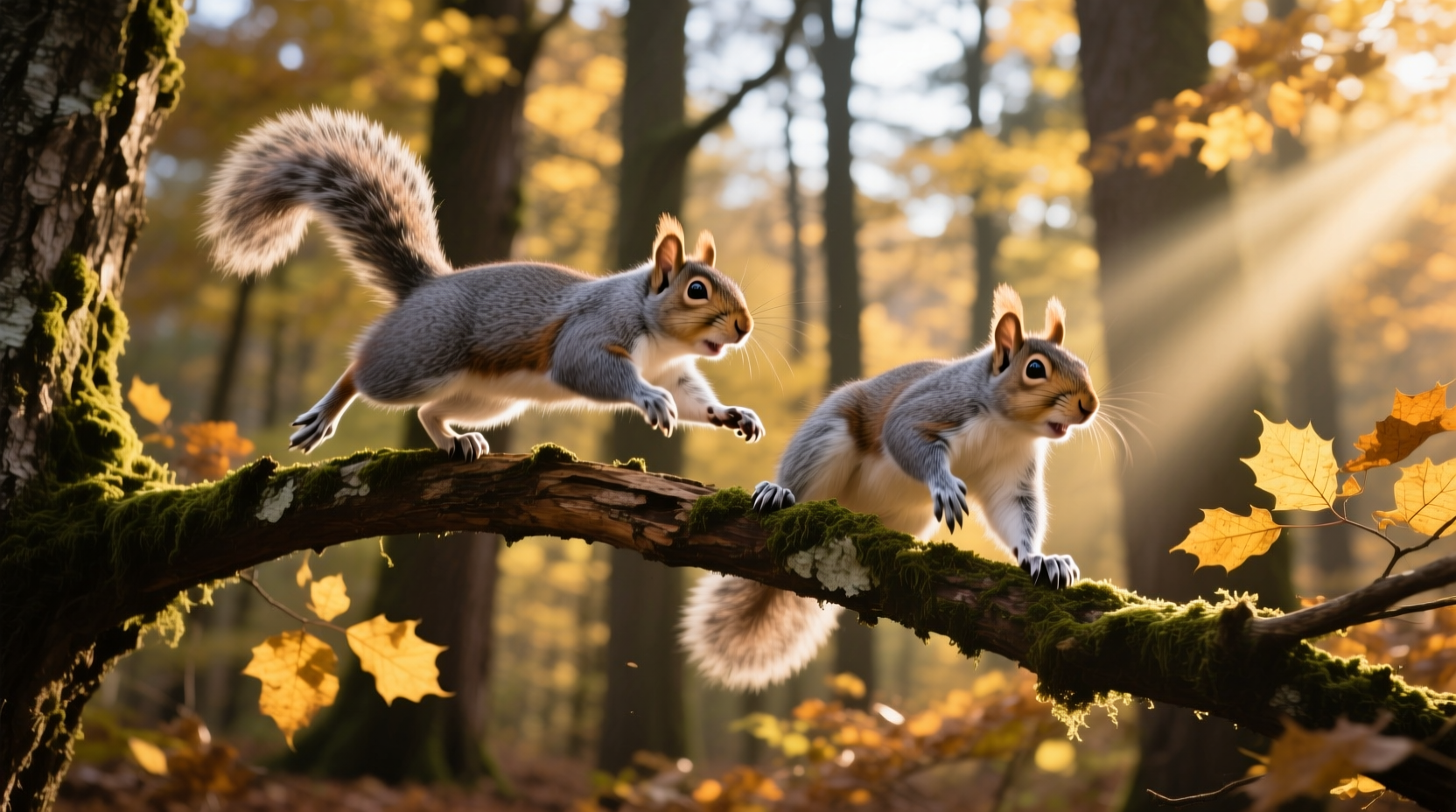
Squirrels belong to the family Sciuridae, which includes tree squirrels, ground squirrels, and flying squirrels. Tree squirrels—especially the eastern gray squirrel (Sciurus carolinensis)—are among the most commonly observed species engaging in aerial chases. Their agility in navigating three-dimensional forest canopies makes them ideal subjects for studying dynamic animal interactions.
Chasing is a form of social signaling. Unlike solitary animals that avoid contact, squirrels live in overlapping home ranges where encounters are frequent. They’re not pack animals, but they maintain loose social networks influenced by kinship, reproductive status, and resource availability. When two squirrels take off in pursuit through the canopy, they’re often communicating without vocalizing—using speed, direction, and persistence to convey intent.
Biologists classify squirrel chases into several functional categories: territorial defense, mating competition, maternal protection, juvenile play, and dominance assertion. Each has distinct patterns in timing, duration, and participant characteristics.
“Squirrel chases are rarely about aggression in the human sense. They’re nuanced displays of fitness, ownership, and readiness.” — Dr. Laura Mendez, Behavioral Ecologist, University of Vermont
Territorial Disputes: Defending Food and Space
One of the primary reasons squirrels chase each other is to defend valuable resources. Although squirrels don’t maintain strictly defined territories like wolves or birds of prey, they do establish **home ranges**—areas they regularly use for foraging, nesting, and shelter. Within these zones, certain spots become critical: a mature oak with abundant acorns, a hollow tree used as a drey (nest), or a reliable bird feeder in a suburban yard.
When an intruder enters this space, especially during periods of scarcity such as late winter or early spring, the resident squirrel may respond with a rapid chase to drive the interloper away. These chases tend to be intense, direct, and short-lived—often ending when one squirrel retreats or switches direction abruptly to signal submission.
Resource defense isn’t limited to food. Nest sites are particularly valuable, especially in colder months when thermal insulation matters. A squirrel defending a well-insulated drey may aggressively pursue another attempting to investigate or enter, even if no young are present.
Signs of a Territorial Chase
- Occurs during non-mating seasons (late fall, winter)
- Involves adult squirrels, often of the same sex
- Followed by scent marking or vocalizations (kuk calls)
- Directional and focused—less zigzagging, more pursuit-to-ejection
Mating Season Mayhem: More Than Just Romance
Perhaps the most dramatic squirrel chases occur during breeding season. Eastern gray squirrels typically have two mating peaks: one from mid-December to February and another from June to July. During these windows, females enter estrus for just a few hours, triggering intense competition among males.
When a receptive female emits pheromones, nearby males detect the signal and begin converging on her location. What follows is a chaotic, spiraling chase up, down, and around trees—a so-called “mating chase” or “mating spiral.” Multiple males may pursue a single female, jostling for position and demonstrating physical prowess.
Interestingly, the female isn’t passively fleeing. She controls the pace and route, effectively testing the stamina and agility of her suitors. After a prolonged chase, she may suddenly stop and allow the most persistent male to mate. This natural selection process ensures that only the fittest males pass on their genes.
These chases can last 10–30 minutes and cover large distances. Observers often mistake them for fights, but they rarely involve physical contact. Instead, they’re endurance trials masked as chaos.
Key Features of Mating Chases
- Occur in predictable seasonal windows
- Involve one female pursued by multiple males
- Highly acrobatic with frequent branch-switching
- Preceded by tail flicking and soft mewing sounds
Playful Pursuits: How Juveniles Learn Survival Skills
Not all chases are serious. Young squirrels, especially those between 8 and 14 weeks old, engage in frequent mock chases that resemble play. These interactions are vital for motor development, spatial awareness, and social learning.
Play chasing helps juveniles practice evasion from predators, improve balance on narrow branches, and understand social boundaries. It often looks disorganized—full of sudden stops, exaggerated leaps, and rolling tumbles—but beneath the surface, it’s structured training.
Unlike adult territorial or mating chases, playful pursuits are reciprocal. One juvenile may initiate the chase, then reverse roles moments later. There’s little urgency, and neither participant shows signs of stress or aggression. Vocalizations, if any, are soft chirps rather than alarm calls.
Because play mimics real-life scenarios, it strengthens neural pathways associated with decision-making under pressure. A squirrel that spends its youth practicing quick turns and mid-air adjustments is better equipped to escape a hawk or outmaneuver a rival later in life.
“Play behavior in squirrels isn’t frivolous—it’s evolutionary homework.” — Dr. Alan Prescott, Developmental Zoologist, University of Alberta
Distinguishing Play from Conflict
| Aspect | Playful Chase | Aggressive/Defensive Chase |
|---|---|---|
| Participants | Two or more juveniles | Adults, often same sex |
| Duration | Variable, often shorter bursts | Longer, sustained pursuit |
| Movement Style | Zigzag, tumbling, role reversal | Direct, purposeful, linear |
| Vocalizations | Soft chirps, quiet squeaks | Loud \"kuk\" barks, screeches |
| Outcome | No clear winner; ends naturally | One retreats or flees |
Other Reasons for Squirrel Chases
Beyond territory, mating, and play, squirrels may chase for additional reasons tied to survival and social structure.
Maternal Defense
A mother squirrel will fiercely protect her nestlings. If another squirrel approaches her drey—especially during the first few weeks after birth—she may launch a swift, aggressive chase to deter potential threats. Though infanticide is rare in squirrels, nest site intrusion can trigger defensive behavior.
Dominance Hierarchies
In areas with high population density, squirrels establish informal dominance hierarchies. Higher-ranking individuals gain priority access to food and preferred nesting sites. Subordinate squirrels may be chased simply for being too close, reinforcing social order without full-blown combat.
Predator Distraction
In some cases, a squirrel may chase another not out of conflict, but to redirect a predator’s attention. This altruistic behavior, while uncommon, has been observed in kin groups where related squirrels increase their own risk to protect siblings or offspring.
Mini Case Study: Urban Squirrel Dynamics in Toronto
In 2021, researchers at the University of Toronto launched a six-month observational study tracking squirrel behavior in High Park, a mixed woodland and urban green space. Using motion-triggered cameras and hourly field logs, they documented over 300 chases involving eastern gray squirrels.
The data revealed seasonal trends: mating chases peaked in January and June, while territorial disputes spiked in November and March—coinciding with mast (nut) scarcity. Juvenile play was most common from April through August, aligning with birthing cycles.
One notable finding was the impact of human-provided food. In areas near picnic zones with frequent feeding, chases increased by 40% compared to undisturbed zones. The researchers concluded that concentrated food sources intensified competition, leading to more frequent and longer chases—even outside typical mating periods.
This case illustrates how urban environments alter natural behaviors. What might be a seasonal ritual in the wild becomes a year-round occurrence in cities due to constant food availability and habitat fragmentation.
Frequently Asked Questions
Do squirrels ever get injured during chases?
Yes, though rarely. Falls from trees are the most common injury, especially during high-speed mating chases. Most squirrels survive due to their light weight and bushy tails acting as parachutes. Serious injuries are uncommon but possible, particularly in urban settings with hard surfaces below.
Can I tell if a chase is between siblings or strangers?
Not easily without long-term observation. However, chases between known relatives (such as a mother and offspring) tend to be less intense and may include grooming afterward. Unrelated adults show sharper movements and greater distance maintenance post-chase.
Why do squirrels chase each other but not fight?
Chasing avoids physical confrontation, which carries risks of injury. By using speed and agility as proxies for strength, squirrels resolve conflicts efficiently. Actual biting or grappling is rare and usually reserved for extreme situations, such as direct nest invasions.
Actionable Tips for Observing and Supporting Squirrel Behavior
To better understand squirrel dynamics in your area, follow this checklist:
📋 **Squirrel Chase Observation Checklist**- Record the date, time, and weather conditions
- Note the number and apparent age of squirrels involved
- Observe the pattern: circular, linear, erratic?
- Listen for vocalizations before, during, and after the chase
- Check for visible nests, food sources, or recent births nearby
- Repeat observations over several weeks to identify patterns
Conclusion: Appreciating the Complexity Behind the Chase
The next time you see squirrels racing through the treetops, pause before dismissing it as mere playfulness. That chase could be a high-stakes mating competition, a quiet assertion of dominance, or a young squirrel’s first lesson in survival. These small mammals navigate intricate social landscapes with intelligence and precision, using motion as language.
By understanding the reasons behind squirrel chases, we gain deeper appreciation for wildlife behavior in both natural and urban ecosystems. Whether you're a casual observer or a dedicated nature enthusiast, taking a moment to decode these interactions enriches your connection to the living world around you.




 浙公网安备
33010002000092号
浙公网安备
33010002000092号 浙B2-20120091-4
Comments
No comments yet. Why don't you start the discussion?