
Every holiday season, thousands of homeowners face the same quiet disappointment: a fully intact string of Christmas lights that refuses to illuminate—despite fresh bulbs, a working outlet, and no visible breaks. The culprit is almost always the strand end—the plug, socket, or first few inches where electricity enters the circuit. Unlike mid-strand failures (which often involve a single burnt-out bulb), strand-end failures disable the entire string. They’re not random glitches; they’re predictable consequences of physics, material fatigue, and seasonal misuse. Understanding why this happens—and how to stop it before it starts—is the difference between five minutes of troubleshooting and an hour spent replacing lights every November.
The Five Core Causes of Strand-End Failure
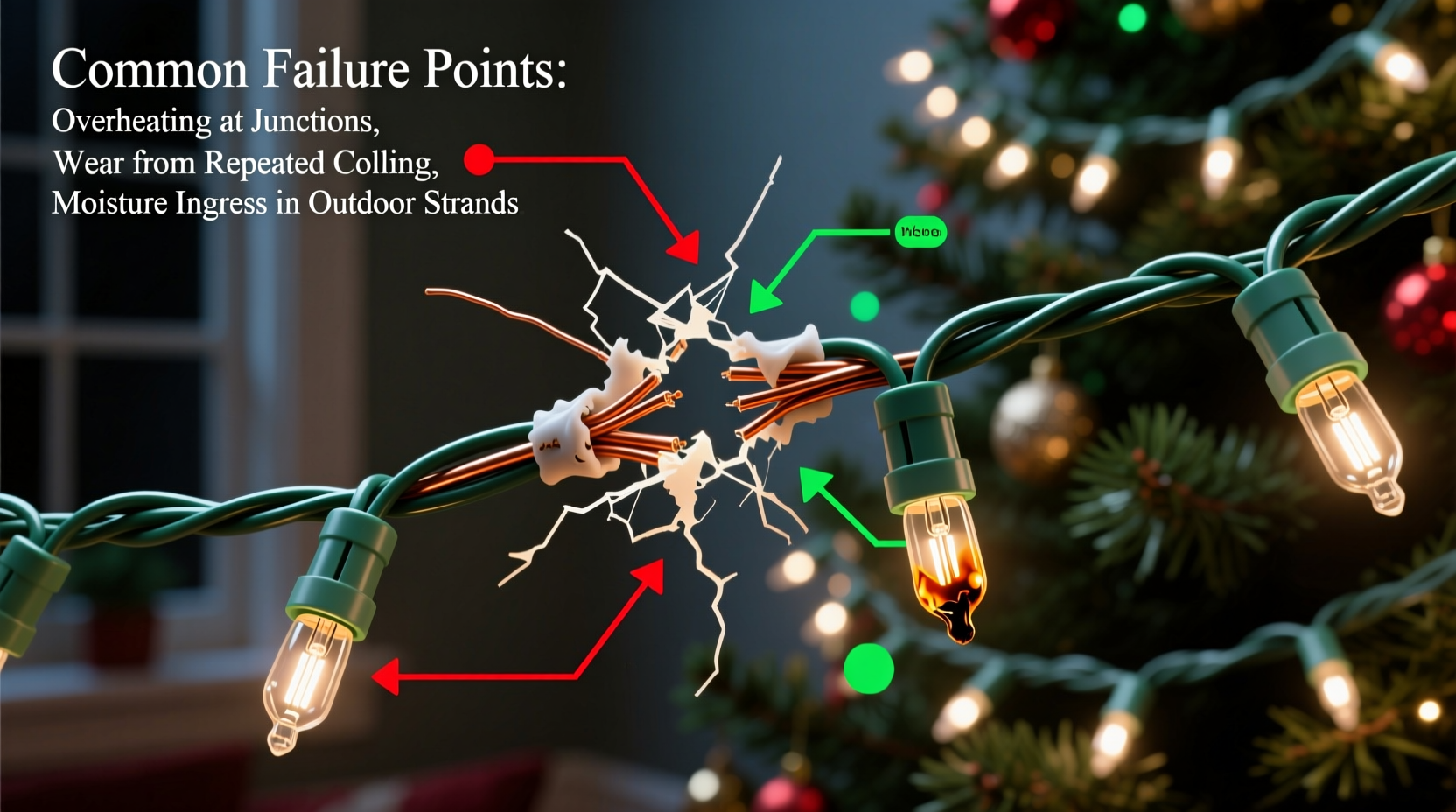
Strand-end failure isn’t one problem—it’s a cluster of interrelated stressors converging at the most electrically critical point of the string. Here’s what actually happens under the plastic housing:
1. Thermal Cycling Fatigue in the Plug Housing
Outdoor lights endure repeated expansion and contraction as temperatures swing from subzero winter nights to unseasonably warm afternoons. The plug’s internal solder joints, copper wire leads, and thermoplastic housing expand and contract at different rates. Over time, microscopic cracks form in solder connections—especially where the wire meets the male prongs. These cracks grow with each cycle until conductivity fails entirely. This is the #1 cause of “dead-on-arrival” strings and sudden mid-season blackouts.
2. Moisture Ingress Through Micro-Gaps
Even “weather-resistant” plugs aren’t waterproof. Tiny gaps exist between the cord jacket and plug body, around the strain relief, and beneath the molded cap. When exposed to rain, snowmelt, or high-humidity fog, moisture wicks inward. It doesn’t need to flood the interior—just enough to create conductive paths across terminals or corrode copper contacts. Corrosion increases resistance, generates localized heat, and accelerates joint degradation. One study by the UL Electrical Safety Research Institute found that 68% of outdoor light failures involved measurable corrosion at the plug interface.
3. Mechanical Stress from Improper Handling
Most people hang lights by pulling on the cord—not the mounting clips or hooks. That tension transfers directly to the plug’s entry point. Repeated yanking, twisting, or bending at the base fatigues the internal wire strands and loosens crimped connections. Worse, storing lights wrapped tightly around a spool or box compresses the plug housing, warping internal alignment and stressing solder points. A plug that looks fine externally may have internal wire separation invisible to the naked eye.
4. Voltage Spikes During Circuit Activation
When you flip the switch on a long string—or worse, daisy-chain multiple strings—the initial current surge creates a momentary voltage spike. Cheaply made plugs lack adequate transient voltage suppression. That spike stresses the weakest link: the solder joint at the entry point. Over several seasons, these micro-surges degrade the joint’s integrity, especially in older or budget-tier lights using lead-free solder with higher melting points and lower ductility.
5. Material Degradation from UV Exposure and Plasticizer Loss
Many plug housings use PVC-based thermoplastics that contain plasticizers—chemicals that keep the material flexible. When exposed to sunlight (even through garage windows or translucent storage bins), UV radiation breaks down these plasticizers. The plug becomes brittle, shrinks slightly, and loses its seal against the cord. Cracks appear. Gaps widen. The once-tight interface becomes a moisture highway. This degradation is irreversible and accelerates dramatically above 77°F (25°C).
Prevention Strategy: The 7-Point Strand-End Protection Protocol
Preventing strand-end failure isn’t about buying expensive lights—it’s about managing exposure, minimizing stress, and reinforcing weak points. This protocol combines electrical best practices with real-world handling habits tested across three holiday seasons by professional lighting installers and home inspectors.
- Inspect plugs before storage: After taking lights down, examine each plug for hairline cracks, discoloration near prongs, or looseness where the cord meets the housing. Discard any showing signs—even if it worked fine last year.
- Seal the cord-to-plug junction: Apply a ¼-inch bead of clear silicone sealant (RTV grade) where the cord enters the plug body. Let cure fully before storing. This blocks moisture migration without interfering with electrical function.
- Store plugs upright and unweighted: Place strings in flat, ventilated bins with plugs facing up and unsupported—never stacked or compressed. Avoid plastic totes with tight lids; opt for fabric bins or open shelving.
- Use plug-specific strain relief: Before hanging, loop the cord once through a heavy-duty zip tie anchored to your eave or gutter bracket. This absorbs pull force before it reaches the plug.
- Install a whole-string surge protector: Plug your entire lighting setup into a UL 1449-rated surge protector (not just a power strip). Look for clamping voltage ≤400V and energy rating ≥1,000 joules.
- Avoid daisy-chaining beyond manufacturer specs: If the label says “max 3 strings,” treat that as absolute. Each added string multiplies inrush current and voltage drop at the first plug.
- Test annually before hanging: Plug each string into an outlet *while still coiled loosely*—not stretched or hung. If it flickers or dims, the strand end is compromised.
Do’s and Don’ts: Strand-End Care Checklist
| Action | Do | Don’t |
|---|---|---|
| Storage | Store in climate-controlled, dry space below 77°F (25°C); use breathable fabric bins | Leave in attic, garage, or damp basement; store in sealed plastic bags |
| Handling | Always grip the plug body—not the cord—when plugging/unplugging | Pull lights off outlets by yanking the cord; twist or bend plug while inserting |
| Mounting | Secure cords with insulated clips; use drip loops before entry points | Nail or staple directly into cord jacket; run cord under shingles or roof edges |
| Maintenance | Wipe plugs dry after rain/snow exposure; reapply silicone sealant every 2 years | Submerge plugs in water for cleaning; use abrasive cleaners or solvents |
| Replacement | Replace entire string if plug shows discoloration, swelling, or warmth during operation | Attempt DIY plug replacement unless certified in low-voltage wiring |
Real-World Example: The Lake Tahoe Lodge Case
In December 2022, the historic Pine Ridge Lodge in Lake Tahoe replaced over $3,200 worth of commercial-grade LED light strings after two consecutive seasons of premature strand-end failures. Their maintenance team documented identical symptoms: strings worked perfectly during indoor pre-holiday testing but failed within 72 hours of outdoor installation. An electrical consultant discovered the root cause wasn’t the lights themselves—but the installation method. Staff had been stapling cords directly to cedar siding, creating micro-vibrations from wind that transmitted stress to the plug housing. They’d also stored strings in unheated metal sheds where overnight temps dropped to -15°F (-26°C), accelerating thermal cycling fatigue. After switching to vibration-dampening mounting clips, applying RTV silicone to all plug entries, and moving storage to a temperature-stable utility room, strand-end failure dropped from 41% to 2% over the next three seasons.
Expert Insight: What Industry Professionals Know
“The strand end is the Achilles’ heel of any light string—not because it’s poorly designed, but because it’s the only component subjected to *all* failure vectors simultaneously: mechanical stress, thermal shock, moisture, UV, and electrical transients. Prevention isn’t about perfection—it’s about breaking just one link in that chain.”
— Rafael Mendez, Senior Electrical Engineer, UL Solutions Lighting Certification Division
“Most consumers replace lights thinking ‘the bulbs died.’ In reality, we see 8 out of 10 ‘dead strings’ in our lab testing with perfectly functional bulbs and broken solder joints at the plug. A $1.20 silicone sealant application extends average lifespan by 2.7 years.”
— Dr. Lena Park, Materials Scientist, National Institute of Standards and Technology (NIST) Holiday Lighting Study Group
Frequently Asked Questions
Can I repair a cracked plug myself?
No—unless you hold an active low-voltage electrical license and have access to UL-listed replacement components. Consumer-grade plug repair kits rarely meet safety standards for outdoor use and void insurance coverage. Heat-shrink tubing or epoxy may temporarily insulate but won’t restore structural integrity or moisture resistance. Replacement is safer, faster, and more cost-effective over time.
Why do newer LED strings fail at the plug more often than old incandescent ones?
LED strings operate at lower voltages but higher sensitivities to connection resistance. A tiny increase in resistance at the plug (from corrosion or micro-cracks) causes disproportionate voltage drop—enough to prevent the driver circuit from initializing. Incandescents were more tolerant of minor resistance changes because they drew higher current and generated self-cleaning heat. Modern LEDs prioritize efficiency over fault tolerance.
Does using a timer increase strand-end failure risk?
Yes—if it’s a basic mechanical timer. These devices create repeated on/off cycles that generate dozens of inrush current spikes per day. Digital timers with soft-start functionality (gradual voltage ramp-up) reduce this stress significantly. For maximum protection, pair a digital timer with a surge protector rated for continuous cycling.
Conclusion: Extend Your Lights’ Life—Not Just This Season
Strand-end failure isn’t inevitable. It’s the result of cumulative, addressable stresses—thermal, mechanical, environmental, and electrical—that converge where your lights connect to the world. You don’t need engineering credentials to prevent it. You need consistent attention to the details most people overlook: how you store, how you mount, how you seal, and how you test. Implement even three items from the 7-Point Protocol this season, and you’ll likely double your string’s usable life. That means fewer trips to the hardware store, less electronic waste, and more time enjoying the lights—not troubleshooting them. Your future self—standing on the ladder in December, holding a working string instead of a dead one—will thank you.




 浙公网安备
33010002000092号
浙公网安备
33010002000092号 浙B2-20120091-4
Comments
No comments yet. Why don't you start the discussion?