
Anyone who has ever taken down holiday decorations knows the frustration: you carefully coil your string lights at the end of the season, store them away, and pull them out months later only to find an impossibly tangled mess. It feels like magic—or sabotage—but in reality, it’s physics. The phenomenon of string lights forming knots during storage isn’t random or supernatural; it’s a predictable outcome governed by entropy, flexibility, and motion. Understanding the science behind this common annoyance not only satisfies curiosity but also empowers smarter storage habits.
The Physics of Tangling: Entropy in Action
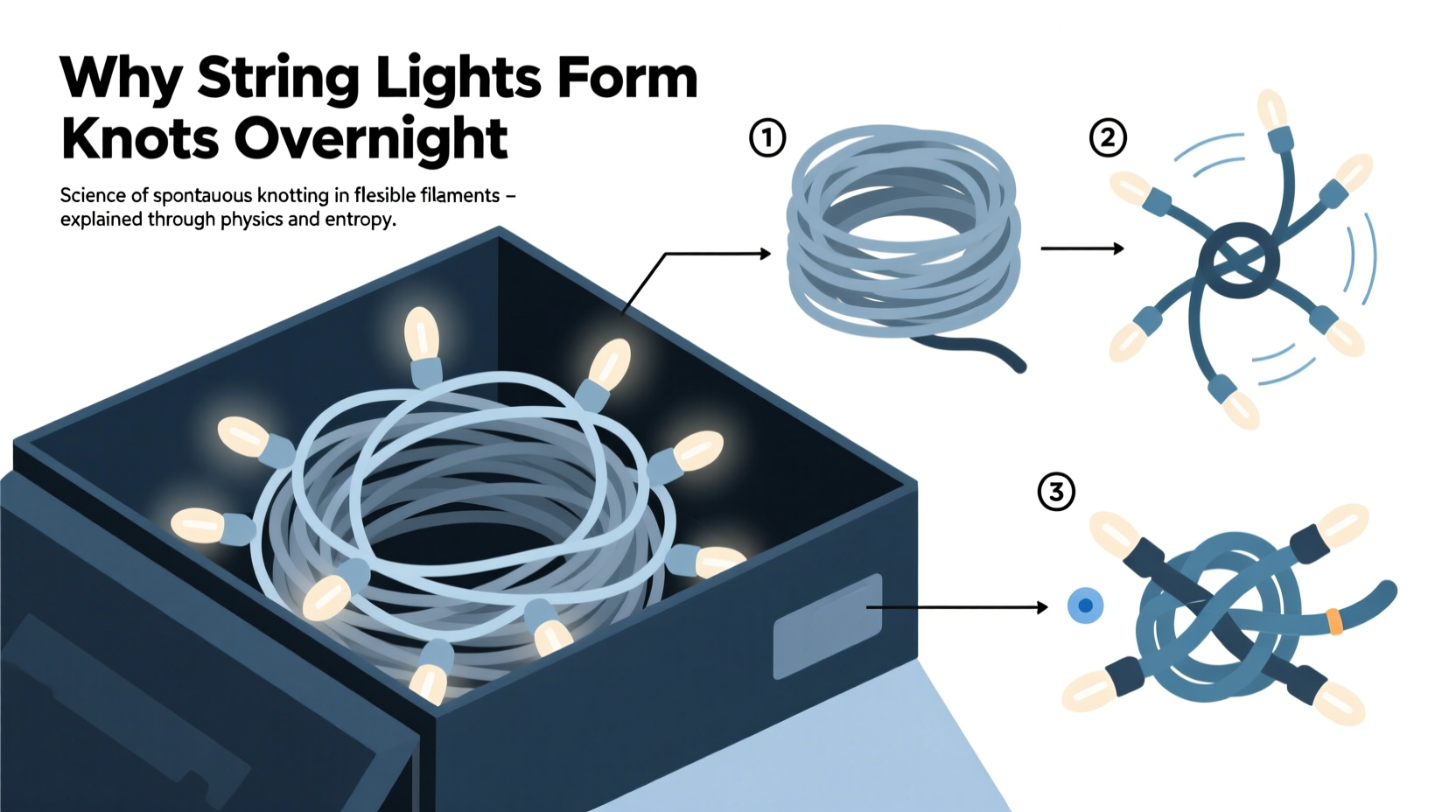
At the heart of the knotting problem lies a fundamental principle of thermodynamics: entropy. In simple terms, entropy is the tendency of systems to move from order to disorder over time. A neatly coiled string of lights represents a low-entropy state—organized and intentional. But when left unattended in a box or drawer, even slight disturbances introduce energy into the system, nudging it toward higher entropy: chaos.
Dr. Dorian Raymer, a physicist who conducted landmark research on spontaneous knot formation at the University of California, San Diego, demonstrated that when a string is agitated—even gently—it will form knots with surprising frequency. In one experiment, a length of rope tumbled inside a rotating box produced complex knots within seconds. The longer the string and the more flexible it is, the higher the probability of knotting.
“Given enough time and movement, nearly any long, flexible object will eventually knot itself.” — Dr. Dorian Raymer, Physicist and Knot Formation Researcher
String lights are especially prone because they combine three key risk factors: length, flexibility, and stiffness variation. The wires are pliable enough to bend easily but rigid enough to resist unfolding once twisted. This creates a perfect storm for persistent knots.
Why String Lights Are Especially Vulnerable
Not all cords behave the same way in storage. Power cables, extension cords, and headphone wires may tangle, but few match the notorious reputation of holiday string lights. Several design and usage factors make them particularly susceptible:
- Length: Most decorative light strands range from 25 to 100 feet, providing ample opportunity for loops to cross and snag.
- Bulb Interference: Bulbs act as natural knot anchors. Once a loop forms around a bulb, it becomes harder to pull free due to increased friction and physical obstruction.
- Material Composition: Copper wiring coated in thin plastic sheathing offers moderate rigidity—flexible enough to bend, stiff enough to hold shape once knotted.
- Storage Conditions: Often shoved into boxes, dropped into bins, or loosely wrapped, string lights experience jostling during transport or seasonal shifts in temperature and humidity.
This combination means that even minimal movement—such as shifting a storage bin on a shelf or stacking items above—can initiate a cascade of twists that culminate in tightly bound snarls.
How Movement Triggers Knot Formation
You don’t need to shake a box violently for knots to form. Studies show that gentle agitation—like tilting a container or walking with a bag—is sufficient to initiate self-knotting in long filaments. When a light strand shifts slightly in storage, one end may pass over or under another segment. If the motion continues, that loop tightens, forming what mathematicians call a “trefoil” or “figure-eight” knot—the most common types found in everyday tangles.
The process accelerates when multiple strands are stored together. Cross-contact between separate strings increases friction points and entanglement risks. What starts as two adjacent coils can quickly evolve into a fused web that requires patience—and often scissors—to untangle.
Temperature fluctuations can also play a subtle role. As materials expand and contract with changes in heat and moisture, the internal tension in the wire shifts. Over months, these micro-movements allow segments to slide against each other, increasing the likelihood of accidental looping.
Real Example: The Attic Storage Dilemma
Sarah from Portland hangs her Christmas lights every November after retrieving them from an attic closet. Last year, she spent nearly 45 minutes untangling a single 50-foot strand. She had coiled it neatly the previous January, secured it with a twist tie, and placed it in a plastic tub. But the attic experiences wide temperature swings—from freezing winters to sweltering summers—and the tub was occasionally moved when accessing other items. These small disruptions, combined with thermal expansion of the plastic coating, caused the lights to shift incrementally, resulting in deep knots by the next season.
After researching the issue, Sarah switched to a spool-based storage system and noticed immediate improvement. Her lights now come out tangle-free, saving time and reducing breakage from forced unraveling.
Proven Methods to Prevent String Light Knots
While you can’t eliminate entropy, you can significantly reduce its impact through smart handling and storage techniques. The goal is to minimize freedom of movement, eliminate loose ends, and protect the strand from external agitation.
Step-by-Step Guide: How to Store String Lights Without Tangles
- Start with a clean, dry strand. Wipe down wires and bulbs before storage to prevent corrosion and ensure smooth winding.
- Use a rigid storage reel or DIY spool. Cardboard tubes, PVC pipes, or commercial light reels keep the shape consistent and prevent collapse.
- Wrap slowly and evenly. Begin at the plug end and wind clockwise (or counterclockwise—just be consistent) around the spool, keeping tension light but firm.
- Avoid overlapping or crisscrossing. Each loop should sit neatly beside the last, not on top of it.
- Secure both ends. Use Velcro straps, soft ties, or tape to fasten the beginning and end of the strand. Never use metal clips or rubber bands, which can damage insulation.
- Store vertically or flat in a labeled container. Keep the spool upright in a bin to avoid pressure distortion. Label clearly for easy identification.
Storage Comparison: Effective vs. Risky Methods
| Method | Effectiveness | Why It Works (or Doesn’t) |
|---|---|---|
| Spool or Reel System | High | Restricts movement, maintains alignment, protects bulbs |
| Cardboard Box + Soft Coiling | Moderate | Better than tossing, but still allows shifting unless secured well |
| Twist Tie or Loose Wrap | Low | Loops compress and rub, creating friction points for knots |
| Tossed in Bin or Drawer | Poor | Maximum exposure to motion and entanglement |
| Original Packaging (if rigid) | Medium-High | Only effective if lights are pre-wound on a form and sealed securely |
Expert-Recommended Tools and Accessories
Investing in the right tools makes a measurable difference in long-term cord management. Professionals in event lighting, theater production, and electrical work rely on standardized winding practices to maintain hundreds of feet of cable without daily tangles.
- Cable Reels: Available in various sizes, these allow full-length winding with handles for easy transport.
- Velcro Cable Ties: Gentle on insulation and reusable, unlike zip ties which can cut into wires.
- Fabric Cord Organizers: Pouch-style wraps with individual slots keep strands separated and cushioned.
- 3D-Printed Light Spools: Customizable designs available online optimize fit for specific light types.
“In professional settings, we never hand-coil cables. We use over-under coiling for audio lines and spools for anything over 20 feet. It takes five extra minutes, but saves hours in setup.” — Marcus Lin, Stage Lighting Technician
Checklist: Tangle-Free String Light Storage
- ✅ Clean and inspect lights before storing
- ✅ Choose a rigid spool, reel, or cardboard tube
- ✅ Wind from plug to end (or vice versa), consistently
- ✅ Maintain even tension—no overlapping loops
- ✅ Secure both ends with soft ties
- ✅ Store in a cool, dry place away from heavy objects
- ✅ Label each strand (length, color, indoor/outdoor)
- ✅ Avoid stacking multiple strands in one bundle
Frequently Asked Questions
Can I prevent knots by freezing or heating my lights before storage?
No. Temperature treatment won’t alter the physical tendency to tangle. In fact, exposing plastic-sheathed wires to extreme temperatures may degrade the insulation over time. Focus instead on mechanical restraint and proper winding.
Is there a best way to untangle already-knotted lights?
Yes. Lay the strand flat on a large surface like a table or floor. Locate the loose end and gently trace it through crossings—never pull hard. Work from the outside in, loosening loops gradually. Using gloves can improve grip without damaging wires.
Do LED lights tangle less than incandescent ones?
Not inherently. While LED strings are often lighter and thinner, they’re just as prone to knotting due to similar length and flexibility. However, their lower heat output makes them safer to store near other materials.
Conclusion: Mastering the Art of Tangle-Free Storage
The nightly transformation of orderly string lights into chaotic knots isn’t mysterious—it’s a direct consequence of natural physical laws. But understanding the science removes helplessness. With deliberate winding, proper tools, and mindful storage, you can defy entropy’s pull and preserve your lights in pristine condition year after year.
Every minute spent wrapping carefully today saves ten minutes of frustration tomorrow. Whether you’re managing a single holiday strand or dozens for a display business, the principles remain the same: restrict motion, eliminate slack, and protect integrity. Make these habits part of your seasonal routine, and you’ll reclaim peace of mind along with perfectly working lights.




 浙公网安备
33010002000092号
浙公网安备
33010002000092号 浙B2-20120091-4
Comments
No comments yet. Why don't you start the discussion?