
It’s a familiar moment for any gamer: you’re sneaking through a dimly lit corridor, inching toward an enemy, when suddenly—your character drops through the floor, vanishes into a wall, or falls endlessly into a void beneath the map. These moments, known as \"physics glitches,\" break immersion and remind players that behind every virtual world lies complex code striving to simulate reality. But why do these glitches happen? What causes characters to pass through solid walls or fall through platforms? The answer lies at the intersection of game physics, collision detection, and computational limitations.
While it might seem like a flaw in design, such behavior is often the result of well-understood technical constraints. Game engines must balance realism with performance, and sometimes, this compromise leads to unexpected outcomes. Understanding the mechanics behind these glitches reveals not only how games work but also the challenges developers face in creating seamless digital experiences.
How Game Physics Simulate the Real World
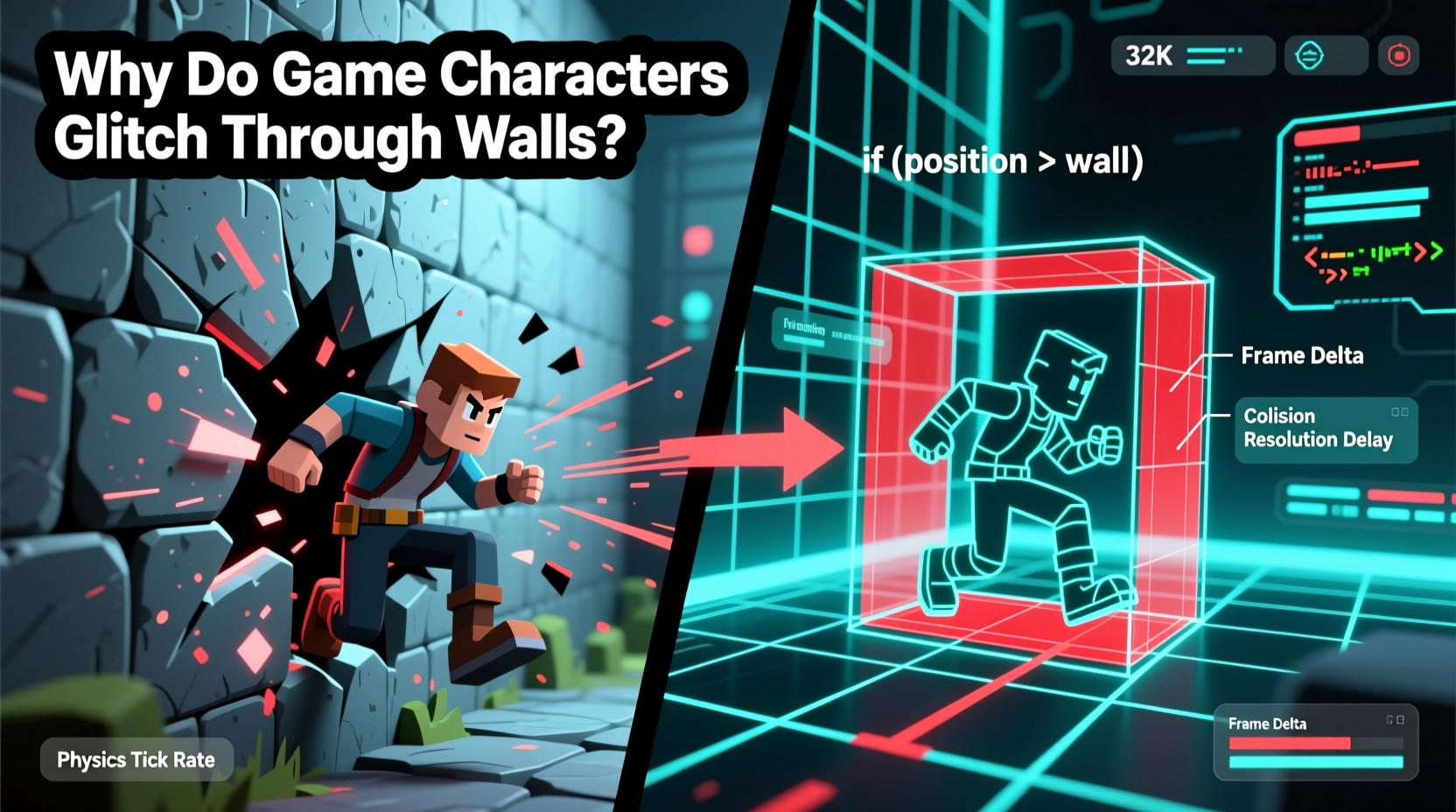
Video games mimic real-world physics using mathematical models and algorithms. Instead of gravity, friction, and momentum occurring naturally, they are simulated by code that updates thousands of times per second. This simulation runs within a framework called a physics engine—software responsible for calculating object movement, collisions, and interactions.
Popular engines like Havok, PhysX, and Unity’s built-in physics system approximate physical laws rather than replicate them perfectly. For example, gravity might be represented as a constant downward force applied each frame. Objects gain velocity over time, and when they collide with surfaces, the engine calculates bounce, slide, or stop based on material properties.
However, unlike the continuous nature of real-world physics, game physics operate in discrete steps—each tied to a frame of animation. This means motion isn’t truly smooth; it’s a series of tiny jumps from one position to the next. If a character moves fast enough between frames, they might skip over a collision point entirely, effectively “teleporting” through a wall without the system registering contact.
The Role of Collision Detection in Preventing Glitches
At the heart of preventing characters from walking through walls is collision detection—the process by which the game determines whether two objects are touching or intersecting. There are several methods used in modern games, each with trade-offs between accuracy and performance.
The most common approach uses bounding volumes: simplified shapes (like boxes, spheres, or capsules) wrapped around 3D models. When a character approaches a wall, the engine checks if their bounding volume overlaps with the wall’s. If so, it applies forces or restrictions to prevent further penetration.
But here's where problems arise. Bounding volumes are approximations. A capsule might represent a human-shaped character well, but it doesn't capture every detail—like fingers or boots. Similarly, level geometry may use simplified collision meshes separate from visual models. These invisible \"hitboxes\" define where collisions occur, and if misaligned—even slightly—it creates gaps or overlaps that allow clipping.
Another issue emerges during rapid movement. Consider a bullet fired at a thin wall. In one frame, it’s in front of the wall; in the next, it’s far behind. Because no intermediate positions are checked, the engine never detects impact. This phenomenon, called tunneling, affects not just projectiles but also fast-moving players, especially in high-speed platformers or multiplayer shooters.
“Collision detection is a constant balancing act between precision and performance. You can’t check every triangle against every other triangle in real time—that would cripple even the best hardware.” — Dr. Lena Torres, Game Engine Developer at Frostbite Labs
Frame Rate, Time Steps, and the Problem of Discrete Updates
Games run on a loop: update logic, render graphics, repeat. This cycle typically occurs 30 to 120 times per second, depending on the device and settings. Each iteration is called a frame, and physics calculations happen once per frame. This fixed interval introduces a critical limitation: motion is not continuous.
Imagine a character moving at 10 meters per second in a game running at 30 frames per second. That’s about 0.33 meters moved per frame. If a wall is thinner than that distance—or if the character starts just before it—their new position could land completely on the other side, bypassing the wall without triggering a collision.
This is particularly problematic in online multiplayer games, where network latency adds another layer of complexity. Player positions are updated based on data sent from remote machines, often interpolated between known points. If updates arrive infrequently or out of order, the local client might place a player inside a wall temporarily, leading to sudden corrections or permanent clipping.
To combat tunneling, some engines use continuous collision detection (CCD). Instead of checking start and end points, CCD traces the path an object takes during the frame, detecting intersections along the way. While effective, CCD is computationally expensive and usually reserved for small, fast objects like bullets—not full-character avatars.
Common Causes of Wall-Phasing Glitches
Several specific factors contribute to characters passing through walls. Understanding them helps explain why glitches persist despite advances in technology.
- Low frame rates: Slower frame rates increase the distance traveled per update, raising the chance of tunneling.
- Poorly optimized collision meshes: Simplified geometry may leave holes or misalign with visuals.
- Animation-driven movement: Some games blend scripted animations with physics, occasionally overriding positional constraints.
- Numerical precision errors: Floating-point arithmetic can introduce tiny inaccuracies that accumulate over time.
- Network desynchronization: In multiplayer, conflicting state data can cause temporary clipping until corrected.
Additionally, modded or poorly tested levels often lack proper collision setup. Custom maps in games like Minecraft or Source-engine titles sometimes feature invisible gaps because creators forget to assign collision properties to new structures.
Mini Case Study: The Legend of Zelda: Breath of the Wild Tower Climb
In one famous example from The Legend of Zelda: Breath of the Wild, players discovered they could scale towers faster by launching themselves with stasis-powered boulders. However, under certain conditions—especially when the frame rate dropped—the character Link would phase through the tower’s outer wall and appear inside. Once trapped, he couldn’t escape without reloading.
This occurred due to a combination of high-speed momentum and imprecise collision handling. The tower’s collision mesh didn’t perfectly match its visual model, leaving narrow zones where rapid upward motion allowed Link to bypass detection. Nintendo later patched the exploit, but the incident highlighted how even AAA studios struggle with edge cases in physics systems.
Solutions and Best Practices Used by Developers
Game developers employ various strategies to minimize physics glitches while maintaining performance. These include:
- Using continuous collision detection selectively: Applied only to fast-moving objects to avoid performance hits.
- Implementing movement validation: Servers or engines verify that new positions are physically plausible before accepting them.
- Optimizing collision meshes: Ensuring hitboxes closely follow visual geometry and eliminating unnecessary complexity.
- Adding penetration recovery: If an object ends up inside a wall, the engine pushes it back along the shortest path.
- Limiting maximum velocities: Preventing extreme speeds reduces tunneling risk.
- Frame-independent physics updates: Running physics at a fixed timestep regardless of rendering frame rate improves consistency.
Some engines also use predictive correction. For instance, if a player’s avatar is detected inside a wall, the system may rewind their position slightly and re-simulate the last step with finer granularity. Others rely on \"snap-to-surface\" rules, automatically adjusting position when minor clipping is detected.
| Technique | Purpose | Drawback |
|---|---|---|
| Bounding Volume Hierarchies | Speeds up collision checks | Less accurate than mesh-level testing |
| Continuous Collision Detection | Prevents tunneling | High CPU cost |
| Fixed Timestep Physics | Improves simulation stability | May lag behind visuals |
| Penetration Resolution | Fixes accidental overlaps | Can cause jittery movement |
| Client-Side Prediction | Smooths online gameplay | Risk of visible corrections |
Checklist: How Players Can Reduce Glitch Frequency
While developers bear primary responsibility, players can also reduce the likelihood of encountering physics glitches:
- Keep your system updated with the latest drivers and patches.
- Maintain stable frame rates by lowering graphical settings if needed.
- Avoid exploiting known movement bugs that stress the physics engine.
- Play on stable internet connections to reduce network-related desync.
- Report persistent glitches to developers with detailed reproduction steps.
Frequently Asked Questions
Can physics glitches be completely eliminated?
No—not practically. Due to computational limits and the discrete nature of digital simulations, some degree of error will always exist. Developers aim to make glitches rare and non-disruptive, but eliminating them entirely would require infinite processing power or abandoning real-time interactivity.
Are older games more prone to glitches?
Older games often had simpler physics systems and lower polygon counts, which reduced complexity but also made collision detection less precise. However, modern games face new challenges with larger worlds and more dynamic interactions. So while the types of glitches have evolved, they haven’t disappeared.
Do console versions suffer more glitches than PC?
Not necessarily. Consoles offer consistent hardware, making optimization easier. PCs vary widely in performance, which can lead to frame-rate fluctuations and thus more tunneling. However, mods and unofficial patches on PC can also fix issues not present in console releases.
Conclusion: Embracing Imperfection in Virtual Worlds
Glitches aren’t just quirks—they’re windows into the intricate machinery of game development. When a character phases through a wall, it exposes the fragile illusion of solidity maintained by code, math, and clever approximations. These moments remind us that virtual worlds, no matter how polished, are built on layers of compromise.
For developers, minimizing glitches means constant refinement of physics models, collision systems, and performance tuning. For players, understanding the causes fosters patience and appreciation for the engineering behind their favorite games. And for both, glitches remain a shared part of gaming culture—sometimes frustrating, often hilarious, and occasionally inspiring entire communities dedicated to breaking the rules.




 浙公网安备
33010002000092号
浙公网安备
33010002000092号 浙B2-20120091-4
Comments
No comments yet. Why don't you start the discussion?