
Elden Ring, developed by FromSoftware and directed by Hidetaka Miyazaki, stands as a landmark in modern game design. Its vast open world, intricate lore, and unforgiving combat have drawn millions into its hauntingly beautiful realm. Yet one feature conspicuously absent from the experience is something most players take for granted: a pause button. Unlike nearly every other action RPG, Elden Ring does not allow players to freeze gameplay at will—no pausing during combat, exploration, or even mid-leap off a cliff. This deliberate omission is not an oversight but a cornerstone of the game’s deeper design philosophy. Understanding why requires examining how FromSoftware approaches immersion, challenge, and player presence.
The Role of Immersion in Game Design
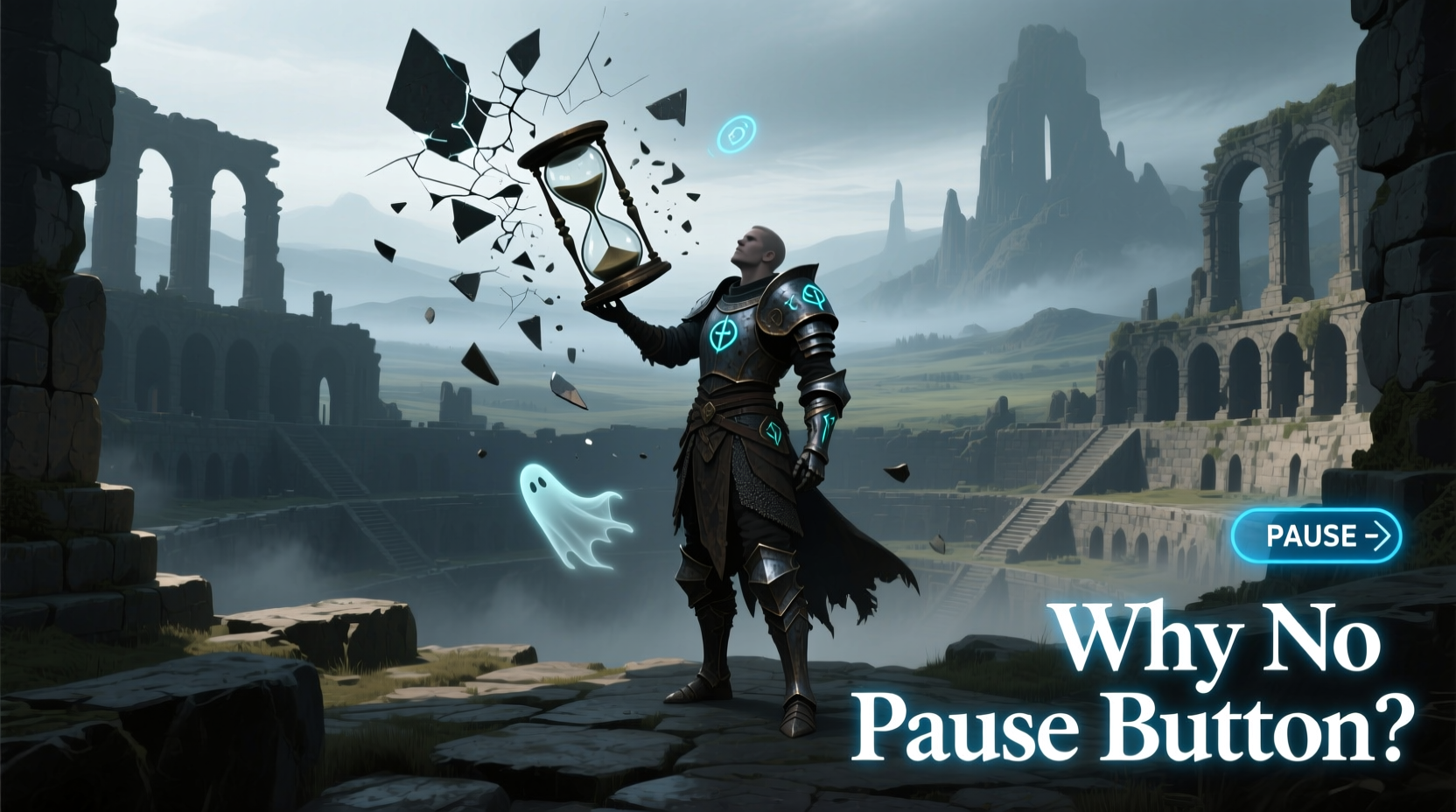
At the heart of Elden Ring’s design is a commitment to uninterrupted immersion. The Lands Between are meant to feel alive—an ecosystem of danger, mystery, and consequence that operates independently of the player’s input. When you cannot pause the game, time continues to flow regardless of your actions. Enemies keep moving, traps reset, weather shifts, and NPCs follow their routines. This continuous simulation fosters a sense of realism and urgency that would be disrupted by frequent pauses.
Consider the moment you’re navigating a narrow ledge above a bottomless chasm. In most games, you might pause to check your inventory, reassess your strategy, or simply catch your breath. In Elden Ring, doing so isn’t an option. The wind howls, your horse might spook, or an enemy archer could appear over the ridge—all while you're still mid-motion. This forces players to remain present, aware, and engaged with their surroundings at all times.
“Games can create powerful emotional experiences when they demand full attention. Pausing breaks that spell.” — Hidetaka Miyazaki, Game Director, FromSoftware
This philosophy echoes earlier FromSoftware titles like Dark Souls and Bloodborne, which also lack traditional pause functions outside menus. The continuity of experience is treated not as a limitation but as a strength—a way to deepen the connection between player and world.
Tension as a Core Gameplay Mechanic
In Elden Ring, tension isn't just a side effect of difficulty—it's a designed mechanic. The absence of a pause button amplifies this tension significantly. Combat encounters, especially against formidable bosses or hidden enemies, require split-second decision-making. There’s no opportunity to “stop and think” once an ambush begins. You must rely on muscle memory, preparation, and instinct.
This creates a rhythm unique to FromSoftware games: cautious exploration punctuated by bursts of high-stakes action. Players learn to assess threats before engaging, often retreating to safe zones to plan their next move. But once committed, there’s no backing out without consequences. The inability to pause reinforces this push-and-pull dynamic, making victories feel earned and failures instructive.
Design Consistency Across FromSoftware Titles
The lack of a pause button isn’t new to Elden Ring—it’s a long-standing tradition in FromSoftware’s catalog. A look at their previous titles reveals a consistent pattern rooted in intentional design choices:
| Game | Pause Function? | Design Rationale |
|---|---|---|
| Dark Souls (2011) | No (outside menus) | Maintain tension in hostile environments |
| Sekiro: Shadows Die Twice (2019) | No | Precision combat demands constant focus |
| Bloodborne (2015) | No | Foster urgency and momentum in fast-paced combat |
| Elden Ring (2022) | No | Preserve immersion in an expansive, reactive world |
This table illustrates a clear lineage. Each title prioritizes uninterrupted gameplay as a means of enhancing emotional engagement. For Miyazaki and his team, the risk of death—or failure—is more impactful when it unfolds in real time, without the safety net of a pause.
Player Agency and the Illusion of Control
Modern games often give players extensive control over the experience: adjustable difficulty, skipable cutscenes, instant respawns, and yes—pausing at will. While these features improve accessibility, they can also dilute the sense of vulnerability that drives meaningful gameplay. Elden Ring deliberately limits such controls to preserve a specific kind of player agency—one based on consequence rather than convenience.
Without a pause button, players must develop strategies that account for timing, positioning, and resource management in live scenarios. You can’t pause to read item descriptions mid-battle or change equipment during an enemy assault. This forces premeditation. Before entering a dungeon or confronting a boss, you must consider your build, consumables, and approach. Mistakes aren’t just about reflexes—they’re often the result of poor planning.
In this way, the lack of pausing doesn’t remove agency; it redistributes it. Power shifts from moment-to-moment correction to long-term decision-making. The game trusts players to prepare wisely, then holds them accountable for their choices in real time.
A Real-World Example: The Margit Encounter
One of the earliest major challenges in Elden Ring is the fight against Margit, the Fell Omen, guarding the entrance to Stormveil Castle. Many players encounter him unprepared, lured by curiosity or overconfidence. Suddenly, the music shifts, the camera locks, and the battle begins.
There’s no chance to pause and switch spells, adjust stance, or consult a guide. You’re thrown into a complex fight with limited knowledge, forced to react instantly. Some retreat immediately, others attempt to fight and perish. Either way, the encounter teaches a crucial lesson: in the Lands Between, readiness matters.
This moment exemplifies FromSoftware’s philosophy. By denying the pause, the game ensures that the stakes feel real. The fear, the adrenaline, the scramble to survive—it all contributes to a memorable, formative experience. Had players been able to pause and optimize mid-fight, much of that impact would be lost.
Technical and Philosophical Trade-offs
Of course, the decision to omit a pause button comes with trade-offs. It can frustrate newcomers unfamiliar with FromSoftware’s design language. Players accustomed to more forgiving systems may perceive the lack of pausing as punitive rather than purposeful. Additionally, practical concerns arise—such as needing to step away mid-gameplay due to real-life interruptions.
However, FromSoftware addresses these through alternative systems:
- Sites of Grace serve as designated safe zones where players can rest, level up, and reconfigure gear.
- Fast travel allows quick relocation to known sites, minimizing backtracking after disengaging.
- Menu access is available outside combat, encouraging strategic planning before engagements.
These mechanics don’t replace pausing—they reframe it. Instead of interrupting the flow of the world, players are encouraged to work within its rhythms. Safety exists, but only in specific, earned locations.
Checklist: How to Adapt to No Pause in Elden Ring
To thrive in a game without a pause function, players should adopt certain habits. Here’s a practical checklist:
- ✅ Plan your loadout before entering dangerous areas.
- ✅ Memorize key item effects to avoid checking descriptions mid-combat.
- ✅ Use Spirit Ashes proactively to manage aggro and create breathing room.
- ✅ Retreat to a Site of Grace when overwhelmed—don’t force fights.
- ✅ Keep consumables mapped to quick-use slots for rapid access.
- ✅ Learn enemy patterns so reactions become instinctive, not deliberative.
- ✅ Save frequently by resting at grace points before risky maneuvers.
Adopting these practices turns the lack of pausing from a hindrance into a training mechanism—one that sharpens awareness and responsiveness over time.
Expert Insight: What Miyazaki Values in Game Design
Hidetaka Miyazaki has spoken extensively about his vision for interactive storytelling and gameplay. Central to his philosophy is the idea that meaningful challenge leads to profound satisfaction. In interviews, he emphasizes that overcoming difficulty should feel personal—not handed to the player through accessibility shortcuts, but earned through persistence and insight.
“We want players to feel the weight of their actions. If everything can be stopped, analyzed, and optimized, the emotional resonance fades.” — Hidetaka Miyazaki, Edge Magazine Interview, 2022
For Miyazaki, the absence of a pause button aligns with broader goals: preserving mystery, fostering discovery, and ensuring that triumph feels hard-won. He believes players remember moments not because they were easy, but because they demanded full attention and resilience.
Frequently Asked Questions
Can you pause Elden Ring at all?
You cannot pause gameplay in the traditional sense. However, you can access menus (inventory, map, etc.) when not in combat or cinematic sequences. During active combat or cutscenes, menu access is disabled to maintain immersion and fairness.
Why don’t other RPGs follow this design choice?
Most RPGs prioritize player convenience and flexibility, allowing pausing to support complex systems like inventory management or dialogue trees. FromSoftware, by contrast, values continuous engagement and environmental realism over convenience, creating a different kind of player experience.
Is the lack of a pause button considered inaccessible?
Some players and advocacy groups have noted that the lack of pausing can be challenging for those with disabilities or attention-related conditions. While Elden Ring offers quality-of-life improvements (like adjustable HUD and difficulty mods via community patches), official support for deeper accessibility options remains limited compared to other AAA titles.
Conclusion: Embracing the Unbroken Flow
The absence of a pause button in Elden Ring is far more than a quirk—it’s a statement of design intent. By refusing to let players halt the world at will, FromSoftware reinforces the integrity of its universe. Time moves forward. Danger persists. Every decision carries weight. This creates a rare kind of engagement: one where attention never wavers, and every victory feels genuinely earned.
As gaming evolves toward greater customization and comfort, Elden Ring stands as a counterpoint—a reminder that constraints can breed creativity, and that sometimes, the most powerful experiences emerge when we’re fully present in the moment. Whether you love it or find it frustrating, the no-pause rule is inseparable from what makes the game exceptional.




 浙公网安备
33010002000092号
浙公网安备
33010002000092号 浙B2-20120091-4
Comments
No comments yet. Why don't you start the discussion?