
One moment your tree glows warmly—golden, festive, inviting. The next, the bottom third is dark while the top remains stubbornly bright. Or perhaps it’s the left side that’s dead, the right side blinking merrily. You check the plug, jiggle the cord, swap outlets—nothing changes. This isn’t random failure. It’s a predictable symptom of how modern mini-light strands are engineered: in series-wired circuits with built-in fail-safes. When half a strand goes dark, it’s rarely “bad luck.” It’s physics, design, and sometimes simple oversight—working exactly as intended. Understanding why helps you fix it faster, avoid unnecessary replacements, and extend the life of your lights for years.
How Mini-Light Strands Actually Work (and Why Half Dies)
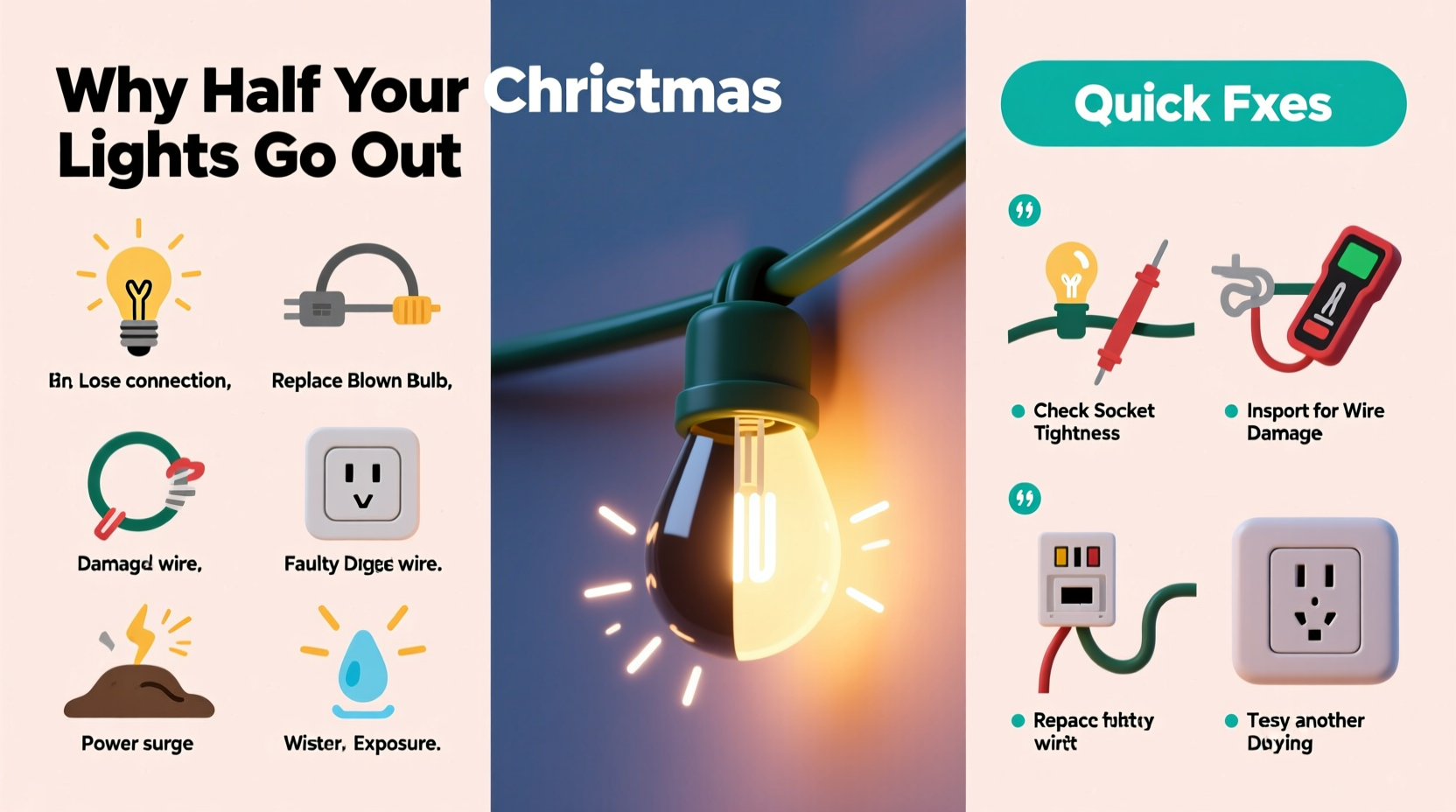
Most incandescent and LED mini-light strands sold since the early 2000s use a “split-series” or “two-circuit” design. Instead of one long continuous loop (which would kill the entire strand if one bulb failed), manufacturers divide the string into two independent sections—often labeled “A” and “B” on the plug or housing. Each section runs its own series circuit, typically containing 50–100 bulbs. Power enters at the plug, splits at an internal junction point (usually near the first few inches of wire), then feeds both sections separately. If one section fails, the other stays lit—hence the classic “half-out” scenario.
This design improves reliability but introduces new failure points: the internal splitter, the shunt in the first faulty bulb, voltage drop across long runs, and connector integrity. Unlike older single-circuit strings where one dead bulb killed everything, today’s partial outages point directly to where the break occurred—making diagnosis methodical, not magical.
The 7 Most Common Causes—and Exactly How to Fix Each
1. A Blown Shunt in the First Bulb of the Dead Section
Mini-lights rely on tiny tungsten shunts inside each bulb’s base. When a filament breaks, electricity should jump across the shunt, keeping the rest of that section lit. But if the shunt itself fails—or corrodes over time—the circuit opens, killing everything downstream. This is especially common in the first 3–5 bulbs of the dark section, where heat and stress accumulate.
Fix: Use a bulb tester (or a multimeter on continuity mode) to check each bulb in sequence, beginning at the first socket of the dark half. Replace any bulb that shows no continuity—even if it looks intact. Don’t twist bulbs back in; push straight in until you hear/feel a soft click. Over-tightening damages sockets and shunts.
2. A Faulty or Corroded Plug Connector
The molded plug contains more than just prongs. Inside lies a small plastic housing with metal contacts that split power between the two sections. Moisture, dust, or repeated plugging/unplugging can oxidize contacts or loosen solder joints. One degraded contact kills only its assigned circuit—leaving the other half glowing.
Fix: Unplug the strand. Examine the plug’s interior with a flashlight. Look for greenish corrosion on brass contacts or visible gaps in solder. Clean gently with isopropyl alcohol and a cotton swab. If solder looks cracked or brittle, replace the plug entirely using a UL-listed replacement kit ($4–$7 online). Never bypass or tape over a damaged plug.
3. Voltage Drop in Long or Daisy-Chained Strands
Manufacturers rate strands for a maximum number of sets daisy-chained end-to-end (e.g., “Connect up to 3 sets”). Exceeding this limit starves the second half of voltage—especially the farthest bulbs. They may glow dimly, flicker, or go completely dark. This worsens with older strands, thinner gauge wire, or outdoor use in cold temperatures (which increases resistance).
| Symptom | Likely Cause | Quick Verification |
|---|---|---|
| Bottom half dim or intermittent | Voltage drop in daisy chain | Unplug all downstream sets. Does the half revive? |
| Dark half starts working after 10+ minutes | Cold-temperature resistance increase | Bring strand indoors for 20 mins. Test again. |
| Only fails when plugged into extension cord | Undersized or damaged extension | Plug directly into wall outlet. Does it work? |
4. A Broken Wire at the Split Point
The physical junction where the cord divides into two circuits is a stress point. Bending, kinking, or yanking the cord near the plug can fracture the internal copper wires—especially the smaller-gauge wires feeding the “B” section. You won’t see it externally; the outer insulation hides the break.
Fix: Gently flex the first 4 inches of cord, starting at the plug and moving toward the first bulb. Watch for flickering in the dark half—if it briefly lights during flexing, you’ve found the break. Cut the cord 1 inch past the plug, strip the wires, and solder or crimp a new UL-listed plug. Do not wrap with tape or use wire nuts—these violate electrical safety codes for seasonal lighting.
5. Water Intrusion in Outdoor Strands
Even “weather-resistant” lights aren’t waterproof. Condensation builds inside sockets during temperature swings. Moisture bridges contacts, causing short circuits—or worse, corrodes the shunt path so it can’t activate when a filament fails. This often manifests as one consistent dead section, especially after rain or morning dew.
Fix: Bring the strand indoors and let it air-dry for 24 hours in a warm, low-humidity room (not near a heater). Then test. If still dead, inspect sockets for white powdery residue (corrosion) or blackened contacts. Replace affected bulbs and apply dielectric grease (a non-conductive silicone compound) to the base of new bulbs before insertion. This seals out future moisture.
6. Incompatible LED Bulbs in Mixed Strands
Many people replace burned-out incandescent bulbs with generic LED replacements. But not all LEDs are created equal. Some lack compatible shunt designs or draw different current profiles. Installing even one mismatched LED in a section can prevent the shunt from activating elsewhere in that circuit—causing cascading failure. The result? A fully dark half, even though no bulb appears visibly damaged.
“LED retrofits must match the original strand’s voltage profile and shunt specification—or they’ll disable the entire circuit’s failover logic.” — Carlos Mendez, Electrical Engineer, UL Lighting Certification Division
Fix: Remove all LED replacements from the dead section. Reinstall original-spec bulbs (check packaging: “For use with [Brand] Series-Circuit Lights”). If originals are unavailable, buy a full replacement section from the same manufacturer—not individual bulbs.
7. A Damaged or Misaligned Socket
Sockets wear out. The internal spring contacts lose tension, or the plastic housing cracks, allowing the bulb base to sit crooked. Electricity fails to transfer—not because the bulb is bad, but because the connection is incomplete. This is frequent in older strands or those stored tightly coiled, which stresses socket housings.
Fix: With the strand unplugged, gently press each bulb in the dark half straight down. If one sinks deeper than the others or feels loose, that socket is compromised. Replace the socket using a socket replacement tool kit (under $10) or cut out the faulty socket and splice in a new one with heat-shrink tubing. Never force a bulb into a damaged socket—it risks shorting the entire strand.
Step-by-Step Diagnostic Flowchart (Under 8 Minutes)
- Observe & Isolate: Confirm exactly which half is dark. Note whether it’s consistently off, flickering, or intermittent.
- Check Power Path: Plug the strand directly into a known-good wall outlet—no extension cords or power strips.
- Test the Plug: Inspect for damage/corrosion. Clean contacts. Try flipping the plug 180° (some have polarized contacts).
- Locate the Split Point: Find where the cord widens or has a small molded bump (usually 2–4 inches from plug). Gently flex here while watching for flicker.
- Test First 5 Bulbs: Using a bulb tester, check continuity on each bulb in the dead section, starting at socket #1. Replace any open-circuit bulb.
- Verify Bulb Type: Ensure all bulbs in the dark section match the original spec—same brand, same model number, same wattage.
- Dry & Re-test: If used outdoors, dry thoroughly for 24 hours before final test.
Mini Case Study: The “Living Room Tree That Wouldn’t Cooperate”
Sarah in Portland strung 12 identical 100-light LED strands around her 7-foot Fraser fir. By December 10th, the bottom three strands—covering the lower trunk—were completely dark. She replaced bulbs, checked fuses, swapped outlets. Nothing worked. Frustrated, she called a local holiday light technician. He noticed immediately: all dark strands were daisy-chained *after* a single 50-foot heavy-duty extension cord rated for only 10 amps. Her 12 strands drew 13.2 amps total. The cord overheated, dropping voltage below 110V at the last three sets—enough to disable their internal voltage regulators. Solution? She replaced the cord with a 12-gauge, 15-amp-rated model and separated the strands into two independent chains. All lights returned instantly. Total fix time: 14 minutes.
Prevention Checklist: Keep Your Lights Reliable for Years
- ✅ Store strands loosely coiled—not wrapped tightly around cardboard or in vacuum bags (pressure damages sockets).
- ✅ Label each box with year purchased and strand model number (helps with bulb matching later).
- ✅ Before first use each season, do a “quick sweep”: plug in, walk the strand, note any dark sections, and test bulbs immediately.
- ✅ Use only UL-listed extension cords rated for outdoor/indoor use *and* sufficient amperage (check strand label for wattage; divide by 120V = amps needed).
- ✅ Never connect more than the manufacturer’s stated maximum number of strands in series—even if they “seem to work.”
FAQ
Can I cut and rewire a strand to fix a broken section?
No—unless you’re a licensed electrician familiar with UL 588 standards. Cutting alters the strand’s certified safety rating. Rewired strands void insurance coverage and create fire hazards. Replace damaged sections with manufacturer-approved parts or retire the strand.
Why do some strands have a “fuse” in the plug—and what if it’s blown?
That fuse protects against overcurrent (e.g., short circuits), not partial outages. If the fuse is blown, the *entire* strand goes dark—not half. Replace it only with the exact amperage/type specified (usually 3A or 5A slow-blow). Never substitute with higher-rated fuses.
Is it safe to leave lights on overnight or while away?
Modern UL-listed LED strands generate minimal heat and are rated for unattended operation—but only if undamaged, properly rated for indoor/outdoor use, and not covered by flammable materials (e.g., curtains, dried pine boughs). Incandescent strands should never be left unattended. Always use a timer.
Conclusion
Half-dark Christmas lights aren’t a holiday curse—they’re a diagnostic opportunity. Every flicker, every dead section, every inconsistent glow tells a precise story about voltage, resistance, corrosion, or design limits. You don’t need special tools or electrical training to solve most of these issues. You need observation, systematic testing, and respect for how these small circuits are built to behave. Replace a bulb, clean a contact, swap a cord—small actions restore light, confidence, and tradition. Your lights don’t have to be perfect to be meaningful. But with this knowledge, they *can* be reliable, year after year. Pull out last season’s strands tonight. Test one section. Fix one socket. Feel that quiet satisfaction when the whole tree shines evenly again—not by chance, but by understanding.




 浙公网安备
33010002000092号
浙公网安备
33010002000092号 浙B2-20120091-4
Comments
No comments yet. Why don't you start the discussion?