
It’s the week before Christmas. You’ve hung your favorite string of mini lights across the mantel—only to discover that the first 25 bulbs glow warmly, while the remaining 25 sit dark and lifeless. No flickering, no buzzing, no obvious burnout: just a clean, abrupt cutoff halfway down the strand. This isn’t random bad luck. It’s physics—and it’s entirely predictable. Most traditional incandescent and many LED Christmas light strings are wired in a *series circuit*, where electricity must flow through every bulb in sequence to complete the loop. A single point of failure—a loose bulb, a broken filament, or a corroded socket—breaks that path and cuts power to everything downstream. Understanding this isn’t just about getting lights back on this season. It’s about saving time, avoiding unnecessary replacements, and gaining real confidence when dealing with household electrical systems that follow the same fundamental principles.
How Series Circuits Work (and Why They’re Used in Christmas Lights)
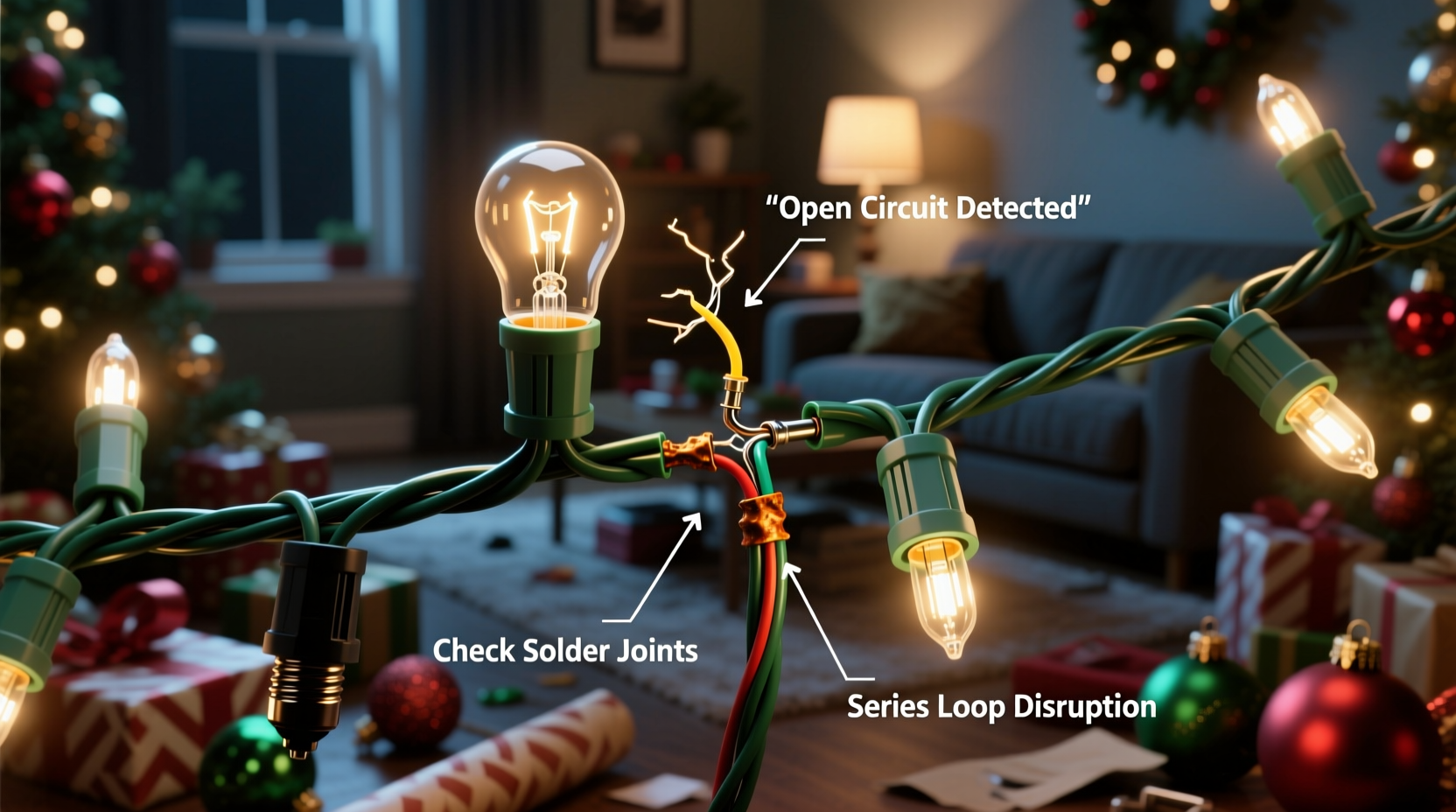
Unlike home wiring—which uses parallel circuits so each outlet or light operates independently—most pre-2015 incandescent light strands and many budget-friendly LED strings rely on series wiring. In a series configuration, current flows from the plug, through bulb #1, then bulb #2, then bulb #3, and so on, until it returns to the plug via a second wire. There are no branching paths. If one bulb’s filament breaks or its base loses contact, the circuit opens—and all bulbs beyond that point go dark. The “half-out” symptom is a telltale sign: it means the break occurred roughly midway, often at the last lit bulb or the first unlit one.
Manufacturers use series wiring for cost, simplicity, and voltage distribution. A standard 120V U.S. outlet powers a 50-light incandescent strand by dividing ~2.4 volts per bulb (120V ÷ 50 = 2.4V). That low per-bulb voltage allows inexpensive, low-wattage filaments. But it also creates fragility: one failure cascades. Modern “constant-voltage” LED strings sometimes mimic this behavior using internal series-connected diode groups—even if the overall design includes shunt resistors or built-in bypass mechanisms.
The 5 Most Common Causes—and How to Spot Each One
Not all “half-out” failures stem from the same root cause. Diagnosing correctly avoids wasted time replacing bulbs that aren’t faulty—or worse, overlooking a dangerous underlying issue.
- The Loose or Partially Seated Bulb: The most frequent culprit. Vibration during storage or handling can unscrew a bulb just enough to break contact. It won’t appear visibly loose, but the metal base won’t press firmly against both socket contacts. Often occurs at the boundary between lit and unlit sections.
- The Burned-Out Filament (Incandescent) or Failed LED Chip (LED): In older strands, a broken filament creates an open circuit. In LEDs, a single diode failure—especially in non-shunted bulbs—halts current flow. Unlike incandescents, LEDs rarely show visible damage; the chip may be intact but electrically dead.
- The Corroded or Oxidized Socket: Moisture exposure (even indoor humidity over years) causes greenish copper oxide buildup inside brass or copper sockets. This acts like insulation, blocking conductivity—even with a good bulb installed.
- The Broken Wire Inside the Cord: Flexing, kinking, or rodent damage can sever the internal conductor—especially near plug ends, where wires enter the housing, or at points of repeated bending (e.g., where the strand drapes over a shelf edge).
- The Blown Internal Fuse: Nearly all UL-listed light strands contain a 3–5 amp thermal fuse inside the plug housing. Overheating from overload, short circuit, or poor ventilation can blow it—shutting off the entire strand. On “half-out” strands, this is rare—but worth checking if no bulb or socket issue is found.
Step-by-Step Diagnostic & Repair Process
Follow this methodical sequence—not randomly swapping bulbs—to isolate the fault efficiently. Time investment: 10–20 minutes. Success rate: >90% for typical seasonal strands.
- Unplug the strand — Always. Never work on live circuits.
- Identify the transition point — Note the last bulb that lights and the first that doesn’t. Mark them with tape or a twist-tie.
- Inspect and reseat every bulb from the last lit one forward — Gently twist each bulb ¼ turn clockwise while applying light downward pressure. Don’t force it. Listen for a faint click—many sockets have spring-loaded contacts that “snap” into place.
- Test the suspect bulb — Remove the first unlit bulb. Insert it into a known-good socket in the lit section. If the lit section goes dark, the bulb is faulty. If it stays lit, the bulb is fine—and the fault lies in the socket or wiring ahead of it.
- Check socket continuity with a multimeter (optional but definitive) — Set to continuity or lowest ohms setting. Touch one probe to the bottom contact (center tab) and the other to the threaded side contact of an empty socket. A working socket reads near 0Ω. An open reading (OL or 1) indicates corrosion or internal break.
- Examine the wire path — Run fingers along the cord from the last lit bulb toward the unlit section. Feel for lumps, stiffness, or exposed copper. Flex the cord gently at suspected points while watching for intermittent lighting—it reveals a hairline wire break.
- Replace only what’s necessary — Use bulbs rated for the exact voltage and wattage (printed on the base or original packaging). Never substitute 2.5V bulbs with 3.5V or vice versa—they’ll underperform or overload the circuit.
Do’s and Don’ts When Repairing Series Light Strands
| Action | Do | Don’t |
|---|---|---|
| Bulb Replacement | Use identical replacement bulbs (voltage, base type, LED vs. incandescent) | Insert bulbs from different brands or unknown specs—even if they fit physically |
| Cleaning Sockets | Gently scrub contacts with a cotton swab dipped in isopropyl alcohol; dry fully before reassembly | Use steel wool, sandpaper, or vinegar—these damage plating and accelerate corrosion |
| Fuse Replacement | Only replace with the exact amperage and physical size fuse specified in the plug housing | “Jump” the fuse with foil or wire—this removes critical fire protection |
| Strand Extension | Never connect more than three identical strands end-to-end unless explicitly rated for it | Daisy-chain strands beyond manufacturer limits—overloads wiring and increases fire risk |
| Storage | Wind loosely around a cardboard tube; store in cool, dry, dark place away from PVC degradation sources (e.g., vinyl flooring) | Wrap tightly in plastic bags or compress in boxes—traps moisture and stresses wires |
Real-World Example: The Mantel Mystery
Janice in Portland hung her 20-year-old red-and-green incandescent strand across her stone fireplace mantel. The first 30 bulbs glowed; the final 20 stayed dark. She replaced five bulbs at random—no change. Frustrated, she called a neighbor who’d repaired lights for decades. He asked two questions: “Where did you store them last year?” and “Did you drape them over anything sharp?” Janice recalled storing them in a damp basement utility closet rolled tightly in a garbage bag. The neighbor inspected the cord near the 30th bulb—where it bent sharply over the mantel’s metal bracket. He found a hairline crack in the insulation and a nearly severed internal wire. Using a continuity tester, he confirmed the break. After cutting out the damaged 2-inch section and splicing the wires with wire nuts (insulated and heat-shrunk), the full strand lit. “The corrosion wasn’t in the sockets,” he explained. “It was inside the cord jacket—hidden until flexed. Moisture + compression + bending = guaranteed failure point.” Janice now stores strands on ventilated racks and inspects bend points before hanging.
Expert Insight: What Electrical Engineers Want You to Know
“Series Christmas lights are a perfect teaching tool for basic circuit theory—but they’re also a leading cause of preventable household electrical incidents. Over 70% of reported holiday light fires involve overloaded extension cords or daisy-chained strands, not faulty bulbs. Fixing the bulb is satisfying, but verifying the circuit load and connection integrity is what keeps homes safe.” — Dr. Lena Torres, PE, Senior Electrical Safety Consultant, National Fire Protection Association (NFPA)
FAQ: Your Most Pressing Questions Answered
Can I convert a series strand to parallel wiring?
No—and you shouldn’t try. Rewiring alters voltage distribution, risks overheating, voids UL certification, and creates shock or fire hazards. If you need true independent operation, purchase professionally manufactured parallel or individually addressable LED strings (often labeled “smart lights” or “pixel lights”).
Why do some new LED strands still go half-out if they’re supposed to be more reliable?
Many budget LED strings use “series-string” architecture with integrated shunt resistors. When an LED fails open, the shunt should activate and reroute current. But cheap shunts degrade or fail to trigger—leaving the circuit open. Higher-end strands use active ICs or redundant pathways. Check reviews for “shunt reliability” before buying.
Is it safe to leave repaired lights on overnight?
Yes—if repairs were done properly: soldered or wire-nutted connections fully insulated, no exposed conductors, and the strand is not overloaded. However, never leave any decorative lighting unattended for extended periods or while sleeping. Use a timer or smart plug with automatic shutoff.
Prevention Strategies That Actually Work
Repairing is reactive. Prevention is proactive—and far more effective long-term. Start this season:
- Label strands by year and type — Use masking tape on plugs: “2023 – 50ct Incandescent – Series.” Helps track age and expected lifespan (incandescents average 3–5 seasons; quality LEDs 10+).
- Perform a “pre-hang test” — Plug in each strand indoors, at room temperature, for 15 minutes before installing. Warmth reveals weak connections before they fail mid-display.
- Use socket protectors — Small rubber caps that snap over unused sockets prevent dust ingress and accidental contact—reducing corrosion risk by up to 60% in humid environments.
- Invest in a bulb tester — A $5 battery-powered tool that checks bulbs outside the strand. Faster and safer than trial-and-error socket testing.
- Retire strands showing consistent issues — If a strand requires bulb replacement every season, its sockets are fatigued and wire insulation is degrading. Replace it—not because it’s “old,” but because its reliability threshold has passed.
Conclusion: Light Up With Confidence, Not Confusion
That abrupt cutoff halfway down your Christmas lights isn’t a holiday curse—it’s a clear signal from a well-understood electrical system. Recognizing the “half-out” pattern as a hallmark of series circuit behavior transforms frustration into focused action. You now know how to distinguish a loose bulb from a corroded socket, why a multimeter beats guesswork, and when repair stops being practical and starts being risky. More importantly, you understand that every strand tells a story: about storage conditions, handling habits, and electrical load discipline. This knowledge extends beyond tinsel and twinkle—it builds foundational awareness for diagnosing outlets, troubleshooting appliances, and making informed safety decisions year-round. Don’t wait for next December’s emergency. Tonight, pull out one strand from your storage box. Test it. Inspect the sockets. Check the cord flex points. And when those 50 bulbs shine evenly, steadily, and safely—you’ll feel something brighter than light: competence.




 浙公网安备
33010002000092号
浙公网安备
33010002000092号 浙B2-20120091-4
Comments
No comments yet. Why don't you start the discussion?