
If your air conditioning system makes a distinct clicking sound but fails to start, you're likely facing a mechanical or electrical issue within the compressor or its supporting components. This symptom is more than just an annoyance—it's a warning sign that something in your HVAC system needs immediate attention. Ignoring it can lead to reduced efficiency, higher energy bills, or even complete system failure during peak summer months.
The \"click\" you hear is typically the contactor engaging—a normal part of the startup sequence. But when that’s followed by silence instead of the expected hum of the compressor kicking on, there’s a breakdown somewhere in the chain of events required for operation. Understanding why this happens empowers homeowners to diagnose issues early, communicate effectively with technicians, and sometimes perform basic troubleshooting themselves.
Understanding the AC Compressor Startup Sequence
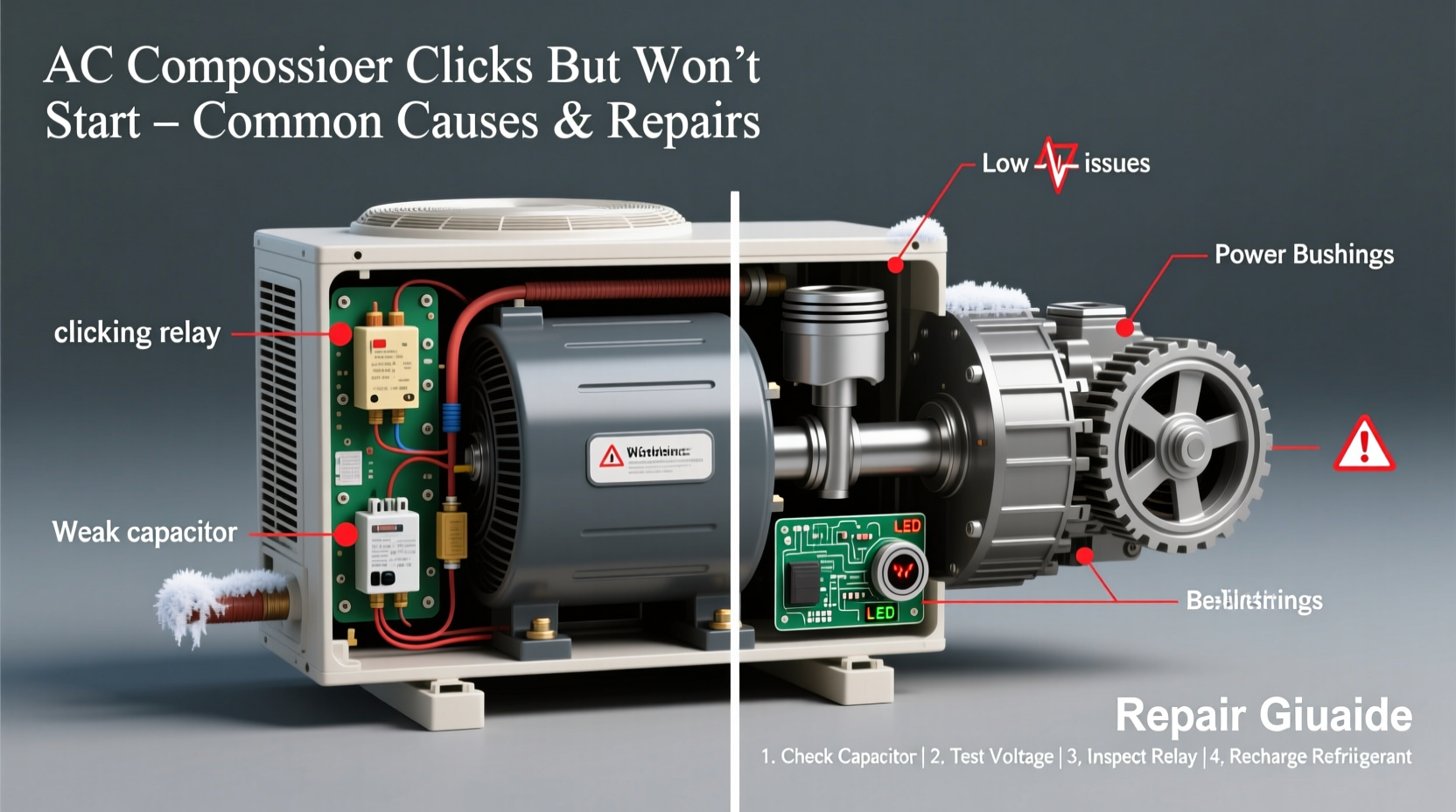
Before diving into failures, it helps to understand how a healthy system behaves. When your thermostat calls for cooling:
- The thermostat sends a signal to the outdoor unit’s control board.
- The contactor (a relay switch) closes with an audible “click.”
- Power flows to the compressor and fan motor.
- The compressor begins running, circulating refrigerant through the system.
- Cool air is delivered indoors via the evaporator coil and blower.
The initial click is normal. Problems arise when steps 3–5 don’t follow. A failed startup could stem from power supply issues, worn components, safety cutoffs, or environmental factors.
Common Causes of Clicking Without Starting
1. Faulty or Stuck Contactor
The contactor is responsible for delivering high-voltage power to the compressor. Over time, contacts can become pitted, corroded, or mechanically stuck due to heat cycles and moisture exposure. If the coil energizes (causing the click), but the contacts fail to fully close, the compressor won’t receive sufficient voltage.
Symptoms include repeated clicking, visible arcing marks, or a burnt smell near the contactor. Using a multimeter, you can test continuity across the terminals when activated. Replacement is straightforward for licensed professionals but should not be attempted without proper training.
2. Failed Start Capacitor
The start capacitor provides the extra torque needed to get the compressor moving. It works in tandem with the run capacitor to overcome inertia. A weak or dead capacitor often results in a single click followed by nothing—no hum, no vibration.
Visually, bulging tops, leaking oil, or ruptured seals indicate failure. Even if it looks intact, internal degradation may prevent function. Technicians use microfarad (µF) meters to verify capacitance against rated values. Replacing a faulty capacitor is one of the most cost-effective fixes in HVAC maintenance.
3. Tripped Internal Overload or Open Windings
Compressors have built-in thermal overload protectors that shut down the motor if temperatures rise too high. These can trip due to overheating from poor airflow, dirty coils, or prolonged operation under load. Once tripped, they require cooldown before resetting—sometimes taking minutes or hours.
If the windings inside the compressor are damaged (open circuit), no amount of resetting will restore function. This is diagnosed using resistance measurements between common, start, and run terminals. An open winding means the compressor must be replaced.
4. Low Refrigerant Charge or Blocked Lines
Low refrigerant increases head pressure and forces the compressor to work harder. Safety controls like the low-pressure switch may prevent startup altogether. Similarly, a clogged filter drier or kinked line can restrict flow, leading to abnormal pressures that trigger lockouts.
A system low on refrigerant usually indicates a leak, which must be repaired before recharging. Operating a compressor with insufficient refrigerant causes rapid wear and potential seizure.
5. Electrical Supply Issues
Voltage drops, loose wiring, or blown fuses can interrupt power delivery despite the control signal being sent. Check the disconnect switch near the outdoor unit—ensure it’s fully engaged. Test voltage at the contactor line side (should read ~240V). Fluctuations below 200V can prevent reliable compressor operation.
Loose lugs in the breaker panel or corrosion on terminal connections are common culprits, especially in coastal or humid environments.
“Over 60% of ‘no-start’ compressor calls we see involve either capacitors or contactors. These are wear items—they aren’t meant to last the life of the unit.” — Mark Reynolds, Master HVAC Technician with 22 years in residential service
Troubleshooting Checklist: Step-by-Step Diagnosis
Follow this logical sequence to identify the root cause safely and efficiently:
- Turn off power at the thermostat and disconnect switch.
- Inspect visually for obvious signs: burnt wires, swollen capacitors, rust, or debris blocking airflow.
- Check the air filter—a severely clogged filter reduces indoor airflow, causing coil freeze-up and high pressure.
- Restore power and listen: Does the click occur once or repeatedly?
- Test voltage at the contactor (line side): Should read 230–240V AC.
- Check capacitor(s) with a multimeter set to microfarads; compare reading to label.
- Examine contactor contacts for pitting or welding. Clean gently with electrical contact cleaner if lightly corroded.
- Measure compressor terminals: Use ohmmeter to check resistance between C-S, C-R, S-R. No continuity suggests open windings.
- Verify thermostat signal: Confirm Y wire receives 24V when cooling is called.
- Look for error codes on modern units—many condensing units flash LED patterns indicating fault types.
Repair Options by Cause
| Cause | Diagnosis Method | Possible Repair | Estimated Cost (DIY vs Pro) |
|---|---|---|---|
| Faulty Contactor | Multimeter test, visual inspection | Replace contactor | $25 DIY / $150 pro labor + part |
| Bad Start Capacitor | Capacitance meter, visual signs | Replace dual-run or start capacitor | $15 DIY / $120–$200 pro |
| Open Compressor Windings | Ohmmeter shows infinite resistance | Replace compressor or entire condenser | N/A / $800–$2,500 |
| Low Refrigerant | Pressure gauge readings, bubble sight glass | Leak repair + recharge | N/A / $500–$1,200 |
| Tripped Overload | No power to motor despite control signal | Allow cooldown or replace protector | $0 if self-resetting / $75 pro |
| Electrical Failure | Voltage drop, blown fuse | Tighten connections, replace fuse/breaker | $10 DIY / $100–$200 pro |
Real-World Example: The Case of the Cycling Condenser
A homeowner in Phoenix reported their AC clicking every few minutes but never starting. Ambient temps were above 105°F, yet the house wasn’t cooling. Initial inspection revealed a clean filter and clear coils. Power was present at the disconnect, and the thermostat signaled correctly.
Upon opening the condenser cabinet, the technician heard the familiar click—but noticed the contactor shuddered slightly, failing to hold. Voltage testing showed only 198V reaching the unit. Further investigation traced the issue to a loose double-pole breaker in the main panel. After tightening the terminal screws and confirming stable 240V output, the system started normally.
This case highlights how seemingly complex problems can stem from overlooked basics. In extreme heat, marginal electrical connections overheat and increase resistance, dropping voltage below operational thresholds.
When to Call a Professional
While some checks—like replacing a capacitor or cleaning coils—can be handled by skilled DIYers, many aspects of compressor troubleshooting require specialized tools and knowledge:
- Handling refrigerants requires EPA Section 608 certification.
- Improperly sizing replacement parts can damage other components.
- High-voltage systems pose serious electrocution risks.
- Modern units with variable-speed compressors use proprietary diagnostics.
If you’ve verified power, replaced the capacitor, and cleaned the unit but still experience clicking without startup, professional evaluation is essential. Continuing to cycle a failing compressor accelerates damage and may void warranties.
Frequently Asked Questions
Can a bad thermostat cause the compressor to click but not start?
Yes. While less common, a failing thermostat may send intermittent signals to the contactor, causing it to click on and off rapidly. However, if the click occurs only once per call for cooling, the issue is more likely downstream—in the outdoor unit itself.
Is it safe to keep resetting the breaker when the AC clicks and stops?
No. Repeatedly resetting the breaker without diagnosing the underlying issue risks overheating wires, damaging the compressor, or creating a fire hazard. If the breaker trips or the system fails to start after one attempt, shut it down and investigate.
How long should an AC compressor last after it starts clicking abnormally?
There’s no fixed timeline. Some compressors struggle for weeks; others fail completely within days. Abnormal sounds or behaviors are early warnings. Address them promptly to avoid emergency breakdowns during heat waves.
Final Thoughts and Action Plan
A clicking AC compressor that won’t start is a red flag demanding prompt attention. While the symptom may appear minor, the underlying causes range from simple fixes like capacitor replacement to major repairs such as compressor or refrigerant system overhaul.
Start with the basics: ensure power is stable, filters are clean, and the outdoor unit is free of obstructions. Test accessible components like the capacitor and contactor if you have experience. For anything involving refrigerant, high-voltage circuits, or internal motor diagnostics, rely on a licensed HVAC technician.
Regular maintenance—including annual tune-ups, coil cleaning, and electrical inspections—can prevent many of these failures. Systems in hot climates benefit from biannual checks to withstand extreme seasonal loads.




 浙公网安备
33010002000092号
浙公网安备
33010002000092号 浙B2-20120091-4
Comments
No comments yet. Why don't you start the discussion?