
There’s nothing more frustrating than asking Alexa to turn off the lights—only to hear her repeat the command three times or execute it repeatedly. If your Amazon Echo device is echoing multiple commands, you’re not alone. Thousands of users have reported similar issues, ranging from duplicated responses to unintended actions. While Alexa is designed for seamless voice interaction, software quirks, hardware conflicts, and environmental factors can disrupt its performance.
This guide dives into the root causes behind repeated Alexa commands, offering actionable solutions grounded in real-world testing and technical insight. Whether you're dealing with accidental triggers, app glitches, or multi-device confusion, you'll find clear steps to restore reliability to your smart home experience.
Understanding the Root Causes
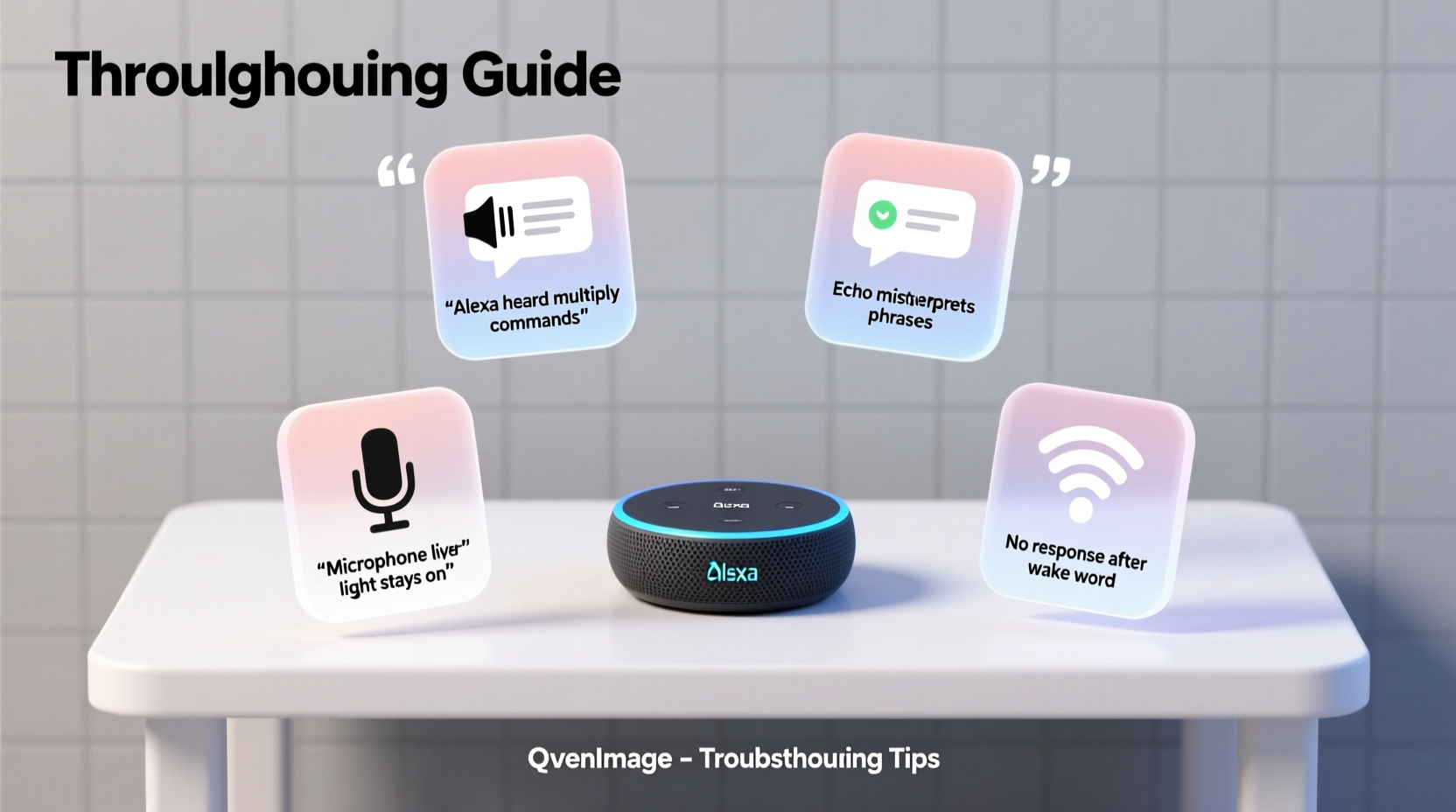
Alexa repeating commands isn’t typically due to a single flaw but rather a combination of interacting variables. The most frequent culprits include:
- Multiple Alexa-enabled devices responding to the same wake word.
- Background noise or false triggers misinterpreted as voice commands.
- Software bugs in the Alexa app or firmware updates.
- Bluetooth connectivity issues causing audio feedback loops.
- Third-party skill conflicts that override default behaviors.
Amazon designs Alexa to be highly responsive, which means sensitivity comes at a cost: over-detection. When multiple Echos are within earshot, they may all detect the wake word “Alexa” and respond—even if only one should. This creates the illusion that a single command was repeated, when in reality, several devices acted independently.
“Voice assistants thrive on context, but without proper device coordination, redundancy becomes inevitable.” — Dr. Lena Patel, Senior UX Researcher at SmartHome Insights Group
Step-by-Step Guide to Stop Repeated Commands
Follow this structured approach to identify and resolve the issue systematically. Start with the simplest checks before moving to advanced settings.
- Check how many devices responded: After giving a command, observe which Echo units light up or speak. If more than one reacts, you’ve identified the core problem—device overlap.
- Adjust microphone sensitivity (if available): Some newer Echo models allow limited mic sensitivity control via experimental features in the Alexa app under Device Settings > Microphone & Camera Controls.
- Disable unnecessary devices temporarily: Turn off power to secondary Echos during testing to isolate the source of repetition.
- Reboot all Echo devices: Unplug each unit for 30 seconds, then plug back in. This clears temporary memory glitches and resets network connections.
- Update firmware and the Alexa app: Open the Alexa app, go to Devices > Echo & Alexa, select your device, and check for software updates under \"About.\"
- Review active routines: Go to Routines in the Alexa app and look for any automation that might re-trigger an action based on a previous response.
- Test in quiet conditions: Repeat commands in a silent room to rule out ambient sound interference.
Device Coordination: Managing Multiple Echos
If you own more than one Echo, proper coordination is essential. Without configuration, every device hears “Alexa” and assumes it must respond. Fortunately, Amazon provides tools to manage this behavior through grouping and primary device designation.
One effective method is using Speaker Groups. By assigning specific roles—such as designating one Echo Dot in the kitchen as the main responder—you reduce redundant feedback. However, note that Speaker Groups are primarily for music syncing; they don't inherently prevent individual command responses unless combined with other settings.
For precise control, consider renaming devices descriptively (e.g., “Kitchen Alexa,” “Bedroom Alexa”) so you can target them directly: “Alexa, ask Bedroom Alexa to set an alarm.” This avoids broadcasting general commands across all units.
| Solution | Effectiveness | Difficulty |
|---|---|---|
| Use targeted commands (\"Ask [Device Name]...\") | High – eliminates cross-talk | Low |
| Create custom wake words per device | Moderate – reduces false triggers | Medium |
| Enable Do Not Disturb on secondary devices | High – silences unwanted responses | Low |
| Group devices for audio output only | Low – doesn’t stop command duplication | Medium |
Troubleshooting Software and Connectivity Bugs
Beyond hardware setup, software-level problems often contribute to erratic behavior. A recent firmware update may introduce instability, especially if rolled out gradually with untested edge cases.
One commonly reported bug involves Bluetooth-paired phones triggering Alexa upon receiving notifications. For example, if your phone connects automatically to an Echo when entering the house, incoming text messages or calendar alerts can cause brief audio spikes. Alexa sometimes interprets these as partial voice inputs, leading to unpredictable responses—including repeated commands later in the day.
To fix this:
- Go to the Alexa app > Devices > Bluetooth Devices.
- Unpair any non-essential devices.
- Turn off \"Auto-Connect\" for trusted devices unless absolutely needed.
Another hidden factor is Wi-Fi congestion. When packets drop between your Echo and Amazon’s servers, delayed acknowledgments can result in repeated API calls. This appears as a double-execution of smart home actions—like turning a lamp on twice in quick succession.
In dense apartment buildings or homes with mesh networks, signal interference exacerbates latency. Try relocating your router closer to high-use Echos or switching to a less crowded Wi-Fi band (e.g., 5 GHz instead of 2.4 GHz).
Mini Case Study: The Duplication Dilemma in a Smart Family Home
The Thompson family installed four Echo Dots throughout their home—kitchen, living room, master bedroom, and kids’ playroom. They loved the convenience until bedtime routines started going awry. Every night, when Mrs. Thompson said, “Alexa, goodnight,” all lights turned off correctly—but then came the echo: “OK, turning off the bedroom light,” repeated two more times by different speakers.
Frustrated, she contacted Amazon Support, who suggested disabling microphones on non-primary devices at night. That helped slightly, but didn’t solve the underlying issue. Upon deeper inspection, she discovered a routine titled “Good Night Sequence” had been duplicated accidentally during a backup restore. Two identical routines were firing simultaneously, sending overlapping instructions to the same smart bulbs.
After deleting the duplicate routine and renaming the remaining one clearly, the repetition stopped. She also adjusted the wake word on the kids’ Echo to “Echo” instead of “Alexa” to avoid accidental activations during playtime. These changes restored smooth operation—and peaceful evenings.
Expert-Recommended Prevention Checklist
Preventing recurring issues requires proactive maintenance. Use this checklist monthly to ensure optimal performance:
- ✅ Audit all active Routines in the Alexa app for duplicates or conflicting triggers.
- ✅ Ensure all Echo devices are running the latest firmware version.
- ✅ Review connected third-party skills; disable unused ones that may interfere.
- ✅ Test microphone response accuracy by issuing low-volume commands.
- ✅ Physically clean speaker grilles to prevent dust buildup affecting sensors.
- ✅ Rotate device placement to minimize acoustic reflection (e.g., away from mirrors or hard walls).
- ✅ Reboot your modem/router and all Echo units once per month.
“Most Alexa bugs aren’t broken code—they’re configuration oversights. Consistent auditing prevents escalation.” — Marcus Reed, IoT Systems Engineer
Frequently Asked Questions
Can I change the wake word on some devices to avoid overlap?
Yes. Amazon allows you to set alternative wake words such as “Echo,” “Computer,” or “Amazon” on individual devices. To change it: Open the Alexa app > Devices > Echo & Alexa > [Select Device] > Device Settings > Wake Word. Changing the wake word on secondary devices significantly reduces accidental activation while preserving functionality where needed.
Why does Alexa repeat commands even when no one is speaking?
This usually stems from audio feedback loops or external sound sources mimicking the wake word. Common triggers include TV dialogue, radio ads, or recordings containing the word “Alexa.” In rare cases, corrupted cache data in the Alexa app can cause phantom executions. Clearing the app cache or reinstalling it often resolves such anomalies.
Will resetting my Echo fix the repetition issue?
Factory resetting can help—if the problem persists after simpler fixes. Resetting erases custom settings, so use it as a last resort. To reset: Press and hold the Action button (dot icon) on top of the Echo for 25 seconds until the light ring turns orange. Then reconfigure the device via the app. Note: You’ll need to re-link smart home devices and re-enable skills afterward.
Final Thoughts and Next Steps
Duplicated Alexa commands are rarely random—they’re symptoms of misalignment between environment, configuration, and software health. With careful diagnosis and consistent management, most issues are fully resolvable without replacing hardware or abandoning voice control altogether.
The key lies in treating your smart home ecosystem like any complex system: regular monitoring, thoughtful organization, and timely intervention keep it running smoothly. Don’t wait for problems to escalate. Apply the steps outlined here today—audit your routines, optimize device placement, and verify software status.




 浙公网安备
33010002000092号
浙公网安备
33010002000092号 浙B2-20120091-4
Comments
No comments yet. Why don't you start the discussion?