
Every holiday season, families across the country unpack their artificial Christmas trees with excitement—only to be met with an unexpected jolt. A light touch to the branches sends a small but startling electric shock, turning festive moments into mildly painful ones. You're not imagining it: artificial trees really do generate static electricity, especially in winter. But why? And more importantly, what can you do about it?
The phenomenon isn’t dangerous, but it is annoying—and surprisingly common. From synthetic materials to dry indoor air, multiple factors contribute to this seasonal nuisance. Understanding the science behind the shock is the first step toward eliminating it. More than just comfort, reducing static also helps protect delicate ornaments and electronics near the tree.
This guide breaks down the root causes of static on artificial trees, explains the environmental conditions that make it worse, and offers actionable solutions backed by physics and real-world testing. Whether you’ve dealt with this for years or are noticing it for the first time, these strategies will help you enjoy a safer, more comfortable holiday display.
The Science Behind Static Electricity in Artificial Trees
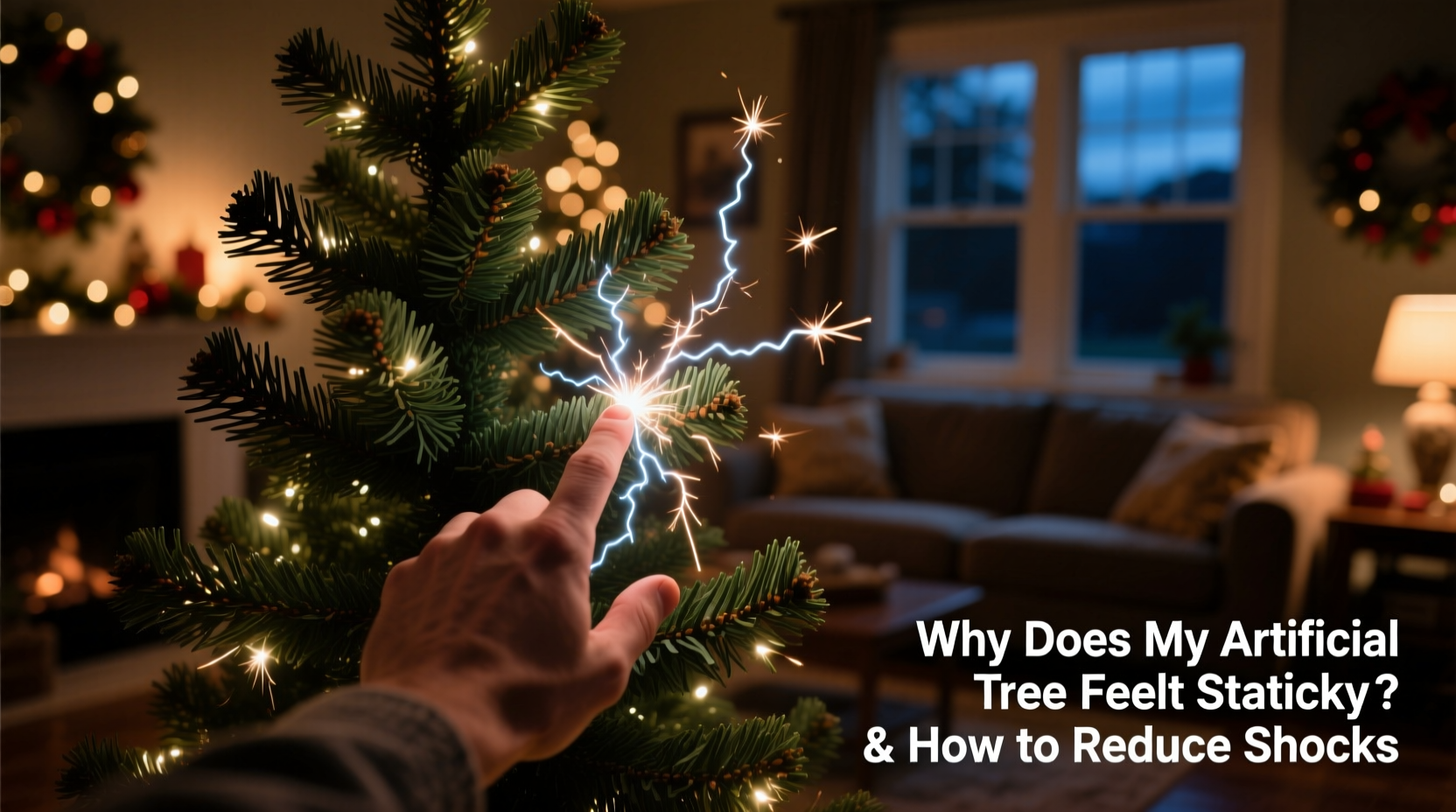
Static electricity occurs when electrons transfer between materials through contact, a process known as triboelectric charging. When two surfaces rub together—like your hand brushing against plastic branches—electrons can jump from one surface to the other. The material that gains electrons becomes negatively charged; the one losing them becomes positively charged. Since the charge has nowhere to go, it builds up until it discharges—often as a sharp zap when you touch something conductive, like a metal ornament or another person.
Artificial Christmas trees are typically made from polyvinyl chloride (PVC) or polyethylene (PE), both synthetic plastics that rank high on the triboelectric series—the scale measuring a material’s tendency to gain or lose electrons. These materials easily become negatively charged, especially when disturbed. As you fluff branches or hang ornaments, tiny friction events accumulate charge across the tree.
Additionally, most artificial trees have metal support frames. While the frame itself doesn’t generate static, it acts as a conductor. Once the surrounding branches charge up, the frame can concentrate that charge, making shocks more intense when touched. This combination of insulating plastics and conductive metal creates the perfect storm for repeated zaps.
“Plastic materials used in artificial trees are excellent at holding static charges, particularly in low-humidity environments. It’s not a defect—it’s basic physics.” — Dr. Lena Pruitt, Materials Scientist at the National Institute of Standards and Technology (NIST)
Why Winter Makes the Problem Worse
Static shocks aren’t unique to Christmas trees—but they’re far more noticeable during the holidays because of seasonal climate conditions. Winter air, especially indoors, tends to be extremely dry. Heating systems pull moisture from the air, often dropping relative humidity levels below 30%. In such environments, static charges build up more easily and dissipate more slowly.
In humid conditions, water molecules in the air help conduct excess electrons away from surfaces, preventing charge buildup. But in dry air, there are fewer free ions to carry the charge, so it remains trapped on insulating materials like plastic branches. This is why you’re more likely to get shocked in December than in July, even if your tree sits in the same spot year-round.
Other contributing factors include:
- Carpets and rugs: Synthetic flooring materials generate static when walked on, increasing your body’s overall charge before you even reach the tree.
- Sock-clad feet: Wool or synthetic socks rubbing against carpet amplify personal static buildup.
- Low ventilation: Closed windows and limited airflow prevent natural charge dissipation.
Effective Ways to Reduce Static Shocks
Eliminating static entirely may not be possible, but you can dramatically reduce its frequency and intensity. The key is targeting both the tree and its environment. Below are proven methods tested by homeowners and supported by electrostatic principles.
1. Increase Indoor Humidity
The single most effective solution is raising humidity levels. A home humidifier introduces moisture into the air, allowing static charges to leak away naturally. For best results, place a cool-mist humidifier near the tree—without wetting the tree directly—and maintain a humidity level between 40% and 50%.
2. Treat the Tree with Anti-Static Spray
Commercial anti-static sprays (like those used for laundry) can be lightly applied to tree branches. These products contain surfactants that attract moisture from the air, creating a microscopic conductive layer on the plastic surface. Always test on a small area first and apply in a well-ventilated space. Avoid overspraying near lights or electrical components.
3. Ground the Tree Frame
If your tree has a metal pole or base, grounding it can safely channel built-up charge into the floor. Attach a copper wire from the metal frame to a grounded object—such as a cold water pipe or grounded appliance outlet screw (not the outlet itself). This method is commonly used in electronics labs to prevent electrostatic discharge.
4. Use Natural Fiber Decorations
Swap out synthetic garlands (like tinsel or plastic icicles) for natural alternatives such as popcorn strings, dried citrus slices, or cotton bunting. These materials don’t hold static charge and reduce overall electron buildup on the tree.
5. Wear Low-Static Clothing and Footwear
Wool sweaters, polyester jackets, and rubber-soled shoes all increase your personal static potential. When decorating or adjusting the tree, wear cotton clothing and leather-soled shoes—or go barefoot on non-carpeted floors to minimize charge transfer.
Step-by-Step Guide to De-Static Your Tree (Before Decorating)
Follow this sequence before assembling and decorating your tree each year to minimize shocks throughout the season:
- Choose a location away from heat vents – Place the tree in an area not directly exposed to forced air, which dries out surroundings faster.
- Set up a humidifier nearby – Turn it on 24 hours before assembling the tree to stabilize humidity.
- Assemble the tree slowly – Rapid fluffing increases friction. Take your time to reduce charge generation.
- Spray branches with anti-static solution – Use commercial or homemade mix, applying evenly but lightly.
- Ground the metal base (if applicable) – Connect a wire from the pole to a grounded pipe or outlet screw.
- Let the tree sit for a few hours – Allow any residual charge to dissipate before adding lights or ornaments.
- Add natural fiber decorations first – Begin with non-synthetic items to reduce future static triggers.
Do’s and Don’ts: Managing Static on Artificial Trees
| Do | Don't |
|---|---|
| Use a humidifier to keep indoor air above 40% RH | Run heaters directly toward the tree |
| Lightly spray branches with diluted fabric softener | Soak the tree or get electrical components wet |
| Touch a grounded metal object before handling the tree | Decorate immediately after assembly without letting it settle |
| Use cotton gloves when fluffing or adjusting branches | Wear wool or synthetic gloves during setup |
| Ground the metal stand with a copper wire | Attach wires to live electrical outlets |
Real Example: How One Family Solved Their Shocking Tree Problem
The Reynolds family in Denver had struggled with their 7-foot artificial tree for three consecutive Christmases. Every time someone reached to hang an ornament, they’d recoil from a sharp zap. “It got so bad our youngest refused to go near it,” said Sarah Reynolds. “We thought it was broken or defective.”
After researching online, they discovered the role of dry air. They purchased a $40 ultrasonic humidifier and placed it beside the tree. They also mixed a DIY anti-static spray using liquid fabric softener and water, lightly misting each branch section before fluffing. Finally, they grounded the metal pole by running a thin copper wire from the base to a nearby radiator pipe.
The difference was immediate. “No more shocks,” Sarah reported. “Even when the kids run up and hug the tree, nothing happens. It’s been the most peaceful holiday in years.”
Frequently Asked Questions
Is static electricity from my artificial tree dangerous?
No, the shocks are generally harmless. They are low-current discharges similar to touching a doorknob after walking on carpet. However, people with pacemakers or sensitive medical devices should consult their doctor and consider minimizing exposure as a precaution.
Can I use dryer sheets on my tree to reduce static?
Yes, but sparingly. Rubbing a used dryer sheet over branches can leave a light anti-static residue. However, avoid leaving sheets in the tree—they can become a fire hazard near lights or outlets. Do not use new, scented sheets excessively, as oils may degrade plastic over time.
Will keeping the tree lights on help reduce static?
Not directly. While powered electrical systems can influence local electromagnetic fields, standard Christmas lights do not neutralize static charge. In fact, poorly insulated wiring could increase risk if moisture-based solutions are overused. Lights should be properly rated and kept dry.
Expert Tips for Long-Term Prevention
Preventing static isn’t just a one-season fix. How you store and maintain your tree year-round plays a major role in how much it shocks the next time it’s assembled.
- Store in a breathable bag: Avoid sealed plastic containers, which trap dry air and encourage static retention. Use canvas or woven storage bags instead.
- Keep in a climate-stable area: Store the tree in a basement or closet with stable temperature and moderate humidity—avoid attics or garages where extremes occur.
- Dust with anti-static cloths: When cleaning pre-storage, use microfiber cloths treated for static reduction rather than dry rags.
- Label and organize sections: Reducing assembly friction by knowing which branch goes where minimizes unnecessary rubbing.
“The best defense against holiday static starts long before December. Proper storage and material choices matter just as much as mid-season fixes.” — Mark Tran, Home Appliance Engineer and Holiday Lighting Consultant
Conclusion: Enjoy a Shock-Free Holiday Season
A staticky artificial Christmas tree is a common but solvable problem. By understanding the science of static electricity and addressing the environmental triggers—especially dry air—you can eliminate those surprising zaps for good. Simple changes like using a humidifier, applying anti-static treatments, and grounding the frame make a dramatic difference.
Beyond comfort, reducing static protects your decorations, enhances safety, and preserves the joy of the season. With a little preparation, your tree can be a centerpiece of warmth—not a source of surprise shocks.




 浙公网安备
33010002000092号
浙公网安备
33010002000092号 浙B2-20120091-4
Comments
No comments yet. Why don't you start the discussion?