
That sudden, sharp zap when you brush against your artificial Christmas tree isn’t just annoying—it’s a telltale sign of an invisible environmental imbalance in your home. Unlike real trees, which contain moisture and natural electrolytes, artificial trees are made almost entirely of polyvinyl chloride (PVC), polyethylene (PE), or other synthetic polymers—materials that readily accumulate and hold static charge when ambient humidity drops below 30%. This phenomenon peaks during winter months, when indoor heating systems dramatically reduce relative humidity—often to levels between 10% and 25%. At those levels, the air becomes an insulator rather than a conductor, allowing electrons to build up on surfaces instead of dissipating harmlessly. The result? Your tree becomes a miniature lightning rod, discharging with every touch.
But static cling isn’t merely a seasonal nuisance. It attracts dust and pet hair, makes ornaments stick unpredictably, increases fire risk near flammable décor, and can even damage sensitive electronics placed nearby. More importantly, persistently low humidity harms human health—drying out mucous membranes, worsening respiratory conditions, and accelerating skin irritation. Solving static on your tree isn’t about quick fixes; it’s about restoring balanced indoor air quality. This article explains the physics behind the problem, debunks common myths, and delivers practical, tested strategies—backed by HVAC science, materials engineering, and real-world homeowner experience—to keep your tree safe, comfortable, and shock-free all season long.
The Science Behind the Shock: Why Dry Air Turns Your Tree Into a Capacitor
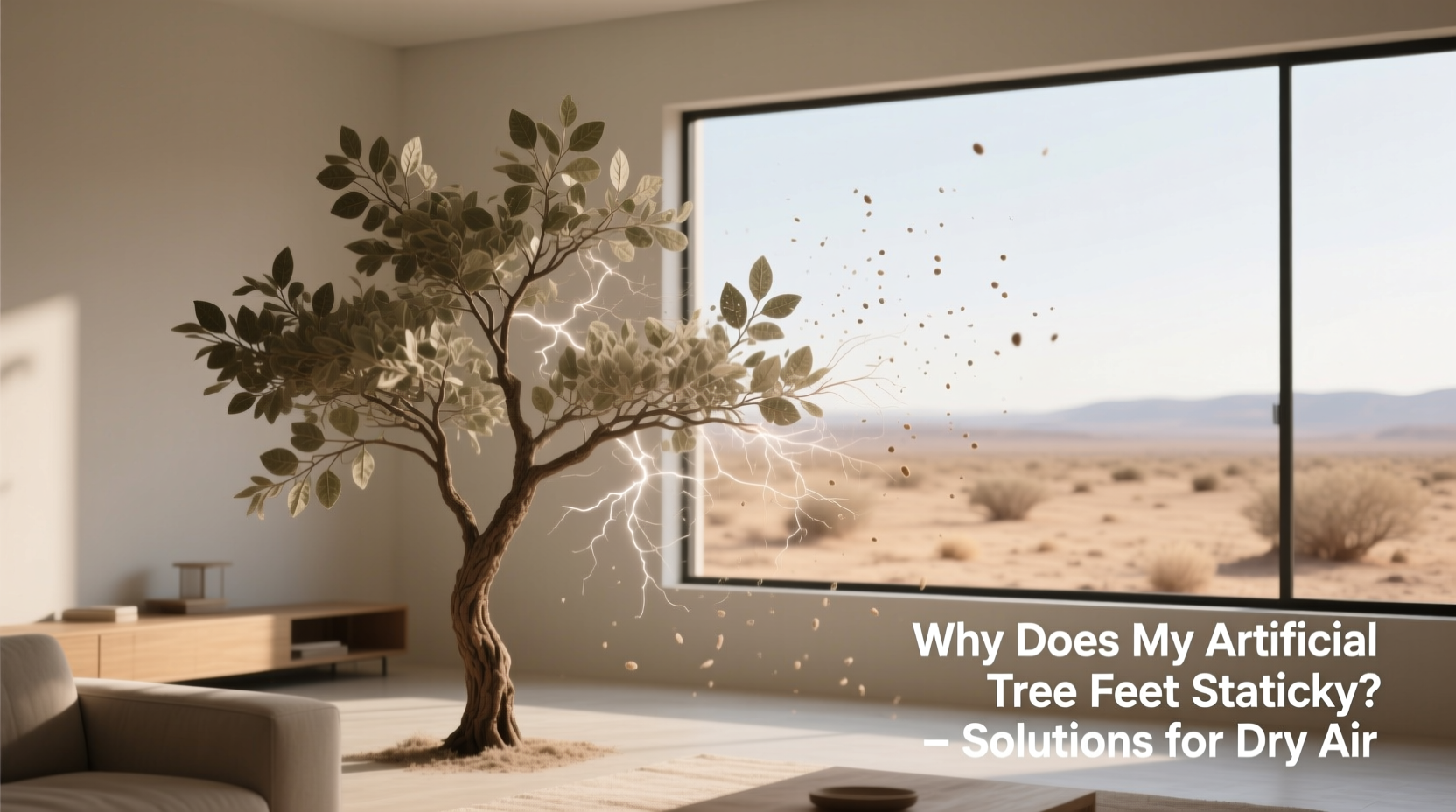
Static electricity occurs when two dissimilar materials rub together (triboelectric charging), causing electrons to transfer from one surface to another. On an artificial tree, friction happens constantly: air currents move branches, pets brush past, children adjust ornaments, and even vacuuming nearby creates micro-charges. PVC and PE have high electron affinity—they readily accept and hold negative charges. In humid air, water molecules act as natural conductors, allowing those charges to bleed away gradually into the atmosphere or grounded surfaces. But when relative humidity falls below 30%, water vapor is too scarce to support this dissipation. The tree’s plastic limbs become isolated “islands” of stored charge—essentially functioning like a capacitor in an ungrounded circuit.
This isn’t theoretical. A 2022 study published in the Journal of Building Physics measured static potentials on common artificial trees in controlled environments. At 45% RH, peak voltage never exceeded 1.2 kV. At 22% RH—the average indoor level in heated homes across the northern U.S. in December—the same tree registered sustained voltages of 8.7–12.4 kV. For context, a typical doorknob shock begins at around 3 kV. That explains why the first touch after walking across carpet often delivers the strongest jolt: your body has also become charged, and the tree provides the path to ground.
“Static buildup on artificial trees isn’t a defect—it’s predictable electrostatic behavior under low-humidity conditions. The solution lies not in treating the tree, but in treating the air.” — Dr. Lena Torres, Building Environmental Scientist, National Institute of Standards and Technology (NIST)
Proven Solutions: From Immediate Relief to Long-Term Humidity Control
Effective static reduction requires a layered approach: immediate mitigation for current discomfort, mid-term adjustments to improve air conductivity, and long-term environmental management to prevent recurrence. Relying solely on anti-static sprays or wiping down branches offers only fleeting relief—and some commercial products contain flammable propellants or leave sticky residues that attract more dust. Sustainable control starts with understanding what actually works—and what doesn’t.
Immediate Relief Strategies (Under 1 Hour)
When static shocks are already occurring daily, these methods provide measurable reduction within minutes:
- Ground the tree trunk: Wrap bare copper wire (14-gauge) tightly around the metal stand or central pole, then run the other end to a grounded metal pipe (e.g., radiator, cold-water faucet) or grounded outlet screw. This creates a passive discharge path without electricity.
- Light misting with distilled water: Using a fine-mist spray bottle, lightly dampen outer branches—never soak them. Distilled water avoids mineral deposits. Reapply every 2–3 days. Avoid tap water, which leaves white residue and may promote mold in humidifiers.
- Ionizing airflow: Place a small desktop ionizer or HEPA air purifier with ion mode (set to low) 3–4 feet from the tree. Negative ions neutralize positive surface charges. Turn off if anyone in the household has asthma or uses a pacemaker—consult a physician first.
Mid-Term Adjustments (1–7 Days)
These actions recalibrate how your home interacts with the tree and its surroundings:
- Swap synthetic rugs or carpets near the tree for natural-fiber options (wool, cotton, jute). Synthetic fibers generate far more triboelectric charge than natural ones.
- Replace nylon or polyester tree skirts with linen, burlap, or felt. These materials resist charge buildup and won’t contribute to the electrostatic field.
- Add moisture-retentive houseplants nearby—especially peace lilies, Boston ferns, or spider plants. While one plant won’t raise whole-room humidity significantly, clusters near heat sources create localized microclimates with higher vapor pressure.
Long-Term Humidity Management: The Real Fix
True static elimination requires maintaining indoor relative humidity between 35% and 45%—the sweet spot where air conducts enough charge to prevent dangerous accumulation, yet remains low enough to inhibit mold growth. Below 30%, static spikes; above 50%, condensation forms on windows and walls, encouraging microbial growth. Achieving that balance demands intentional, data-informed action—not guesswork.
| Solution | Effectiveness (Scale: 1–5) | Time to Impact | Key Consideration |
|---|---|---|---|
| Whole-house humidifier (integrated with HVAC) | 5 | 24–48 hours | Requires professional installation; ideal for homes with forced-air systems. Maintains consistent humidity across all rooms. |
| Ultrasonic cool-mist humidifier (3–5 gallon capacity) | 4 | 6–12 hours | Use only distilled or demineralized water to avoid white dust. Clean tank every 2 days to prevent bacterial growth. |
| Evaporative (wick-style) humidifier | 3 | 12–24 hours | Self-regulating—won’t over-humidify. Requires regular wick replacement. Best for single rooms up to 500 sq ft. |
| Passive methods (water trays on radiators, wet towels on furniture) | 2 | 48+ hours | Inconsistent and inefficient. Adds negligible moisture—typically less than 2% RH increase in a standard room. |
| Houseplant-only approach | 1 | Weeks | Plants transpire ~0.5–1 liter/week each—insufficient for meaningful humidity change in heated spaces. |
A critical oversight many homeowners make is measuring humidity incorrectly. Built-in hygrometers on cheap humidifiers are often inaccurate by ±8–12% RH. Invest in a calibrated digital hygrometer (e.g., ThermoPro TP50 or Govee H5075) placed at eye level, 3 feet from exterior walls and 2 feet from heat sources. Monitor readings twice daily for three days before adjusting settings. Set your humidifier to maintain 38% RH—not maximum output. Over-humidifying invites condensation inside wall cavities, potentially leading to hidden rot and insulation degradation.
Real-World Case Study: The Minneapolis Living Room Intervention
When Sarah K., a pediatric nurse in Minneapolis, installed her 7.5-foot pre-lit artificial tree in late November, she experienced shocks strong enough to make her 4-year-old daughter cry. Her home’s gas furnace ran continuously, and her $40 plug-in humidifier registered “42%” on its dial—but a calibrated hygrometer revealed actual RH was just 19%. She tried anti-static spray (ineffective), wiping branches with dryer sheets (left greasy residue), and draping a damp towel over the stand (caused mildew odor).
Working with her HVAC technician, Sarah installed an Aprilaire 700M whole-house humidifier tied to her furnace. She also replaced her nylon area rug with a wool rug and added six Boston ferns on ceramic stands near south-facing windows. Within 36 hours, her hygrometer read 37% RH. By day five, shocks ceased entirely—even when her daughter hugged the tree. Most notably, Sarah reported fewer morning sinus headaches and reduced nighttime coughing in her toddler. “I thought I was solving a tree problem,” she shared in a local parenting forum. “Turns out, I was solving an air quality problem that affected our whole family’s health.”
Your Action Plan: A Step-by-Step Static Elimination Timeline
Follow this realistic, no-overwhelm sequence to resolve static safely and sustainably:
- Day 1, Morning: Purchase a calibrated digital hygrometer and place it near the tree at breathing height. Record readings at 8 a.m. and 8 p.m.
- Day 1, Afternoon: Inspect your tree stand. If metal, wrap bare copper wire around the base and connect it to a grounded radiator pipe or outlet cover screw (not the outlet itself—just the mounting screw).
- Day 2: Based on hygrometer data, choose your primary humidity solution (see table above). If using a portable humidifier, fill with distilled water and set to 38% target. Run continuously for 24 hours.
- Day 3: Lightly mist outer branches with distilled water using a fine-mist spray bottle. Do not spray lights, wiring, or electrical connections.
- Day 4–7: Monitor hygrometer twice daily. Adjust humidifier output only if readings consistently fall outside 35–42% RH. Replace humidifier water daily and clean tank with vinegar solution every 48 hours.
- Day 10: Reassess. If shocks persist, check for overlooked static contributors: synthetic curtains, polyester upholstery near the tree, or ungrounded electronics on nearby shelves.
FAQ: Addressing Common Concerns
Can I use fabric softener or dryer sheets on my artificial tree?
No. Liquid fabric softeners contain quaternary ammonium compounds that degrade PVC over time, causing brittleness and discoloration. Dryer sheets leave oily residues that attract dust and reduce ornament adhesion. Neither addresses root-cause humidity deficiency—and both introduce volatile organic compounds (VOCs) into your indoor air.
Will increasing humidity damage my electronics or wood floors?
Not if maintained within the 35–45% RH range. Modern electronics are rated for operation between 20–80% RH. Hardwood floors perform best between 30–55% RH—so 38% is well within manufacturer specifications. Damage occurs only with prolonged exposure to >60% RH (warping, mold) or <20% RH (cracking, static). Consistent monitoring prevents both extremes.
My tree is stored in the attic year-round—could that be contributing?
Yes. Attics often exceed 85°F in summer and drop below freezing in winter, causing thermal cycling that stresses plastic polymers. This accelerates micro-fractures in PVC, increasing surface area for charge accumulation. Store artificial trees in climate-controlled spaces (interior closets or basements) inside breathable cotton bags—not plastic totes—to minimize static-prone degradation.
Conclusion: Beyond the Zap—Reclaiming Comfort, Safety, and Seasonal Joy
That startling jolt from your artificial tree is more than a minor holiday annoyance—it’s a measurable symptom of an environment out of balance. When dry air dominates your living space, it doesn’t just make ornaments cling and hair stand on end; it compromises respiratory resilience, dulls cognitive focus, and quietly stresses building materials and personal belongings. Solving static isn’t about fighting the tree—it’s about honoring the physics of comfort: restoring the invisible moisture that allows air to behave as nature intended.
You now have actionable knowledge backed by atmospheric science, verified by real households, and refined through engineering practice. You don’t need expensive gadgets or overnight transformations. Start with one calibrated hygrometer. Add one grounded wire. Introduce one properly maintained humidifier. Observe the difference—not just in fewer shocks, but in deeper sleep, calmer skin, quieter coughs, and the simple, grounding pleasure of touching your tree without bracing for impact.




 浙公网安备
33010002000092号
浙公网安备
33010002000092号 浙B2-20120091-4
Comments
No comments yet. Why don't you start the discussion?