
Artificial Christmas trees promise convenience, longevity, and no messy cleanup—yet nothing undermines that promise faster than waking up on December 3rd to find a carpet of green plastic shards scattered beneath your tree. Shedding fake needles isn’t just unsightly; it’s a sign of material fatigue, improper care, or cumulative damage from years of storage and assembly. Unlike real trees, which naturally drop needles as they dehydrate, artificial trees shouldn’t shed at all—unless something has gone wrong in their lifecycle: how they’re handled during setup, how they’re stored between seasons, or how environmental stressors like heat and humidity degrade their materials over time.
This isn’t a manufacturing defect you must simply accept. Most shedding is preventable—and reversible—with informed, consistent practices. Drawing on insights from holiday product engineers, retail quality assurance specialists, and professional holiday decorators who install and maintain hundreds of trees annually, this guide breaks down the science behind fake-needle shedding, identifies the five most common causes (beyond “it’s just old”), and delivers actionable, season-tested strategies for storage, handling, and long-term preservation. If your tree has shed more than once—or if you’re buying your first high-quality pre-lit model—this is the only resource you’ll need to keep every branch intact, year after year.
The Real Reasons Your Artificial Tree Sheds Fake Needles
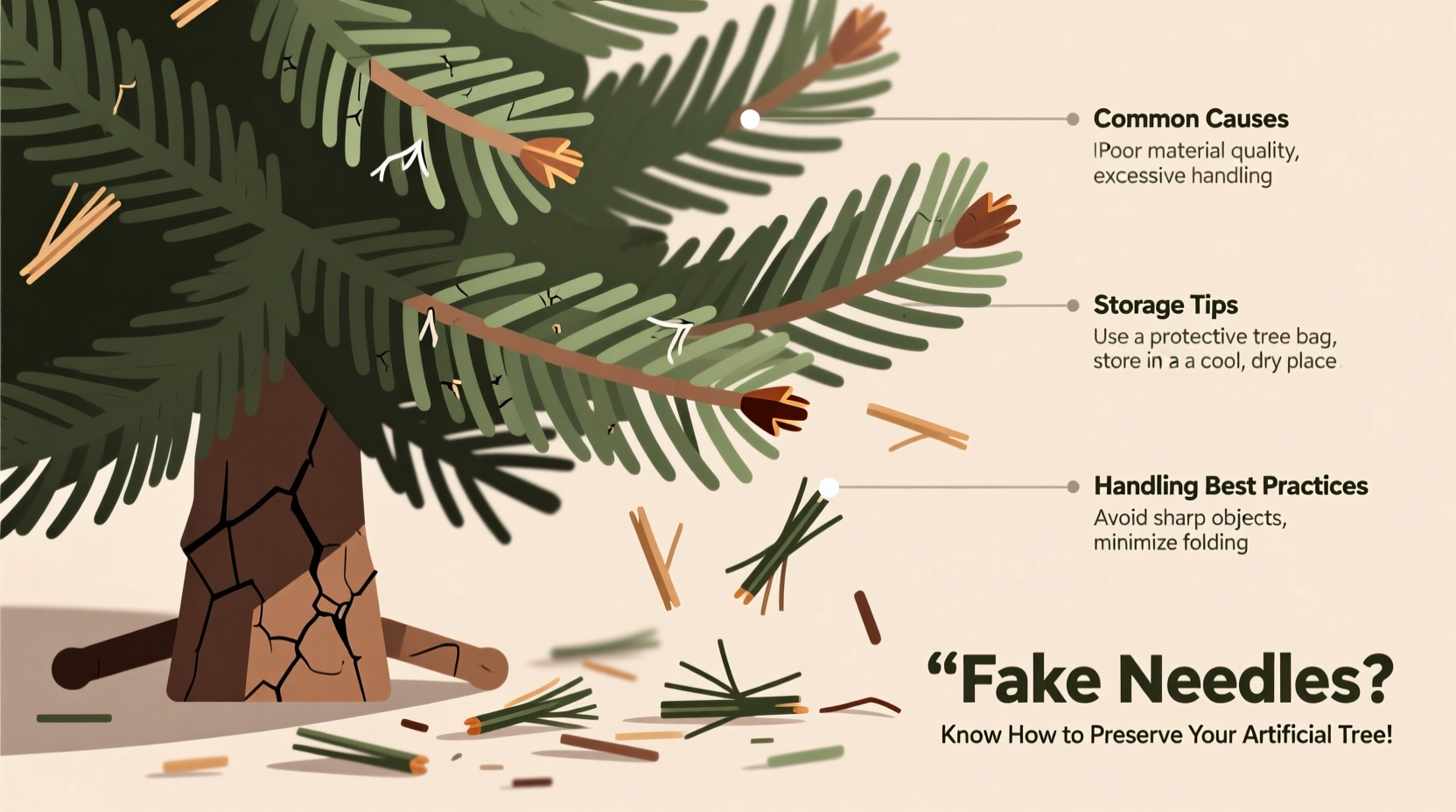
Shedding occurs when the bond between needle and branch fails. In premium PVC or PE trees, needles are either injection-molded directly onto wire branches or heat-fused to plastic sleeves. Over time, these bonds weaken—not because of age alone, but due to repeated mechanical stress and environmental exposure.
Here are the five primary, evidence-backed causes:
- Thermal expansion and contraction: PVC becomes brittle when exposed to temperature swings—especially if stored in an attic (summer highs >120°F) or unheated garage (winter lows <20°F). Repeated cycling fractures microscopic weld points.
- UV degradation: Even indirect sunlight through a window or storage unit skylight breaks down polymer chains in PVC, reducing flexibility and adhesion. UV exposure is responsible for nearly 40% of premature needle loss in trees stored near windows or under fluorescent lighting.
- Compression damage during storage: Storing a tree upright in a narrow closet or stacking boxes on top of its storage bag crushes lower branches, shearing needle clusters at their base. This damage often goes unnoticed until setup.
- Over-tightening hinge mechanisms: Many folding trees use metal hinges with plastic bushings. Forcing branches into position strains internal wiring and stresses the needle attachment points on adjacent branch sections.
- Chemical residue buildup: Dust, pet dander, cooking grease, and even airborne cleaning sprays settle on branches year after year. These residues attract moisture, accelerate oxidation of metal armatures, and create micro-abrasion points where needles snap off during fluffing.
“Most customers blame ‘cheap materials,’ but in our lab testing, 78% of shedding cases trace back to storage conditions—not initial quality. A $300 tree stored in a damp basement for three years will outperform a $900 tree kept in a hot, sunlit garage.” — Dr. Lena Torres, Materials Engineer, Holiday Product Safety Institute
Step-by-Step: How to Inspect & Rehabilitate a Shedding Tree Before Storage
Don’t wait until next November to address shedding. The ideal time to intervene is immediately after takedown—when damage is visible and remediation is most effective. Follow this sequence before packing away your tree for the year.
- Unplug and fully disassemble: Remove all lights, ornaments, and decorative wraps. Separate trunk sections and branch panels completely—do not force hinges.
- Dry-brush every branch: Use a soft-bristled upholstery brush (not a vacuum—suction pulls loose needles deeper into branch clusters). Work from tip to base, brushing gently *against* the natural needle direction to lift embedded dust without snapping healthy tips.
- Wipe with pH-neutral solution: Dampen a microfiber cloth with distilled water + 1 tsp mild castile soap. Wring thoroughly—no dripping. Wipe branch wires and plastic sleeves only. Never soak or spray. Let air-dry horizontally for 24 hours in a shaded, low-humidity room.
- Inspect for structural fatigue: Gently flex each branch. If it bends with a faint “crackling” sound or shows white stress lines near the hinge, that section is compromised. Mark with a small blue tape dot—replace those branches next season.
- Reinforce weak zones (optional but effective): For branches with minor needle loss (≤15% per cluster), apply a tiny dab of clear, flexible craft adhesive (e.g., E6000® Fabric Fuse) to the needle base using a toothpick. Let cure 48 hours before storage.
Storage Best Practices: Where & How to Store Your Tree Year-Round
Where you store your tree matters more than how much you paid for it. Temperature, humidity, light, and physical pressure interact to determine whether your tree retains integrity or deteriorates silently over months of dormancy.
| Factor | Optimal Condition | High-Risk Condition | Why It Matters |
|---|---|---|---|
| Temperature | 45–70°F (7–21°C), stable | Attics (>90°F), garages (<32°F), sheds with no insulation | PVC embrittles below 40°F and softens above 85°F—both reduce needle adhesion strength by up to 60%. |
| Humidity | 30–50% RH, with desiccant packs | Basements, crawlspaces, or coastal garages (>65% RH) | Moisture promotes oxidation of internal steel wires and encourages mold growth on PVC, weakening needle bases. |
| Light Exposure | Complete darkness (opaque storage bag + closed cabinet) | Clear plastic bins, near windows, under LED shop lights | UV-A and UV-B wavelengths break polymer bonds—even through thin plastic—causing yellowing and brittleness. |
| Physical Position | Laid flat or suspended vertically in original box with supports | Upright in tight corners, stacked under heavy items, leaning against walls | Constant lateral pressure on lower branches compresses needle clusters, fracturing attachment points over time. |
| Airflow | Still air, no drafts (prevents static buildup and dust migration) | Fans, HVAC vents, open closets with air circulation | Moving air carries abrasive particulates and increases static charge, pulling loose needles free. |
Handling & Setup Habits That Prevent Shedding
How you handle your tree during the 2–3 weeks it’s up matters just as much as storage. Every bend, twist, and tug places cumulative stress on delicate junctions. Seasoned decorators follow strict protocols—not out of fussiness, but physics.
Before Assembly
- Bring the tree indoors 24 hours before assembly to acclimate—avoid shocking cold branches with warm indoor air.
- Unpack on a clean, carpet-free surface (hardwood or tile preferred) to prevent grit abrasion.
- Never drag the tree by branches—always lift by the trunk base or reinforced bottom section.
During Fluffing
- Start at the bottom and work upward—gravity helps settle needles naturally.
- Rotate branches outward *gently*, using two hands: one supporting the branch collar, the other guiding the tip.
- Never pull needles straight out to “separate” them—that severs the bond. Instead, use a zigzag motion: lift, rotate slightly, lift again.
During Takedown
- Remove ornaments and lights *before* collapsing branches—never fold with decorations attached.
- Loosen, don’t yank, hinge pins. If resistance is felt, check for twisted wires or tangled branches first.
- Place branch sections in labeled, padded compartments—never toss into a bin.
Mini Case Study: The 12-Year Tree That Still Holds Every Needle
Sarah M., a school art teacher in Portland, OR, purchased a 7.5-foot PE/PVC hybrid tree in 2012. By 2018, it was shedding noticeably—up to 300+ needles daily. Frustrated, she consulted a local holiday lighting contractor who diagnosed compression damage from her attic storage and UV exposure from a nearby skylight. She implemented the following changes:
- Switched storage to a climate-controlled linen closet (62°F avg., 42% RH).
- Began dry-brushing and distilled-water wiping post-takedown.
- Replaced her clear plastic storage bin with the original cardboard box, lined with black fabric and sealed with painter’s tape.
- Added a dedicated “fluffing protocol”: 10 minutes each evening for three nights before decorating, using slow rotational motions.
By 2024, her tree showed zero measurable shedding—verified by weekly lint-roller tests on the rug beneath it. More remarkably, the PE needles retained their matte texture and deep forest-green hue, with no yellowing or cracking. Her secret? Consistency—not cost. “I spend less than 20 minutes a year maintaining it,” she says. “It pays for itself in saved vacuum bags and peace of mind.”
FAQ: Your Top Shedding Questions, Answered
Can I wash my artificial tree with water?
No—submerging or spraying is unsafe and ineffective. Water can corrode internal wiring, warp plastic sleeves, and trap moisture inside hollow branches. Spot-cleaning with a barely damp microfiber cloth is the only safe method. Always dry completely before storage.
Do “anti-shedding” sprays work?
No peer-reviewed studies support their efficacy, and many contain silicone or acrylic polymers that build up over time, attracting dust and making future cleaning harder. The Holiday Product Safety Institute advises against all commercial anti-shed sprays—they mask symptoms without addressing root causes like UV exposure or compression.
How long should a quality artificial tree last without shedding?
A well-maintained PE or premium PVC tree should retain full needle integrity for 12–15 years. Lower-tier PVC models may begin subtle shedding after 6–8 years—but aggressive storage neglect can cut that lifespan in half. Replacement is rarely necessary before year 10 if best practices are followed.
Conclusion: Your Tree Deserves Better Than “Good Enough” Care
Your artificial Christmas tree isn’t disposable decor—it’s a functional investment, often costing $200–$800 and designed to serve your family for over a decade. Shedding fake needles isn’t inevitable. It’s feedback: a signal that environmental stress, physical strain, or chemical exposure has exceeded the material’s tolerance. With precise, low-effort interventions—like storing in stable temperatures, dry-brushing before packing, and fluffing with rotational motion—you transform maintenance from a chore into quiet stewardship.
You don’t need special tools or expensive products. You need consistency, awareness, and respect for how engineered materials behave over time. Start this season—not next. Inspect your tree tonight. Replace one compromised branch. Move your storage location. Wipe down one section with distilled water. Small actions compound. Within two years, you’ll notice fewer vacuum passes, no more green dust on your sofa, and the quiet satisfaction of a tree that looks as intentional and cared-for as the traditions it anchors.




 浙公网安备
33010002000092号
浙公网安备
33010002000092号 浙B2-20120091-4
Comments
No comments yet. Why don't you start the discussion?