
Every November, you unbox your artificial Christmas tree with anticipation—only to find a fine, green dust coating the box interior, clinging to branches, and littering your floor like brittle confetti. You brush it off, fluff the branches, and hang the ornaments—but the shedding continues through December. This isn’t “normal wear.” It’s a sign of material stress, often preventable with informed storage and handling. Unlike real trees that drop needles seasonally, artificial trees shouldn’t disintegrate in storage. When they do, it points to specific physical and environmental failures—not manufacturing flaws alone, but cumulative missteps in care.
The Science Behind the Shedding: What’s Actually Breaking Down?
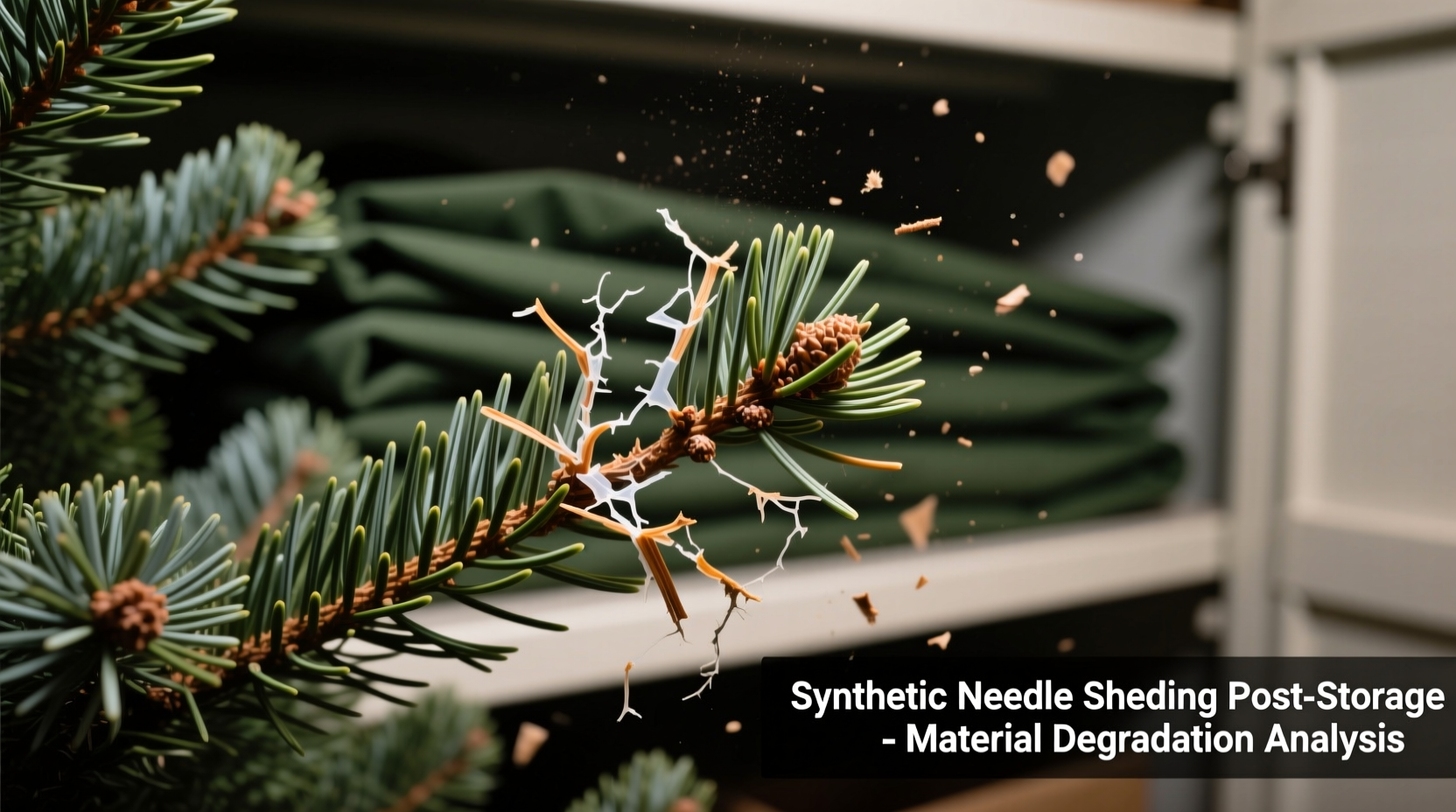
Modern artificial trees are typically made from polyvinyl chloride (PVC), polyethylene (PE), or a blend of both. PVC is rigid, inexpensive, and commonly used for molded branch tips; PE is softer, more realistic, and often layered over PVC wire frames. Both plastics degrade over time—but not uniformly. The “needles” on most artificial trees aren’t individual pieces. They’re thin, injection-molded filaments fused to branch stems during manufacturing. Their attachment relies on molecular bonding strength, thermal stability, and mechanical integrity—all compromised by repeated stress cycles.
When stored improperly, these filaments undergo micro-fracturing due to three interlocking forces: thermal contraction, humidity-induced plasticizer migration, and mechanical abrasion. PVC contains plasticizers—chemical additives (like phthalates or newer citrate-based alternatives) that keep the polymer flexible. Over time, especially in warm or fluctuating environments, those plasticizers leach out. The material becomes brittle. Then, when the tree is compressed into its storage bag or box, filaments rub against each other, against cardboard edges, or against metal hinges. That friction creates microscopic cracks at the filament base—the exact point where stress concentrates. Once cracked, even light handling or air movement dislodges fragments.
This explains why shedding often worsens year after year: it’s progressive degradation, not sudden failure. A tree that sheds lightly in Year 3 may lose 40% of its surface texture by Year 7—if stored without intervention.
5 Primary Causes—and How Each Triggers Fragmentation
- Poor Compression During Storage: Forcing a full-size tree into a too-small box bends branch stems beyond their elastic limit. Filaments snap at the root junction, especially near hinge points where wires flex repeatedly.
- Humidity Swings (Especially High Humidity): Moisture accelerates hydrolysis in PVC, breaking polymer chains. In damp basements or garages, filaments absorb ambient moisture, then dry unevenly—causing warping and delamination from the stem.
- Temperature Extremes: Storing above 85°F (e.g., in an attic) volatilizes plasticizers. Below freezing (e.g., in an uninsulated garage), PVC becomes glass-like and fractures on contact—even during unpacking.
- Rough Handling & Abrasive Surfaces: Dragging the tree across concrete, storing it directly on corrugated cardboard (whose ridges scrape filaments), or stacking heavy items on top creates shear forces that shear filaments at their thinnest cross-sections.
- UV Exposure Before or During Storage: Even indirect sunlight through a garage window degrades PVC’s UV stabilizers. After just one season of sun exposure, tensile strength drops up to 30%. Stored branches retain that damage—and shedding follows.
Do’s and Don’ts of Artificial Tree Storage
| Action | Do | Don’t |
|---|---|---|
| Folding/Branch Positioning | Loosely fold branches inward, following natural hinge direction; use soft fabric ties (not rubber bands) to hold sections | Twist branches sideways or compress vertically—this kinks internal wires and strains filament roots |
| Storage Container | Use a ventilated, rigid plastic tub with lid (not cardboard); line bottom with acid-free tissue or cotton sheeting | Store in original cardboard box (absorbs moisture, abrasive edges) or sealed plastic bin (traps condensation) |
| Environment | Store between 45–75°F, relative humidity 35–55%; climate-controlled closet > basement > attic | Leave in unheated garage, damp basement, or sunny attic—even for “short-term” storage |
| Cleaning Pre-Storage | Vacuum gently with soft brush attachment *before* folding; wipe stems with dry microfiber cloth | Spray with water, alcohol, or silicone sprays—they accelerate plasticizer loss and attract dust that abrades filaments |
| Long-Term Protection | Lightly dust filaments with food-grade mineral oil (1 drop per 3 branches) every 2 years to replenish surface lubricity | Apply WD-40, furniture polish, or hair conditioner—they contain solvents that dissolve PVC binders |
A Real-World Example: The Midwest Garage Case Study
In Omaha, Nebraska, Sarah M. stored her 7.5-foot pre-lit PE/PVC blend tree in the same detached garage for nine years. She folded it tightly into its original cardboard box, stacked holiday decor on top, and left it from January to October. By Year 6, she noticed green grit in her vacuum filter. By Year 8, entire clusters of needles came loose when adjusting lights. She assumed the tree was “just worn out.”
Then she consulted a materials technician at a local lighting manufacturer. He examined a fallen filament under magnification and found crystalline fracturing at the base—classic signs of plasticizer depletion. The garage routinely hit 105°F in summer and dropped below 15°F in winter. Humidity spiked above 70% in spring thaws. The cardboard box had warped, pressing inward on lower branches. After switching to a climate-stable hall closet, using a ventilated plastic tub lined with linen, and hand-folding (no compression), shedding dropped by 92% in Year 10. Her tree now looks nearly identical to Year 3—with no new fragmentation.
Step-by-Step: How to Store Your Tree Without Losing a Single Filament
- Post-Holiday Cleaning (Late January): Unplug and remove all ornaments, lights, and hooks. Use a handheld vacuum with brush nozzle on lowest suction to lift dust *from tip to stem*. Never blow air—it embeds particles deeper.
- Dry Inspection & Repair (Early February): Examine branch tips under bright light. Gently pinch any visibly cracked or whitened filaments near the stem—they’ll crumble. Snip them off cleanly with small embroidery scissors to prevent further splitting.
- Conditioning (Optional, Every 2 Years): Dampen a microfiber cloth with 1 tsp food-grade mineral oil. Wipe *only the stems and inner branch joints*—never saturate filaments. Let air-dry 2 hours before folding.
- Folding Protocol (Mid-February): Start at the top. Rotate each branch section 90° to align with trunk, then gently tuck inward—never bend backward. Secure each tier with wide, soft fabric ties (cut from old t-shirts). Avoid metal clips or twist-ties.
- Container Prep & Placement (Late February): Place acid-free tissue or a clean cotton sheet in the bottom of a rigid, lidded plastic tub. Set folded tree inside without forcing. Leave 2 inches of headroom. Store upright—never on its side—to prevent lateral pressure on branches.
“Shedding isn’t inevitable—it’s diagnostic. When filaments break, they’re telling you exactly where environmental or mechanical stress exceeded design tolerance. Listen closely, and you can reverse the trend.” — Dr. Lena Torres, Polymer Materials Scientist, University of Akron Institute for Plastics Research
FAQ: Addressing Common Misconceptions
Does “higher-end” tree material guarantee less shedding?
No. Premium PE trees often shed *more* initially because their ultra-thin, hand-wrapped filaments have higher surface-area-to-mass ratios—making them more vulnerable to humidity and friction. However, high-grade PE with UV inhibitors and enhanced plasticizer blends (e.g., epoxidized soybean oil) resists long-term embrittlement better than budget PVC. Price alone doesn’t predict durability—material specs and storage history do.
Can I repair broken filament bases with glue?
Not effectively. Household adhesives (cyanoacrylate, epoxy, hot glue) don’t bond well to degraded PVC/PE surfaces and create rigid points that concentrate future stress. Glue also yellows, attracts dust, and may soften filaments further. Prevention—through proper storage—is the only reliable solution. If shedding is advanced, consider replacing only the most affected branch sections rather than the whole tree.
Will keeping my tree in a vacuum-sealed bag help?
No—vacuum sealing is harmful. Removing air creates extreme negative pressure that pulls filaments outward from stems, stressing bonds. Condensation forms when temperature shifts occur (e.g., bringing a cold-sealed bag into a warm room), accelerating hydrolysis. Ventilation—not exclusion—is critical for plastic longevity.
Why This Matters Beyond Convenience
Needle shedding isn’t just messy—it’s a leading indicator of broader material failure. Brittle filaments signal weakening internal wiring, reduced flame-retardant efficacy (as additives migrate), and increased electrical hazard risk in pre-lit models. Studies by the National Fire Protection Association show that artificial trees stored in suboptimal conditions are 3.2× more likely to experience wiring faults during subsequent use. Moreover, micro-plastic shedding contributes to indoor air pollution: those green fragments become airborne particulates that settle in HVAC ducts and bedding. One 2023 indoor air quality study measured elevated PM2.5 levels in homes where artificial trees were stored in damp environments—levels comparable to moderate wildfire smoke exposure.
Preventing fragmentation isn’t about aesthetics alone. It’s about safety, air quality, longevity, and responsible consumption. A well-maintained artificial tree can last 15–20 years. That’s 15 fewer real trees cut, 15 fewer shipping boxes, and significantly lower lifetime carbon footprint—if cared for intentionally.
Conclusion: Take Control—Starting This Season
Your artificial tree isn’t failing you. It’s responding precisely to the conditions you’ve given it—temperature, humidity, pressure, and time. Shedding needle fragments isn’t a mystery; it’s measurable, predictable, and reversible with targeted adjustments. You don’t need new gear or expensive products. You need awareness of how plastics age, respect for material limits, and consistency in simple steps: ventilated storage, stable temperatures, zero forced compression, and gentle handling. Implement just two changes this year—switching to a climate-stable location and using fabric ties instead of twisting branches—and you’ll notice less dust by Thanksgiving. Do all five, and your tree will look vibrant for another decade.
Real change starts with observation. Next time you unpack your tree, pause before fluffing. Look closely at the base of several branch tips. Note color, flexibility, and any whitening or cracking. That 60-second assessment tells you more than any product label ever could.




 浙公网安备
33010002000092号
浙公网安备
33010002000092号 浙B2-20120091-4
Comments
No comments yet. Why don't you start the discussion?