
Every year, millions of households bring a Christmas tree into their homes, transforming living rooms into festive sanctuaries. But for many cat owners, this seasonal joy comes with an unexpected side effect: a feline ambush. Cats leap, swat, claw, and sometimes topple the very centerpiece of holiday cheer. While frustrating, this behavior isn’t mischievous—it’s instinctual. Understanding why your cat attacks the Christmas tree is the first step toward preventing it. More importantly, you can protect both your tree and your pet using humane, effective strategies that respect your cat’s natural drives.
The Feline Instinct Behind Tree Attacks
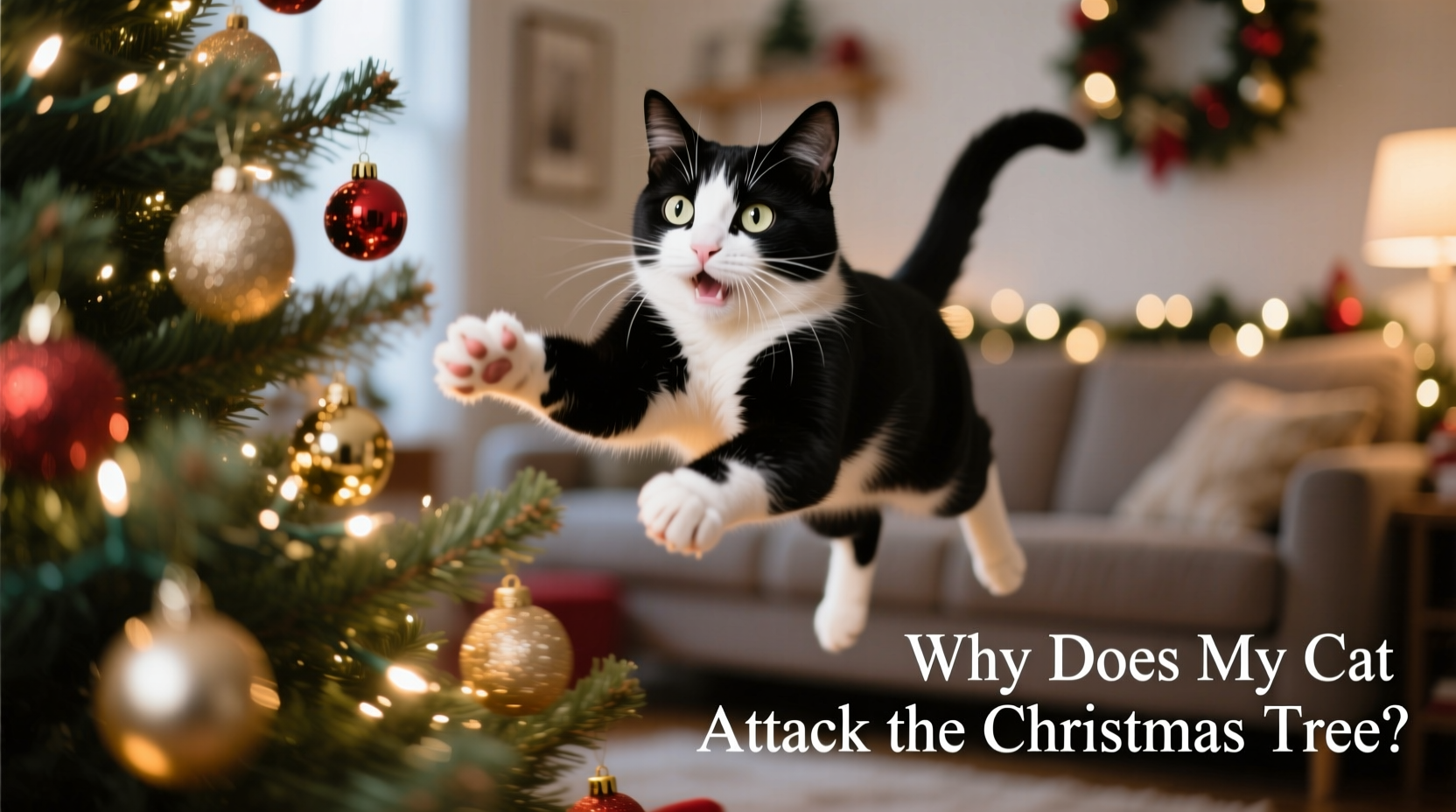
Cats don’t target Christmas trees out of spite. Their actions stem from deeply ingrained behaviors shaped by evolution. A freshly cut evergreen in the middle of the living room triggers multiple sensory and psychological responses in cats.
First, movement attracts cats. Ornaments that dangle and sway mimic prey—small birds or rodents rustling through branches. The reflective surfaces of baubles catch light and flicker, further stimulating predatory instincts. To a cat, these aren’t decorations; they’re toys waiting to be batted down.
Second, height matters. In the wild, cats seek elevated vantage points to survey their territory. A Christmas tree offers a novel vertical landscape—perfect for climbing, perching, and claiming as part of their domain. This territorial impulse is especially strong in multi-cat homes, where dominance plays a role.
Third, scent plays a critical role. Evergreen trees emit strong terpenes—aromatic compounds that are highly stimulating to cats. These scents are not unpleasant; they’re intriguing. Combine that with unfamiliar water, soil (if using a live tree), and new objects, and the tree becomes a sensory hotspot.
“Cats perceive the Christmas tree as both a challenge and an opportunity. It’s novel, tall, scented, and full of movement—all triggers for exploration and play.” — Dr. Lydia Ryan, Feline Behavior Specialist
Effective Strategies to Deter Climbing and Protect Your Tree
Preventing tree attacks doesn’t require punishment or stress-inducing methods. Instead, focus on environmental management, redirection, and enrichment. The goal is not to stop your cat from being a cat, but to guide that behavior appropriately.
1. Choose the Right Location
Place the tree in a low-traffic area that’s still visible to your cat. Avoid corners that allow easy jumping access from furniture. Keep it away from sofas, bookshelves, or window sills that serve as launchpads.
If possible, position the tree in a doorway or narrow space where your cat has limited angles of approach. Using a baby gate to partially restrict access during unsupervised hours can also help, especially if you have a particularly determined climber.
2. Stabilize the Tree Securely
A wobbly tree invites investigation. If your cat nudges it and it moves, that motion reinforces play behavior. Invest in a sturdy tree stand with a wide base and secure it to the wall using fishing line or thin cables anchored to eye screws in the trunk.
For real trees, ensure the water reservoir is covered with a decorative skirt or mesh guard. Not only does this prevent spills, but it also stops curious cats from drinking potentially harmful water containing preservatives or mold.
3. Modify Decorations Strategically
Not all ornaments are cat-safe. Avoid tinsel, which can cause intestinal blockages if ingested, and steer clear of fragile glass near lower branches. Reserve delicate or sentimental items for the upper third of the tree.
Use lightweight, unbreakable ornaments on lower levels—items your cat can bat without consequence. Consider placing pinecones or felt ornaments within reach. These satisfy curiosity without risk.
Step-by-Step Guide: Cat-Proofing Your Christmas Tree
Follow this timeline in the days leading up to and after setting up your tree to minimize incidents.
- Day 1–2: Prepare the Space
Select a stable location away from jump-off points. Test stability by gently shaking the tree. Install wall anchors if needed. - Day 3: Introduce the Tree Gradually
Set up the tree without lights or ornaments. Allow your cat to investigate under supervision. Reward calm behavior with treats. - Day 4–5: Add Lights Only
Install lights and leave them on for several hours daily. Monitor your cat’s reaction. Some cats are startled by blinking lights, while others are drawn to them. - Day 6: Introduce Low-Hanging Ornaments
Use soft, durable items on lower branches. Observe interactions. Remove any that provoke excessive batting or chewing. - Day 7+: Full Decoration & Ongoing Management
Add higher ornaments and finalize setup. Continue supervision, especially during the first week. Rotate alternative climbing structures nearby.
Enrichment: Redirect, Don’t Restrict
Depriving a cat of stimulation backfires. Instead of banning interaction, offer better alternatives. Cats don’t climb because they hate your tree—they climb because they need to climb.
Install a tall cat tree or shelving system near the Christmas tree. Position it so your cat can observe the room from above. Add dangling toys, hammocks, or sisal-wrapped posts to make it more appealing than the evergreen.
Engage your cat in daily interactive play sessions using wand toys that mimic prey—feather teasers, motorized mice, or crinkle tunnels. A tired cat is less likely to seek out trouble. Aim for two 10–15 minute sessions daily, ideally before bedtime.
Consider food puzzles or treat-dispensing toys to keep your cat mentally stimulated. Boredom often fuels destructive behavior, especially during the holidays when routines shift.
Mini Case Study: The Thompson Family’s Tinsel Troubles
The Thompsons had always struggled with their Bengal cat, Milo, attacking their Christmas tree. By Christmas Eve, the tree was usually stripped of ornaments and leaning at a 30-degree angle. After consulting a feline behaviorist, they changed their approach.
Instead of setting up the tree early, they waited until five days before Christmas. They placed it in the dining room, away from the sofa, and secured it to the ceiling joist with transparent cable. They added a six-foot-tall cat tree beside it, complete with a perch overlooking the living room.
They used only plastic ornaments below the four-foot mark and hung Milo’s favorite feather toy from the cat tree. Daily play sessions increased, and they gave him a “holiday puzzle” feeder filled with kibble and catnip.
The result? Milo investigated the tree briefly on Day 1 but spent most of his time on his own structure. The tree remained intact through New Year’s. “We stopped seeing it as a battle,” said Sarah Thompson, “and started seeing it as enrichment.”
Do’s and Don’ts: Holiday Tree Safety for Cats
| Do | Don’t |
|---|---|
| Secure the tree to the wall or ceiling | Leave the tree unsecured on a slippery surface |
| Use pet-safe, non-toxic decorations | Hang tinsel, ribbons, or small ingestible items |
| Offer alternative climbing structures | Punish your cat for natural behaviors |
| Supervise initial interactions | Leave fragile ornaments within paw’s reach |
| Cover tree water to prevent ingestion | Allow open access to tree water |
FAQ: Common Questions About Cats and Christmas Trees
Can I use citrus peels or sprays to keep my cat away?
While citrus scents are generally unpleasant to cats, relying on them alone is inconsistent. Some cats ignore them entirely. Additionally, essential oils can be toxic if ingested or absorbed through the skin. If used, apply sparingly and never directly on the tree or near water.
Is it safe to let my cat interact with the tree at all?
Limited, supervised interaction is fine—especially if decorations are safe. Letting your cat explore under watch reduces frustration. The key is managing risk: no breakable items low down, no electrical hazards, and no toxic materials.
What if my cat is still obsessed despite deterrents?
Some cats, especially high-energy breeds like Bengals or Siamese, may remain fixated. In such cases, consider delaying tree setup until closer to Christmas or using a pre-lit artificial tree with built-in stabilizers. You might also designate a separate “cat tree” decorated with safe, cat-friendly ornaments.
Checklist: Cat-Safe Christmas Tree Setup
- ✅ Choose a stable tree stand with a wide base
- ✅ Anchor the tree to the wall or ceiling
- ✅ Cover tree water with a skirt or barrier
- ✅ Use shatterproof, lightweight ornaments below 4 feet
- ✅ Avoid tinsel, ribbons, and small hanging parts
- ✅ Place a cat tree or shelves nearby
- ✅ Increase daily play and mental stimulation
- ✅ Supervise initial exposure and reward calm behavior
- ✅ Inspect lights for frayed wires before setup
- ✅ Rotate toys and enrichment regularly to maintain interest
Conclusion: Harmony Over Holiday Havoc
Your cat’s fascination with the Christmas tree isn’t a flaw—it’s a reflection of their nature. With thoughtful planning, you can coexist peacefully during the holidays. The goal isn’t a perfect, untouched tree, but a home where both your traditions and your pet’s well-being are respected.
By understanding the \"why\" behind the behavior and implementing practical, compassionate solutions, you create an environment where curiosity doesn’t lead to chaos. This season, let your response be guided not by frustration, but by empathy. After all, the magic of Christmas includes every member of the household—even the furry ones who see the tree as their personal jungle gym.




 浙公网安备
33010002000092号
浙公网安备
33010002000092号 浙B2-20120091-4
Comments
No comments yet. Why don't you start the discussion?