
If you've ever woken up in the middle of the night to find a woolen sock gently deposited beside your pillow—or worse, dropped directly onto your face—you're not alone. This peculiar feline ritual baffles many cat owners. While it might seem random or even mischievous, your cat’s nighttime sock deliveries are rooted in instinct, communication, and sometimes, a subtle plea for attention. Understanding the reasons behind this behavior can deepen your bond with your pet and help you manage it more effectively.
Cats don’t act without purpose. Whether it’s dragging a toy across the living room at 3 a.m. or presenting you with a crumpled gym sock, these actions are forms of expression. Socks, in particular, carry strong scents, textures, and associations that make them especially appealing to cats. By examining the biological, psychological, and environmental factors at play, we can decode what your cat is truly trying to tell you when they leave you a nocturnal textile gift.
The Instinctual Roots of Gift-Giving Behavior
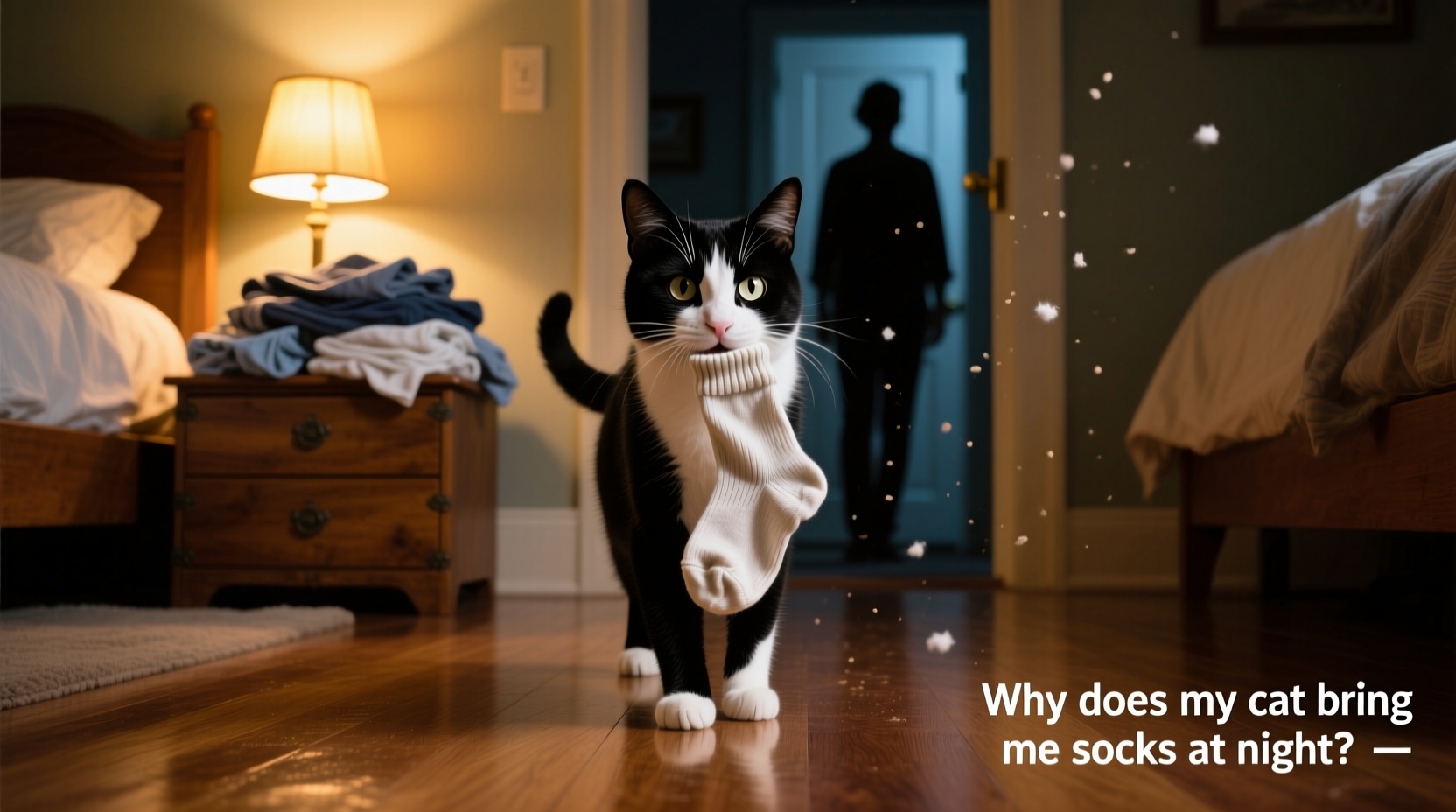
Cat behavior experts agree that bringing objects to their humans echoes natural hunting instincts. In the wild, mother cats bring injured prey back to the den to teach their kittens how to eat or practice killing. Similarly, domestic cats may view soft household items like socks as “prey” substitutes—especially if they’re dragged from under furniture or pulled from laundry baskets.
When your cat selects a sock and carries it to you at night, they may be engaging in a symbolic act of provisioning. To them, you’re part of their social group, possibly even perceived as an inept hunter who needs help. Dr. Sarah Ellis, co-author of *The Trainable Cat*, explains:
“Cats often bring their owners items because they see us as part of their colony. The behavior isn’t about utility—it’s about social bonding and fulfilling an innate drive to share resources.” — Dr. Sarah Ellis, Feline Behavior Scientist
This instinct is heightened at night because cats are crepuscular—they’re most active during twilight hours. Your sleeping form becomes a focal point for their energy, making bedtime the perfect window for gift delivery.
Scent, Texture, and Emotional Attachment
Socks aren't chosen at random. They carry your personal scent, which is deeply comforting and familiar to your cat. Unlike clean towels or blankets, used socks are rich in human odor—something cats use to mark territory and strengthen social bonds. The texture also plays a role: wool and cotton mimic the feel of small animals, making them ideal for carrying and “killing” through biting and pawing.
Some cats develop strong attachments to specific socks—perhaps one with a distinct pattern or smell. This preference can turn into a nightly ritual, especially if the cat receives attention (even negative) after delivering the item. Over time, the behavior becomes reinforced through interaction.
Interestingly, neutered or indoor-only cats are more likely to redirect hunting behaviors toward household objects. Without access to real prey, their predatory sequence—stalk, chase, capture, present—gets fulfilled through toys, hair ties, or yes, your missing argyle sock.
Attention-Seeking and Communication
Nighttime is quiet. Lights are off. You’re still. For a cat seeking engagement, this signals opportunity. If your cat has learned that dropping a sock on your chest results in movement, speech, or petting—even if you’re grumbling—they’ll repeat the behavior. Attention, in any form, is rewarding.
This is especially common in households where cats are left alone during the day. They compensate by becoming more interactive at night, using whatever tools they have. A sock is easy to access, lightweight, and carries your scent, making it the perfect prop for initiating contact.
In some cases, this behavior overlaps with separation-related stress. Cats may bring socks not just for play, but as a way to self-soothe. The act of retrieving and presenting provides mental stimulation and emotional release.
“Cats are masters of operant conditioning. If a behavior gets a reaction, they’ll do it again. The key is to reward the right behaviors and ignore the inconvenient ones.” — Dr. Mikel Delgado, Certified Cat Behavior Consultant
Step-by-Step Guide to Managing Nocturnal Sock Delivery
If the nightly sock parade is disrupting your sleep, consider this five-step approach to gently modify the behavior while respecting your cat’s instincts:
- Redirect before bedtime: Engage your cat in 10–15 minutes of active play using wand toys or puzzle feeders to simulate the hunt. This satisfies their predatory drive before sleep.
- Remove temptation: Store loose socks, shoes, and small clothing items in closed cabinets or containers, especially at night.
- Provide alternatives: Leave out designated “prey” toys—small plush mice, crinkle balls, or fabric scraps—that mimic the size and texture of socks.
- Avoid reinforcing the behavior: Do not shout, laugh excessively, or pick up the sock dramatically. Instead, calmly place it aside and return to sleep without eye contact.
- Reward silence: If your cat settles quietly at night, offer gentle praise or a treat in the morning to reinforce calm behavior.
Consistency is crucial. It may take several weeks for the behavior to diminish, especially if it’s been ongoing for months. Patience and routine will yield better results than punishment, which can damage trust.
Do’s and Don’ts When Your Cat Brings You Socks
| Do | Don’t |
|---|---|
| Stay calm and avoid overreacting | Yell, throw the sock, or punish your cat |
| Offer appropriate toys as alternatives | Leave accessible clothing piles unattended |
| Engage in evening play sessions | Ignore your cat’s need for mental stimulation |
| Use positive reinforcement for quiet nights | Give attention immediately after sock delivery |
| Understand it’s natural behavior | Assume your cat is being “spiteful” or “weird” |
Mini Case Study: Luna and the Midnight Sock Ritual
Maria, a graphic designer from Portland, noticed her cat Luna began bringing her a different sock each night around 2 a.m. At first, she found it amusing. But after three weeks of disrupted sleep, she grew frustrated. She tried hiding her laundry, but Luna would dig through drawers. She scolded the cat, only for the behavior to worsen.
After consulting a veterinary behaviorist, Maria learned that Luna was bored during the day and using nighttime as her primary activity window. The solution wasn’t restriction—it was enrichment. Maria started daily play sessions with a feather wand, introduced a timed food puzzle, and provided a “toy basket” filled with soft, crinkly items near her bed.
Within two weeks, Luna stopped raiding the sock drawer. Instead, she’d bring a stuffed mouse and drop it softly beside Maria’s pillow. The gift-giving impulse remained, but it was now channeled appropriately. Maria no longer dreaded bedtime—she looked forward to the quiet ritual of connection.
Tips for Encouraging Healthier Alternatives
- Introduce treat-dispensing toys that mimic the “capture and consume” sequence.
- Use catnip or silver vine to make alternative toys more enticing.
- Try leaving a worn T-shirt (not a sock) in a safe space so your cat can cuddle your scent without disruption.
- Consider a second cat if your current one shows signs of loneliness—though this should be done carefully and gradually.
Frequently Asked Questions
Is it normal for cats to bring socks at night?
Yes, it’s completely normal. Many cats exhibit object-fetching behavior, especially at night when their natural activity peaks. As long as the cat isn’t ingesting fabric or showing signs of distress, it’s typically harmless.
Why does my cat only bring me socks and not other items?
Socks combine multiple appealing traits: your scent, soft texture, small size, and mobility. They’re easy to carry, fun to bat around, and often located in high-traffic areas like bedrooms or laundry rooms. Other items may not offer the same sensory satisfaction.
Should I discourage this behavior entirely?
Not necessarily. The act of giving gifts is a sign of trust and affection. Rather than stopping it completely, redirect it toward acceptable items. Suppressing natural behaviors can lead to stress; guiding them leads to harmony.
Conclusion: Embracing the Quirks of Feline Love
Your cat bringing you socks at night isn’t a malfunction—it’s a message. Whether it’s instinct, affection, or a cry for engagement, this behavior reveals the depth of your cat’s complex inner world. Instead of viewing it as a nuisance, consider it a unique form of communication, one rooted in millennia of evolution and a genuine desire to connect.
By responding with understanding and providing appropriate outlets, you can preserve the sweetness of the gesture while restoring peace to your nights. After all, few creatures show love quite like a cat who drags you a slightly chewed tube sock at midnight—not as a joke, but as a heartfelt offering.




 浙公网安备
33010002000092号
浙公网安备
33010002000092号 浙B2-20120091-4
Comments
No comments yet. Why don't you start the discussion?