
If you’ve ever been jolted awake at 3 a.m. by the soft thud of a crumpled paper ball or a half-chewed feather toy landing on your chest, you’re not alone. Many cat owners experience this peculiar ritual: their feline companion delivers a “gift” in the dead of night with quiet pride. While it might seem random—or even inconvenient—this behavior is deeply rooted in instinct, social bonding, and your cat’s unique way of communicating. Understanding why your cat chooses 3 a.m. for these offerings can transform frustration into appreciation for your pet’s complex inner world.
Cats are crepuscular by nature, meaning they’re most active during dawn and dusk. But domestication has shifted some of their rhythms, often aligning more closely with human schedules—except when it doesn’t. The 3 a.m. toy drop-off isn’t just about timing; it’s a convergence of biology, environment, and emotional connection. To decode this behavior, we need to explore feline instincts, communication methods, and the subtle ways cats perceive their humans as part of their social group.
The Evolutionary Roots of Toy-Giving
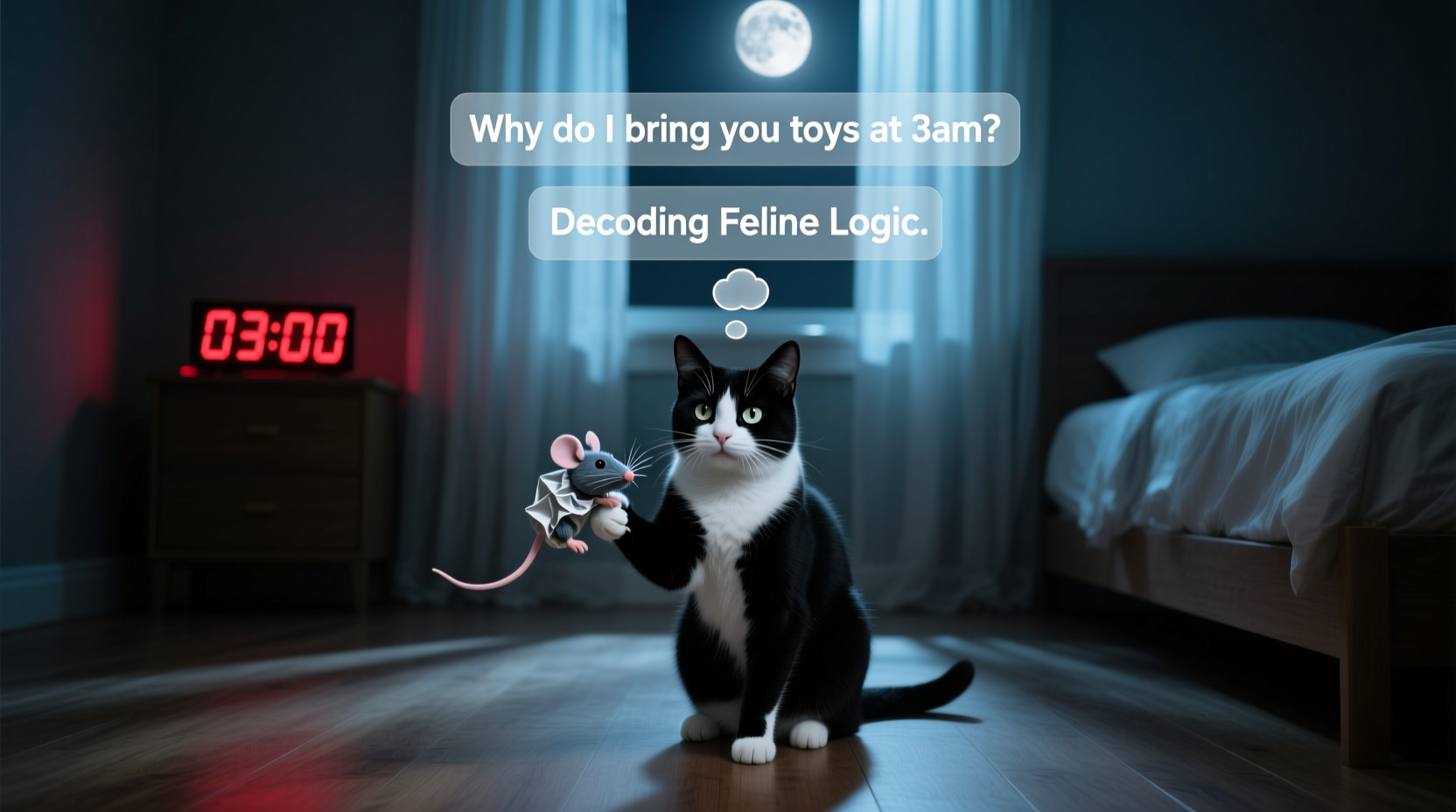
In the wild, mother cats teach their kittens survival skills by bringing them injured prey. This allows the young to practice hunting techniques in a controlled environment. Adult cats may also present prey to other members of their colony as a form of social bonding or teaching. When your cat brings you a toy—or occasionally, an actual mouse—it’s replicating this instinctual behavior.
Domestic cats don’t need to hunt for food, but their predatory drive remains strong. Play hunting satisfies part of that urge, but presenting the \"kill\" to you serves another purpose: inclusion. Your cat likely views you as part of its family unit, perhaps even as an inept member who needs instruction. From their perspective, dropping a toy on your pillow is like saying, “I caught this for you. Watch how it’s done.”
“Cats don’t see us as fellow cats, but they do integrate us into their social structure. Gift-giving is one of the clearest signs of trust and affiliation.” — Dr. Sarah Ellis, Feline Behavior Scientist, University of Lincoln
This behavior isn’t limited to biological mothers. Unspayed females are more likely to exhibit teaching behaviors, but neutered males and spayed females also bring toys, suggesting the instinct transcends reproduction. It’s less about breeding and more about relational dynamics.
Why 3 a.m.? Decoding the Timing
The specific hour—often between 2 a.m. and 4 a.m.—isn’t arbitrary. Several factors converge to make this time prime for feline activity:
- Natural circadian rhythm: Cats are biologically wired to peak in activity during twilight hours. 3 a.m. mimics pre-dawn conditions, triggering hunting-mode alertness.
- Household quiet: With minimal noise and movement, your cat feels safe to roam, play, and perform rituals without interruption.
- Attention-seeking payoff: If you react—even negatively—your cat learns that 3 a.m. antics get results. A sleepy grunt or groggy petting session reinforces the behavior.
- Leftover energy: Indoor cats, especially those without sufficient daytime stimulation, accumulate pent-up energy that surfaces overnight.
Unlike dogs, which often adjust to human sleep schedules, cats maintain a stronger link to their ancestral rhythms. They don’t perceive nighttime as “quiet time”—they see it as prime time.
What the Toy Choice Reveals About Your Cat
Not all toys are created equal in your cat’s eyes. The type of object selected for delivery can offer clues about your cat’s state of mind and preferences.
| Toy Type | Possible Meaning |
|---|---|
| Feather wands or bird-like toys | Reflects aerial prey preference; may indicate high arousal or mimicry of outdoor hunting. |
| Mice-shaped plush toys | Taps into natural rodent-hunting instincts; often used in teaching behaviors. |
| Crumpled paper or hair ties | Improvised prey; suggests limited toy access or strong compulsive drive to “catch” something. |
| Same toy repeatedly | Strong emotional attachment; may be a favorite or perceived as most “successful” in play. |
| Multiple toys in one night | High stimulation need or possible anxiety; could signal under-stimulated daytime routine. |
A cat that consistently brings the same red feather toy every night may have formed a strong association between that object and successful “hunts.” Another that drags socks from the laundry basket might lack appropriate outlets for its predatory sequence: stalk, chase, pounce, bite, and present.
Is This Behavior a Sign of Affection?
Yes—though it might not feel like a gift when you’re half-asleep. In feline terms, sharing prey is one of the highest forms of trust. Wild cats rarely share food unless bonded. By bringing you toys (or, in rare cases, actual animals), your cat is treating you as a trusted member of its inner circle.
Some researchers suggest that cats view humans as clumsy, oversized kittens who need help surviving. A study published in *Applied Animal Behaviour Science* found that cats brought “gifts” more frequently to household members who spent the most time interacting with them, indicating a social rather than purely instinctual motive.
Interestingly, cats are more likely to present toys to people who respond positively—by acknowledging the offering, petting them, or playing along. Negative reactions (yelling, throwing the toy away) may suppress the behavior temporarily but can damage trust over time.
“When a cat drops a toy at your feet, it’s not just instinct—it’s inclusion. You’re being invited into their world, on their terms.” — Jackson Galaxy, Cat Behaviorist & Host of 'My Cat from Hell'
How to Manage 3 a.m. Toy Deliveries Without Suppressing Natural Behavior
You don’t need to stop the behavior entirely—nor should you. Instead, redirect it to more reasonable hours and ensure your cat’s needs are met proactively. Here’s a step-by-step approach:
- Adjust feeding times: Serve a portion of your cat’s daily food via puzzle feeders right before bedtime. This mimics the post-hunt eating pattern and promotes drowsiness.
- Engage in evening play: Run a 10–15 minute interactive session with a wand toy an hour before bed. End with a treat or meal to simulate the “hunt-eat-groom-sleep” cycle.
- Provide solo-play options: Leave motion-activated toys or treat-dispensing puzzles out at night to keep your cat occupied independently.
- Limit bedroom access (if needed): Use a baby gate or closed door to prevent 3 a.m. interruptions, especially during training phases.
- Respond calmly when gifts occur: If your cat brings a toy, acknowledge it quietly—without overexcitement—and gently remove the item after a brief interaction.
Consistency is key. It may take 2–3 weeks for new routines to shift your cat’s schedule, but most adapt well once their hunting and play needs are met earlier in the evening.
Checklist: Reducing Nocturnal Toy Drops
- ✅ Schedule two interactive play sessions per day (morning and evening)
- ✅ Use puzzle feeders for 50% of daily food intake
- ✅ Rotate toys weekly to maintain interest
- ✅ Introduce automatic or motion-based toys for nighttime engagement
- ✅ Avoid reinforcing 3 a.m. behavior with loud reactions or play
- ✅ Consider a timed feeder with a morning snack to delay wake-up calls
Mini Case Study: Luna and the Midnight Mouse Parade
Sarah, a graphic designer from Portland, adopted Luna, a 2-year-old tuxedo cat, six months ago. Within weeks, she began waking up to a growing collection of plush mice on her pillow—sometimes three in one night. Frustrated and sleep-deprived, she considered locking Luna out of the bedroom.
After consulting a veterinary behaviorist, Sarah implemented a structured routine: 10 minutes of laser-pointer play at 8 p.m., followed by a measured portion of kibble placed inside a rolling puzzle ball. She also installed a battery-powered butterfly toy on a rotating timer set for midnight, giving Luna an alternative focus.
Within 10 days, the toy deliveries dropped from nightly to once every few days—and always before midnight. “It turns out Luna wasn’t trying to annoy me,” Sarah said. “She just needed a better outlet. Now she plays with the butterfly thing and crashes by 1 a.m. I get my sleep, and she gets her hunt.”
Frequently Asked Questions
Is it normal for my cat to bring toys only to me and not others in the house?
Yes. Cats often form stronger bonds with one household member and direct nurturing or teaching behaviors toward that person. It may also reflect who spends the most time with them or responds most consistently to their actions.
Should I be concerned if my cat brings real animals instead of toys?
While unsettling, this is still normal predatory behavior. However, outdoor or indoor-outdoor cats that hunt may carry diseases or parasites. Consider keeping your cat indoors for safety, or use a bell collar to reduce hunting success. Always wash hands after handling prey items.
Can I train my cat to stop bringing toys altogether?
Not easily—and not advised. Toy-giving is a healthy expression of instinct. Instead of eliminating it, redirect it to acceptable times and responses. Punishment can lead to anxiety and suppressed behavior, which may manifest in other problematic ways.
Conclusion: Embracing the Quirks of Feline Communication
Your cat’s 3 a.m. toy delivery isn’t a glitch in their programming—it’s a window into their evolutionary past and emotional world. What feels like an odd disruption is, in fact, a gesture of trust, care, and inclusion. Rather than resisting it, consider how you can meet your cat’s natural needs in a way that respects both their instincts and your need for rest.
By enriching their daytime environment, structuring play around their biological rhythms, and responding thoughtfully to their “gifts,” you create a harmonious relationship built on mutual understanding. The next time a felt squirrel lands on your blanket at 3:07 a.m., remember: your cat isn’t trying to wake you. They’re trying to connect.




 浙公网安备
33010002000092号
浙公网安备
33010002000092号 浙B2-20120091-4
Comments
No comments yet. Why don't you start the discussion?