
Every December, a familiar scene unfolds in homes across the Northern Hemisphere: tinsel glitters, lights twinkle, and somewhere—midway up the Douglas fir—a wide-eyed cat perches triumphantly on a branch, tail flicking, one paw delicately nudging a glass ornament toward its inevitable demise. It’s equal parts charming and nerve-wracking. But this isn’t random mischief. Your cat isn’t “being bad”—it’s responding to deeply ingrained instincts, environmental cues, and unmet needs. Understanding the *why* is the first, essential step toward resolving the *how*. This article moves beyond quick fixes and punitive deterrents. Instead, it draws on feline ethology, veterinary behavior research, and real-world case outcomes to offer compassionate, effective, and lasting solutions.
The Instinctive Roots: Why Cats See the Tree as Prime Real Estate
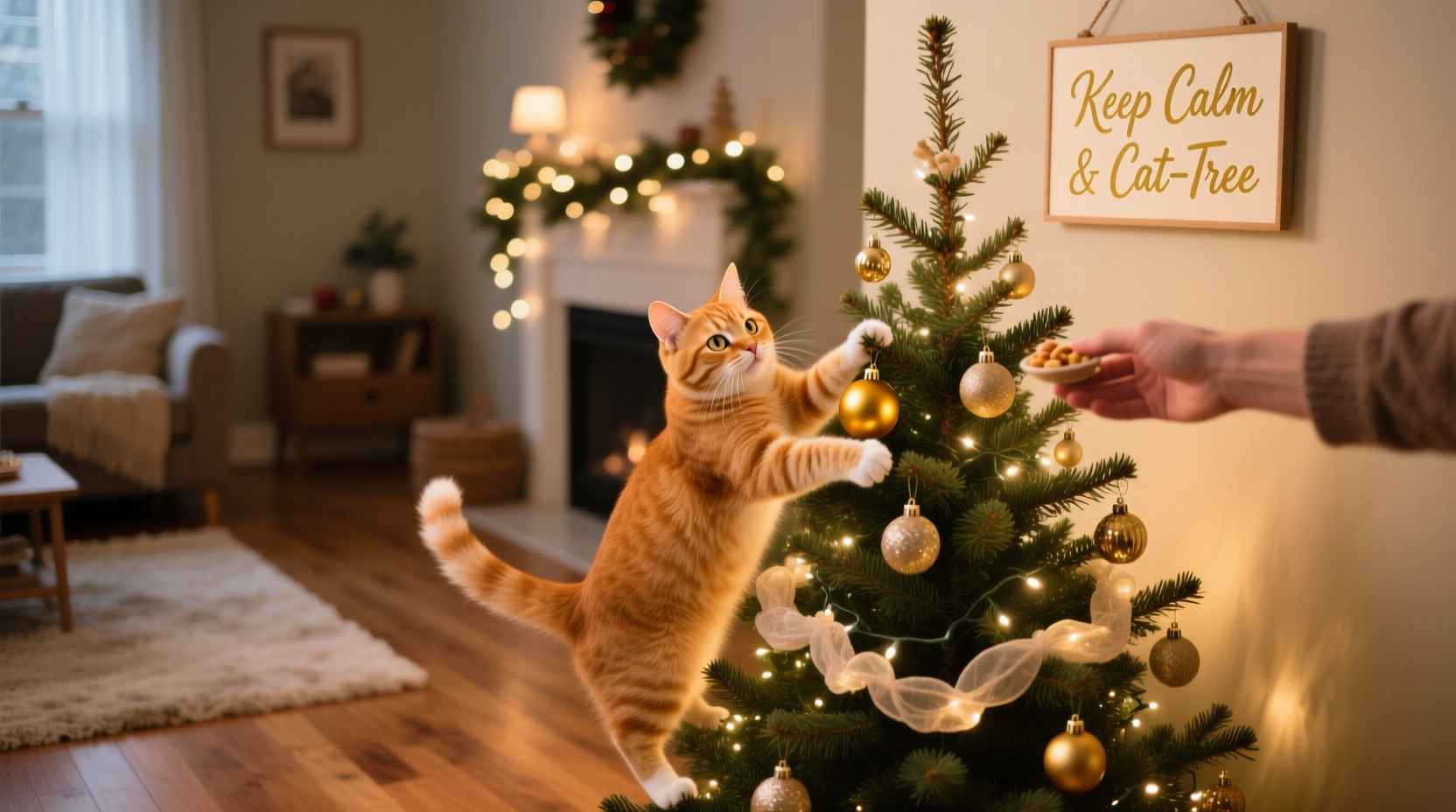
Cats don’t climb Christmas trees because they’re plotting holiday sabotage. They climb because the tree satisfies multiple evolutionary imperatives—some of which have been amplified by the very design of modern holiday decor.
First, vertical space is non-negotiable for feline well-being. In the wild, elevated vantage points allow cats to survey territory, detect predators or prey, and regulate social distance. A 6-foot Christmas tree—especially one placed near windows or high-traffic living areas—becomes an irresistible observation post. Its height, density, and relative instability (compared to a bookshelf or cat tree) add novelty and sensory stimulation.
Second, the tree is a multisensory playground. The rustle of tinsel mimics the sound of small prey; dangling ornaments reflect light unpredictably, triggering the innate “stare-and-pounce” reflex; pine needles release volatile organic compounds—including pinene and limonene—that many cats find mildly stimulating (though not toxic at typical exposure levels). Even the scent of sap and the texture of bark-like trunk wrapping can evoke curiosity.
Third, timing matters. The tree usually appears during a period of household disruption—new decorations, altered routines, guests arriving, and increased noise. For sensitive or routine-dependent cats, this creates mild stress. Climbing becomes a coping mechanism: a way to regain control, withdraw safely, or redirect nervous energy.
“Cats rarely engage in ‘destructive’ behavior without cause. What looks like play or defiance is often communication—about boredom, anxiety, lack of appropriate outlets, or even underlying pain.” — Dr. Sarah Wooten, DVM, CVJ, Certified Veterinary Journalist and feline behavior consultant
What *Not* to Do: Common Missteps That Backfire
Before implementing solutions, it’s critical to recognize approaches that worsen the problem—or harm your relationship with your cat. These methods may produce short-term suppression but increase long-term stress, erode trust, and sometimes escalate unwanted behavior.
| Method | Why It Fails | Better Alternative |
|---|---|---|
| Spraying water or shouting | Creates negative association with *you*, not the tree; increases fear-based arousal and may trigger redirected aggression | Redirect attention calmly with a toy or treat; reinforce alternative behaviors |
| Sticky tape or citrus sprays on lower branches | Only deters at point of contact; ignores root causes; citrus oils can irritate paws or respiratory tracts in sensitive cats | Provide superior climbing alternatives *before* the tree goes up; use safe, non-toxic deterrents only as temporary support |
| Physical punishment or grabbing the cat mid-climb | Triggers panic, risks injury from falls, damages bond, and teaches avoidance—not understanding | Use gentle, consistent redirection and environmental enrichment |
| Leaving the tree unattended overnight | Allows reinforcement of climbing through unsupervised success; increases risk of ingestion, electrocution, or toppling | Supervise or block access during low-attention hours using baby gates or closed doors |
A Humane, Step-by-Step Prevention Plan
Effective deterrence begins *before* the tree arrives—not after your cat has already claimed it as territory. Follow this evidence-informed sequence, starting 7–10 days pre-decorating:
- Install a dedicated cat climbing structure—ideally taller than your tree and placed within 3 feet of where the tree will stand. Choose one with sisal-wrapped posts, multiple platforms, and a stable base. Introduce it gradually with treats and play sessions.
- Reduce novelty-driven attraction by placing unadorned branches (real or faux) around the room for 3–4 days before erecting the full tree. Let your cat explore and habituate without lights or ornaments.
- Tree-proof the base: Wrap the trunk in smooth, slippery material (e.g., aluminum foil or plastic sheeting secured with double-sided tape) *only on the bottom 18 inches*. Avoid covering more—cats may simply leap over or find alternate routes.
- Anchor the tree securely using a wall-mounted bracket or heavy-duty stand with a wide footprint. A wobbling tree invites climbing; a stable one discourages it. Test stability by gently pushing the top—no noticeable sway should occur.
- Remove high-value lures: Hang breakable ornaments above 3 feet; keep tinsel, ribbons, and edible decorations completely off-limits. Use shatterproof ornaments below eye level—and only those with secure, non-removable hooks.
- Implement consistent positive reinforcement: Reward your cat *every time* they choose the cat tree, perch on a window seat, or rest quietly near—but not on—the tree. Use high-value treats (e.g., freeze-dried chicken) and quiet praise. Consistency over five days builds reliable new habits.
Real-World Success: How the Chen Family Reduced Climbing by 92% in 11 Days
In Portland, Oregon, the Chen family adopted a 2-year-old domestic shorthair named Mochi in October. By early December, Mochi had knocked over two trees and swallowed three pine needles (requiring a vet visit). Frustrated but committed to humane methods, they consulted a certified feline behavior specialist.
Their plan followed the six-step framework above—with one key adaptation: they introduced a tall, curved cat tree with a hammock-style platform facing the window, directly adjacent to the tree location. They also installed a motion-activated LED light strip *on the cat tree only*, so every time Mochi jumped up, soft blue light pulsed—creating a novel, rewarding visual cue tied to the right behavior.
Within four days, Mochi spent 78% of his vertical time on the cat tree. By Day 11, he’d climbed the Christmas tree just once—and only to retrieve a dropped feather toy that had rolled beneath it. Crucially, his overall activity level increased, his sleep improved, and his interactions with the family became more relaxed. “We stopped seeing the tree as a battleground,” said Li Chen. “It became part of a bigger system—one that gave Mochi choice, safety, and fun.”
Proven, Cat-Safe Deterrents (Backed by Behavior Science)
When used *alongside* enrichment—not as standalone fixes—these tools leverage natural feline aversions without causing distress. All are non-toxic, non-sticky, and reversible.
- Aluminum foil barriers: Cats dislike the crinkly sound and unstable surface. Line the floor in a 3-foot radius around the tree base. Remove after 5–7 days as alternative behaviors solidify.
- Double-sided tape strips: Place narrow strips (1 inch wide) on the lowest 12 inches of trunk wrap. The texture feels unpleasant underfoot—but won’t trap fur or skin. Replace every 48 hours for freshness.
- Strategic scent boundaries: Rub fresh (not dried) rosemary or lavender sprigs along the base perimeter. These herbs are safe for cats and subtly discourage lingering—without the toxicity risks of citrus or essential oils.
- Low-level motion-activated air puff devices: Devices like the SSSCAT spray *only* when movement is detected within 3 feet of the tree base. The sudden, harmless puff of compressed air startles—not harms—and conditions cats to associate proximity with surprise, not reward. Use sparingly (max 1–2 times daily) and discontinue once climbing drops significantly.
Frequently Asked Questions
My cat only climbs when I’m not home. Does that mean they’re doing it out of spite?
No. Cats do not experience or express “spite.” What appears to be targeted misbehavior is almost always a response to stress, boredom, or unmet needs. When left alone, your cat may climb to self-soothe, burn excess energy, or investigate novel scents and sounds (e.g., HVAC drafts, distant birdsong, or neighbor activity) that intensify in your absence. Focus on enriching solo time—automated feeders, puzzle toys, and window perches with bird feeders outside yield far better results than assuming motive.
Will getting a second cat solve the problem?
Not reliably—and it introduces significant complexity. While some cats form beneficial social bonds, others become more competitive or stressed with a new companion. Introducing a second cat requires months of careful, supervised integration and doubles the resource needs (litter boxes, feeding stations, vertical space). It’s never a shortcut for environmental management. Address the root cause first; consider companionship only after consulting a feline behaviorist and confirming your home supports multi-cat dynamics.
Are artificial trees safer than real ones for cats?
Artificial trees eliminate needle ingestion and sap exposure—but introduce new concerns. Many PVC-based trees contain phthalates, which can leach onto paws and be ingested during grooming. Cheaper models may have sharp wire frames or loose plastic parts. If choosing artificial, opt for PE (polyethylene) plastic, check for ASTM F963 certification (U.S. toy safety standard), and avoid trees with exposed wiring or easily detachable components. Regardless of type, anchoring and supervision remain essential.
Conclusion: Building Trust, Not Barriers
Your cat’s fascination with the Christmas tree isn’t a flaw to be corrected—it’s a window into their nature. They’re curious, vertically oriented, sensorially attuned, and deeply responsive to environment and routine. When we meet those needs thoughtfully—by offering better alternatives, removing unintentional lures, and reinforcing calm choices—we don’t just protect our decorations. We deepen mutual understanding. We reduce chronic stress that can manifest as overgrooming, litter box avoidance, or aggression. And we honor the intelligence and dignity of a species that has shared our homes for over 9,000 years—not as pets, but as partners in cohabitation.
This holiday season, let your tree stand not as a symbol of fragility to be guarded, but as an opportunity: to observe closely, respond patiently, and nurture connection through consistency and compassion. Start today—not with a spray bottle or a scolding, but with a new perch, a quiet moment of play, and the intention to see your cat, truly, as they are.




 浙公网安备
33010002000092号
浙公网安备
33010002000092号 浙B2-20120091-4
Comments
No comments yet. Why don't you start the discussion?