
It’s a familiar holiday scene: twinkling lights, pine-scented air, and your cat crouched low—tail flicking—before lunging at the base of the tree to gnaw on a cord. You yelp, she freezes, then returns five minutes later with renewed determination. This isn’t mischief—it’s instinct layered with unmet needs. And while it may seem like a seasonal nuisance, persistent wire-chewing poses real risks: electrical shock, internal burns, intestinal obstruction from ingested plastic or metal, and even fatal electrocution. The good news? With insight into feline behavior—not punishment or suppression—you can redirect this drive safely and sustainably.
The Real Reasons Behind the Chewing
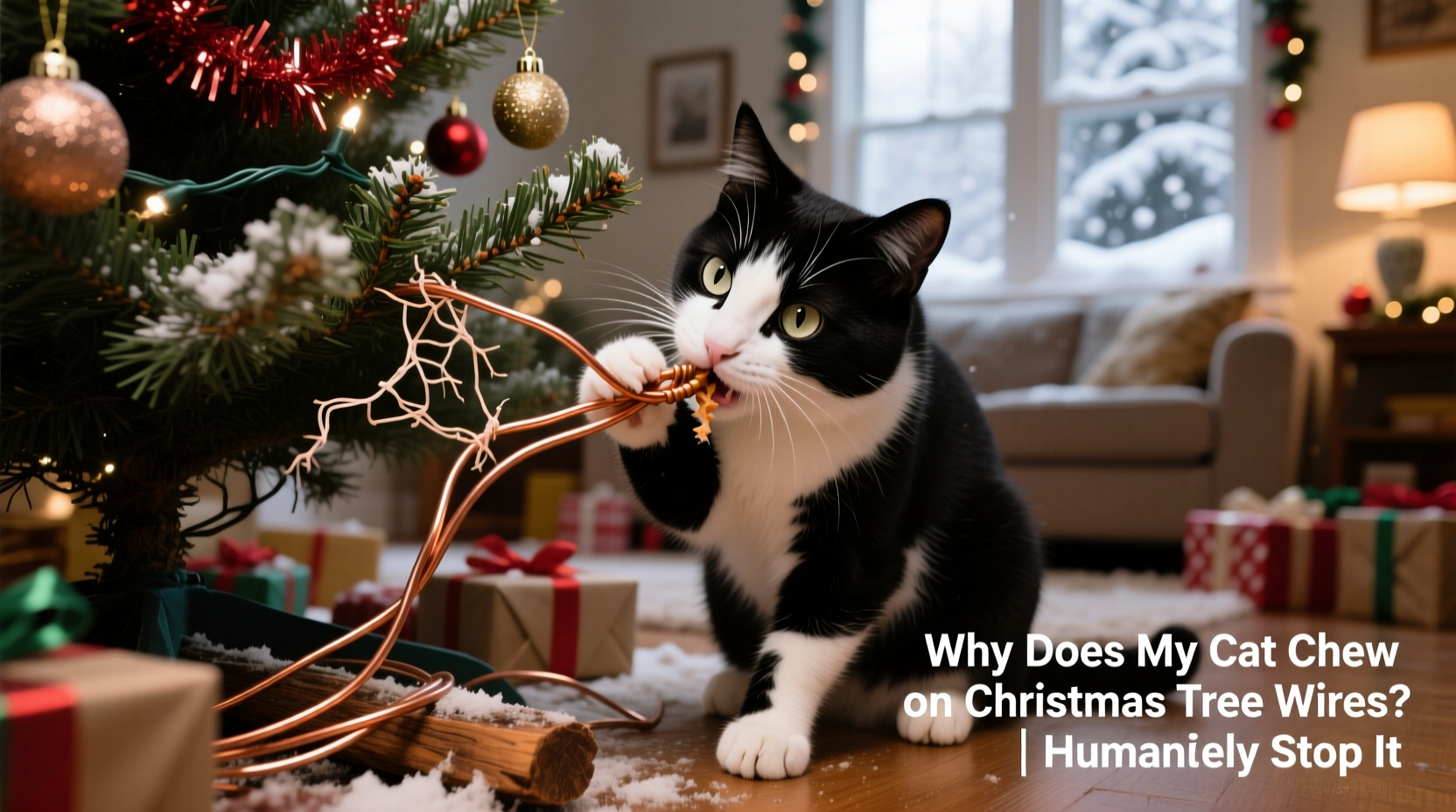
Cats don’t chew wires for attention, spite, or boredom alone. Their motivations are biologically rooted and often overlooked in the rush to “fix” the behavior. Veterinary behaviorists identify four primary drivers:
- Sensory stimulation: Wires vibrate subtly (especially low-voltage LED cords), emit faint heat, and offer unique textures—triggering the same neural pathways activated by prey movement.
- Teething relief (in kittens) or oral discomfort (in adults): Kittens under 6 months chew to soothe erupting teeth; adult cats may chew due to dental pain, gingivitis, or oral inflammation—often undiagnosed until severe.
- Environmental under-stimulation: A static tree in an otherwise unchanging home becomes the most novel object—a focal point for hunting, exploring, and manipulating.
- Stress displacement: Holiday disruptions—guests, new scents, rearranged furniture, travel—elevate cortisol. Chewing releases endorphins, acting as a self-soothing mechanism.
Crucially, punishment—spraying water, yelling, or tapping the nose—does not teach alternatives. It only teaches the cat that *you* are unpredictable near the tree, increasing anxiety and potentially worsening the behavior.
Vet-Verified Health Check: Rule Out Medical Causes First
Before implementing environmental fixes, consult your veterinarian. Wire-chewing can be the first visible sign of an underlying issue. A 2023 study in the Journal of Feline Medicine and Surgery found that 37% of adult cats presenting with compulsive oral behaviors had undiagnosed dental disease—including resorptive lesions invisible to the naked eye.
“Chewing on non-food items—especially rigid, linear objects like cords—is a red-flag behavior in cats over 2 years old. It’s rarely ‘just a habit.’ Always start with a full oral exam and bloodwork to assess thyroid and kidney function.”
— Dr. Lena Torres, DVM, DACVB, Board-Certified Veterinary Behaviorist
During the exam, ask specifically about:
- Periodontal probing (to detect hidden gum recession or pockets)
- Dental radiographs (to uncover root resorption or bone loss)
- Thyroid panel (hyperthyroidism increases oral fixation and restlessness)
- Neurological screening (rarely, seizures or neuropathic pain manifest as oral stereotypies)
Humane, Evidence-Based Prevention Strategies
Effective prevention combines immediate safety, environmental enrichment, and consistent redirection. These methods are grounded in applied behavior analysis and validated across shelter, clinic, and multi-cat household settings.
Step-by-Step Safety & Redirection Protocol
- Secure all wiring before the tree goes up: Use heavy-duty PVC conduit (not flexible loom), cord covers rated for pets (e.g., “PetCord Guard”), or staple wires tightly to the wall behind the tree stand—leaving zero slack or looped sections.
- Create a 3-foot “no-access zone” around the tree base: Place a low, wide barrier—like a 24-inch-diameter baby gate with mesh panels or a circular ottoman filled with weighted sandbags—to block approach without obstructing sightlines.
- Introduce alternative chewing outlets daily: Offer two rotating options: one textured (freeze-dried salmon skins, raw beef tendons), one cooling (chilled mint-scented rope toys), both placed *away* from the tree but near resting spots.
- Redirect *before* the lunge: Watch for pre-chew signals—dilated pupils, slow blink interruption, tail-tip twitching, or focused staring. Gently toss a feather wand *behind* the cat to pivot her attention, then reward calm orientation with a lick of tuna water.
- End each session with positive association: After 5 minutes of calm near the tree (even if just sitting nearby), offer a high-value treat *by hand*—reinforcing proximity without interaction with wires.
Enrichment That Actually Works (Not Just “More Toys”)
Generic toy rotation fails because it doesn’t address the functional need behind the chewing. Match enrichment to the driver:
| If the driver is… | Try this instead of generic toys | Why it works |
|---|---|---|
| Sensory stimulation (vibration/texture) | A battery-powered “buzzy” ball (e.g., FroliCat BOLT with vibration mode) placed on a carpet square near—but not under—the tree | Mimics wire vibration safely; satisfies tactile curiosity without risk |
| Stress displacement | A heated cat bed placed 4 feet from the tree, lined with a worn t-shirt carrying your scent + a drop of calming silver vine | Provides thermal comfort and olfactory security—reducing cortisol-driven oral seeking |
| Hunting drive | Twice-daily 10-minute “hunt sessions”: hide 8–10 kibble-sized treats inside cardboard tubes taped shut, scattered in a hallway away from the tree | Fulfills predatory sequence (search → stalk → capture → consume) without linking the tree to reward |
Real-World Case Study: Luna, 3-Year-Old Domestic Shorthair
Luna lived in a quiet downtown apartment with her owner, Maya. Every December, Luna would target the tree’s power strip—ignoring deterrent sprays and citronella collars. After two near-electrocution incidents, Maya consulted a veterinary behaviorist. Dental X-rays revealed three advanced tooth resorptions. Luna received extractions and post-op pain management. Simultaneously, Maya implemented the step-by-step protocol: conduit-encased wiring, a woven willow basket filled with dried catnip and frozen tuna water cubes placed beside Luna’s favorite window perch, and scheduled “pre-dinner hunts” using puzzle feeders.
Within 11 days, Luna stopped approaching the tree base entirely. By Day 22, she’d begun napping *beside* the tree—on a blanket Maya placed there—without touching wires. Maya noted, “It wasn’t about stopping her—it was about giving her something better to do, and healing what hurt.”
What NOT to Do (And Why They Backfire)
Well-intentioned interventions often escalate risk or damage trust. Avoid these common missteps:
- Applying bitter apple spray directly to wires: Cats’ sensitive noses detect residue long after drying. They may avoid the area—but also associate the entire room (or you) with aversion, increasing stress-induced chewing elsewhere.
- Using motion-activated air sprayers near the tree: These startle cats unpredictably, raising baseline anxiety. In multi-cat homes, they may trigger redirected aggression or urine marking.
- Leaving tinsel or ornaments within paw’s reach: Tinsel causes life-threatening linear foreign body obstructions; glass ornaments shatter into sharp shards. Both increase emergency vet visits more than wires alone.
- Isolating the cat from the living room: Confinement removes access to safe outlets and social bonding, reinforcing the idea that holidays = loss of control.
FAQ: Practical Questions Answered
Can I use citrus peels or vinegar to deter chewing?
No. While cats dislike strong citrus scents, placing peels or vinegar near wires creates inconsistent, short-lived aversion—and risks skin or paw irritation. More critically, it doesn’t address the underlying need driving the behavior. Focus on enrichment and medical evaluation instead.
Will a fake tree solve the problem?
Not reliably. Many cats chew fake tree bases, PVC trunks, or the cords powering their lights. The core issue is the cat’s oral drive and environment—not the tree’s botanical authenticity. A real tree with proper safety measures is often safer than a poorly secured artificial one.
How long does behavior change take?
With medical issues ruled out or treated, most cats show measurable reduction in targeting within 7–10 days. Full cessation typically occurs between 14–21 days when enrichment is consistently applied. Patience is physiological—not permissive. Neural pathways rewire through repetition, not force.
Conclusion: Safety Is Empathy in Action
Your cat isn’t defying you. She’s communicating—through teeth and tension—that something is missing: comfort, stimulation, health, or security. Humane prevention isn’t about making the tree “cat-proof.” It’s about making your home *cat-wise*: observing closely, responding compassionately, and meeting needs before they manifest as risk. Start today—not with a spray bottle, but with a vet appointment, a length of PVC conduit, and five minutes of intentional play. Your peace of mind, your holiday calm, and your cat’s well-being aren’t competing priorities. They’re aligned outcomes of the same thoughtful choice.




 浙公网安备
33010002000092号
浙公网安备
33010002000092号 浙B2-20120091-4
Comments
No comments yet. Why don't you start the discussion?