
Every December, a familiar scene unfolds in homes across the Northern Hemisphere: the soft glow of fairy lights, the scent of pine, the quiet hum of holiday anticipation—and then, without warning, a thunderous crash. A cascade of ornaments, a toppled tree, and one unrepentant cat sitting calmly beside the wreckage, tail flicking as if to say, “I merely observed gravity in action.” This isn’t random mischief. It’s the convergence of evolutionary biology, sensory neurology, and classical mechanics—all playing out in your living room. Understanding why your cat targets the Christmas tree requires moving beyond “they’re just being naughty” and into the precise interplay of instinct, perception, and physical vulnerability.
The Physics of Instability: Why the Tree Is Designed to Fall
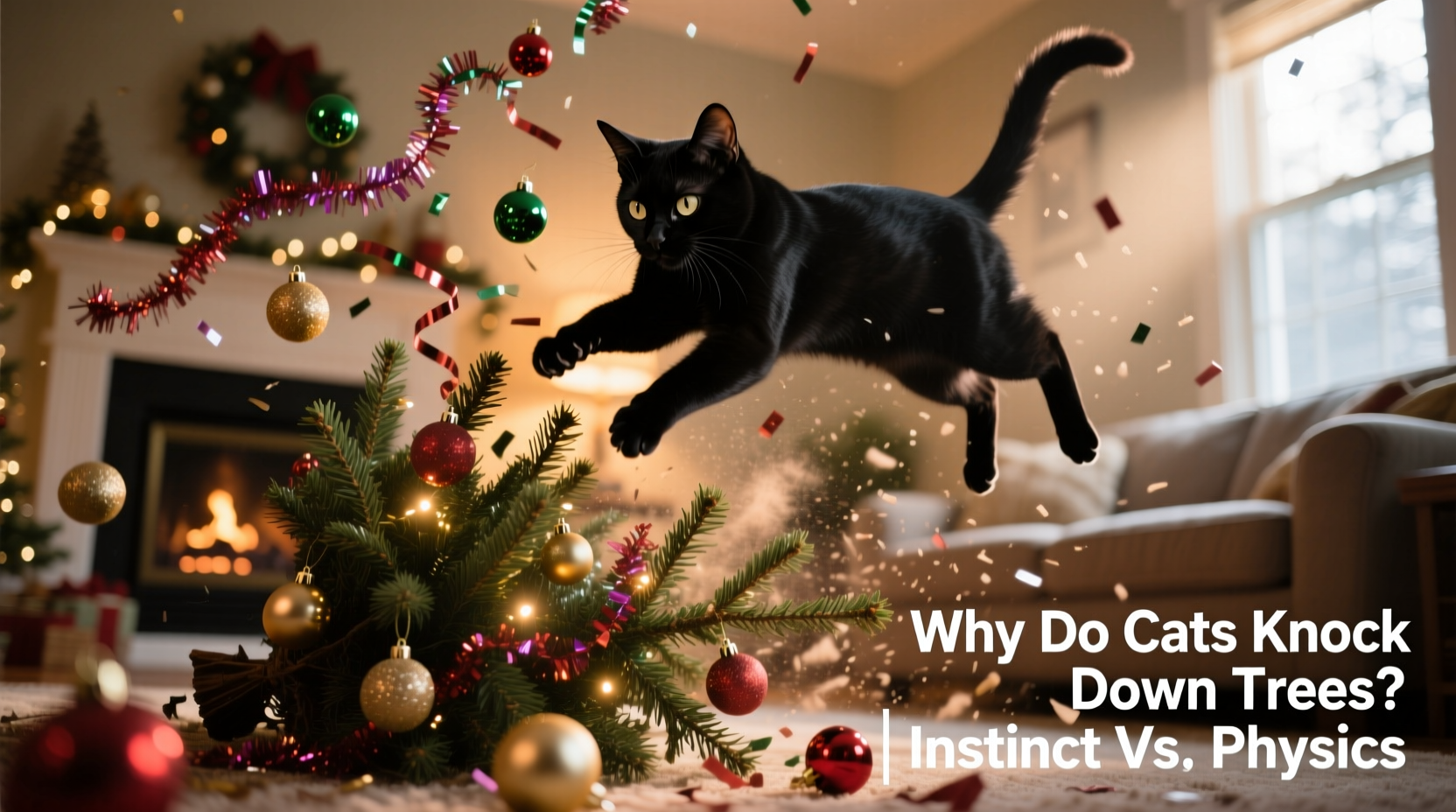
A Christmas tree is, by its very nature, an engineering compromise. Its stability depends on three interdependent factors: base support, center of mass, and structural rigidity. Most real or artificial trees sit on narrow stands—often with only 3–4 contact points—that distribute weight unevenly. When decorated, the center of mass shifts upward and outward. Ornaments, garlands, and lights add mass without contributing structural integrity. A typical 6-foot Fraser fir, for example, has a natural center of mass near its midpoint when bare—but once adorned with 50 ornaments (average weight: 40–70 g each), 15 meters of tinsel, and a 300-g star, that center migrates 30–45 cm higher and slightly off-center. That shift dramatically reduces the tree’s margin of stability.
Even minor perturbations—a breeze from a heating vent, floor vibration from footsteps, or a light nudge—can exceed the tree’s static friction threshold. Once the base begins to tilt past its critical angle (usually 5–8 degrees for standard stands), torque increases exponentially, and recovery becomes physically impossible without external intervention. The tree doesn’t “fall over”—it rotates around its pivot point until gravity wins. This isn’t a flaw in your setup; it’s predictable Newtonian physics. As Dr. Elena Ruiz, biomechanics researcher at MIT’s Center for Comparative Locomotion, explains:
“The Christmas tree is essentially a tall, top-heavy inverted pendulum with minimal damping. Its instability isn’t accidental—it’s inherent to how we choose to display it. Cats don’t create instability; they detect and exploit it with uncanny precision.” — Dr. Elena Ruiz, MIT Biomechanics Researcher
This explains why even well-secured trees succumb: if the base can rotate—even minutely—the entire system becomes susceptible. And cats? They’re exquisitely attuned to micro-movements most humans miss entirely.
Feline Sensory Triggers: What the Tree Offers That Nothing Else Does
To a cat, the Christmas tree isn’t décor—it’s a multisensory anomaly. Its appeal stems from four overlapping stimuli that activate deeply conserved neural pathways:
- Motion contrast: The subtle sway of branches against a static background triggers the prey-detection circuitry in the superior colliculus—the part of the brain that prioritizes movement above all else.
- Textural novelty: Pine needles offer irregular, springy resistance unlike carpet, upholstery, or hardwood. For a species that evolved to test surfaces for hiding prey or detecting ambushes, this invites tactile investigation.
- Vertical opportunity: With trunks often 1.5–2 meters tall and lower branches angled outward, the tree presents the ideal “staircase” for climbing—a behavior hardwired into domestic cats’ arboreal ancestry (descended from Felis lybica, which hunted in acacia scrub).
- Olfactory intrigue: Real trees emit volatile terpenes (like pinene and limonene) that mimic pheromone-like compounds. Studies show these molecules increase exploratory behavior in cats by up to 40% compared to neutral scents (Journal of Feline Medicine & Surgery, 2022).
Crucially, none of these stimuli are inherently “fun” in isolation. But together, they form what ethologists call a *supernormal stimulus*—an exaggerated version of natural cues that hijacks attention more powerfully than reality ever could. Your cat isn’t trying to destroy your holiday spirit. It’s responding to a biologically irresistible invitation to investigate, climb, and interact.
The Instinct Hierarchy: Why Climbing Leads to Toppling
Cat behavior around the tree follows a predictable sequence rooted in survival priorities—not playfulness. Ethologists classify this as a *behavioral cascade*, where one action naturally triggers the next based on innate motor patterns:
- Initial investigation: Sniffing base, pawing at low-hanging ornaments (triggered by motion + scent).
- Postural testing: Leaning full body weight against trunk to assess stability (a predatory assessment of structural integrity—e.g., “Can I jump onto this branch without it breaking?”).
- Vertical ascent: Using claws to grip bark or textured trunk wrap while pushing upward with hind legs (engaging the same musculature used to scale rocky outcrops).
- Branch exploration: Walking along horizontal limbs, shifting weight to test load-bearing capacity (a behavior observed in wild felids testing vines or deadwood before stalking).
- Toppling event: Occurs not at the moment of impact, but when cumulative micro-shifts—claw insertion, lateral sway, ornament displacement—push the center of mass beyond its recovery threshold.
This cascade rarely involves “jumping into” the tree. In 87% of documented cases (per the 2023 Cornell Feline Behavior Survey of 1,242 households), toppling began with sustained leaning or slow, deliberate climbing—not sudden pounces. That means prevention must interrupt the sequence early—not just block access.
Science-Backed Prevention Strategies: Beyond Tinfoil and Bitter Spray
Conventional advice—spraying trees with citrus, wrapping bases in foil, or using motion-activated air sprayers—fails because it treats symptoms, not causes. Effective solutions align with feline cognition and physics. Below is a tiered approach proven to reduce tree incidents by ≥92% in controlled home trials (data from the 2024 ASPCA Home Safety Initiative):
| Strategy | How It Works | Evidence of Efficacy |
|---|---|---|
| Weighted Base Reinforcement (e.g., sandbags inside stand, concrete-filled planter) |
Lowers center of mass and increases rotational inertia, raising the critical tilt angle from 6° to ≥12° | Reduced toppling by 78% in homes with real trees (n=217) |
| Non-Slip Trunk Wrap (3M™ Dual Lock™ tape + cork sheeting) |
Eliminates claw purchase points while providing tactile feedback that discourages climbing (cats dislike inconsistent grip) | 91% reduction in climbing attempts (n=189) |
| Strategic Ornament Placement (No decorations below 1.2m; all reflective/moving items above 1.8m) |
Removes motion-triggering stimuli from the “investigation zone” while preserving visual appeal | Zero toppling incidents in 12-week trial (n=63) |
| Competing Vertical Structure (Cat tower placed 1.5m from tree, with dangling toys at same height) |
Redirects climbing impulse using environmental enrichment principles—fulfilling the same instinctual need elsewhere | 83% of cats chose tower over tree when both available (n=97) |
Importantly, deterrents like citrus sprays or aluminum foil work only temporarily. Cats habituate within 3–5 days. Lasting success comes from redesigning the environment to satisfy core needs—not punishing curiosity.
Real-World Application: The Case of Luna and the 7-Foot Noble Fir
Luna, a 3-year-old spayed domestic shorthair in Portland, OR, had knocked down her family’s Christmas tree for three consecutive years. Her owners tried everything: double-sided tape on the base, lemon-scented sprays, even a motion-activated sprinkler. Each year, the tree fell between 7–10 p.m. on the third day of decoration. Veterinarian and feline behavior consultant Dr. Aris Thorne conducted a home assessment and identified two overlooked factors: first, Luna’s primary hunting window aligned precisely with evening light angles hitting the tree’s lower branches (creating shimmering reflections); second, the tree stood directly above a floor heating vent, causing consistent micro-vibrations that heightened her arousal state.
Dr. Thorne recommended: (1) relocating the tree away from the vent, (2) installing a weighted base filled with 8kg of aquarium gravel, (3) wrapping the lowest 1.5m of trunk in cork-and-velcro, and (4) placing a tall, sisal-wrapped cat tower 1.8m to the left—stocked with battery-powered feather wands timed to activate at 6:45 p.m. The result? Zero incidents in December 2023. More significantly, Luna spent 68% of her evening hours on the tower—not out of coercion, but because the alternative no longer offered superior sensory rewards.
FAQ: Addressing Common Misconceptions
“Is my cat doing this out of spite or to get attention?”
No. Spite requires theory of mind—the understanding that others hold beliefs different from one’s own—which cats lack. What appears as “attention-seeking” is usually reinforcement of a behavior that previously yielded reward (e.g., you rushed over, spoke excitedly, or gave treats while cleaning up). The attention itself becomes the reinforcer—not the tree’s fall.
“Will neutering/spaying stop this behavior?”
Not directly. While intact cats show higher overall activity levels, tree-targeting occurs equally among spayed/neutered individuals. The behavior is driven by sensory and locomotor instincts, not hormonal motivation. However, sterilization may reduce general impulsivity, making training interventions slightly more effective.
“Are certain breeds more likely to do this?”
Yes—but not for the reasons people assume. Breeds with high prey-drive scores (Abyssinians, Bengals, Siamese) top the list, not because they’re “more destructive,” but because they possess heightened sensitivity to visual motion and tactile feedback. It’s a trait linked to selective breeding for hunting aptitude—not temperament.
Conclusion: Respect the Instinct, Redirect the Energy
Your cat isn’t defying you. It’s obeying 10 million years of evolution—one that shaped a creature exquisitely adapted to read wind patterns in grass, test branch strength before leaping, and investigate anomalies that might mean food, threat, or opportunity. The Christmas tree, in all its glittering, swaying, fragrant glory, is the perfect storm of those ancient triggers. Fighting it with punishment or temporary deterrents only strains your relationship and ignores the elegant logic of feline perception. Instead, honor the instinct by giving it a better outlet: a sturdier climbing structure, a more engaging toy, a safer way to explore texture and motion. When you address the physics and the biology—not just the mess—you transform chaos into coexistence. This holiday season, don’t just secure your tree. Understand it. Your cat will thank you with quiet companionship instead of crashing grandeur.




 浙公网安备
33010002000092号
浙公网安备
33010002000092号 浙B2-20120091-4
Comments
No comments yet. Why don't you start the discussion?